Theater
Honoring GALA Theatre’s Rebecca Read Medrano
From a neighborhood playhouse to a D.C. Latino stronghold
The Victor Shargai Leadership Award
Jan. 22
Atlas Performing Arts Center
1333 H St., N.E.
Theatrewashington.org
Awards are part and parcel of the theater world. And that’s a good thing.
The Victor Shargai Leadership Award (VSLA), presented annually by Theatre Washington, recognizes individuals, groups, or institutions whose outstanding service and creative leadership have strengthened the Washington, D.C.-area theater community.
Established in 2021 by Theatre Washington and retired community development banker Craig Pascal in honor of Pascal’s late husband, the VSLA isn’t static. Far from it.
Shargai was D.C. theater’s biggest fan. For many years, he supported the scene – actors, institutions, theaters both big and small – with time, energy, and, not insignificantly, money. Shargai also served as a long-time chair and member of the Theatre Washington board of directors and played a huge role in shaping the Helen Hayes Awards.
Pascal explains, “Because Victor was such a do-er, we wanted to have something ongoing beyond a tribute to acknowledge his leadership. We want the VSLA to serve as a spur in future leadership. There are lots of challenges in today’s theater; we hope current and future leaders will rise to those challenges.”
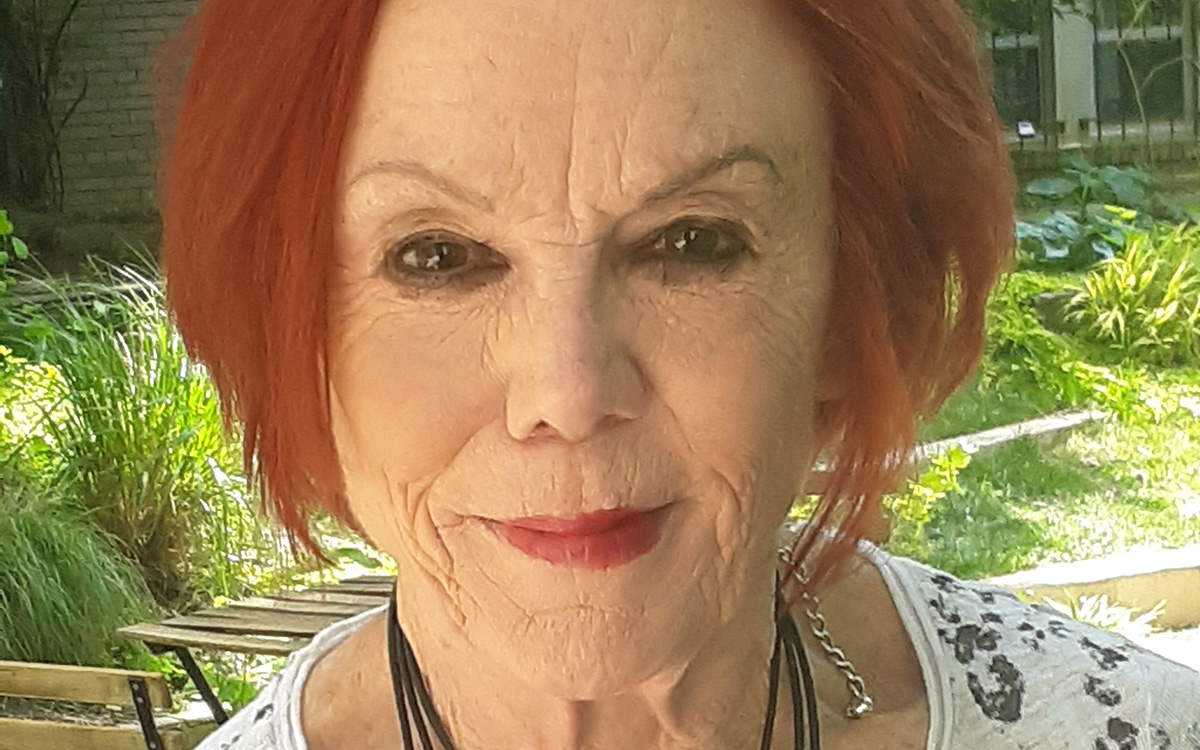
On Jan. 22, the VSLA will be presented to Rebecca Read Medrano, co-founder and executive director of GALA Hispanic Theatre since 1976.
Despite enjoying a raft of honors in recent years, Medrano says it’s never been about the awards. It’s always about getting the work done. And there’s been plenty of work.
For almost five decades, Medrano and her late husband Hugo Medrano (GALA co-founder and artistic director) grew GALA from a neighborhood playhouse to a D.C. Latino stronghold with a national presence.
With its many education and outreach programs, GALA has impacted the lives of thousands of young people in D.C. and the body of work from “essential translations of classic work to world premieres from emerging Latinx artists,” has entertained and enlightened a huge swathe of Latino theatergoers as well as non-Spanish speaking aficionados who (thanks to translated surtitles) have been exposed to works they might otherwise have never known.
Like everyone else who met him, Medrano has a Shargai memory. She recalls how he delved into the experience and energy of GALA without worrying about the language barrier, and how he eschewed GALA’s big opening nights, preferring the matinees attended mostly by students. He enjoyed their reactions and trusted their insights.
Community has always been at GALA’s core, says Medrano, 75. In the beginning they were mistaken as a community theater. They weren’t, and soon proved you could be a Helen Hayes-winning professional company and also deeply invested in the community.
In conversation, it always becomes evident that Medrano credits her success to wedded teamwork.
“Hugo had a gift of moving into a community and absorbing and opening doors. Whatever GALA’s location — 18th Street or Park Road, or the current Tivoli location in Columbia Heights — he connected with the community around whether political exiles from Chile, neighborhood Black poets, or later immigrant communities from Central America. He created programs that reflected their realities,” says Medrano.
According to Theatre Washington’s out president and CEO Amy Austin, “So many are capable of leadership. It takes an energy and a desire; a wanting to be the person who solves the problem or creates community where they don’t see it exists or create stronger bonds.
“Leadership comes in many ways and we’re not rigid in categorizing that,” adds Austin. “Last year’s VSLA recipient Paige Hernandez is an amazing interdisciplinary artist whereas Rebecca shows vision about how everyone makes community.”
Easily identified by a shock of trademark orange hair, Medrano, originally a dancer who graduated from Smith College, is perpetually in motion. She can often be found working the GALA lobby, engaging everyone from small children to avuncular diplomats, seamlessly switching from Spanish to English. Other times she’s in the office banging out the grant applications that have and continue to bring the GALA vision to fruition.
From a distance, it seems Medrano hasn’t skipped a beat since her husband’s passing in May 2023. GALA has kept its season going and hired an excellent new producing artistic director, Gustavo Ott. But naturally, feelings remain raw: “I miss him so much. I have to believe he’s still here. That keeps me going.
“It’s a lot about moving forward and creating the next generation. You follow and lead, and you lead and you follow. If we’re an inspiration, I hope it’s a good one and it gives new leaders something to hang on to. It adds to the happiness of your life when you have community.”
Sometimes when running GALA got especially tough, she would complain to her stepmother who’d reply, “You could have married a dentist.”
“That’s something I could never have done,” says Medrano.
The event will take place on Jan. 22 at the Atlas Performing Arts Center (1333 H St., N.E.) and will begin with the announcement of nominations for the 2024 Helen Hayes Awards followed by the Victor Shargai Leadership Award presentation to Rebecca Medrano.






It’s been a year filled with drama and music, re-imaginings and new works. There was a lot on offer in 2025, and much to enjoy. Here are 10 now-closed productions that come to mind.
On Valentine’s Day at Folger Theatre on Capitol Hill, out actor Holly Twyford served as narrator for “The Love Birds” a Folger Consort work that melds medieval music with a world-premiere composition by acclaimed composer Juri Seo and readings from Geoffrey Chaucer’s “A Parlement of Foules”
Standing behind a podium, Twyford beautifully read Chaucer’s words (translated from Middle English and backed by projected slides in the original language), alternating with music played on old and new instruments.
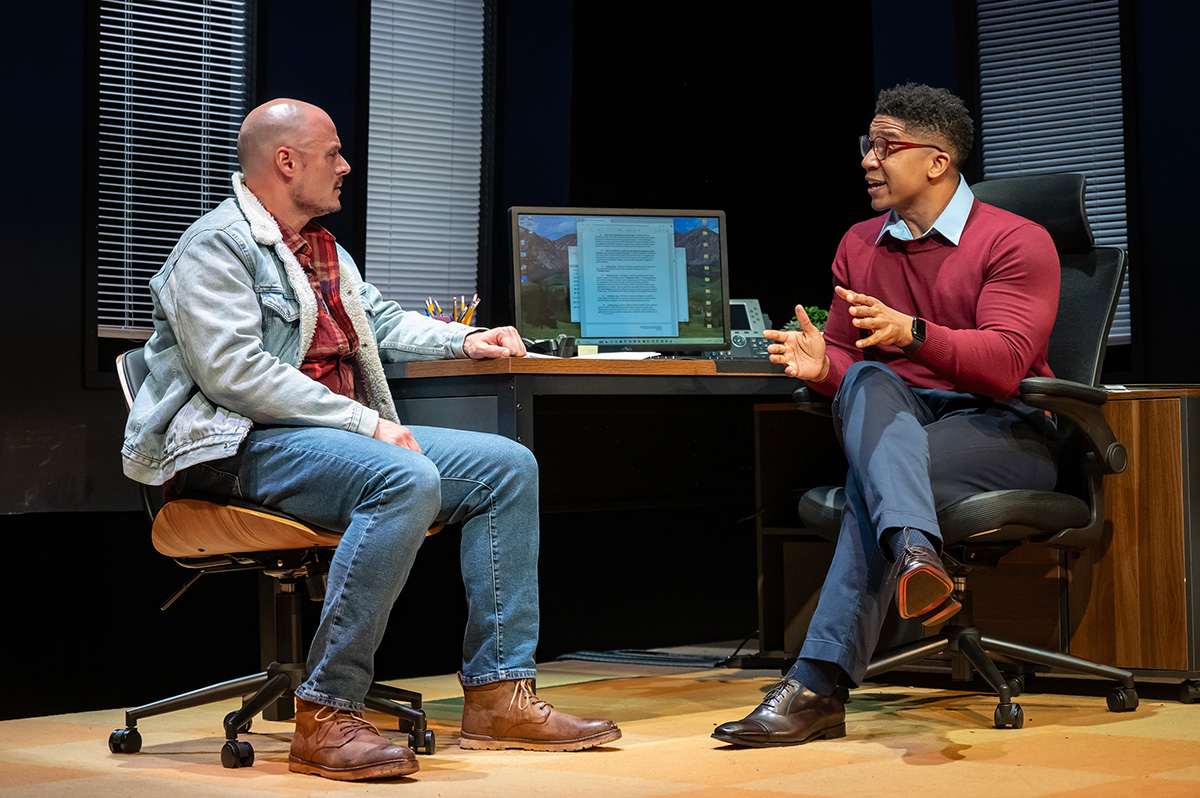
While Mosaic Theater’s “A Case for the Existence of God,” closed in mid-December, it’s proving a production not soon forgotten. Precisely staged by Danilo Gambini, and impressively acted by Lee Orsorio and Jaysen Wright, the soul-searching two hander by out playwright Samuel D. Hunter, tells the story of two men who form an unlikely friendship based on single-fatherhood, a specific sadness, and hope.
The action unfolds in a small office in southern Idaho, where the pair discuss the perplexing terms of a mortgage loan while delving deep into their lives and backgrounds. Nothing is left off the table.
Shakespeare Theatre Company’s spring production of “Uncle Vanya” gave audiences something both fresh yet enduring. Staged by STC’s artistic director Simon Godwin, the production put an impeccably pleasing twist on Russian playwright Anton Chekhov’s classic. It ranks among the very best area productions of the year.
Featuring a topnotch cast led by Hugh Bonneville (TV’s “Downton Abbey”) in the title role, the play was set on an unfinished stage cluttered with costume racks and assorted props, all assembled by crew uniformed in black and actors in street clothes. Throughout the drama tinged with comedy, the actors continued to assist with ever increasingly period set changes accompanied by an underscore of melancholic cello strings. It was innovative and wonderful.
GALA Hispanic Theatre’s production of Manuel Puig’s “Kiss of the Spider Woman” was an intimate and affecting piece of theater. Staged by José Luis Arellano, it starred out actors Rodrigo Pedreira and Martín Ruiz as two very different men whose paths cross as convicts in an Argentine prison.
Arena Stage scored with a re-imagined and updated take on the widely liked musical “Damn Yankees.” Directed by Sergio Trujillo, the Broadway bound production has been “gently re-tooled for its first major revival in the 21st century,” moving the action from the struggling Washington Senators baseball team to the turn-of-the-century Yankees lineup. Ana Villafañe’s charmingly seductive Lola and a chorus of fit ball players made for a good time.
Also at Arena, out playwright Reggie D. White’s new work “Fremont Ave.” was very well received. A semi-autobiographical glimpse into home and the many definitions of that idea specifically relating to three generations of Black men, the work boasts a third act with a deeply queer storyline to boot.
Before his smash hit “Hamilton” transformed Broadway, Lin-Manuel Miranda wrote “In the Heights,” a seminal musical set against the vicissitudes of an upper Manhattan bodega. Infused with hip-hop, rap, and pop ballads, the romance/dramedy takes place over a lively few days in the vibrant, close-knit Latin neighborhood, Washington Heights.
Signature Theatre’s exciting take on “In the Heights” featured a talented cast including out actor Ángel Lozado as the bodega owner who figures prominently in the barrio and the action.
Studio Theatre’s recent production of lesbian playwright Paula Vogel’s newest work “The Mother Play,” a drama with humor, is about a well put together alcoholic mother and her two gay children living under difficult circumstances in the less glitzy parts of suburban Maryland. With nuanced performances and smart direction, the production was terrific.
Keegan Theatre surpassed expectations with its production of “Lizzie” a punk rock opera about Miss Borden, the fabled axe wielding title character. Performed by a super all-female cast, they belted a score that hits hard on subjects like money, queerness, and strained (to say the least) family relationships.
Round House Theatre impressed autumn audiences with “The Inheritance,” a two-part drama sensitively staged by out director Tom Story and acted by a mostly queer cast that included young actor Jordi Bertrán Ramírez in a breakout performance.
Penned by out playwright Matthew López, the epic work inspired by E.M. Forster’s novel “Howards End,” explores themes of love, legacy, and the AIDS crisis through the lives of three generations of gay men in New York City.
Prior to opening, Story commented that with the production’s predominately queer cast you get actors who “really understand the situation, the humor, and the struggle. It works well.” And he was right.
Theater
Out actor talks lead role in ‘Fiddler on the Roof’
Signature Theatre production runs through Jan. 25
‘Fiddler on the Roof’
Through Jan. 25
Signature Theatre
4200 Campbell Ave.
Arlington, Va.
Tickets start at $47
Sigtheatre.org
Out actor Ariel Neydavoud is deep into a three-month run playing revolutionary student Perchick in the beloved 1964 musical “Fiddler on the Roof” at Signature Theatre in Arlington. And like his previous gigs, it’s been a learning experience.
This time, he’s gleaning knowledge from celebrated gay actor Douglas Sills who’s starring as the show’s central character Tevya, a poor Jewish milkman in the fictional village of Anatevka in tsarist Russia circa 1905.
In addition to anti-Semitism and expulsion, Tevya is struggling with waning traditions in a changing world where his daughters dare suggest marrying for love. Daughter Hodel (Lily Burka) falls for Perchick, an outsider who comes to town brandishing new ideas.
And along with its compelling and humor filled storyline, “Fiddler” boasts iconic numbers like “If I Were a Rich Man,” “Tradition,” “Matchmaker, Matchmaker,” and “Sunrise, Sunset.”
Neydavoud, born and raised as an only child in the West Los Angeles neighborhood lightheartedly referred to as Tehrangeles (due to the large Iranian-American population), has always been passionate about performing. “It’s like I came out of the womb tap dancing,” he says. Fortunately, his mother, an accomplished pianist and composer, served as built-in accompanist.
He began acting and singing at kid camps and a private Jewish middle school alongside classmate Ben Platt. In his teens, Neydavoud spent three glorious weeks at Stagedoor Manor, a well-known theater camp in Upstate New York, where he solidified his desire to pursue theater as a profession, and started to feel comfortable with being queer.
Following high school, he studied at AMDA (American Musical and Dramatic Academy) and soon after morphed from theater student to professional actor.
WASHINGTON BLADE: Your entry into showbiz seems to have been a smooth one.
ARIEL NEYDAVOUD: I’m happy to hear it seems that way. I’d rarely describe anything about this profession as smooth; nonetheless, what I love about this work is that it gives opportunities to have so many new experiences: new shows, new parts, and new communities who come together in a moment’s notice purely for the sake of creating art.
BLADE: Tell us about Perchick.
NEYDAVOUD: He comes to Anatevka and challenges their ideals and way of life. That’s something I can relate to.
I’m Jewish on both sides, but I’m also queer, first generation American, [his mother and father are from Germany and Iran, respectively], and a person of color. I never feel like I belong to a single community. That’s what has emboldened my inner activist to speak up and challenge ideas that I don’t necessarily buy into.
BLADE: You sing beautifully. Perchick’s song is “Now I have Everything,” an Act II melody about finding love. Was it an instant fit for you?
NEYDAVOUD: Not instantly.I’m traditionally a first tenor. Perchick is baritone range, a little outside of my comfort zone. After being cast, I asked our director Joe Calarco if he would be comfortable raising the key, something they did with the recent Broadway revival. He was firm about not doing that.
As an artist I see challenges as opportunities to grow, so it’s been really good exploring my lower register.
BLADE: Audiences have commented on an intimacy surrounding this production.
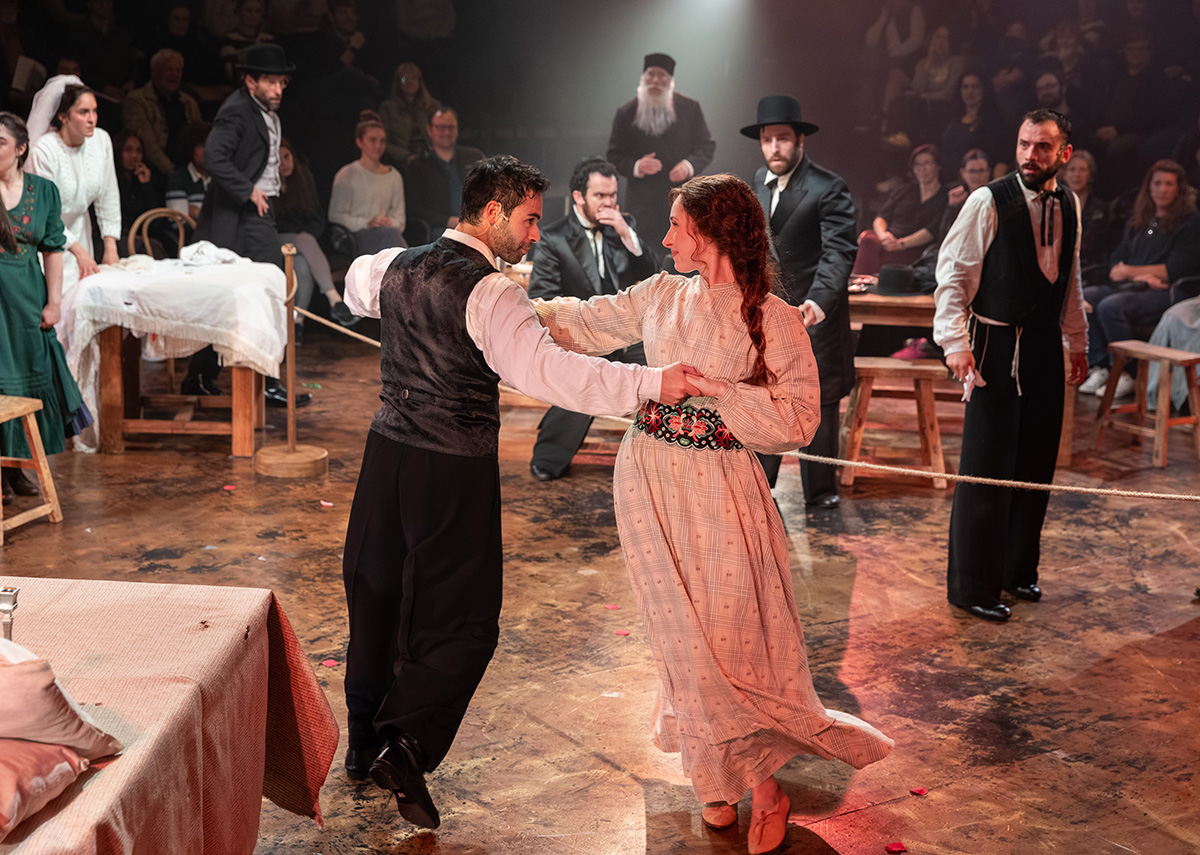
TK: It’s performed in the round with a dining table at its center. It could be a sabbath or seder table, however you interpret it, but I find it a brilliant way to illustrate community and tradition.
It feels like the audience is invited to the table and join the residents of Anatevka. The show’s moments of joy like the betrothal song “To Life (L’Chaim)” are intensified, and conversely the pogrom scenes are made more difficult. It feels like we’re sharing space.
BLADE: Do your encompassing identities broaden casting possibilities for you?
NEYDAVOUD: Marketing yourself as ethnically ambiguous can be a helpful tool. After “Hamilton” and the pandemic there was more of a shift toward authenticity. I try to steer toward playing Middle Eastern, Southwest Asian, Jewish, and mixed-race characters without being too prescriptive.
BLADE: Tell us your dream roles?
NEYDAVOUD: I’d love to play the Emcee in Cabaret [often portrayed as a gender-fluid, queer-coded, or non-binary figure]. And I’d like to direct a production of “Godspell” with a fully Middle Eastern cast. I think portraying Jesus and disciples in Middle Eastern bodies as Bohemian idealists living under an oppressive regime could be especially impactful.
BLADE: Can today’s queer audiences relate to life on the shtetl?
NEYDAVOUD: As a piece, “Fiddler” is timeless. Beyond the magical score, it hits home with just about anyone who’s ever felt othered. There are relevant themes of displacement and persecution, and maintaining cultural identity in the wake of turbulence, all ideas that tend to resonate with queer people.
Theater
Studio’s ‘Mother Play’ draws from lesbian playwright’s past
A poignant memory piece laced with sadness and wry laughs
‘The Mother Play’
Through Jan. 4
Studio Theatre
1501 14th St., N.W.
$42 – $112
Studiotheatre.org
“The Mother Play” isn’t the first work by Pulitzer Prize-winning lesbian playwright Paula Vogel that draws from her past. It’s just the most recent.
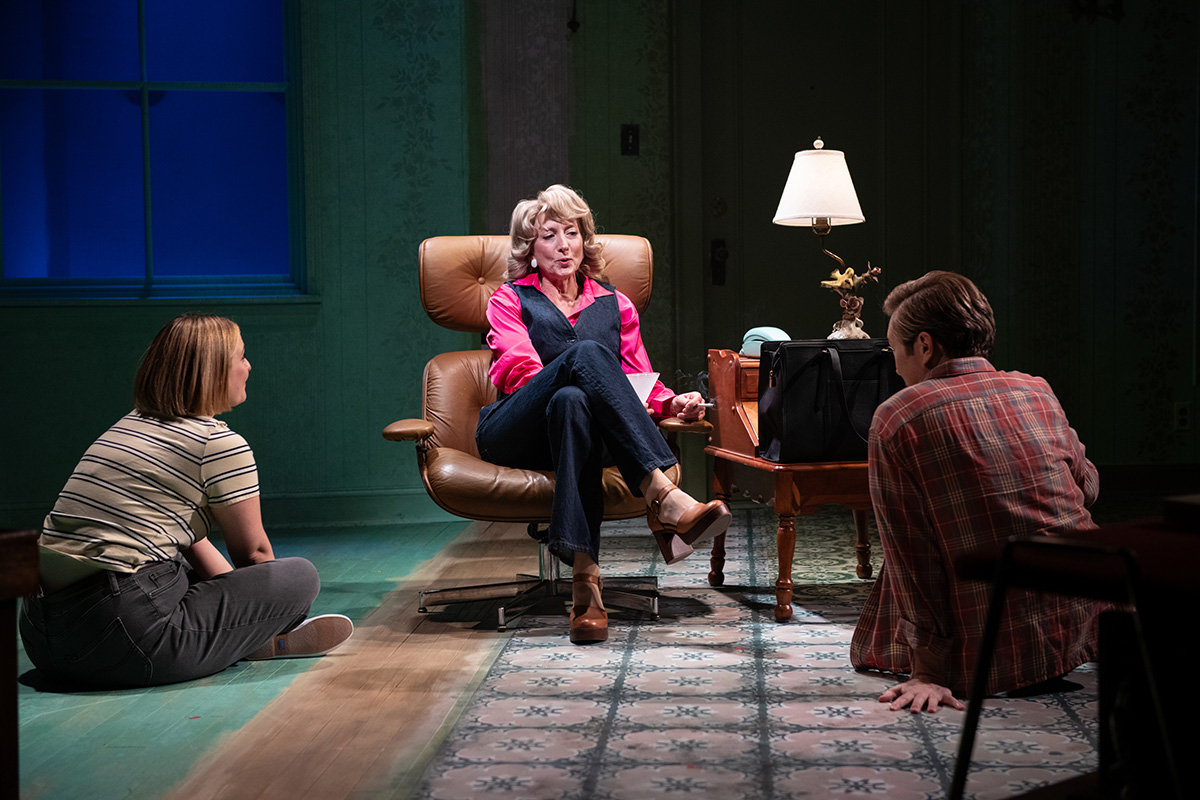
Currently enjoying an extended run at Studio Theatre, “The Mother Play,” (also known as “The Mother Play: A Play in Five Evictions,” or more simply, “Mother Play”) is a 90-minute powerful and poignant memory piece laced with sadness and wry laughs.
The mother in question is Phyllis Herman (played exquisitely by Kate Eastwood Norris), a divorced government secretary bringing up two children under difficult circumstances. When we meet them it’s 1964 and the family is living in a depressing subterranean apartment adjacent to the building’s trash room.
Phyllis isn’t exactly cut out for single motherhood; an alcoholic chain-smoker with two gay offspring, Carl and Martha, both in their early teens, she seems beyond her depth.
In spite (or because of) the challenges, things are never dull in the Herman home. Phyllis is warring with landlords, drinking, or involved in some other domestic intrigue. At the same time, Carl is glued to books by authors like Jane Austen, and queer novelist Lytton Strachey, while Martha is charged with topping off mother’s drinks, not a mean feat.
Despite having an emotionally and physically withholding parent, adolescent Martha is finding her way. Fortunately, she has nurturing older brother Carl (the excellent Stanley Bahorek) who introduces her to queer classics like “The Well of Loneliness” by Radclyffe Hall, and encourages Martha to pursue lofty learning goals.
Zoe Mann’s Martha is just how you might imagine the young Vogel – bright, searching, and a tad awkward.
As the play moves through the decades, Martha becomes an increasingly confident young lesbian before sliding comfortably into early middle age. Over time, her attitude toward her mother becomes more sympathetic. It’s a convincing and pleasing performance.
Phyllis is big on appearances, mainly her own. She has good taste and a sharp eye for thrift store and Goodwill finds including Chanel or a Von Furstenberg wrap dress (which looks smashing on Eastwood Norris, by the way), crowned with the blonde wig of the moment.
Time and place figure heavily into Vogel’s play. The setting is specific: “A series of apartments in Prince George’s and Montgomery County from 1964 to the 21st century, from subbasement custodial units that would now be Section 8 housing to 3-bedroom units.”
Krit Robinson’s cunning set allows for quick costume and prop changes as decades seamlessly move from one to the next. And if by magic, projection designer Shawn Boyle periodically covers the walls with scurrying roaches, a persistent problem for these renters.
Margot Bordelon directs with sensitivity and nuance. Her take on Vogel’s tragicomedy hits all the marks.
Near the play’s end, there’s a scene sometimes referred to as “The Phyllis Ballet.” Here, mother sits onstage silently in front of her dressing table mirror. She is removed of artifice and oozes a mixture of vulnerability but not without some strength. It’s longish for a wordless scene, but Bordelon has paced it perfectly.
When Martha arranges a night of family fun with mom and now out and proud brother at Lost and Found (the legendary D.C. gay disco), the plan backfires spectacularly. Not long after, Phyllis’ desire for outside approval resurfaces tenfold, evidenced by extreme discomfort when Carl, her favorite child, becomes visibly ill with HIV/AIDS symptoms.
Other semi-autobiographical plays from the DMV native’s oeuvre include “The Baltimore Waltz,” a darkly funny, yet moving piece written in memory of her brother (Carl Vogel), who died of AIDS in 1988. The playwright additionally wrote “How I Learned to Drive,” an acclaimed play heavily inspired by her own experiences with sexual abuse as a teenager.
“The Mother Play” made its debut on Broadway in 2024, featuring Jessica Lange in the eponymous role, earning her a Tony Award nomination.
Like other real-life matriarch inspired characters (Mary Tyrone, Amanda Wingfield, Violet Weston to name a few) Phyllis Herman seems poised to join that pantheon of complicated, women.

2026 Most Eligible LGBTQ Singles nominations

Gay Venezuelan man who fled to Colombia uncertain about homeland’s future

PHOTOS: Freddie’s Follies

Imperial Court of Washington drag group has ‘dissolved’

What to watch for in 2026: midterms, Supreme Court, and more

A look back at the best books of 2025

D.C.’s 10 best theater productions of 2025

The year in photos

Safer Ways to Pay for Online Performances and Queer Events