India
Transgender Indian parliamentary candidate vows to continue fight for equality
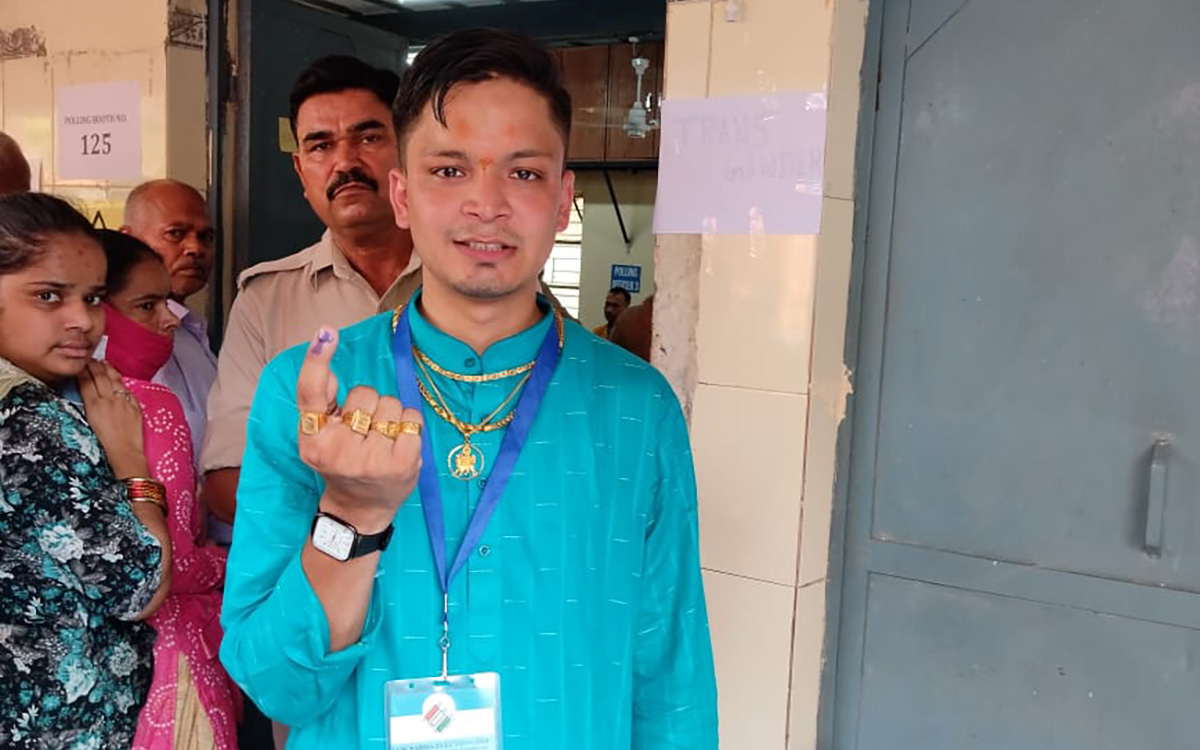
Rajan Singh, 26, is from New Delhi
The storm that was India’s general elections has finally settled, leaving behind a landscape transformed by democratic choice.
The Bharatiya Janata Party, under the leadership of Prime Minister Narendra Modi, clinched a decisive victory with a majority in parliament with 293 seats. The daily hum of life is returning to normal as the country resumes its rhythm amid the sweltering heat of summer.
Beneath the surface of political triumph and routine, however, there lies an overlooked narrative: The story of the transgender community. In the vibrant tapestry of this election, trans people remained a subtle but significant thread. A few trans people for the first time boldly stepped into the political arena, running for office and asserting their right to representation.
Rajan Singh, 26, was the youngest trans candidate.
She hails from New Delhi, the bustling heart of the nation. Singh secured 300 votes and lost the election, but as the first and youngest independent candidate to run in the recent general elections, her story is one of ambition and audacity. In a political landscape dominated by well-established parties and seasoned politicians, Singh’s decision to enter the fray as an independent was both bold and inspiring.
With her soft and humble voice, Singh told the Washington Blade that even after 75 years of independence, India still lacks even 75 public restrooms dedicated to the trans community. She highlighted a stark reality: There is no platform available for trans people who want to raise their voice on important issues.
Singh expressed her frustration and disappointment, pointing out the irony in India’s highly regarded constitution.
“Our constitution begins with ‘We, the people of India,'” she said, “Yet in these 75 years, that ‘we’ has never truly included us.” Her words shed light on the ongoing struggle for recognition and equality faced by the trans community in a country that prides itself on its democratic values and inclusive ethos.
“That was the main reason I decided to fight in the 2024 general election,” said Singh. “I am the first, youngest candidate from India’s capital, New Delhi. When I was born in 1997, my identity was male. In 2022, the government certificate indicated I was transgender, and in 2024, the Election Commission of India (ECI) issued a certificate stating me as third gender. When I apply for a government job, I become ‘others.’ so one person has four identities. Most strikingly all these identities are not mine. I identify as a trans woman and no one recognizes my feelings and identity.”
Singh told the Blade that when she filed her nomination for the election, her primary goal was to bring the real identity of the trans community to the center stage of the country. She explained her candidacy was a means to breathe life into the identity of her community, asserting that if people had acknowledged the trans community’s presence over the past 75 years, they would have been granted the same rights as other citizens.
With a voice tinged with pain, Singh told the Blade that if the trans community had been truly recognized as alive, there would have been moments when people saw the community speaking out.
“There would have been a time when we had a leader to represent us, a chief minister, and even a prime minister,” she said. “But there is no one for the transgender community.”
During her interview with the Blade, Singh shared a slogan she coined for her election campaign: “Sauchalay se Sansad Tak” or “From the toilet to parliament.” This slogan encapsulated her mission to elevate the trans community from the margins of society to the heart of the nation’s decision-making process.
Singh told the Blade only a few trans people voted in the last election. However, this time, however, 228 trans individuals cast their votes in Delhi, a significant increase fueled by the community’s belief that someone was finally standing up for them.
“I was manhandled and threatened on the streets just for announcing my candidacy in the 2024 General Elections,” said Singh. “I was told ‘Chakka’ (a slang word for trans people), I was told how could we fight in election. When I went to the cops to file a First Information Report, they did not file my report. On April 29, Delhi High Court provided me heavy police protection and with that I went to file my nomination for election. If High Court would not have given me the police protection, I would not have been able to file my nomination.”
She told the Blade that society has been conditioned to view the trans community as only beggars and prostitutes, a misconception that is far from the truth. Singh emphasized these stereotypes have long overshadowed the diverse and significant contributions of trans people. Her campaign sought to challenge these harmful narratives and showcase the true potential and worth of the trans community.
While talking to the Blade, Singh said India’s trans community has not seen much progress in the last 75 years. She acknowledged Modi has taken some steps for the community, notably with the passage of the Transgender Persons (Protection of Rights) Act in 2019, which has increased awareness among ordinary citizens.
Singh, however, emphasized these efforts are not enough and much more work needs to be done. With great hope and determination, she called on the prime minister to establish a National Transgender Commission. This, she argued, would provide the necessary platform and resources to address the ongoing challenges faced by the trans community, ensuring their rights and dignity are fully protected and promoted.
“The world has seen for the first time in the last 75 years, that during the prime minister’s swearing-in ceremony this year three transgender people were invited,” said Rajan. “I was one of them.”
With immense pride and positivity, Singh stated this is not a loss for her or the community. She views it as a significant victory. For the first time, the trans community voted for one of their own. It marked the historic moment when a trans individual’s name appeared on the Electronic Voting Machine, an integral part of India’s voting system. This election symbolized a newfound self-respect and empowerment, as members of the trans community proudly pressed the button on the EVM, voting for representation and a brighter future.
“We will prepare and fight for the establishment of National Transgender Commission in the country,” said Singh. “We will pressure those political parties who will support the creation of the National Transgender Commission and basic services for the community, we will support them. I will again fight the election.”
Ankush Kumar is a reporter who has covered many stories for Washington and Los Angeles Blades from Iran, India, and Singapore. He recently reported for the Daily Beast. He can be reached at [email protected]. He is on Twitter at @mohitkopinion.



India
Expected India Supreme Court ruling could shape future LGBTQ rights cases
Decision to determine whether courts can use constitutional morality doctrine
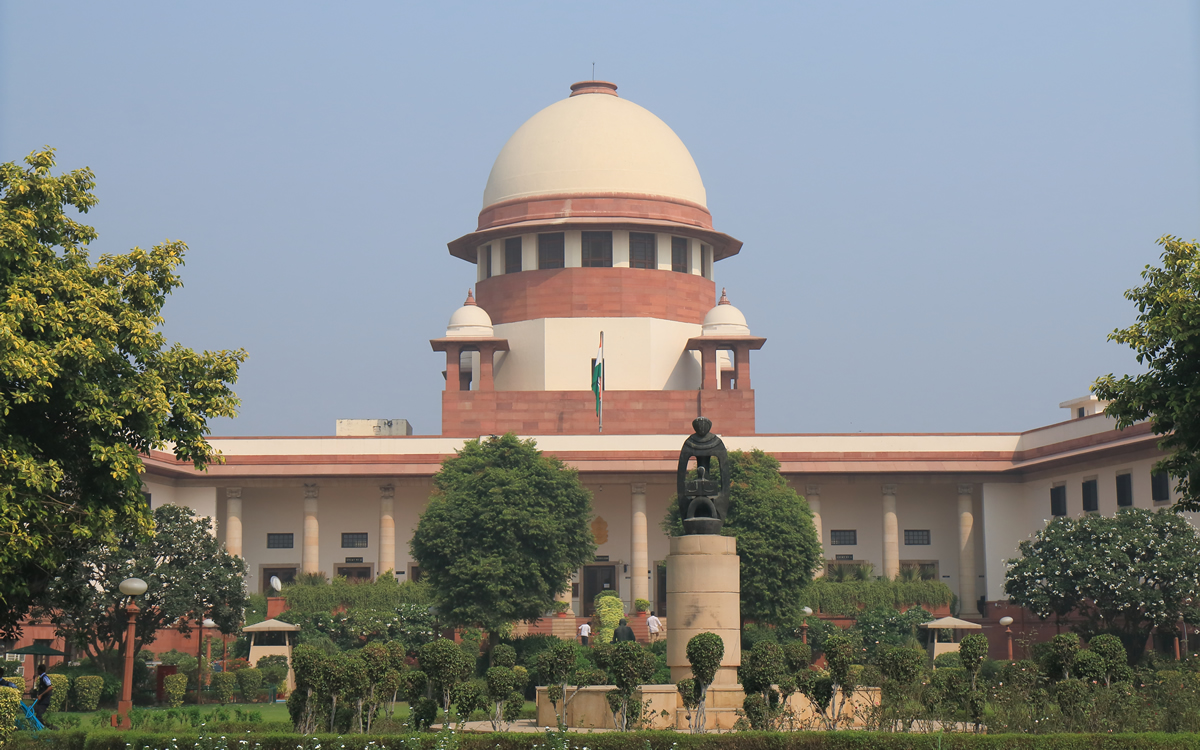
India’s Supreme Court is expected to issue a closely watched constitutional ruling that could shape the future of LGBTQ rights litigation.
The decision will determine whether courts can continue to rely on the doctrine of constitutional morality, a principle that has underpinned several landmark rights decisions. During hearings in April, the Indian government urged the Supreme Court to reject the doctrine, arguing that it has no basis in the Constitution and should not guide judicial decision-making.
For years, the Supreme Court has relied on the constitutional morality doctrine to treat the Constitution as a living document: one whose enduring promises of justice, liberty, equality, and fraternity must be applied to the realities of a changing society rather than remain frozen in the era in which it was written.
The Indian government in April asked the Supreme Court to revisit the constitutional reasoning behind two landmark judgments: one that struck down the country’s adultery law and another that decriminalized consensual same-sex relations, arguing that both relied on a subjective invocation of constitutional morality and should no longer be treated as good law.
Arguing before a 9-judge bench considering constitutional questions referred from the Supreme Court’s 2018 Sabarimala temple case, which allowed women of menstruating age to enter one of Hinduism’s holiest shrines after a centuries-old ban, Solicitor General Tushar Mehta, India’s second-highest law officer, argued that “constitutional morality” has no textual basis in the Constitution and is instead a judicially evolved concept that is vague and indeterminate.
Mehta said the government did not oppose the Supreme Court’s decision to strike down Section 497 of the Indian penal code, which criminalized adultery, if it was based on Article 14 of the Constitution, which guarantees equality before the law and equal protection of the laws. Instead, he argued that the court should not have relied on what he described as the “vague and subjective” doctrine of constitutional morality to reach its conclusion.
Mehta told the Supreme Court that its 2018 Navtej Singh Johar v. Union of India ruling that decriminalized consensual same-sex relations wrongly equated “morality” with majoritarian or mob morality while relying on constitutional morality as the basis for its reasoning.
To support his argument against relying on constitutional morality, Mehta quoted extensively from then-Justice Antonin Scalia’s dissent in the U.S. Supreme Court’s 2003 decision in Lawrence v. Texas.
Scalia argued that courts should not import foreign legal trends or allow evolving social values to drive constitutional interpretation, contending that judges must remain neutral arbiters rather than participants in broader cultural debates.
Referring to the Supreme Court’s landmark decisions in Navtej Singh Johar and Joseph Shine, Mehta questioned whether the judgments reflected the constitutional vision of India’s founding generation.
“If these judgments, Navtej Johar, Joseph Shine, etc., were to be read by Dr. Ambedkar or Kanhaiyalal Munshi or Alladi Krishnaswamy Iyer, I do not know whether they would be surprised, shocked or they would say that this is what we wanted. I believe, they did not want this to happen,” he told the bench.
“A new trend starts, which is Naz Foundation v. Government of NCT of Delhi,” Mehta said. “This is the judgment of Delhi High Court which was ultimately affirmed in Navtej Johar, sodomy … ‘In our scheme of things, constitutional morality must outweigh the argument of public morality, even if it be the majoritarian view.’ In case of a country governed by democratic principles, the view which is always majoritarian will prevail. When it is question of testing a law, it is always the majority which passes the law. How can you define morality based on this?”
The Naz Foundation case marked the beginning of a landmark constitutional challenge to Section 377 of the Indian penal code, a colonial-era provision that criminalized consensual same-sex relations between adults as “against the order of nature.” The public interest litigation, filed in 2001 by the Naz Foundation, an NGO working on HIV/AIDS and sexual health, argued that the law violated fundamental rights guaranteed under the Constitution.
In 2009, the Delhi High Court ruled in the organization’s favor, holding that Section 377 violated the rights to equality under Article 14, protection against discrimination under Article 15, and life and personal liberty under Article 21 of the Constitution.
The Delhi High Court’s ruling was short-lived.
In 2013, the Supreme Court, in Suresh Kumar Koushal v. Naz Foundation overturned the decision, recriminalizing homosexuality under Section 377.
The court held that the law affected only a “minuscule fraction” of the population and said it was for Parliament — not the judiciary — to decide whether the provision should remain on the statute books. Five years later, the Supreme Court’s Constitutional Bench in Navtej Singh Johar, unanimously overruled its 2013 judgment, holding that Section 377 was unconstitutional. The decision marked the culmination of the Naz Foundation’s long legal challenge to the colonial-era provision.
Anish Gawande, the first openly gay person to serve as a national spokesperson for a major political party in India, the Nationalist Congress Party (Sharadchandra Pawar), told the Washington Blade that the doctrine of constitutional morality, which he said underpinned not only Navtej Singh Johar but also forms one of the foundational principles of India’s constitutional jurisprudence, is “an incredibly important concept.”
“It provides a moral backbone to the document in a way that prevents any amendments to the Constitution from being out into place that would violate the very ethos upon which the Constitution was framed,” Gawande said. “Constitutional morality is an incredibly important antidote to societal morality. It’s been what has allowed us to clamp down on things like dowry. It’s been something that has allowed us to bar even regressive religious practices that might go against human dignity. It’s also been an incredibly important framework that has allowed for the advancement of LGBTQ rights in opposition to arguments made by practitioners and leaders of various religious denominations about the societal immorality of queerness.”
“The most critical part of constitutional morality, which is a doctrine that has been put in place by the courts, is that it is a very effective bulwark against majoritarianism and the unilateral diktat of the executive over the judiciary and, in some ways, also the legislature,” he added.
Gawande said those factors make constitutional morality “an incredibly important concept” in Indian constitutional jurisprudence.
If the Supreme Court were ultimately to narrow or reject the doctrine, he said, judgments that have relied on constitutional morality, including the landmark Navtej Singh Johar ruling could come under renewed scrutiny. He added, however, that he did not believe the Supreme Court would take that step because it would run contrary to its own institutional interests.
Gawande said the government has advanced several reasons for challenging the doctrine of constitutional morality. One of them, he said, is that the solicitor general has opposed the doctrine in cases involving religious issues, arguing that courts should not rely on it in constitutional adjudication.
“The downward repercussions of this, however, could extend to LGBTQ rights and to the rights of all sorts of persecuted minorities in the future,” he said.
“The second thing is that, in principle, the section 377 judgment, of course, rests upon constitutional morality, but it is also resting upon so many other fundamental rights, including the right to privacy that Puttuswamy upheld before the Navtej Singh Johar verdict,” Gawande added. “In Navtej, the right to privacy was also cited as an incredibly important condition upon which the decriminalization of ‘carnal intercourse against the order of nature’ could be permitted. In many ways, the fact that Section 377 does not exist on the statute books at all in the present updated penal codes, Bharatiya Nyaya Sanhita and Bharatiya Nagarik Suraksha Sanhita, provides some respite. The entry of Section 377, at least immediately after a reading down of constitutional morality, is not imminent yet. However, it opens the door for a new Section 377 to be introduced and the judicial mechanism available to counter that new section 377, if it were to be introduced, to be reduced significantly.”
Ankit Bhupatani, an LGBTQ activist, said he does not believe the Supreme Court’s reconsideration of constitutional morality would lead to the recriminalization of consensual same-sex sexual relations.
He argued the 2018 Navtej Singh Johar decision rests on multiple constitutional principles beyond constitutional morality, but warned that weakening the doctrine could make it more difficult to secure future LGBTQ rights through the courts.
“If we have to take an informed guess on why the government does not like the concept of constitutional morality, it is because it wants a narrower field of judicial review and an elected legislature restored as the primary author of social policy,” Bhupatani said. “But we have already seen parliament’s ability to make laws related to LGBT rights, and it does not give optimism.”
“The only practical way forward for LGBT rights in India is the judiciary,” he added. “But if the government’s argument is accepted by the Supreme Court, it means the next gay Indian who walks into a court for marriage, for adoption, for inheritance, or for a job they were fired from, finds it more difficult to secure these rights from the only institution from which we could hope for a positive outcome.”
Bhupatani said the decriminalization of consensual same-sex sexual relations would probably survive because the Navtej Singh Johar judgment also rests on the constitutional principles of privacy and equality. However, he warned that weakening the doctrine of constitutional morality could stall broader progress for LGBTQ rights.
“The community keeps the floor and loses the staircase,” he said. “Nobody is criminalized, but nobody moves up.”
“The clever thing about this is that it lets the government have it both ways. To its so-called base, who think that making the law, especially on social issues, is the work of elected parliamentarians and not judges,” said Bhupatani. “It signals that the 2018 verdict was a judicial overreach that ought never to have happened. To everyone else, truthfully, that it never asked to recriminalize anyone. Both messages, one filing.”
Bhupatani said the implications of the government’s position extend beyond LGBTQ rights, arguing that asking the Supreme Court to treat the reasoning in Navtej Singh Johar as “not good law” raises broader questions about India’s commitment to constitutional rights. He said such a move could also affect how India’s constitutional democracy is perceived internationally.
India
Iran war causes condom shortage in India
Trade disruptions have strained petrochemicals, lubricant supplies

About 80 days into the U.S.-Iran war, while much of the world struggles with oil supplies, India is confronting a different crisis: a widening condom shortage. Health activists warn the supply disruption could worsen HIV/AIDS risks in the world’s most populous country.
Disruptions in maritime trade through the Strait of Hormuz have strained supplies of petrochemicals and industrial lubricants used in condom manufacturing. The crisis has increased production costs across the sector and pushed retail prices sharply higher.
India’s condom manufacturing industry is valued at nearly $1 billion.
Production depends heavily on silicone oil and ammonia. Silicone oil, a key lubricant used in manufacturing, is in short supply. Ammonia, which stabilizes raw latex, is expected to see price increases of 40-50 percent. Rising packaging costs have added further pressure. Some manufacturers and retailers have reported condom prices increasing by as much as 50 percent.
India is home to an estimated 2.5 million people living with HIV, the world’s second-largest population of HIV-positive people, according to a 2024 report. The Health Ministry’s India HIV Estimation 2025 technical report said 5.4 percent of HIV cases in 2024-2025 were linked to transmission between men who have sex with men.
In 2024, India recorded an estimated 64,470 new HIV infections and 32,160 AIDS-related deaths nationwide. The figures marked declines of 48.69 percent and 81.42 percent, respectively, compared with 2010.
Ankit Bhuptani, an LGBTQ activist in India, told the Washington Blade that the country has made significant progress in reducing HIV infections over the past two decades. But, he said, that progress depended heavily on affordable condoms, targeted outreach programs and on-the-ground work by NGOs serving MSM and transgender people.
“Pull one thread and the whole thing loosens. What worries me about this particular shortage is that it arrives at exactly the moment when India’s LGBTQ community was beginning to access healthcare more openly after the Section 377 reading down,” said Bhuptani. “Young queer Indians in tier-two cities were just starting to trust government health systems enough to engage with them. A price spike that prices them out, or a shortage that sends them to substandard alternatives, could set that trust back by years.”
The Indian Supreme Court in 2018 struck down Section 377, a colonial-era law that criminalized consensual same-sex sexual relations.
In March, the Commerce and Industry Ministry acknowledged the difficulties faced by Indian exporters due to disruptions caused by the war in West Asia and launched a roughly $51.5 million Resilience and Logistics Intervention for Export Facilitation, or RELIEF, program. It provides credit insurance support for exporters whose shipments have been stranded because of the conflict.
“Price elasticity in sexual health products is brutal. When a condom pack goes from 20 rupees to 40, usage drops. It’s that simple,” said Bhuptani. “And when usage drops in populations with higher baseline HIV exposure, you don’t see the consequences for two or three years. Then the numbers arrive and everyone acts surprised.”
The situation has been further aggravated by the structure of India’s condom market, which operates on a high-volume, low-margin model designed to keep products affordable for a population of more than 1.4 billion people. Industry analysts say that model is now under growing pressure from rising raw material and shipping costs.
Reports in Indian media said supply constraints and price volatility involving PVC foil, aluminium foil, and packaging materials have disrupted production and complicated order fulfilment across parts of the condom manufacturing sector.
“Supply chain vulnerability assessments almost never include sexual health commodities. They should. India imports roughly 86 percent of its anhydrous ammonia from West Asian countries including Saudi Arabia, Qatar, and Oman, with that ammonia being essential for stabilizing the natural rubber latex used in domestic condom production,” said Bhuptani. “That is a documented strategic dependency that was never flagged as a risk. The Iran war converted it from a latent vulnerability into an active supply shock in a matter of weeks.”
The National AIDS Control Organization, or NACO, which oversees India’s HIV/AIDS programs, during the 2026-2027 fiscal year received an allocation of about $249 million, up from roughly $238 million the previous year. By comparison, the U.S. approved a $6 billion funding package in 2026 for global HIV/AIDS programs, according to the United Nations.
“The gay and trans community in India report high perceived HIV risk and adopted PrEP through non-profit and private channels, with cost and access remaining consistent concerns,” said Bhuptani. “The community organizations managing that risk perception are now operating in a tighter supply environment while simultaneously absorbing the downstream effects of USAID funding cuts. Health workers seeing increased anxiety among community members are observing the predictable consequence of removing redundancy from a system that had very little to begin with.”
The Washington Blade reached out to Indian condom manufacturer Manforce several times, but the company declined to comment.
Harish Iyer, an LGBTQ and equal rights activist in India, told the Blade that this is the time when the government needs to step in. Condoms, Iyer said, are not about pleasure, but about life.
“Not just in terms of HIV, it is also a source of contraception in a nation which is heavily populated. So, if there is a crisis in the condom industry, it has an adverse effect on the LGBTQ community,” said Iyer. “And eventually it has a compounding effect on the economy as well. Because if the cases of HIV wrecks to rise, if the population was to explode, it is going to have a straining effect on the economy as well. So, I think it is time that the government steps in, and condoms should be recorded as a necessity commodity rather than making it feel like any kind of commodity that some (privileged people) can afford.”
Iyer told the Blade that the government should provide condoms free of cost.
He pointed to the Nirodh Scheme, India’s long-running family planning and safe sex program launched by the government in 1968. Condoms, Iyer said, are a necessity, not a luxury product. He urged the government to classify them as essential items and either remove the Goods and Services Tax or reduce it to a minimum.
The Nirodh Scheme was launched by the Health and Family Welfare Ministry to promote contraception and prevent the spread of sexually transmitted infections, including HIV, through the nationwide distribution of subsidized and free condoms.
India
Amendments to India’s transgender rights law criticized
Lawmakers approved changes that narrow definition of trans person
India has enacted the Transgender Persons (Protection of Rights) Amendment Act, 2026, that will reshape the country’s legal approach to gender identity.
Both houses of parliament approved the legislation last month, and it received presidential approval on March 28.
The Transgender Persons (Protection of Rights) Amendment Act, 2026, narrows the definition of a trans person, removes the provision for self-perceived gender identity, and requires medical certification for legal recognition. These changes mark a shift from the framework established under a 2019 law.
The Transgender Persons (Protection of Rights) Amendment Act, 2026, replaces the earlier definition of a trans person — previously framed as someone whose gender does not align with the gender assigned at birth — with a set of specified categories. It further provides that the term does not include, and is deemed never to have included, people defined solely by their sexual orientation or by self-perceived gender identity.
The bill retains certain categories within its definition, including people with socio-cultural identities such as kinner, hijra, aravani, or jogta. It also includes people with variations in sex characteristics at birth, such as differences in primary sexual characteristics, external genitalia, chromosomes or hormones from the normative standards of male or female bodies.
The Transgender Persons (Protection of Rights) Amendment Act, 2026, removes certain categories from the definition, including a trans man or trans woman, irrespective of whether such a person has undergone sex reassignment surgery, hormone therapy, laser procedures, or other forms of medical intervention. It also excludes genderqueer people — a category that had been recognized under the earlier framework. The Transgender Persons (Protection of Rights) Amendment Act, 2026, however, includes eunuchs, as well as people compelled to assume a trans identity through mutilation, emasculation, castration, or other surgical, chemical or hormonal interventions.
The Transgender Persons (Protection of Rights) Amendment Act, 2026, also revises the process for legal recognition, requiring a trans person to apply to a district magistrate for a certificate of identity, which can now be issued only after the recommendation of a designated medical board. The law specifies that the board will be headed by a senior medical officer and may include other experts. It further provides that individuals issued such a certificate will be entitled to change their first name in official documents, including birth records and other government-issued identification.
The Transgender Persons (Protection of Rights) Amendment Act, 2026, also introduces stricter penalties for certain offences, including cases in which a person is forced to assume a trans identity through kidnapping, coercion or physical harm. Such offenses may attract imprisonment ranging from 10 years to life in prison, along with fines, depending on the severity and whether the victim is an adult or a child. The Transgender Persons (Protection of Rights) Amendment Act, 2026, further requires medical institutions to report gender-affirming surgeries to the district magistrate, and mandates that individuals obtain a revised certificate of identity following such procedures.
India’s 2011 Census recorded 487,803 trans persons, yet only 5.6 percent had applied for a trans identity card, according to the Washington Blade’s previous reporting. These identity cards, required to access government welfare programs, have remained difficult to obtain, with delays and administrative barriers limiting uptake.
The Transgender Persons (Protection of Rights) Amendment Act, 2026, revised the certification process, which introduces additional requirements for legal recognition. This change is against this backdrop of uneven access to identity documentation.
India’s Election Commission in 2009 directed states to modify voter registration forms to include an “other” category, allowing individuals who did not identify as male or female to register accordingly. The Supreme Court in National Legal Services Authority v. Union of India in 2014 recognized trans persons as a “third gender” and affirmed their right to self-identification.
Justice Kalavamkodath Sivasankara Radhakrishna Panicker said that “recognition of transgenders as a third gender is not a social or medical issue, but a human rights issue.” Parliament in 2019 approved the Transgender Persons (Protection of Rights) Bill, 2019.
An advisory committee the Supreme Court created that former Delhi High Court Justice Asha Menon has urged the government to withdraw the Transgender Persons (Protection of Rights) Amendment Act, 2026. The panel said the proposal to deny self-identification of gender is inconsistent with theNational Legal Services Authority v. Union of India ruling.
Menon on March 25 wrote to Social Justice Minister Virendra Kumar conveying the panel’s resolution. According to the Hindu newspaper, the committee described the amendment as a “great shock” and a “tremendous setback” to efforts to mainstream trans communities.
The Queer Hindu Alliance, an advocacy group that seeks to uphold the dignity of LGBTQ people within India’s cultural and constitutional framework, expressed concern over the Transgender Persons (Protection of Rights) Amendment Bill, 2026.
“We write not in the spirit of opposition, but in the spirit of samvad — dialogue — and with a sincere call for community consultation before this legislation proceeds further,” the group said in a statement. “The Supreme Court of India recognized the concerns of the transgender community in 2014. The National Legal Services Authority v. Union of India judgment affirmed that a person knows who they are. This bill seeks to reverse that. The Queer Hindu Alliance finds this troubling as a question of basic human dignity.”
The Queer Hindu Alliance added that India “is not a young civilization fumbling for answers on how to understand human identity.”
“This culture has contemplated the nature of the self more deeply, and for longer, than any legal system that has existed. This is not a foreign conversation imported from the West. It is a conversation Bharat (India) has always been capable of having, on its own terms,” the Queer Hindu Alliance said.
Harish Iyer, an LGBTQ rights activist who was among those who fought for marriage equality in the Supreme Court, told the Blade that the amendment is “not just a rollback, but a blatant, arrogant insult” to the Supreme Court.
“The NALSA judgment gave us the fundamental dignity of self-determination — the right to look in the mirror and say, ‘This is who I am.’ This amendment drags us right back into the dark ages, handing over our bodily autonomy to a bunch of sarkari babus (government officers) and medical boards,” said Iyer. “But here is the most absurd part: you simply cannot define if someone is trans through any physical test. How exactly are you going to diagnose a human mind? Are they only going to regard those who have had gender affirmation surgery as trans? Because that is fundamentally not the definition of being transgender; transition is a choice and a privilege, not a prerequisite for identity. Or are they going to look at someone born with ambiguous genitalia and label them trans? Because that is intersex, which is a completely different reality.”
“Forcing a trans person to undergo degrading physical scrutiny based on the government’s spectacular ignorance of basic gender science isn’t a legal process; it’s state-sponsored trauma,” he added. “We fought too hard for our dignity to let a bureaucratic tribunal demand that we strip down to prove our humanity.”
Iyer said the Transgender Persons (Protection of Rights) Amendment Act, 2026, goes beyond protection and instead imposes control.
“You don’t ‘protect’ a community by criminalizing the chosen families and allies who offer safe haven to trans youth fleeing abusive homes,” he said, referring to provisions in the law. “This bill is about regulation, policing and control. By gatekeeping who gets to be trans and punishing those who support us, the government isn’t acting as a guardian — it’s acting as a warden. It is a calculated attack on our existence.”
Iyer said the revised definition could exclude individuals who do not fall within the listed categories.
“It effectively writes them out of existence,” he said.
Iyer added the Transgender Persons (Protection of Rights) Amendment Act, 2026, could create an administrative “black hole” for gender-fluid individuals and nonbinary people who do not fit into the government’s rigid categories.
“If you are legally invisible, you don’t get access to gender-affirming healthcare, you don’t get legal protection, and you are entirely cut off from participating in society,” said Iyer. “They are trying to legislate us into non-existence because they are too lazy to understand us.”

PHOTOS: Petal Release Party

Madonna headlines World Pride Music Festival in Amsterdam

Reggie White relishing first season as artistic director of Woolly Mammoth

PHOTOS: Amsterdam Pride Canal Parade

Amsterdam Pride Canal Parade draws hundreds of thousands

BLADE ENDORSEMENT: Susan Stewart for mayor of Rehoboth Beach

PHOTOS: Lambda Legal in the Pines

Calendar: July 31-August 6

Taiwan’s government has failed to update process to change gender markers on ID documents