District of Columbia
Man charged with assaulting gay men in D.C.’s Meridian Hill Park acquitted
Defense lawyer argued victims misidentified defendant

A U.S. District Court jury in D.C. on Sept. 27 found a Virginia man not guilty of multiple charges that he assaulted five men, four of whom he believed to be gay, with pepper spray between 2018 and 2021 in D.C.’s Meridian Hill Park, which is also known as Malcolm X Park.
The verdict came a little over two years after a federal grand jury handed down an indictment charging Michael Thomas Pruden, 50, with five counts of assault on federal park land, one count of impersonating a federal officer, and a hate crime designation alleging that he assaulted four of the men because of their perceived sexual orientation.
The indictment states, and witnesses at the trial testified, that Meridian Hill Park is well known as a “cruising” place where men seek out other men for consenting sexual encounters during nighttime hours.
“Michael Thomas Pruden frequented Meridian Hill Park after nightfall on multiple occasions, including those described below, assaulted men in Meridian Hill Park by approaching them with a flashlight, giving them police-style commands, and spaying them with a chemical irritant,” the indictment states. The indictment was handed down by a federal grand jury on June 29, 2022.
Court records show that Pruden was arrested two weeks later on July 14, 2022, in Norfolk, Va., where he was living at that time. Records show he had been living in Oxon Hill, Md., at the time he allegedly committed the assaults in Meridian Hill Park.
Reports surfaced at the time of Pruden’s arrest that he is a former Maryland elementary school teacher.
Pruden’s lead attorney, Alexis Morgan Gardner, who is an assistant federal public defender, argued during the trial that Pruden himself is a gay man who regularly visited Meridian Hill Park. She told the jury that Pruden was misidentified as the perpetrator in the attacks by each of the victims who testified that they recognized Pruden as their attacker.
The two lead prosecutors in the case, Assistant U.S. Attorneys Andrew Cherry and Timothy Visser, argued that each of the victims who testified at the trial identified Pruden as the person who sprayed them with pepper spray after shining a flashlight in their eyes. The prosecutors pointed out that during an investigation of the assaults by the U.S. Park Police, each of the victims identified Pruden from an array of photos that included photos of several other men and Pruden.
The prosecutors noted that Meridian Hill Park is among the federal parks in D.C. that U.S. Park Police oversee.
The victims testified that their attacker identified himself as a police officer or a security guard and gave them police-like commands to leave the park on grounds that it is closed to the public after nightfall.
But during intense cross examination of the victims on the witness stand, Gardner argued that each of their accounts of the attacks during their trial testimony conflicted with statements they made to police or FBI agents, who also became involved in the investigation, at the time they were interviewed by either police or the FBI during the investigation.
At one point during Gardner’s questioning one of the victims, Carl Williams, Williams yelled at Gardner, angrily saying he believed the police reports of his account of what happened were inaccurate in some of the details and that his statements during his trial testimony were the correct version of what happened at the park on the night he says he was assaulted by Pruden.
“I’m not sure what I may have said,” he told Gardner while testifying. “I did not say it the way it was written,” he said, referring to a police report that Gardner told the jury had conflicting information from what Williams said when he was questioned by one of the prosecutors on the witness stand.
Gardner also pointed out that Williams himself has been charged and convicted of violating park rules at Meridian Hill Park by going there at night when it was legally “closed’ to the public.
The jury’s verdict came on the second day of its deliberations and after U.S. District Court Judge Jia M. Cobb instructed the jury that, as in all criminal cases, they should not render a verdict of guilt unless they believe the evidence presented by the government proved the defendant committed the crimes beyond a reasonable doubt.
Pruden’s acquittal on Sept. 27 marked the second time he has been acquitted by a jury in a trial on charges that he targeted gay men for assault in a park.
In September 2021, a U.S. District Court jury in Alexandria, Va., found him not guilty of a charge of assault with a dangerous weapon for allegedly pepper spraying and striking in the head with a tree branch a man in Daingerfield Island park in Alexandria. That park is also known as a gay male cruising site.
Federal court records in Virginia show that the Daingerfield Island assault took place on March 21, 2021, five days before the D.C. grand jury indictment against Prudent says he allegedly assaulted the fifth victim in the Meridian Hill Park attacks on March 26, 2021.
During the trial in the Meridian Hill case, Cherry and Visser argued that any inconsistencies between the testimony by the victims and their statements to police investigators two years or more earlier did not change the overall evidence that proved beyond a reasonable doubt that Pruden committed each of the offenses he was charged with.
The jury’s decision to acquit Pruden on all charges indicates jurors believed Gardner and co-defense attorney Courtney Millian from the Office of the Federal Public Defender for D.C. provided sufficient evidence that prosecutors did not prove their case beyond a reasonable doubt.
Gardner did not respond to a request from the Washington Blade for comment on the jury’s verdict.
Although the U.S. Attorney’s Office for D.C. almost always issues a press release announcing a jury conviction in cases that it prosecutes, in this case spokesperson Patricia Hartman said no statement would be released.
“We respect the jury’s decision,” Hartman told the Blade.




District of Columbia
How Pepper the courthouse dog helps victims of abuse
Reshaping how the legal system balances compassion with procedure
Deborah Kelly’s blind husband, Alton, was dragged for blocks to his death by a hit-and-run driver who had already plowed into her on Alabama Ave., S.E., in June 2024.
But her trauma had only just begun. It took 10 months before the driver, Kenneth Trice, Jr., was arrested, and another six months before he was sentenced to just six months behind bars.
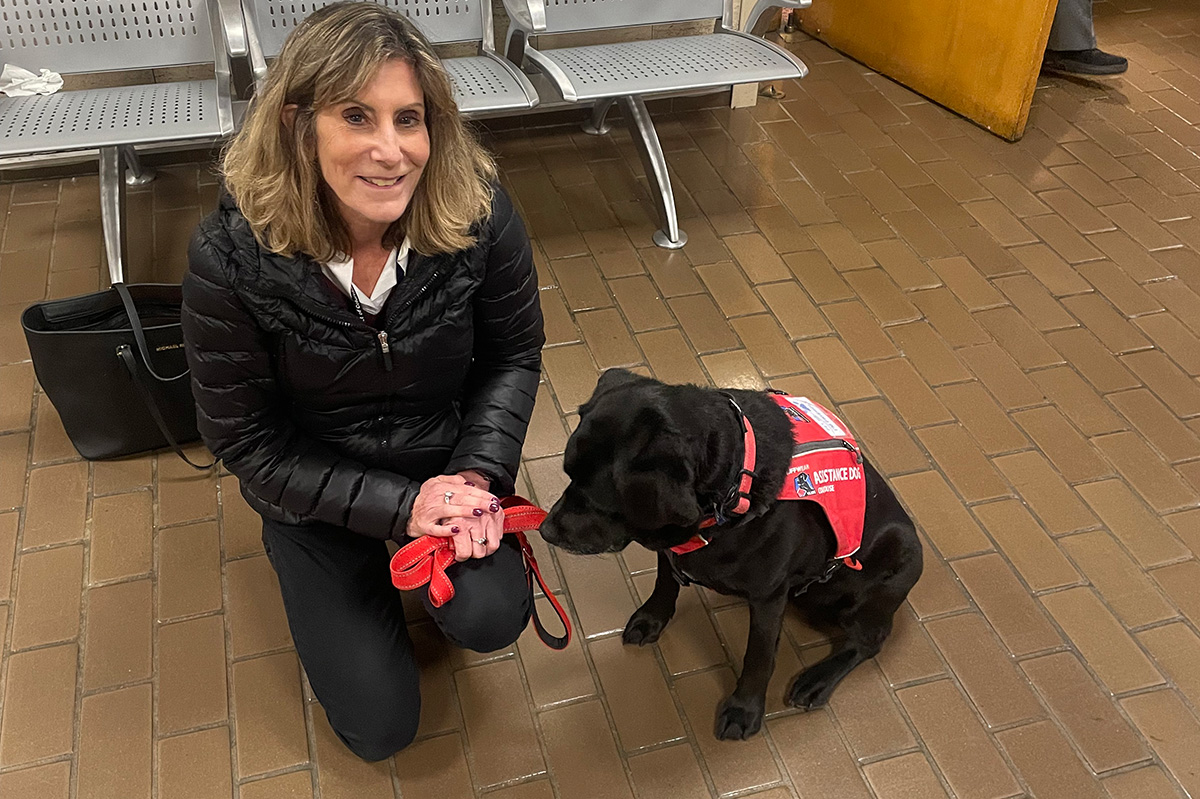
As she heaved and sobbed in the courtroom in November, Kelly had a steady four-legged presence by her side: Pepper the Courthouse Dog, as the black Labrador retriever is known in D.C. Superior Court.
Abby Stavitsky, a former federal prosecutor who now serves as a victims’ advocate, is the owner and handler of nine-year-old Pepper. She says that one of the things that has made Pepper such a great asset in the court in the past six years is the emotional support and comfort she provides to victims.
“She absorbs all of the feelings and the emotions around her, but she’s very good at handling it,” Stavitsky said.
Pepper and Stavitsky started working in Magistrate Judge Mary Grace Rook’s courtroom — and now works in Magistrate Judge Janet Albert’s — to provide support for youth who suffer trauma, especially young survivors of commercial sexual exploitation.
These specially trained dogs offer emotional support to trauma victims of all ages. Courthouse dogs can reduce victims’ and witnesses’ anxiety and stress, making it easier for them to provide clear statements in the courtroom, according to a 2019 report in the Criminal Justice Review.
“Having something to pet and interact with is a distraction that results in victims being calmer when testifying in court,” says Stavitsky. “This gives them an extra level of comfort.”
What brought Stavitsky and Pepper together
Stavitsky, who spent 25 years as an assistant U.S attorney, handled a lot of victim-based crimes, mostly domestic violence and sex offenses. She was also a dog lover, and once she learned about courthouse dogs and their use, she was inspired.
In 2019, Pepper was given to Stavitsky by a Massachusetts-based organization, NEADS, formerly known as the National Education for Assistance Dog Services. Although Pepper was originally trained to be a service dog, evaluators determined her character was best suited for a courthouse dog.
Pepper now works regularly in various treatment court cases involving juveniles, many of whom have experienced trauma or are involved in the child welfare system. She also sits with victims while they are testifying in a trial.
“She loves people, especially children,” Stavitsky said. “She loves that interaction.”
Courthouse dogs have a long history
In courthouses across the U.S. specially trained “facility dogs” are becoming an important part of how the justice system supports vulnerable victims and witnesses.
Since the late 1980s, these dogs were used to help trauma survivors and anxious children during testimonies and interviews. The first dog to make an appearance in a courtroom was Sheba, a German shepherd who assisted child sexual abuse victims in the Queens (N.Y.) District Attorney’s Office. Courthouse dogs help them communicate more clearly, especially in these settings that make them anxious and stressed.
Unlike service dogs, courthouse facility dogs are professionally trained through accredited assistance dog organizations and work daily alongside prosecutors, victim advocates, and forensic interviewers. For example, courthouse dogs can have more social interaction, unlike service dogs.
Courthouse dogs’ growing use has prompted state laws and professional guidelines to recognize the dogs as a trauma-informed tool that helps victims participate in the justice process without compromising courtroom fairness.
As more jurisdictions adopt these programs, courthouse dogs are reshaping how the legal system balances compassion with procedure, ensuring that victims’ voices can be heard in environments that might otherwise silence them.
Pepper makes it easy to see why.
“I really love people, especially kids, and can provide emotional support and comfort during all stages of the court process,” reads the business card Stavitsky hands out with Pepper’s picture. “I’m calm, quiet and can stay in place for several hours.”
(This article was written by a student in the journalism program at Bard High School Early College DC. This work is part of a partnership between the Washington Blade Foundation and Youthcast Media Group, funded through the FY26 Community Development Grant from the Office of D.C. Mayor Muriel Bowser.)
District of Columbia
How new barriers to health care coverage are hitting D.C.
Federally qualified health centers bracing for influx of newly uninsured patients

Washington, D.C. has the second-lowest rate of people who lack health insurance in the country, but many residents are facing new barriers to health care due to provisions of the sweeping federal law passed in July, which threatens access for thousands.
Changes to insurance eligibility and the rising cost of premiums, which kicked in for some in October and others more recently, are expected to leave many more patients uninsured or unable to afford medical care. Federally qualified health centers, including D.C.’s Whitman-Walker Health, where 10 to 12 percent of patients are uninsured, are bracing for an influx of newly uninsured patients while facing their own financial challenges.
Even in D.C., where uninsured rates have been among the lowest in the country, changes brought on by the passage of the Republican mega bill (known as the “Big Beautiful Bill”) will have major effects.
The changes from the bill affect Medicaid, which is free to low-income patients, and subsidies for insurance that people buy on the health insurance exchanges that were started under the Affordable Care Act, which were allowed to expire on Dec. 31.
Erin Loubier, vice president for access and strategic initiatives at Whitman-Walker Health, says some Whitman-Walker Health patients have received notices about premium increases, including several who say the increases are up to 1,000 percent more than they were paying.
“That is like paying rent,” she says. “We live in an expensive city, so any increases are going to be really, really hard on people.”
Whitman-Walker Health and other healthcare providers are expecting the changes to have multiple effects — some patients may not be able to afford coverage or may avoid going to the doctor and allow health conditions to worsen because they can’t afford care, and many more will be seeking care who don’t have insurance.
“I’m worried that we’re going to not just have people who can’t get care, but that they delay care until they’re really sick, and then the care is not as effective because they might have waited too long, and then we may have a less healthy population,” Loubier says.
Loubier says delaying care, and serving more people without insurance has major implications for Whitman-Walker Health and other health centers serving the community.
“There’s going to be a lot of pressure on us to try to find and raise more money, and that’s going to be harder, because I think all organizations who provide health care are going to be facing this,” she says.
The U.S. health care system is the most expensive in the world, and has much higher out-of-pocket costs for individuals. But in other countries like the United Kingdom, Australia, Canada, and many others, health care is much less expensive — or even free.
Even though the U.S. has a high-priced healthcare system, critics say there are still ways to bring down costs by forcing insurance and pharmaceutical companies to absorb more of the costs, rather than transferring the costs to patients.
“In the U.S., they end up trying to cut costs at the person’s level, not at the level of the different corporations or structures that are making a lot of money in healthcare,” said Loubier. “Our system is so complicated and there is probably waste in it, but I don’t think that that cost and waste is at the ‘people’ level. I think it’s higher up at the system level, but that is much, much harder to get people to try to make cuts at that end.”
Ultimately at Whitman-Walker Health, healthcare providers and insurance navigators are planning to help with everyday necessities when it comes to healthcare coverage and striving to provide healthcare in partnership with patients, said Loubier.
“The key here is we’re going to have a lot of people who may lose insurance, and they’re going to rely on places like Whitman-Walker Health and other community health centers, so we have to figure out how we keep providing that care,” she said.
(This article was written by a student in the journalism program at Bard High School Early College DC. This work is part of a partnership between the Washington Blade Foundation and Youthcast Media Group, funded through the FY26 Community Development Grant from the Office of D.C. Mayor Muriel Bowser.)
District of Columbia
Mayor Bowser signs bill requiring insurers to cover PrEP
‘This is a win in the fight against HIV/AIDS’

D.C. Mayor Muriel Bowser on March 20 signed a bill approved by the D.C. Council that requires health insurance companies to cover the costs of HIV prevention or PrEP drugs for D.C. residents at risk for HIV infection.
Like all legislation approved by the Council and signed by the mayor, the bill, called the PrEP D.C. Amendment Act, was sent to Capitol Hill for a required 30-day congressional review period before it takes effect as D.C. law.
Gay D.C. Council member Zachary Parker (D-Ward 5) last year introduced the bill.
Insurance coverage for PrEP drugs has been provided through coverage standards included in the Affordable Care Act, known as Obamacare. But AIDS advocacy organizations have called on states and D.C. to pass their own legislation requiring insurance coverage of PrEP as a safeguard in case federal policies are weakened or removed by the Trump administration, which has already reduced federal funding for HIV/AIDS-related programs.
Like legislation passed by other states, the PrEP D.C. Amendment Act requires insurers to cover all PrEP drugs approved by the U.S. Food and Drug Administration.
Studies have shown that PrEP drugs, which can be taken as pills or by injection just twice a year, are highly effective in preventing HIV infection.
“I think this is a win for our community,” Parker said after the D.C. Council voted unanimously to approve the bill on its first vote on the measure in February. “And this is a win in the fight against HIV/AIDS.”

Surviving spring cleaning

Iconic Eddie Izzard takes on 23 characters in ‘Hamlet’

How Pepper the courthouse dog helps victims of abuse

Women’s FEST returns to Rehoboth Beach next week

Belarusian lawmakers approve bill to crackdown on LGBTQ rights

Senegalese president signs bill that further criminalizes homosexuality

Trans activists gather on National Mall for Transgender Day of Visibility

Md. lawmakers reaffirm legislative priorities

The cost of speaking one’s mind

Kristi Noem ‘devastated’ as husband’s alleged fetish spending surfaces
-

 Senegal5 days ago
Senegalese president signs bill that further criminalizes homosexuality
-
District of Columbia5 days ago
Trans activists gather on National Mall for Transgender Day of Visibility
-
Maryland5 days ago
Md. lawmakers reaffirm legislative priorities
-
Commentary5 days ago
The cost of speaking one’s mind