U.S. Supreme Court
Supreme Court upholds ban on transgender care for minors
Skrmetti decision among this term’s most highly anticipated rulings
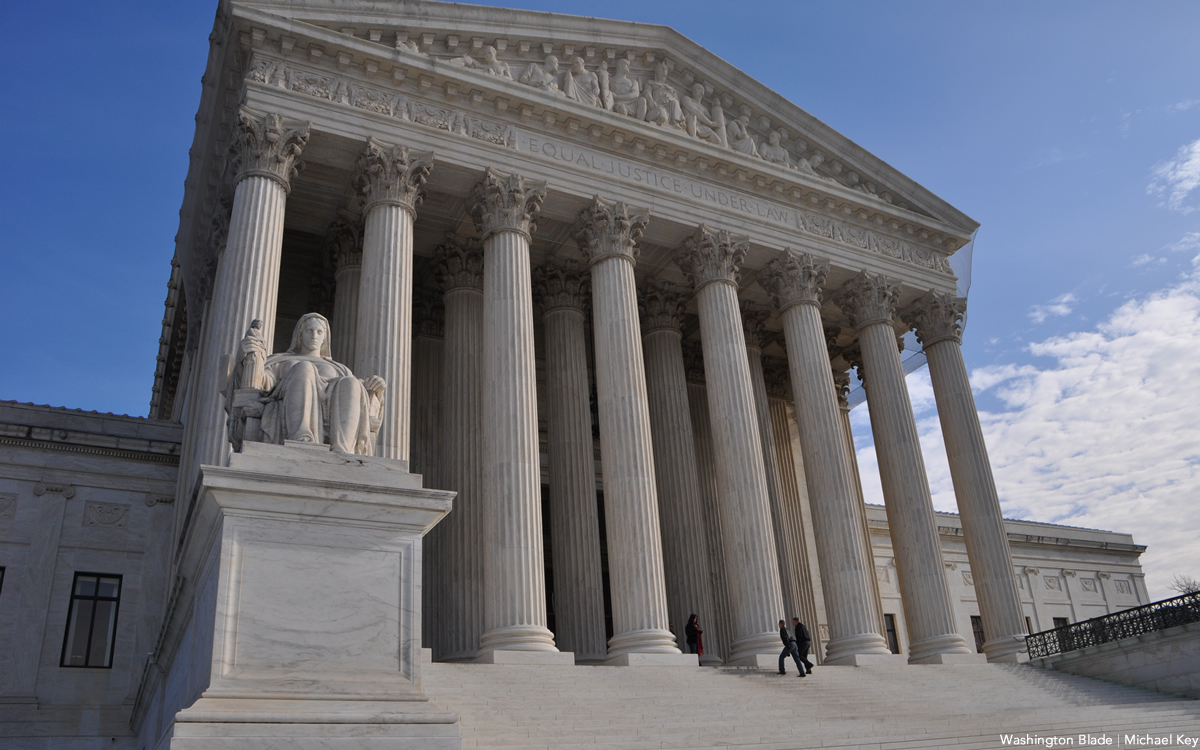
The U.S. Supreme Court on Wednesday upheld a ban on medical interventions for transgender minors in Tennessee, with the three liberal justices dissenting in a ruling that will shield similar laws that block or restrict access to care in more than 20 other states.
Conservative Chief Justice John Roberts, writing for the majority, said questions about the “safety, efficacy, and propriety of medical treatments” should be resolved democratically.
Liberal Justice Sonia Sotomayor argued, in her opinion, that the decision “authorizes, without second thought, untold harm to transgender children and the parents and families who love them,” adding that “Because there is no constitutional justification for that result, I dissent.”
Plaintiffs who challenged Tennessee’s ban were a doctor and three families argued that the policy violated the Equal Protection Clause of the 14th Amendment.
They also emphasized that the care prohibited for minors in the state — puberty delaying medication, hormone therapy, and surgeries — is made available to patients younger than 18 if they are sought for reasons other than gender transitions.
The case, U.S. v. Skrmetti, was among the most anticipated of the court’s June term.
President Donald Trump in February formally reversed course from the Biden-Harris administration’s support for the plaintiffs challenging the Tennessee law, urging the Supreme Court to uphold the ban.
Attorneys, Democratic lawmakers, and medical groups object to the ruling
Representing the plaintiffs in the litigation challenging the ban were the Chase Strangio, co-director of the ACLU’s LGBTQ & HIV Project, Lucas Cameron-Vaughn, senior staff attorney at the ACLU of Tennessee, Karen Loewy, director of constitutional law practice at Lambda Legal, Jennifer Levi, senior director of transgender and queer rights at GLAD Law, Shannon Minter, legal director of the National Center for Lesbian Rights, Sasha Buchert, counsel and director of the Nonbinary and Transgender Rights Project at Lambda Legal, and attorneys with the firm Akin Gump.
“Today’s ruling is a devastating loss for transgender people, our families, and everyone who cares about the Constitution,” said Strangio, who is the first trans lawyer to argue before the Supreme Court. “Though this is a painful setback, it does not mean that transgender people and our allies are left with no options to defend our freedom, our health care, or our lives.”
“The Court left undisturbed Supreme Court and lower court precedent that other examples of discrimination against transgender people are unlawful,” Strangio said. “We are as determined as ever to fight for the dignity and equality of every transgender person and we will continue to do so with defiant strength, a restless resolve, and a lasting commitment to our families, our communities, and the freedom we all deserve.”
“This is a heartbreaking ruling, making it more difficult for transgender youth to escape the danger and trauma of being denied their ability to live and thrive,” said Buchert. “But we will continue to fight fiercely to protect them. Make no mistake, gender-affirming care is often life-saving care, and all major medical associations have determined it to be safe, appropriate, and effective. This is a sad day, and the implications will reverberate for years and across the country, but it does not shake our resolve to continue fighting.”
“The Court today failed to do its job,” said Levi. “When the political system breaks down and legislatures bow to popular hostility, the judiciary must be the Constitution’s backbone. Instead, it chose to look away, abandoning both vulnerable children and the parents who love them. No parent should be forced to watch their child suffer while proven medical care sits beyond their reach because of politics.”
“The Court’s ruling abandons transgender youth and their families to political attacks. It ignored clear discrimination and disregarded its own legal precedent by letting lawmakers target young people for being transgender,” said Minter. “Healthcare decisions belong with families, not politicians. This decision will cause real harm.”
In a press conference on Capitol Hill, Senate Democratic Leader Chuck Schumer (N.Y.) told reporters, “This Supreme Court seems to have forgotten that one of their jobs is to protect individual rights and protect individuals from being discriminated against. It’s an awful decision.”
“On the floor, we had a bill, that the Republicans wanted to take away these rights,” Schumer said. “And we got, I believe, every Democrat voting against it. So it failed because it needed 60 votes. So we’re going to explore every solution.”
U.S. Rep. Pramila Jayapal (D-Wash.) also hosted a press conference, arguing that the court’s decision — and conservative-led efforts to restrict the rights and freedoms of transgender people more broadly — is of a piece with the Republican Party’s broader policy agenda, particularly in Trump’s second term.
In 2019, the congresswoman shared that her daughter, then 22, was trans. When asked on Wednesday whether her staunch opposition to the ruling was both professional and personal, Jayapal said, “I’m not speaking about my personal situation these days” but her family aside, “it’s also personal to me as a member of Congress that represents families who are experiencing the same kinds of issues and the same kind of fear that I hear from people across the country.”
She added, “And so I think what’s important is to recognize that trans people are a tiny percentage of the country and are doing no harm to anyone else. And despite the disinformation, the lies that are being circulated about trans people, I think that we are powerful when we come together, when we realize that these attacks are coordinated and are really about the same thing, which is exerting power over us and taking away our rights in a democracy that should be about allowing everyone to contribute their full selves.”
U.S. Sen. Ed Markey (D-Mass.) said: “Today, hate won. The far-right justices of the Supreme Court endorsed hate and discrimination by delivering a win for Republicans who have relentlessly and cruelly attacked transgender Americans for years. With 25 states already having laws in place that ban gender-affirming care for trans youth, the Supreme Court has cleared the way for families in half of the country to no longer access the medically necessary and life-saving care they need for their children.”
The senator continued, “But here is what no Court nor politician can ever change: trans people will continue to exist. Their health care is lifesaving and essential, and trans rights are human rights. We have a fight ahead of us, but discrimination and hate cannot and must not win.”
U.S. Sen. Jeff Merkley (D-Ore.) said: “Access to medically-necessary care for trans youth saves lives, and the U.S. Supreme Court’s callous decision puts trans youth and their families at risk.
“MAGA extremists across the nation will not stop at banning medically-necessary gender-affirming care for trans youth. The Court’s life-altering decision lays out the playbook for extremist politicians to continue their crusade against trans people and further exclude them from daily life. And this is just the beginning—this decision opens the floodgates for MAGA extremists in state legislatures and Congress to ban medically-necessary care, from gender-affirming care to abortion access.
“This is just wrong—everyone should have access to the care they need, when they need it. No exceptions.
“Let’s get politicians out of the exam room. We will continue to fight these divisive policies in communities nationwide to fully realize the vision of America as a land of freedom and equality for all, and I won’t rest until my Equality Act is signed into law to deliver on this fundamental promise.”
“Today’s decision by the Supreme Court is devastating for young transgender Americans and their families who live in states that decide to put divisive and dehumanizing politics over people,” said U.S. Rep. Mark Takano (D-Wis.), chair of the Congressional Equality Caucus.
“The Court’s ruling upholding Tennessee’s cruel and politically-motivated ban on medically-necessary care for young trans people undermines the ability of transgender patients, their families, and doctors to make medical decisions about accessing evidence-based care without politicians’ interference,” he said.
The congressman added, “The law the Court upheld is an attack on some of the most vulnerable in our community—but we still have other tools to challenge anti-trans laws in courts across the country. As Chair of the Equality Caucus, I am committed to continuing to lead elected officials from across the country in the fight for full equality for transgender people under the law here in Congress.”
“Every parent wants to keep their child healthy. Parents and trans young people have the right to make private health care decisions with their doctors. Today’s ruling allowing Tennessee politicians to interfere in private health care decisions is not only draconian, it’s dangerous and hateful,” said U.S. Rep. Becca Balint (D-Vt.). “I want families who are feeling scared today about the consequences of this decision to know that I’m with you. I’m fighting for you in Congress every single day, and I will not back down.”
Jayapal, Markey, Merkley, Takano, and Balint were among the 164 members of Congress who filed an amicus brief urging the court to preserve access to care.
New York Attorney General Letitia James also released a statement: “At a time when LGBTQ+ communities are under relentless attack, this decision is dangerous and a profound disappointment. Gender-affirming care is essential and lifesaving health care, and denying young people access to it will have devastating consequences.
“Let me be clear: gender-affirming care remains legal and protected in New York, including for young people.
“To the transgender community in Tennessee and across the country: We stand proudly with you. We are strongest together, and we will not let this decision weaken our resolve to build a safer, more just, inclusive, and compassionate nation for all.”
Also issuing a statement was a coalition of seven medical associations that had submitted an amicus brief supporting the plaintiffs — American Academy of Pediatrics, American College of Obstetricians and Gynecologists, American College of Physicians, American Psychiatric Association, Endocrine Society, the National Association of Pediatric Nurse Practitioners, and the American Pediatric Society.
The organizations said:
“As experts dedicated to providing patients with compassionate, evidence-based care every day, we are disappointed in the United States vs. Skrmetti decision, which increases the likelihood that other states will limit or eliminate families’ and patients’ ability to access medical care.
“As doctors, nurse practitioners, and nurses, we believe that every patient is different. Decisions about medical care must be based on individualized assessments by qualified professionals in consultation with the patient and their parents or legal guardians and guided by well-designed medical evidence. This Supreme Court decision strips patients and families of the choice to direct their own health care.
“Every patient should have access to the medical care they need. Health care professionals must be able to rely on their training, education, and expertise to provide appropriate care based on the needs and values of each patient and their family, without bans or interference.”
LGBTQ and civil rights advocacy groups object to the ruling
Allison Scott, president of the Campaign for Southern Equality, said ““I am heartbroken today. No one should be forced to leave their home state to access healthcare – and it is outrageous to see the U.S. Supreme Court uphold these bans and continue to allow the government to interfere with the personal medical decisions of families.”
“The Court’s ruling can’t change what we know in our bones: our identities, our families, and our lives are strong, worthy, and not up for debate by extremists,” she said. “The Trans Youth Emergency Project will be here to help families navigate this painful time.”
“Today, the Supreme Court took the place of parents and doctors and stripped away their ability to make private, lifesaving decisions for their children,” said GLAAD President and CEO Sarah Kate Ellis. “This ruling is a chilling step toward unchecked government overreach, intruding on the most personal aspects of our private lives.”
She added, “All families are now less safe and left vulnerable to politicians and a Court that has abandoned its duty to protect personal liberties. Every family deserves the freedom to make the medical decisions that help their children live, thrive, and be well.”
“This is a devastating and deeply dangerous decision that carries irreversible harm to transgender youth and their families. The majority’s opinion politicizes decades of medical consensus, ignores the Constitution’s mandate of equal protection, and turns its back on youth and their families,” said Skye Perryman, president and CEO of Democracy Forward.
“Our team at Democracy Forward will continue to work every day to support transgender people, including young people, their families, and communities, and we will never give up making the Constitution’s guarantee of equal protection under the law a reality for all people,” she said.
National LGBTQ Task Force President Kierra Johnson said: “Gender affirming care can mean the difference between life and death for our transgender youth. Today, the Supreme Court rejected the science and authorization of gender affirming care, upheld harmful bans, and denied the lived experiences of trans youth.
“The Supreme Court has now rolled back critical protections against discrimination on the basis of sex. This is an especially devastating moment for transgender youth, their parents and their doctors across the country. Tennessee’s ban on essential medical care — and other similar state bans — will continue to wreak havoc on the lives of these families.
“What we know is this: transgender youth denied access to appropriate medical care are in danger of worse physical and mental health outcomes.
“Americans look to the Supreme Court as the highest court of the land, making decisions with long term impact in these critical times; decisions that speak to the value certain communities. Transgender youth are often overlooked, undervalued, and lack the protection that they deserve as both minors and transgender community members. Gender dysphoria impacts more than the physicality of a person and, when left untreated, may result in anxiety and depression. When there is no legal doctrine that speaks to pertinence of gender affirming care, it shows that the law is not on their side, discrediting and disenfranchising a community while obliterating their humanity. ”
Imara Jones, CEO of TransLash Media, said: Today the Supreme Court used the greatest hits of discredited anti-trans, pseudoscientific ideas in order to rule against the equal access of trans kids to healthcare. This is healthcare that is safe, supported by every mainstream medical association, and which is granted with the consent of youth’s parents.
“Moreover, the Court could only issue such a ruling by overlooking the obvious: The denial of equal access to healthcare for trans kids is sex discrimination. Gender-affirming treatments are allowed for some children but not others under the Tennessee law SB1, which explicitly states as one of its goals to encourage minors to ‘appreciate their sex.’
“So what they did here is the equivalent of denying a person’s race, in order to declare that racial discrimination laws don’t apply.
“Now, while the Skirmetti ruling is not as sweeping as it could have been, because it leaves the door open to future cases on sports and bathrooms, it will likely turbocharge attempts to exempt trans people from Constitutional protections. What the court has done is give these efforts the sheen of judicial legitimacy, and a road map for how to do so, by directing them to leave out the explicit targeting of trans people.
“Because as long as the attempts to push trans people outside of the bounds of public life using the law are implicit, then governmental entities have free reign to do so, now.
“The success of manipulating legal, scientific, and media organizations with anti-trans disinformation by Christian Nationalist and authoritarian entities is crystal clear in this decision.”
“LPAC is devastated that the Supreme Court has turned away from experts like the American Academy of Pediatrics and hard data showing that health care for trans youth improves physical and mental health, and instead succumbed to political pressure,” said Janelle Perez, executive director of LPAC. “This cruel decision opens the floodgates for politicians to decide what we and our children need to be healthy. These are decisions that should be made by families and healthcare providers, not politicians.”
Human Rights Campaign President Kelley Robinson said: “Today’s Supreme Court decision is a devastating blow to transgender youth and the families who love them, but it will not break our resolve. Families may now have to make the heartbreaking choice to leave their state or split their families, or take on extensive financial burdens, in order to ensure that their kids can access medically necessary care.
“This Court chose to allow politicians to interfere in medical decisions that should be made by doctors, patients, and families—a cruel betrayal of the children who needed them to stand up for justice when it mattered most.
“As parents, advocates, and community leaders, we know that our fight doesn’t end in courtrooms—it lives in our communities, our hearts, and our unwavering commitment to each other. Still, we will not be deterred. We will support families forced to make impossible choices, fund legal challenges, and build a movement so powerful that no politician can ignore us. Together, we will turn this pain into power and keep fighting until every transgender person in America can live with dignity, safety, and the freedom to be who they are.”
Tennessee AG and Log Cabin Republicans celebrate the ruling
Tennessee Attorney General Jonathan Skrmetti said, “In today’s historic Supreme Court win, the common sense of Tennessee voters prevailed over judicial activism. A bipartisan supermajority of Tennessee’s elected representatives carefully considered the evidence and voted to protect kids from irreversible decisions they cannot yet fully understand.”
The AG continued, “I commend the Tennessee legislature and Governor Lee for their courage in passing this legislation and supporting our litigation despite withering opposition from the Biden administration, LGBT special interest groups, social justice activists, the American Medical Association, the American Bar Association, and even Hollywood.”
Log Cabin Republicans interim executive director Ed Williams released the following statement:
“The U.S. Supreme Court just upheld Tennessee’s law prohibiting trans medical surgeries and treatments for minors. This decision is not ‘anti-trans.’ It is a historic and critical win for children and common-sense. The majority of Americans support equal treatment for trans Americans and protections from discrimination. They also back laws like Tennessee’s, which protect children from receiving life-altering and irreversible medical procedures or treatments often pushed on them by a zealous cabal that views children as pawns in their gender ideology crusade.
“LGBT conservatives have long believed there is a middle-road that upholds respect, inclusion, and protection for trans Americans while curbing the excesses of a radical political movement attempting to push its bizarre agenda in sports, schools, governments, and hospitals. Today’s Supreme Court is a step in the right direction.”
The Washington Blade will update this story.



U.S. Supreme Court
Supreme Court rules against Colo. law banning conversion therapy for minors
8-1 decision could have sweeping impact
The U.S. Supreme Court on Tuesday ruled against a Colorado law that bans so-called conversion therapy for minors.
The justices last October heard oral arguments in Chiles v. Salazar. Today they ruled 8-1 in favor of Kaley Chiles, a Christian therapist who challenged the 2019 law.
In the case, which was heard by the justices in October 2025, Chiles successfully argued to the court that the law restricting this type of therapy was unconstitutional, leading to it being struck down.
The Supreme Court ultimately found that lower state and federal courts has “erred by failing to apply sufficiently rigorous First Amendment scrutiny,” ultimately reversing the widely discredited “medical” treatment that has support by a very narrow margin of mental health specialists — specifically religious and socially conservative ones. This is despite the fact that Colorado state officials have never enforced the measure in practice, and included a religious exemption for people “engaged in the practice of religious ministry.” The now moot law carried fines of up to $5,000 for each violation and possible suspension or revocation of a counselor’s license.
In the ruling, the court said the law, that specifically applies to talk therapy “impermissibly” interferes with free speech rights of Americans, and despite it being “regard[ed] its policy as essential to public health and safety, but the First Amendment stands as a shield against any effort to enforce orthodoxy in thought or speech in this country,” Justice Neil Gorsuch wrote for himself and seven other justices from across the ideological spectrum who overturned the low court’s ruling. He went on to add that the original ban “trains directly on the content of her speech and permits her to express some viewpoints but not others,” sending it back down to a lower court.
Only Justice Ketanji Brown Jackson dissented, which included an in depth summary of her departure from the other eight justices, explaining her fears about the verdict — and its eventual chilling effect on legislation that could attempts to restrict regulatory speech for religious attitudes— despite that these regulations are often made as a direct creation of years of essentially unanimous research, and are vetted though regulatory boards for specific jobs.
“This decision might make speech-only therapies and other medical treatments involving practitioner speech effectively unregulatable,” Jackson wrote on page 32 of the 35-page opinion issued by court in response to her opposing eight members comments on the bench.
Since the ruling late Tuesday morning, a slew of LGBTQ advocacy groups, as well as groups promoting LGBTQ discrimination, have issued statements on the direct impact this will have across the country for LGBTQ people.
Democratic Senator, running for reelection in Colorado, John Hickenlooper issued a condemnation of the practice on his X (formerly Twitter). “Conversion therapy is cruel and inhumane, plain and simple. This SCOTUS decision is dangerous for LGBTQ+ Americans,” Our LGBTQ+ community deserves safety, acceptance, and love. We won’t ever let up in our fight for a better nation.”
Conversion therapy is cruel and inhumane, plain and simple. This SCOTUS decision is dangerous for LGBTQ+ Americans.,” the former Governor said on the platform. “Our LGBTQ+ community deserves safety, acceptance, and love. We won’t ever let up in our fight for a better nation.”
Polly Crozier, director of family advocacy at GLBTQ Legal Advocates & Defenders (GLAD Law), provided a statement to the Washington Blade on the court’s decision.
“Today’s Supreme Court ruling limited Colorado’s statute that preemptively shielded minors from conversion therapy, but it leaves open avenues for states to protect families from harmful, unscrupulous, and misleading practices that divide parents from their children and put LGBTQ+ youth at risk,” Crozier wrote, pointing to the overwhelming evidence on conversion therapy that argues this type of regulatory legislation is helping those suffering rather than harming. “The evidence is clear that conversion practices lead to increased anxiety, depression, and suicidality. This is a dangerous practice that has been condemned by every major medical association in the country. Today’s decision does not change the science, and it does not change the fact that conversion therapists who harm patients will still face legal consequences, and that family advocates, mental health practitioners, and all of us who care about the wellbeing of youth will continue working to shield LGBTQ+ young people and their families from this dangerous practice.”
Human Rights Campaign President Kelley Robinson, who leads the nation’s largest LGBTQ advocacy group, also provided a statement, calling the courts choice a “reckless decision.” The statement also points out how their own data (from the group’s philanthropic arm of the organization) was cited in Brown Jackson’s dissent in the amicus brief.
“The court has weaponized free-speech in order to prioritize anti-LGBTQ+ bias over the safety, health and wellbeing of children,” her statement reads. “So-called ‘conversion therapy’ is pseudoscience, not real therapy. It has been condemned by every mainstream medical and mental health association and harms families, traumatizes children, and robs people of their faith communities. It is cruel and should never be offered under the guise of legitimate mental healthcare. To undermine protections that keep kids and families safe from these abusive practices is shocking — and our children deserve better.”
Liberty Counsel, a nonprofit, tax-exempt Christian ministry that uses litigation to promote evangelical Christian values and limit LGBTQ protections, which was designated as a hate group by the Southern Poverty Law Center, was also cited in the court’s amicus brief, but in support of overturning the law.
“The U.S. Supreme Court’s resounding decision in Chiles v. Salazar is a major victory for the integrity of the counseling profession,” Mat Staver, Founder and Chairman of Liberty Council said today. “This ruling ensures the government cannot strip the First Amendment away from licensed counselors and dictate a state-mandated ideology between counselor and client. Talk therapy is speech, and the government has no authority to restrict that speech to just one viewpoint. Counseling bans can now be struck down nationwide so that people can get the counseling they need.”
GLAAD, one of the nation’s oldest non-profit organizations focused on LGBTQ advocacy and cultural change issued a statement pon the verdict, emphasizing what multiple advocate groups have said – this decision will impact an already vulnerable youth population at an elevated high risk.
“The Court once again prioritized malice over best practice medicine,” Sarah Kate Ellis, President and CEO of GLAAD said in a statement. “In the face of this harmful decision, we need to amplify the voices of survivors of this dangerous and disproven practice, and continue to hold anyone who peddles in this junk science liable.”
Truth Wins Out, an organization that works towards “advancing liberty and democracy through protecting the rights of LGBTQ people and other minorities” called out the court’s majority opinion for its potential for religious extremism and spread of disinformation.
“This ruling is a profound failure of both logic and moral responsibility that confuses ‘free speech’ with ‘false speech’,” Wayne Besen, the Executive Director of Truth Wins Out said in a comment. ” It opens the door for quackery to flourish and allows practitioners of a thoroughly debunked practice to continue harming LGBTQ youth under a thin veneer of legitimacy
Adrian Shanker, the former Deputy Assistant Secretary for Health Policy at Health and Human Services under President Biden, who also led LGBTQI+ policy at the agency spoke about the detrimental impact this will have on rules and regulations within the healthcare field that are supposed to be inherently secular by nature.
“No matter what the Supreme Court decided today, it is irrefutable that conversion therapy is harmful to the health and wellbeing of LGBTQI+ youth,” Shanker told the Blade, continuing the Trump Administration’s choice to no longer formally support LGBTQ inclusive policy. “That’s why in the Biden administration we advanced policies to safeguard youth from this harmful practice.”
In an consistently updated document started in 2018 that cites the major harms risks conversion therapy poses to LGBTQ people, the Trevor Project, the leading suicide prevention and crisis intervention organization for LGBTQ young people, included that the federal government’s own research proved the practice at best questionable and at worst deadly.
In a 2023 report entitled Moving Beyond Change Efforts: Evidence and Action to Support and Affirm LGBTQI+ Youth, the U.S. Department of Health and Human Services’ Substance Abuse and Mental Health Services Administration stressed that “[sexual orientation and gender identity] change efforts are harmful practices that are never appropriate with LGBTQI+
youth, and efforts are needed to end these practices,” the summary of the fight against conversion therapy in the U.S. reads.
More than 20 states and D.C. banned the widely discredited practice for minors prior to the Supreme Court’s ruling.
The Blade last October spoke to conversion therapy survivors after the justices heard oral arguments in the Chiles case.
U.S. Supreme Court
Competing rallies draw hundreds to Supreme Court
Activists, politicians gather during oral arguments over trans youth participation in sports
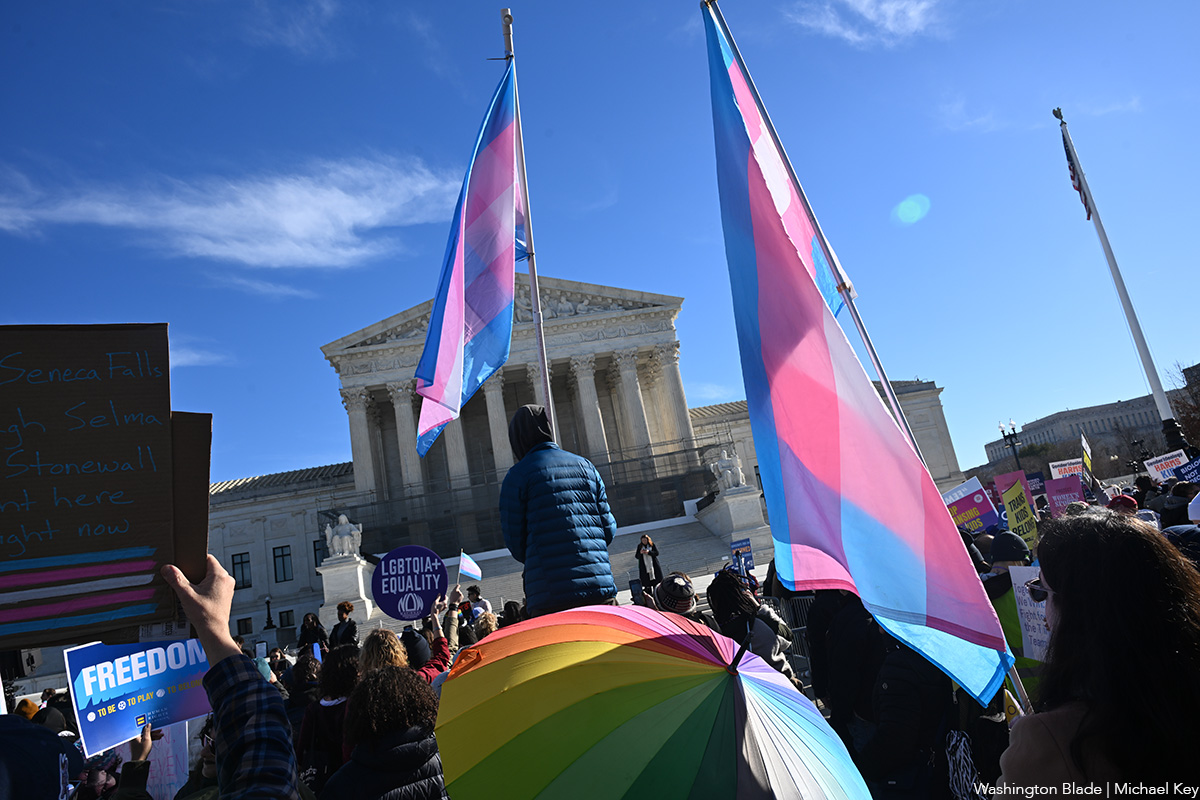
Hundreds of supporters and opponents of trans rights gathered outside of the United States Supreme Court during oral arguments for Little v. Hecox and West Virginia v. B.P.J. on Tuesday. Two competing rallies were held next to each other, with politicians and opposing movement leaders at each.
“Trans rights are human rights!” proclaimed U.S. Sen. Ed Markey (D-Mass.) to the crowd of LGBTQ rights supporters. “I am here today because trans kids deserve more than to be debated on cable news. They deserve joy. They deserve support. They deserve to grow up knowing that their country has their back.”
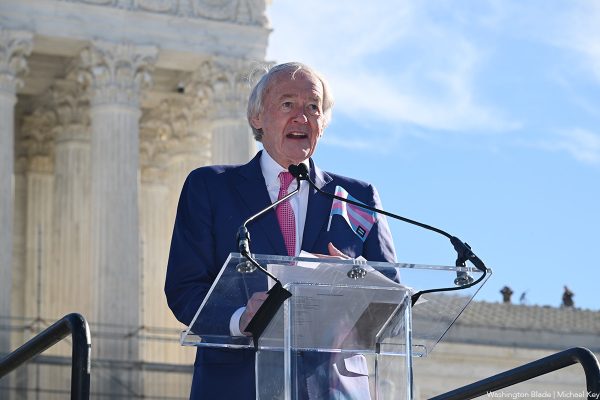
“And I am here today because we have been down this hateful road before,” Markey continued. “We have seen time and time again what happens when the courts are asked to uphold discrimination. History eventually corrects those mistakes, but only after the real harm is done to human beings.”
View on Threads
U.S. Education Secretary Linda McMahon spoke at the other podium set up a few feet away surrounded by signs, “Two Sexes. One Truth.” and “Reality Matters. Biology Matters.”
“In just four years, the Biden administration reversed decades of progress,” said McMahon. “twisting the law to urge that sex is not defined by objective biological reality, but by subjective notion of gender identity. We’ve seen the consequences of the Biden administration’s advocacy of transgender agendas.”
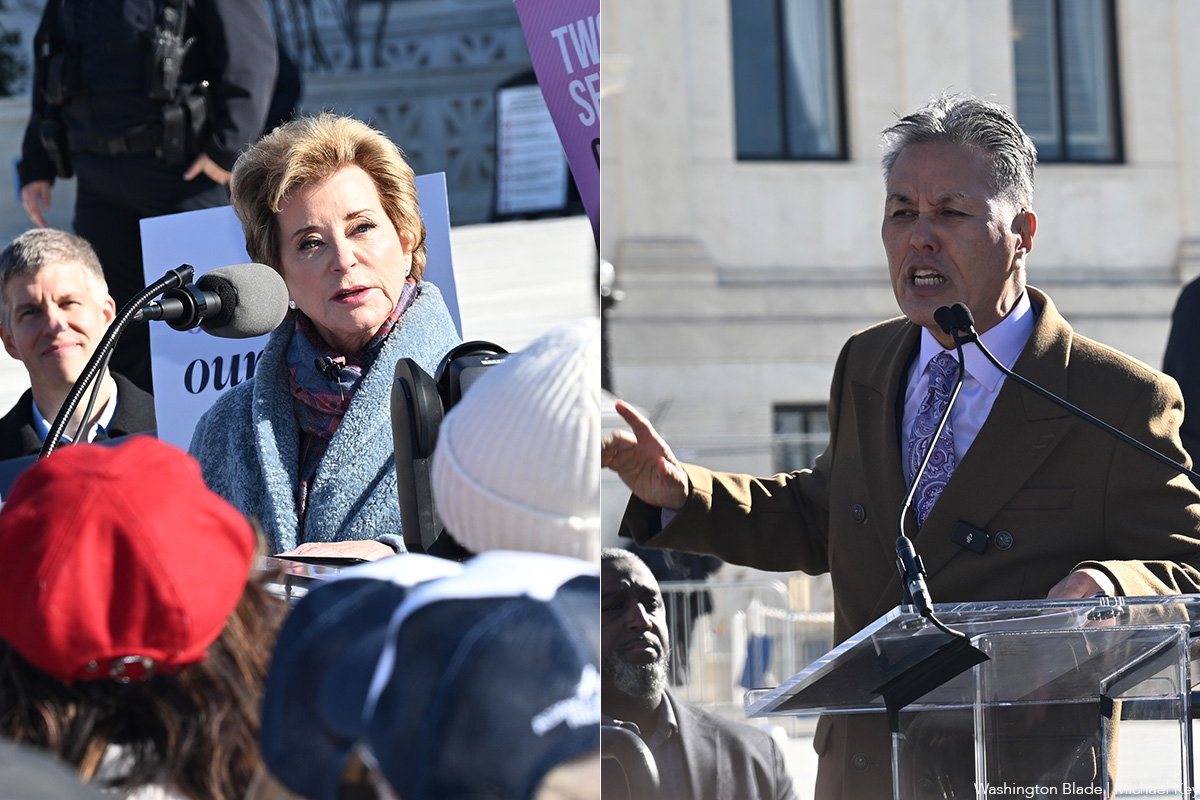
U.S. Rep. Mark Takano (D-Calif.), chair of the Congressional Equality Caucus, was introduced on the opposing podium during McMahon’s remarks.
“This court, whose building that we stand before this morning, did something quite remarkable six years ago.” Takano said. “It did the humanely decent thing, and legally correct thing. In the Bostock decision, the Supreme Court said that trans employees exist. It said that trans employees matter. It said that Title VII of the Civil Rights Act protects employees from discrimination based on sex, and that discrimination based on sex includes discrimination based on gender identity and sexual orientation. It recognizes that trans people have workplace rights and that their livelihoods cannot be denied to them, because of who they are as trans people.”
“Today, we ask this court to be consistent,” Takano continued. “If trans employees exist, surely trans teenagers exist. If trans teenagers exist, surely trans children exist. If trans employees have a right not to be discriminated against in the workplace, trans kids have a right to a free and equal education in school.”
Takano then turned and pointed his finger toward McMahon.
“Did you hear that, Secretary McMahon?” Takano addressed McMahon. “Trans kids have a right to a free and equal education! Restore the Office of Civil Rights! Did you hear me Secretary McMahon? You will not speak louder or speak over me or over these people.”
Both politicians continued their remarks from opposing podiums.
“I end with a message to trans youth who need to know that there are adults who reject the political weaponization of hate and bigotry,” Takano said. “To you, I say: you matter. You are not alone. Discrimination has no place in our schools. It has no place in our laws, and it has no place in America.”
U.S. Supreme Court
Supreme Court hears arguments in two critical cases on trans sports bans
Justices considered whether laws unconstitutional under Title IX.
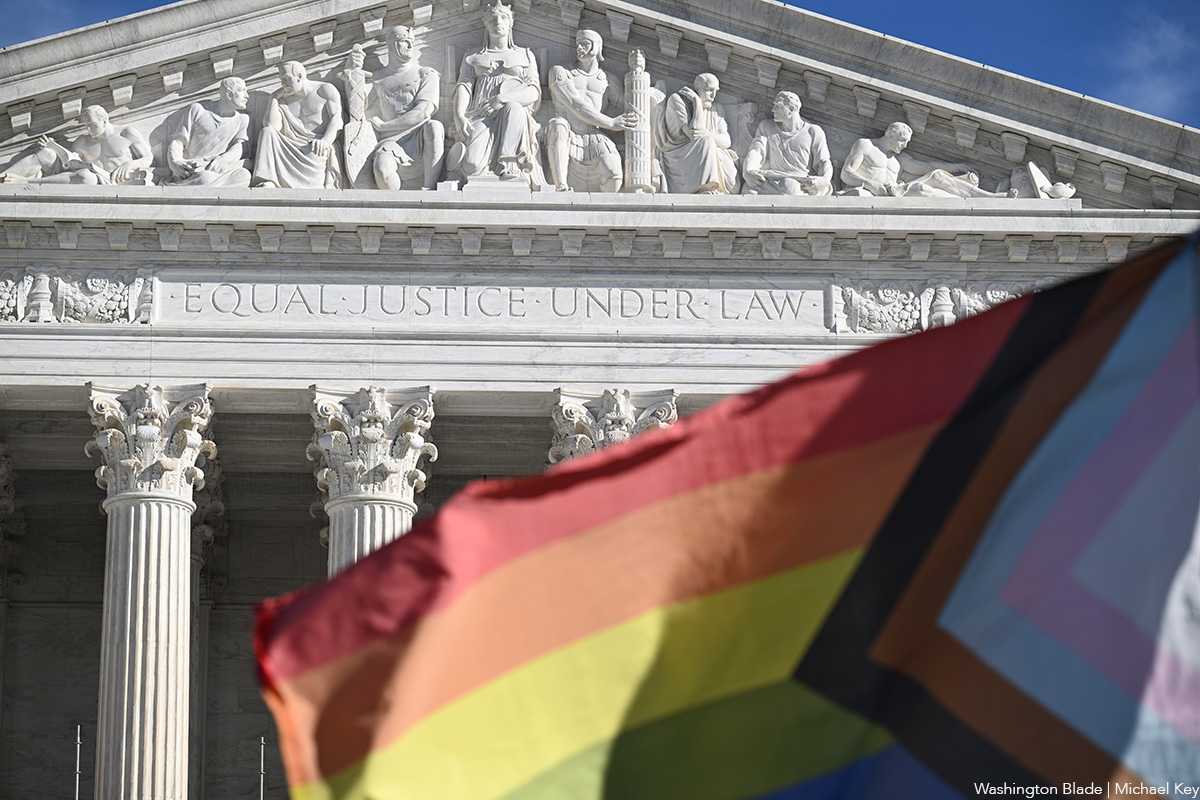
The Supreme Court heard two cases today that could change how the Equal Protection Clause and Title IX are enforced.
The cases, Little v. Hecox and West Virginia v. B.P.J., ask the court to determine whether state laws blocking transgender girls from participating on girls’ teams at publicly funded schools violates the 14th Amendment’s Equal Protection Clause and Title IX. Once decided, the rulings could reshape how laws addressing sex discrimination are interpreted nationwide.
Chief Justice John Roberts raised questions about whether Bostock v. Clayton County — the landmark case holding that Title VII of the Civil Rights Act of 1964 protects employees from discrimination based on sexual orientation or gender identity — applies in the context of athletics. He questioned whether transgender girls should be considered girls under the law, noting that they were assigned male at birth.
“I think the basic focus of the discussion up until now, which is, as I see it anyway, whether or not we should view your position as a challenge to the distinction between boys and girls on the basis of sex or whether or not you are perfectly comfortable with the distinction between boys and girls, you just want an exception to the biological definition of girls.”
“How we approach the situation of looking at it not as boys versus girls but whether or not there should be an exception with respect to the definition of girls,” Roberts added, suggesting the implications could extend beyond athletics. “That would — if we adopted that, that would have to apply across the board and not simply to the area of athletics.”
Justice Clarence Thomas echoed Roberts’ concerns, questioning how sex-based classifications function under Title IX and what would happen if Idaho’s ban were struck down.
“Does a — the justification for a classification as you have in Title IX, male/female sports, let’s take, for example, an individual male who is not a good athlete, say, a lousy tennis player, and does not make the women’s — and wants to try out for the women’s tennis team, and he said there is no way I’m better than the women’s tennis players. How is that different from what you’re being required to do here?”
Justice Samuel Alito addressed what many in the courtroom seemed reluctant to state directly: the legal definition of sex.
“Under Title IX, what does the term ‘sex’ mean?” Alito asked Principal Deputy Solicitor General Hashim Mooppan, who was arguing in support of Idaho’s law. Mooppan maintained that sex should be defined at birth.
“We think it’s properly interpreted pursuant to its ordinary traditional definition of biological sex and think probably given the time it was enacted, reproductive biology is probably the best way of understanding that,” Mooppan said.
Justice Sonia Sotomayor pushed back, questioning how that definition did not amount to sex discrimination against Lindsay Hecox under Idaho law. If Hecox’s sex is legally defined as male, Sotomayor argued, the exclusion still creates discrimination.
“It’s still an exception,” Sotomayor said. “It’s a subclass of people who are covered by the law and others are not.”
Justice Elena Kagan highlighted the broader implications of the cases, asking whether a ruling for the states would impose a single definition of sex on the 23 states that currently have different laws and standards. The parties acknowledged that scientific research does not yet offer a clear consensus on sex.
“I think the one thing we definitely want to have is complete findings. So that’s why we really were urging to have a full record developed before there were a final judgment of scientific uncertainty,” said Kathleen Harnett, Hecox’s legal representative. “Maybe on a later record, that would come out differently — but I don’t think that—”
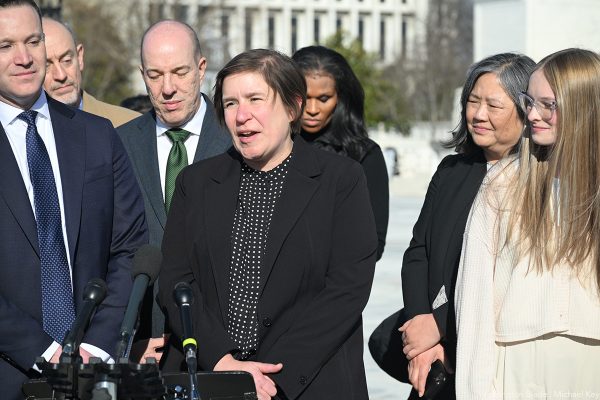
“Just play it out a little bit, if there were scientific uncertainty,” Kagan responded.
Justice Brett Kavanaugh focused on the impact such policies could have on cisgender girls, arguing that allowing transgender girls to compete could undermine Title IX’s original purpose.
“For the individual girl who does not make the team or doesn’t get on the stand for the medal or doesn’t make all league, there’s a — there’s a harm there,” Kavanaugh said. “I think we can’t sweep that aside.”
Justice Amy Coney Barrett questioned whether Idaho’s law discriminated based on transgender status or sex.
“Since trans boys can play on boys’ teams, how would we say this discriminates on the basis of transgender status when its effect really only runs towards trans girls and not trans boys?”
Harnett responded, “I think that might be relevant to a, for example, animus point, right, that we’re not a complete exclusion of transgender people. There was an exclusion of transgender women.”
Justice Ketanji Brown Jackson challenged the notion that explicitly excluding transgender people was not discrimination.
“I guess I’m struggling to understand how you can say that this law doesn’t discriminate on the basis of transgender status. The law expressly aims to ensure that transgender women can’t play on women’s sports teams… it treats transgender women different than — than cis-women, doesn’t it?”
Idaho Solicitor General Alan Hurst urged the court to uphold his state’s ban, arguing that allowing participation based on gender identity — regardless of medical intervention — would deny opportunities to girls protected under federal law.
Hurst emphasized that biological “sex is what matters in sports,” not gender identity, citing scientific evidence that people assigned male at birth are predisposed to athletic advantages.
Joshua Block, representing B.P.J., was asked whether a ruling in their favor would redefine sex under federal law.
“I don’t think the purpose of Title IX is to have an accurate definition of sex,” Block said. “I think the purpose is to make sure sex isn’t being used to deny opportunities.”
Becky Pepper-Jackson, identified as plaintiff B.P.J., the 15-year-old also spoke out.
“I play for my school for the same reason other kids on my track team do — to make friends, have fun, and challenge myself through practice and teamwork,” said Pepper-Jackson. “And all I’ve ever wanted was the same opportunities as my peers. But in 2021, politicians in my state passed a law banning me — the only transgender student athlete in the entire state — from playing as who I really am. This is unfair to me and every transgender kid who just wants the freedom to be themselves.”
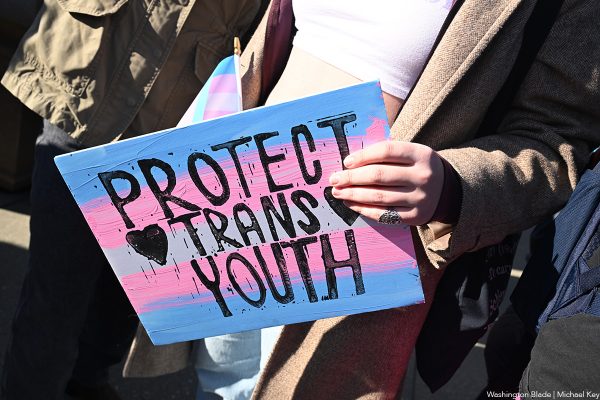
Outside the court, advocates echoed those concerns as the justices deliberated.
“Becky simply wants to be with her teammates on the track and field team, to experience the camaraderie and many documented benefits of participating in team sports,” said Sasha Buchert, counsel and Nonbinary & Transgender Rights Project director at Lambda Legal. “It has been amply proven that participating in team sports equips youth with a myriad of skills — in leadership, teamwork, confidence, and health. On the other hand, denying a student the ability to participate is not only discriminatory but harmful to a student’s self-esteem, sending a message that they are not good enough and deserve to be excluded. That is the argument we made today and that we hope resonated with the justices of the Supreme Court.”
“This case is about the ability of transgender youth like Becky to participate in our schools and communities,” said Joshua Block, senior counsel for the ACLU’s LGBTQ & HIV Project. “School athletics are fundamentally educational programs, but West Virginia’s law completely excluded Becky from her school’s entire athletic program even when there is no connection to alleged concerns about fairness or safety. As the lower court recognized, forcing Becky to either give up sports or play on the boys’ team — in contradiction of who she is at school, at home, and across her life — is really no choice at all. We are glad to stand with her and her family to defend her rights, and the rights of every young person, to be included as a member of their school community, at the Supreme Court.”
The Supreme Court is expected to issue rulings in both cases by the end of June.

Trans activists gather on National Mall for Transgender Day of Visibility

The cost of speaking one’s mind

Senegalese president signs bill that further criminalizes homosexuality

Md. lawmakers reaffirm legislative priorities

Supreme Court rules against Colo. law banning conversion therapy for minors

Celebrate cherry blossoms the drag way

Lorato ke Lorato: marriage equality, democracy, and the unfinished work of justice in Botswana

Japanese Supreme Court to consider marriage equality

The outrage economy is not the LGBTQ community

Anti-trans visa ruling echoes Nazi regime destroying trans documents
-

 Out & About4 days ago
Celebrate cherry blossoms the drag way
-
Botswana5 days ago
Lorato ke Lorato: marriage equality, democracy, and the unfinished work of justice in Botswana
-
Japan4 days ago
Japanese Supreme Court to consider marriage equality
-
Opinions4 days ago
The outrage economy is not the LGBTQ community