U.S. Supreme Court
Supreme Court hears arguments in two critical cases on trans sports bans
Justices considered whether laws unconstitutional under Title IX.
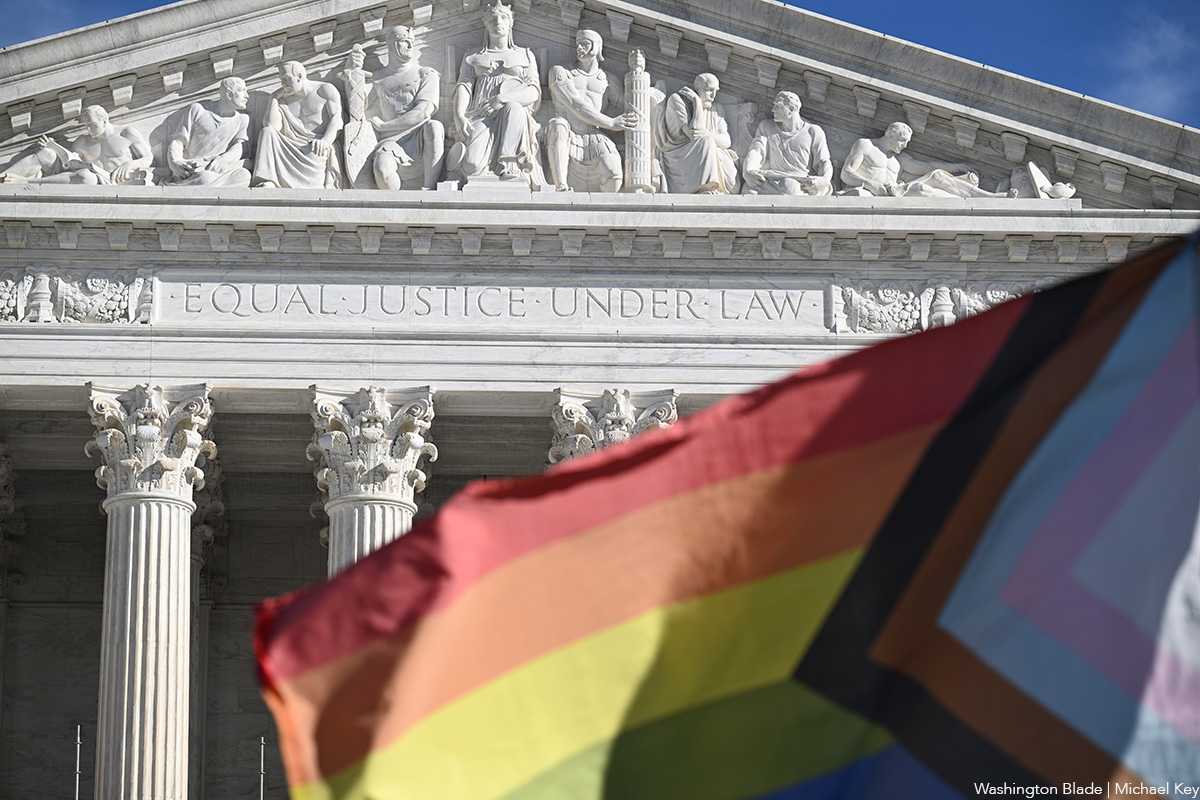
The Supreme Court heard two cases today that could change how the Equal Protection Clause and Title IX are enforced.
The cases, Little v. Hecox and West Virginia v. B.P.J., ask the court to determine whether state laws blocking transgender girls from participating on girls’ teams at publicly funded schools violates the 14th Amendment’s Equal Protection Clause and Title IX. Once decided, the rulings could reshape how laws addressing sex discrimination are interpreted nationwide.
Chief Justice John Roberts raised questions about whether Bostock v. Clayton County — the landmark case holding that Title VII of the Civil Rights Act of 1964 protects employees from discrimination based on sexual orientation or gender identity — applies in the context of athletics. He questioned whether transgender girls should be considered girls under the law, noting that they were assigned male at birth.
“I think the basic focus of the discussion up until now, which is, as I see it anyway, whether or not we should view your position as a challenge to the distinction between boys and girls on the basis of sex or whether or not you are perfectly comfortable with the distinction between boys and girls, you just want an exception to the biological definition of girls.”
“How we approach the situation of looking at it not as boys versus girls but whether or not there should be an exception with respect to the definition of girls,” Roberts added, suggesting the implications could extend beyond athletics. “That would — if we adopted that, that would have to apply across the board and not simply to the area of athletics.”
Justice Clarence Thomas echoed Roberts’ concerns, questioning how sex-based classifications function under Title IX and what would happen if Idaho’s ban were struck down.
“Does a — the justification for a classification as you have in Title IX, male/female sports, let’s take, for example, an individual male who is not a good athlete, say, a lousy tennis player, and does not make the women’s — and wants to try out for the women’s tennis team, and he said there is no way I’m better than the women’s tennis players. How is that different from what you’re being required to do here?”
Justice Samuel Alito addressed what many in the courtroom seemed reluctant to state directly: the legal definition of sex.
“Under Title IX, what does the term ‘sex’ mean?” Alito asked Principal Deputy Solicitor General Hashim Mooppan, who was arguing in support of Idaho’s law. Mooppan maintained that sex should be defined at birth.
“We think it’s properly interpreted pursuant to its ordinary traditional definition of biological sex and think probably given the time it was enacted, reproductive biology is probably the best way of understanding that,” Mooppan said.
Justice Sonia Sotomayor pushed back, questioning how that definition did not amount to sex discrimination against Lindsay Hecox under Idaho law. If Hecox’s sex is legally defined as male, Sotomayor argued, the exclusion still creates discrimination.
“It’s still an exception,” Sotomayor said. “It’s a subclass of people who are covered by the law and others are not.”
Justice Elena Kagan highlighted the broader implications of the cases, asking whether a ruling for the states would impose a single definition of sex on the 23 states that currently have different laws and standards. The parties acknowledged that scientific research does not yet offer a clear consensus on sex.
“I think the one thing we definitely want to have is complete findings. So that’s why we really were urging to have a full record developed before there were a final judgment of scientific uncertainty,” said Kathleen Harnett, Hecox’s legal representative. “Maybe on a later record, that would come out differently — but I don’t think that—”
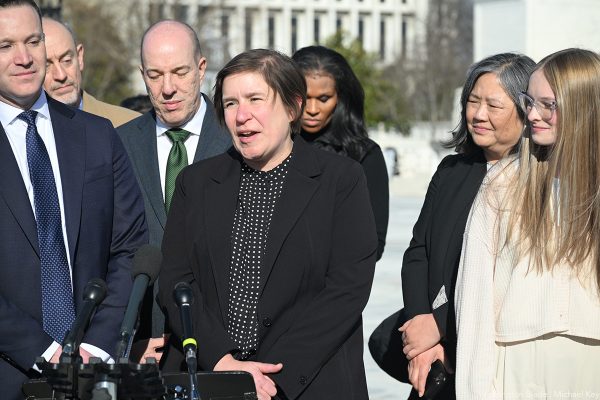
“Just play it out a little bit, if there were scientific uncertainty,” Kagan responded.
Justice Brett Kavanaugh focused on the impact such policies could have on cisgender girls, arguing that allowing transgender girls to compete could undermine Title IX’s original purpose.
“For the individual girl who does not make the team or doesn’t get on the stand for the medal or doesn’t make all league, there’s a — there’s a harm there,” Kavanaugh said. “I think we can’t sweep that aside.”
Justice Amy Coney Barrett questioned whether Idaho’s law discriminated based on transgender status or sex.
“Since trans boys can play on boys’ teams, how would we say this discriminates on the basis of transgender status when its effect really only runs towards trans girls and not trans boys?”
Harnett responded, “I think that might be relevant to a, for example, animus point, right, that we’re not a complete exclusion of transgender people. There was an exclusion of transgender women.”
Justice Ketanji Brown Jackson challenged the notion that explicitly excluding transgender people was not discrimination.
“I guess I’m struggling to understand how you can say that this law doesn’t discriminate on the basis of transgender status. The law expressly aims to ensure that transgender women can’t play on women’s sports teams… it treats transgender women different than — than cis-women, doesn’t it?”
Idaho Solicitor General Alan Hurst urged the court to uphold his state’s ban, arguing that allowing participation based on gender identity — regardless of medical intervention — would deny opportunities to girls protected under federal law.
Hurst emphasized that biological “sex is what matters in sports,” not gender identity, citing scientific evidence that people assigned male at birth are predisposed to athletic advantages.
Joshua Block, representing B.P.J., was asked whether a ruling in their favor would redefine sex under federal law.
“I don’t think the purpose of Title IX is to have an accurate definition of sex,” Block said. “I think the purpose is to make sure sex isn’t being used to deny opportunities.”
Becky Pepper-Jackson, identified as plaintiff B.P.J., the 15-year-old also spoke out.
“I play for my school for the same reason other kids on my track team do — to make friends, have fun, and challenge myself through practice and teamwork,” said Pepper-Jackson. “And all I’ve ever wanted was the same opportunities as my peers. But in 2021, politicians in my state passed a law banning me — the only transgender student athlete in the entire state — from playing as who I really am. This is unfair to me and every transgender kid who just wants the freedom to be themselves.”
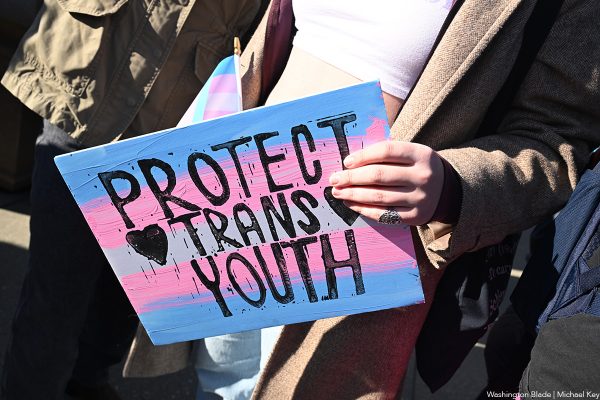
Outside the court, advocates echoed those concerns as the justices deliberated.
“Becky simply wants to be with her teammates on the track and field team, to experience the camaraderie and many documented benefits of participating in team sports,” said Sasha Buchert, counsel and Nonbinary & Transgender Rights Project director at Lambda Legal. “It has been amply proven that participating in team sports equips youth with a myriad of skills — in leadership, teamwork, confidence, and health. On the other hand, denying a student the ability to participate is not only discriminatory but harmful to a student’s self-esteem, sending a message that they are not good enough and deserve to be excluded. That is the argument we made today and that we hope resonated with the justices of the Supreme Court.”
“This case is about the ability of transgender youth like Becky to participate in our schools and communities,” said Joshua Block, senior counsel for the ACLU’s LGBTQ & HIV Project. “School athletics are fundamentally educational programs, but West Virginia’s law completely excluded Becky from her school’s entire athletic program even when there is no connection to alleged concerns about fairness or safety. As the lower court recognized, forcing Becky to either give up sports or play on the boys’ team — in contradiction of who she is at school, at home, and across her life — is really no choice at all. We are glad to stand with her and her family to defend her rights, and the rights of every young person, to be included as a member of their school community, at the Supreme Court.”
The Supreme Court is expected to issue rulings in both cases by the end of June.


U.S. Supreme Court
Competing rallies draw hundreds to Supreme Court
Activists, politicians gather during oral arguments over trans youth participation in sports
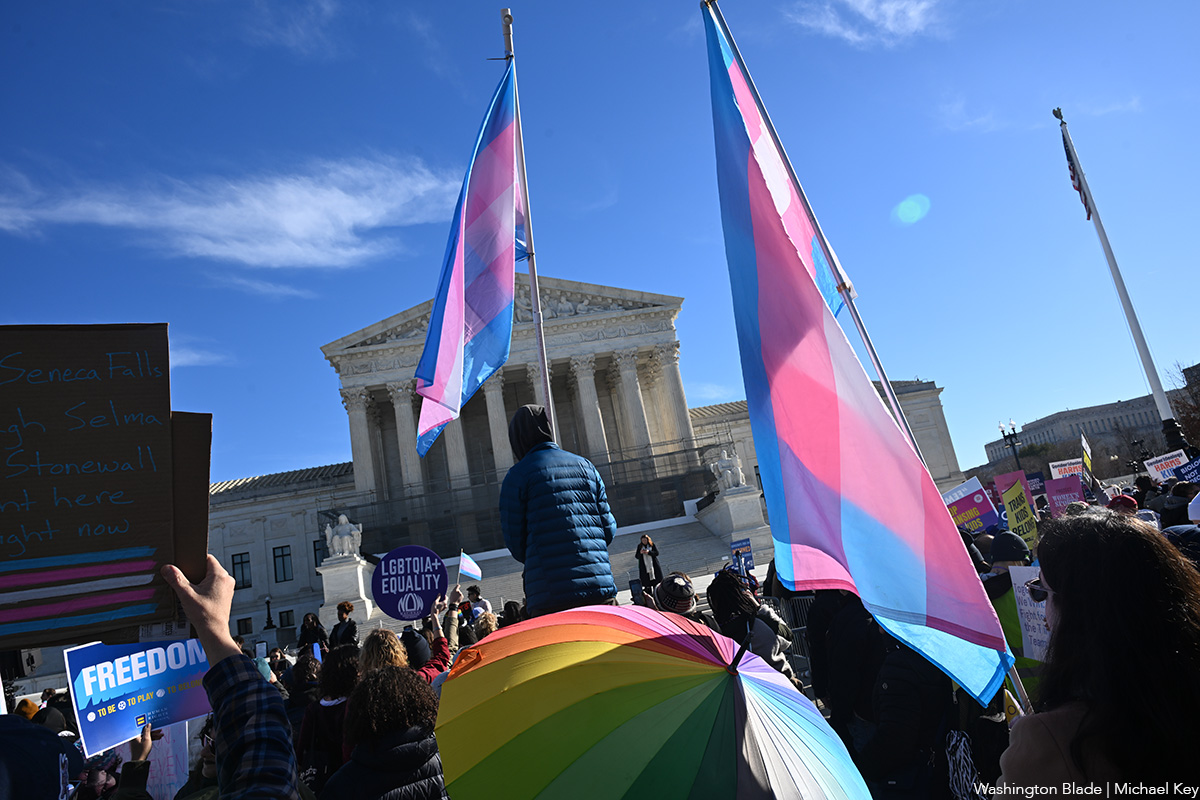
Hundreds of supporters and opponents of trans rights gathered outside of the United States Supreme Court during oral arguments for Little v. Hecox and West Virginia v. B.P.J. on Tuesday. Two competing rallies were held next to each other, with politicians and opposing movement leaders at each.
“Trans rights are human rights!” proclaimed U.S. Sen. Ed Markey (D-Mass.) to the crowd of LGBTQ rights supporters. “I am here today because trans kids deserve more than to be debated on cable news. They deserve joy. They deserve support. They deserve to grow up knowing that their country has their back.”
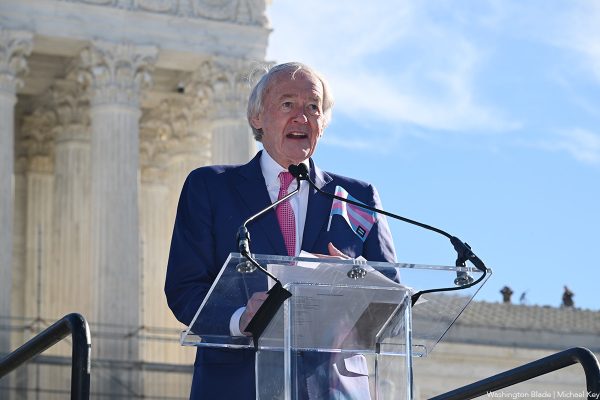
“And I am here today because we have been down this hateful road before,” Markey continued. “We have seen time and time again what happens when the courts are asked to uphold discrimination. History eventually corrects those mistakes, but only after the real harm is done to human beings.”
View on Threads
U.S. Education Secretary Linda McMahon spoke at the other podium set up a few feet away surrounded by signs, “Two Sexes. One Truth.” and “Reality Matters. Biology Matters.”
“In just four years, the Biden administration reversed decades of progress,” said McMahon. “twisting the law to urge that sex is not defined by objective biological reality, but by subjective notion of gender identity. We’ve seen the consequences of the Biden administration’s advocacy of transgender agendas.”
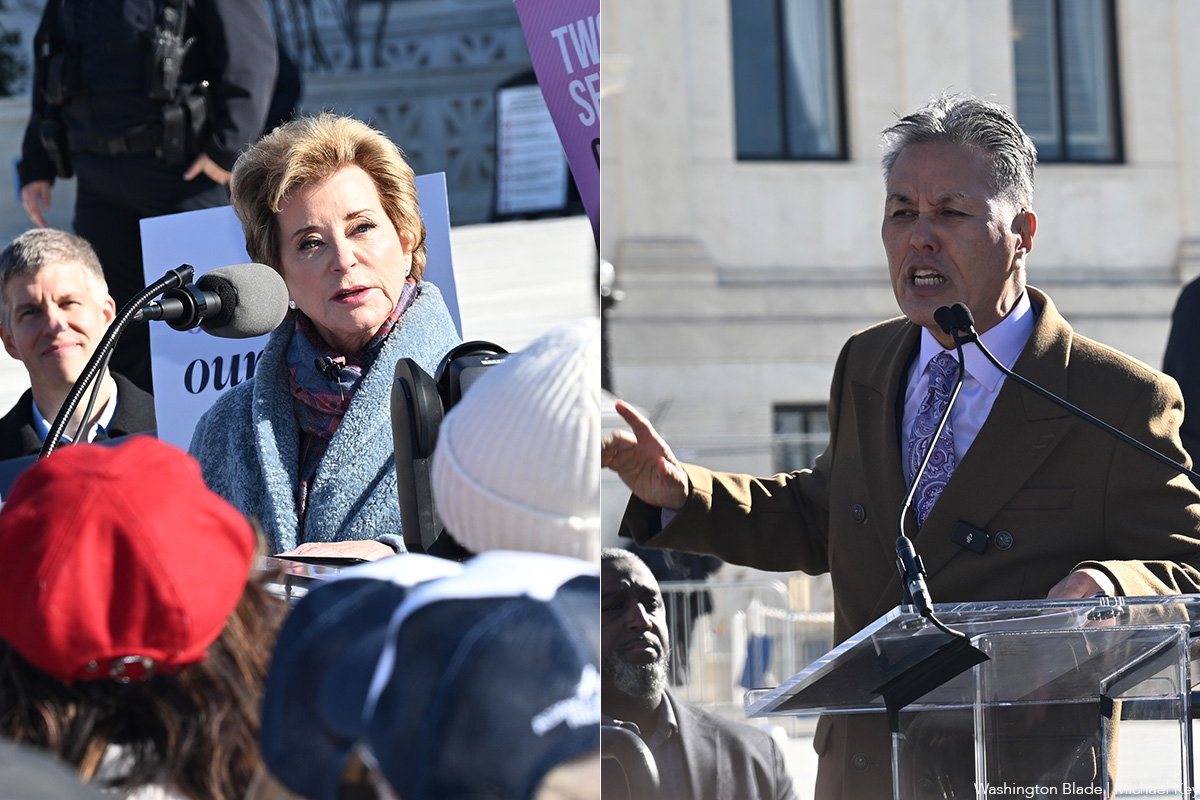
U.S. Rep. Mark Takano (D-Calif.), chair of the Congressional Equality Caucus, was introduced on the opposing podium during McMahon’s remarks.
“This court, whose building that we stand before this morning, did something quite remarkable six years ago.” Takano said. “It did the humanely decent thing, and legally correct thing. In the Bostock decision, the Supreme Court said that trans employees exist. It said that trans employees matter. It said that Title VII of the Civil Rights Act protects employees from discrimination based on sex, and that discrimination based on sex includes discrimination based on gender identity and sexual orientation. It recognizes that trans people have workplace rights and that their livelihoods cannot be denied to them, because of who they are as trans people.”
“Today, we ask this court to be consistent,” Takano continued. “If trans employees exist, surely trans teenagers exist. If trans teenagers exist, surely trans children exist. If trans employees have a right not to be discriminated against in the workplace, trans kids have a right to a free and equal education in school.”
Takano then turned and pointed his finger toward McMahon.
“Did you hear that, Secretary McMahon?” Takano addressed McMahon. “Trans kids have a right to a free and equal education! Restore the Office of Civil Rights! Did you hear me Secretary McMahon? You will not speak louder or speak over me or over these people.”
Both politicians continued their remarks from opposing podiums.
“I end with a message to trans youth who need to know that there are adults who reject the political weaponization of hate and bigotry,” Takano said. “To you, I say: you matter. You are not alone. Discrimination has no place in our schools. It has no place in our laws, and it has no place in America.”
U.S. Supreme Court
As Supreme Court weighs trans sports bans, advocate and former athlete speaks out
PFLAG staffer Diego Sanchez competed at University of Georgia in 1970s
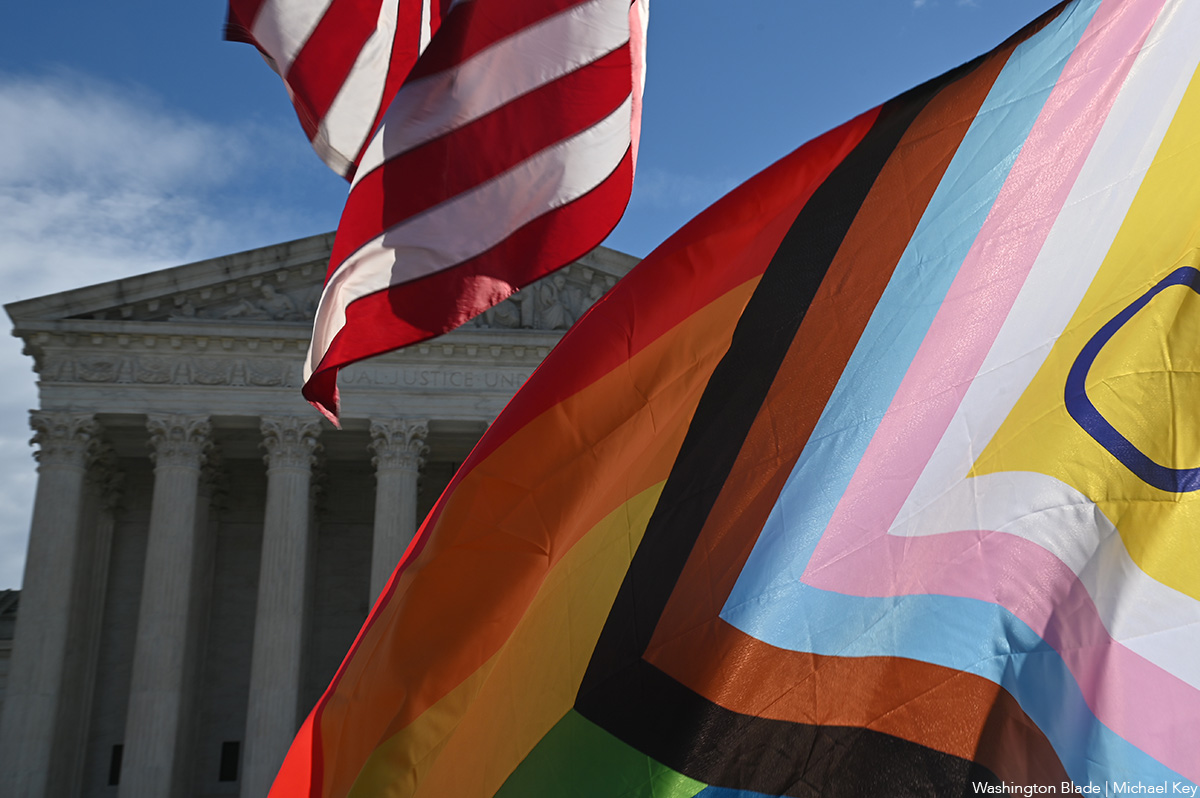
The U.S. Supreme Court will hear two cases Tuesday addressing the legality of banning transgender women and girls from participating in sports under the 14th Amendment.
Though the two cases differ slightly in their fact patterns, they ultimately pose the same constitutional question: whether laws that limit participation in women’s sports to only cisgender women and girls violate the Equal Protection Clause of the 14th Amendment.
In both cases — Little v. Hecox and West Virginia v. B.P.J. — trans girls filed lawsuits against their respective states, Idaho and West Virginia, arguing that the bans violate their right to equal protection under the law by subjecting them to different standards than cisgender girls.
Lindsay Hecox, now 24, filed her lawsuit in 2020 while attending Boise State University. That same year, Idaho enacted the “Fairness in Women’s Sports Act,” which barred trans women from participating in any sport in public schools, from kindergarten through college. Although Hecox underwent hormone therapy that significantly lowered her testosterone levels, she was still excluded under the law when she attempted to try out for the women’s track and cross-country teams.
The second case centers on B.P.J., a 15-year-old trans girl who has identified as female since third grade and has been on puberty blockers since the onset of puberty. In 2021, West Virginia enacted the “Save Women’s Sports Act,” which requires sports teams to be designated by “biological sex” rather than gender identity. B.P.J.’s mother filed suit on her behalf after her daughter was barred from participating on her school’s girls’ cross-country and track teams.
A key distinction between the two cases is that attorneys for B.P.J. have argued that because puberty blockers were part of her development, her body is more aligned with that of a cisgender girl than a cisgender boy. Despite these differences, both cases raise the same constitutional issue: whether it is lawful to bar someone from participation in sports based on sex assigned at birth.
The Washington Blade spoke with PFLAG Vice President of Policy and Government Affairs Diego Sanchez.
Sanchez is a trans elder with firsthand experience as a college athlete at the University of Georgia and later became the first openly trans legislative staff member on Capitol Hill.
His dual experience — as a former athlete and a longtime policy expert deeply familiar with constitutional law — gives him a unique perspective on the questions now before the Supreme Court. Sanchez will also be one of the featured speakers at a rally on the steps of the court as the justices hear arguments.
When asked how attitudes toward trans athletes differ from when he competed at the University of Georgia from 1976-1980 to today — when 27 states have passed laws restricting trans participation in sports — Sanchez said the contrast is stark.
“I had the good experience of being supported by my teammates and my coach,” Sanchez said. “The thing that’s so different today is that these [trans] kids are able to go home and get kisses and hugs from their parents, being lauded in the stands by their families, and then being told that who they are doesn’t necessarily fit with who they’re allowed to be in their expression at the moment, and that to me, seems a terrible injustice.”
Sanchez emphasized that sports offer lessons that extend far beyond competition.
“When you’re an athlete, you learn an awful lot of things about life,” he said. “You learn about leadership, but you also learn that your best effort becomes part of a team effort … how you feel as an individual contributor is affected by what ends up being part of how you live your life as an adult.”
After his time as an athlete, Sanchez began working in government, eventually serving as senior policy advisor to then-U.S. Rep. Barney Frank (D-Mass.) until Frank’s retirement in 2013. Sanchez said that one of the most important aspects of his role was simply being visible as a trans person in spaces where many lawmakers had never knowingly met one before.
“My job was to make sure that no one, no legislator, could say that they had never met a trans person,” Sanchez said.
Sanchez also addressed the broader implications the Supreme Court’s decision could have on how gender is treated within institutional systems.
“I don’t think it affects how people perceive their own gender or express their own gender, but I do think that it could create barriers if it doesn’t welcome the way that community and society actually are,” he said. “The most important thing for people to know … is to remember that every person is an individual, and that the right to contribute to society should be something that is supported by the government, not hindered.”
He added that the court’s role must be understood within the framework of checks and balances established by the Constitution.
“The risk, of course, here is always remembering that we have three branches of government, so that this action by the judiciary branch may or may not have implications on whether or how things can be perceived or executed at other branches,” Sanchez said. “I would hope that our government is interested in letting the future generations and current generations be the best that they can be as well.”
“Do people get to live their lives as they are, or is the government an obstruction or a support?”
When asked what message he would share with young trans athletes watching the Supreme Court take up these cases, Sanchez said community support remains critical, regardless of how the justices rule.
“Make sure that the environment that you put yourself in is something that honors who you know you are and supports you becoming the best person you can be, and that anything that takes away from that is purely dissonance,” he said.
“What we do with dissonance is what distinguishes us as whether we excel or doubt.”
That same sense of community, Sanchez said, is what rallies — like the one planned outside the Supreme Court — are meant to reinforce, even as decisions are made inside the building.
“Rallies, including tomorrow’s, are about people knowing they’re not alone, and hearing from other people who support who they are,” he said. “There is support across the country … I wish that I had had someone my age now that I could have looked to, but I am the role model, but I didn’t have any.”
Looking ahead to the possibility that the court could uphold bans on trans athletes, Sanchez said the immediate challenge will be ensuring that families and communities continue to affirm trans youth amid legal uncertainty.
“Having the endorsement of being supported who you are, it helps you so much,” he said. “You cannot put the issue of rights back into the genie’s bottle once people experience what freedom and welcoming is.”
For Sanchez, whose life has spanned decades of change in both sports and government, the cases before the Supreme Court represent a pivotal moment — not just legally, but culturally.
“Living your life, for me, does not require bravery,” he said. “It’s just taking one step and then another.”
U.S. Supreme Court
Supreme Court rejects Kim Davis’s effort to overturn landmark marriage ruling
Justices declined to revisit the Obergefell decision
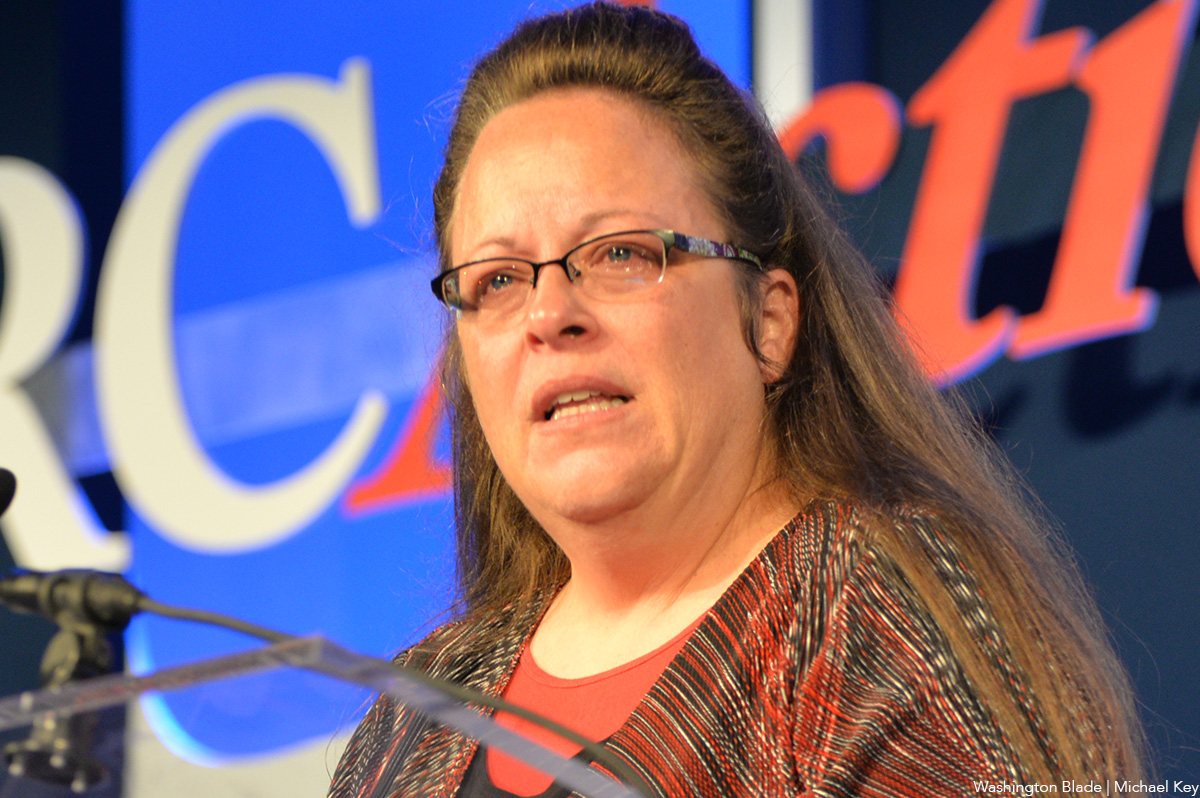
The U.S. Supreme Court has declined to hear an appeal from Kim Davis, the former Rowan County, Ky., clerk best known for refusing to issue marriage licenses to same-sex couples after the landmark 2015 Obergefell v. Hodges decision legalized same-sex marriage nationwide.
Following the Obergefell ruling, Davis stopped issuing marriage licenses altogether and has since filed multiple appeals seeking to challenge same-sex marriage protections. The court once again rejected her efforts on Monday.
In this latest appeal, Davis sought to overturn a $100,000 monetary award she was ordered to pay to David Moore and David Ermold, a same-sex couple to whom she denied a marriage license. Her petition also urged the court to use the case as a vehicle to revisit the constitutional right to same-sex marriage.
The petition, along with the couple’s brief in opposition, was submitted to the Supreme Court on Oct. 22 and considered during the justices’ private conference on Nov. 7. Davis needed at least four votes for the court to take up her case, but Monday’s order shows she fell short.
Cathy Renna, the director of communications for the National LGBTQ Task Force, a non-profit organization that works towards supporting the LGBQ community through grassroots organizing told the Washington Blade:
“Today’s decision is not surprising given the longshot status of Davis’s claim, but it’s a relief that the Supreme Court will not hear it, given the current make up of the court itself. We hope that this settles the matter and marriage equality remains the law of the land for same-sex couples.”
Human Rights Campaign President Kelley Robinson released the following statement:
“Today, love won again. When public officials take an oath to serve their communities, that promise extends to everyone — including LGBTQ+ people. The Supreme Court made clear today that refusing to respect the constitutional rights of others does not come without consequences.
Thanks to the hard work of HRC and so many, marriage equality remains the law of the land through Obergefell v. Hodges and the Respect for Marriage Act. Even so, we must remain vigilant.
It’s no secret that there are many in power right now working to undermine our freedoms — including marriage equality — and attack the dignity of our community any chance they get. Last week, voters rejected the politics of fear, division, and hate, and chose leaders who believe in fairness, freedom, and the future. In race after race, the American people rejected anti-transgender attacks and made history electing pro-equality candidates up and down the ballot.
And from California to Virginia to New Jersey to New York City, LGBTQ+ voters and Equality Voters made the winning difference. We will never relent and will not stop fighting until all of us are free.”
The Log Cabin Republicans, a organization dedicated to conservative LGBTQ people, praising the Court’s decision.
“After months of hand-wringing and fear-mongering by Gay Inc., Democrats, and the media, the conservative majority on the Supreme Court sided with the American people and common sense and declined to revisit marriage equality,” Interim Executive Director Ed Williams said in a statement. “Just like Justice Amy Coney Barrett hinted at earlier this year, Obergefell is settled. Marriage equality has been, and will continue to be, the law of the land.”
This story is developing and will be updated as more information becomes available.

‘No Kings’ protests set for D.C.

Border to border: modern slavery and human trafficking in refugee movements across East Africa

New IOC policy bans trans women from Olympics

Introducing the Torchbearers Awards honoring queer, trans women and nonbinary people

Pa. House passes bill to codify marriage equality in state law

PHOTOS: Capital Stonewall Democrats 50th anniversary

‘Inherit the Wind’ isn’t about science vs. religion, but the right to think

Small is beautiful: subcompact SUVs

Polish court rules country must recognize same-sex marriages from EU states

Capital Stonewall Democrats 50th anniversary gala draws sold out crowd
-

 Photos4 days ago
PHOTOS: Capital Stonewall Democrats 50th anniversary
-
Theater5 days ago
‘Inherit the Wind’ isn’t about science vs. religion, but the right to think
-
Autos5 days ago
Small is beautiful: subcompact SUVs
-
Poland4 days ago
Polish court rules country must recognize same-sex marriages from EU states