Theater
Out actor Kevin Cahoon on starring role in ‘Chez Joey’
Arena production adapted from Broadway classic ‘Pal Joey’
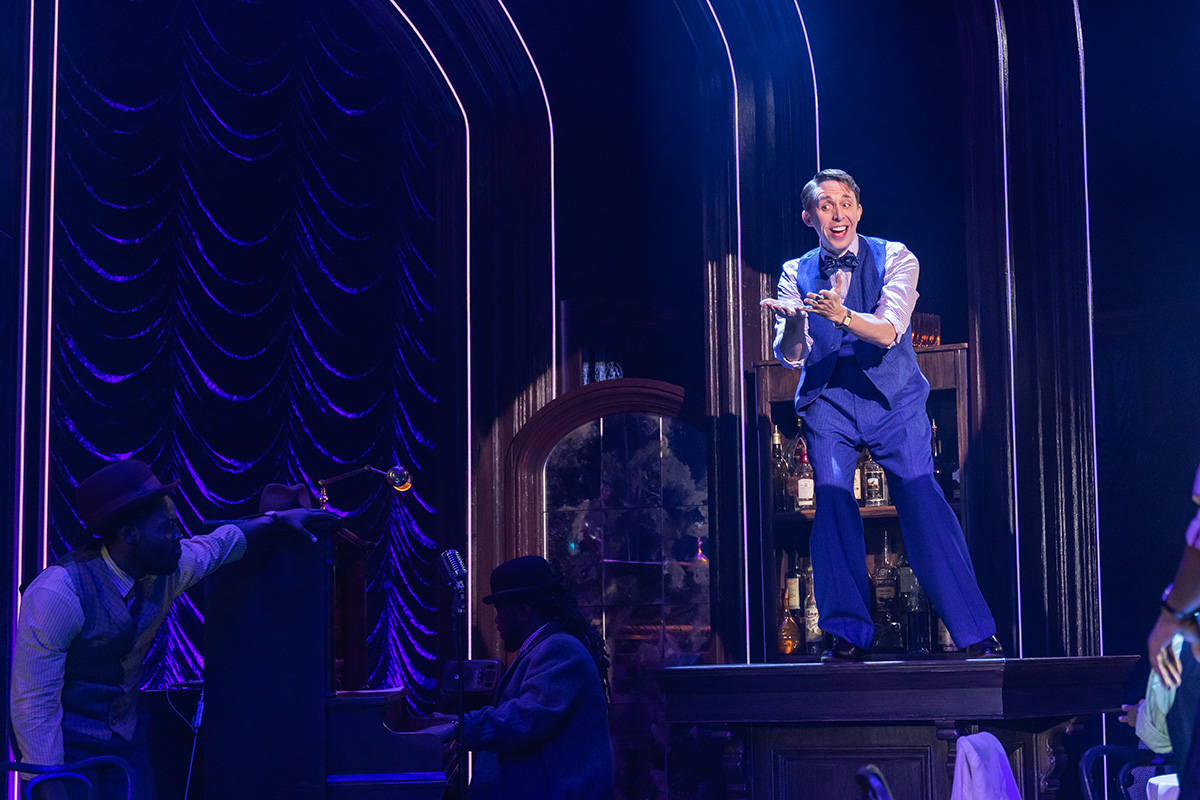
‘Chez Joey’
Through March 15
Arena Stage
1101 Sixth St., S.W.
Tickets start at $93
Arenastage.org
As Melvin Snyder in the new musical “Chez Joey,” out actor Kevin Cahoon plays a showbiz society columnist who goes by the name Mrs. Knickerbocker. He functions as a sort of liaison between café society and Chicago’s Black jazz scene circa 1940s. It’s a fun part replete with varied insights, music, and dance.
“Chez Joey” is adapted from the Broadway classic “Pal Joey” by Richard Rodgers and Lorenz Hart. It’s inspired by John O’Hara’s stories based on the exploits of a small-time nightclub singer published in The New Yorker.
A warm and humorous man, Cahoon loves his work. At just six, he began his career as a rodeo clown in Houston. He won the Star Search teen division at 13 singing songs like “Some People” from “Gypsy.” He studied theater at New York University and soon after graduating set to work playing sidekicks and comedic roles.
Over the years, Cahoon has played numerous queer parts in stage productions including “Hedwig and the Angry Inch,” “La Cage aux Folles,” “Rocky Horror” as well as Peanut in “Shucked,” and George the keyboardist in “The Wedding Singer,” “a sort of unicorn of its time,” says Cahoon.
Co-directed by Tony Goldwyn and the great Savion Glover, “Chez Joey” is a terrific and fun show filled with loads of talent. Its relevant new book is by Richard Lagravenese.
On a recent Monday off from work, Cahoon shared some thoughts on past and current happenings.
WASHINGTON BLADE: Is there a through line from Kevin, the six-year-old rodeo clown, to who we see now at Arena Stage?
KEVIN CAHOON: Anytime I want to land a joke in a theater piece it goes back to that rodeo clown. It doesn’t matter if it’s Arena’s intimate Kreeger Theatre or the big rodeo at the huge Houston Astrodome.
I was in the middle stadium and there was an announcer — a scene partner really. And we were doing a back and forth in hopes of getting laughs. At that young age I was trying to understand what it takes to get laughs. It’s all about timing. Every line.
BLADE: Originally, your part in “Chez Joey” Melvin was Melba who sings “Zip,” a clever woman reporter’s song. It was sort of a star feature, where they could just pop in a star in the run of “Pal Joey.”
CAHOON: That’s right. And in former versions it was played by Martha Plimpton and before her Elaine Stritch. For “Chez Joey,” we switched gender and storyline.
We attempted to do “Zip” up until two days before we had an audience at Arena. Unexpectedly they cut “Zip” and replaced it with a fun number called “I Like to Recognize the Tune,” a song more connected to the story.
BLADE: Wow. You must be a quick study.
CAHOON: Well, we’re working with a great band.
BLADE: You’ve played a lot of queer parts. Any thoughts on queer representation?
CAHOON: Oh yes, definitely. And I’ve been very lucky that I’ve had the chance to portray these characters and introduce them to the rest of the world. I feel honored.
After originating Edna, the hyena on Broadway in “The Lion King,” I left that to do “Hedwig and the Angry Inch” as standby for John Cameron Mitchell, doing one show a week for him.
Everyone thought I was crazy to leave the biggest musical of our time with a personal contract and getting paid more money that I’d ever made to get $400 a week at the downtown Jane Street Theatre in a dicey neighborhood.
At the time, I really felt like I was with cool kids. I guess I was. And I never regretted it.
BLADE: When you play new parts, do you create new backstories for the role?
CAHOON: Every single time! For Melvin, I suggested a line about chorus boys on Lakeshore Drive.
BLADE: What’s up next for Kevin Cahoon?
CAHOON: I’m about to do the New York Theatre Workshop Gala; I’ve been doing it for nine years in a row. It’s a huge job. I’ll also be producing the “Cats: The Jellicle Ball” opening on Broadway this spring; it’s a queer-centric uptown vogue ball with gay actor André de Shields reprising his role as “Old Deuteronomy.”
BLADE: There’s a huge amount of talent onstage in “Chez Joey.”
CAHOON: There is. I’m sharing a dressing room with Myles Frost who plays Joey. He won accolades for playing Michael Jackson on Broadway. We’ve become great friends. He’s a miracle to watch on stage. And Awa [Sal Secka], a D.C. local, is great. Every night the audience falls head over heels for her. When this show goes to New York, Awa will, no doubt, be a giant star.
BLADE: Do you think “Chez Joey” might be Broadway bound?
CAHOON: I have a good feeling it is. I’ve done shows out of town that have high hopes and pedigree, but don’t necessarily make it. “Chez Joey” is a small production, it’s funny, and audiences seem to love it.






Theater
José Zayas brings ‘The House of Bernarda Alba’ to GALA Hispanic Theatre
Gay Spanish playwright Federico García Lorca wrote masterpiece before 1936 execution
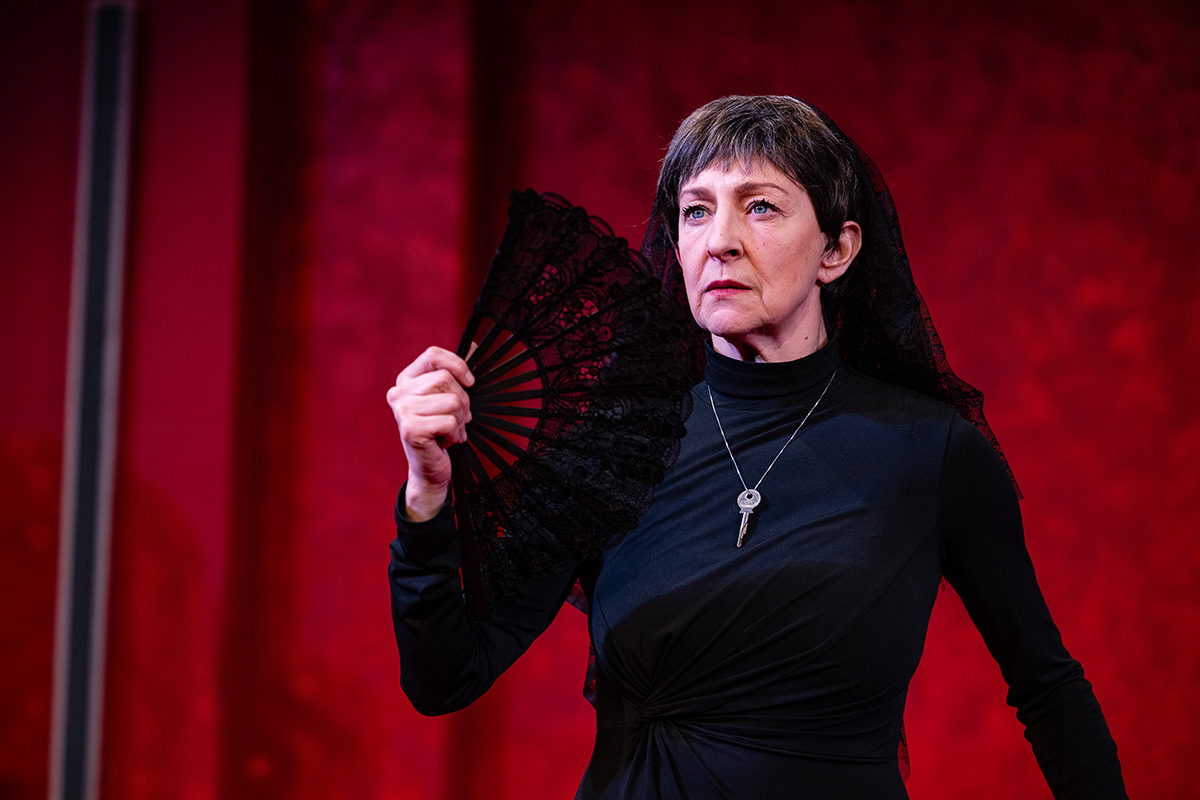
‘The House of Bernarda Alba’
Through March 1
GALA Hispanic Theatre
3333 14th St., N.W.
$27-$52
Galatheatre.org
In Federico García Lorca’s “The House of Bernarda Alba,” now at GALA Hispanic Theatre in Columbia Heights, an impossibly oppressive domestic situation serves, in short, as an allegory for the repressive, patriarchal, and fascist atmosphere of 1930s Spain
The gay playwright completed his final and arguably best work in 1936, just months before he was executed by a right-wing firing squad. “Bernarda Alba” is set in the same year, sometime during a hot summer in rural Andalusia, the heart of “España profunda” (the deep Spain), where traditions are deeply rooted and mores seldom challenged.
At Bernarda’s house, the atmosphere, already stifling, is about to get worse.
On the day of her second husband’s funeral, Bernarda Alba (superbly played by Luz Nicolás), a sixtyish woman accustomed to calling the shots, gathers her five unmarried daughters (ages ranging from 20 to 39) and matter-of-factly explain what’s to happen next.
She says, “Through the eight years of mourning not a breeze shall enter this house. Consider the doors and windows as sealed with bricks. That’s how it was in my father’s house and my grandfather’s. Meanwhile, you can embroider your trousseaux.”
It’s not an altogether sunny plan. While Angustias (María del Mar Rodríguez), Bernarda’s daughter from her first marriage and heiress to a fortune, is betrothed to a much younger catch, Pepe el Romano, who never appears on stage, the remaining four stand little chance of finding suitable matches. Not only are they dowry-less, but no men, eligible or otherwise, are admitted into their mother’s house.
Lorca is a literary hero known for his mastery of both lyrical poetry and visceral drama; still, “Bernarda Alba’s” plotline might suit a telenovela. Despotic mother heads a house of adult daughters. Said daughters are churning with passions and jealousies. When sneaky Martirio (Giselle Gonzáles) steals the photo of Angustias’s fiancé all heck kicks off. Lots of infighting and high drama ensue. There’s even a batty grandmother (Alicia Kaplan) in the wings for bleak comic relief.
At GALA, the modern classic is lovingly staged by José Zayas. The New York-based out director has assembled a committed cast and creative team who’ve manifested an extraordinarily timely 90-minute production performed in Spanish with English subtitles easily ready seen on multiple screens.
In Lorca’s stage directions, he describes the set as an inner room in Bernarda’s house; it’s bright white with thick walls. At GALA, scenic designer Grisele Gonzáles continues the one-color theme with bright red walls and floor and closed doors. There are no props.
In the airless room, women sit on straight back chairs sewing. They think of men, still. Two are fixated on their oldest siter’s hunky betrothed. Only Magdelena (Anna Malavé), the one sister who truly mourns their dead father, has given up on marriage entirely.
The severity of the place is alleviated by men’s distant voices, Koki Lortkipanidze’s original music, movement (stir crazy sisters scratching walls), and even a precisely executed beatdown choreographed by Lorraine Ressegger-Slone.
In a short yet telling scene, Bernarda’s youngest daughter Adela (María Coral) proves she will serve as the rebellion to Bernarda’s dictatorship. Reluctant to mourn, Adela admires her reflection. She has traded her black togs for a seafoam green party dress. It’s a dreamily lit moment (compliments of lighting designer Hailey Laroe.)
But there’s no mistaking who’s in charge. Dressed in unflattering widow weeds, her face locked in a disapproving sneer, Bernarda rules with an iron fist; and despite ramrod posture, she uses a cane (though mostly as a weapon during one of her frequent rages.)
Bernarda’s countenance softens only when sharing a bit of gossip with Poncia, her longtime servant convincingly played by Evelyn Rosario Vega.
Nicolás has appeared in “Bernarda Alba” before, first as daughter Martirio in Madrid, and recently as the mother in an English language production at Carnegie Melon University in Pittsburgh. And now in D.C. where her Bernarda is dictatorial, prone to violence, and scarily pro-patriarchy.
Words and phrases echo throughout Lorca’s play, all likely to signal a tightening oppression: “mourning,” “my house,” “honor,” and finally “silence.”
As a queer artist sympathetic to left wing causes, Lorca knew of what he wrote. He understood the provinces, the dangers of tyranny, and the dimming of democracy. Early in Spain’s Civil War, Lorca was dragged to the the woods and murdered by Franco’s thugs. Presumably buried in a mass grave, his remains have never been found.
Theater
Magic is happening for Round House’s out stage manager
Carrie Edick talks long hours, intricacies of ‘Nothing Up My Sleeve’

‘Nothing Up My Sleeve’
Through March 15
Round House Theatre
4545 East-West Highway
Bethesda, Md. 20814
Tickets start at $50
Roundhousetheatre.org
Magic is happening for out stage manager Carrie Edick.
Working on Round House Theatre’s production of “Nothing Up My Sleeve,” Edick quickly learned the ways of magicians, their tricks, and all about the code of honor among those who are privy to their secrets.
The trick-filled, one-man show starring master illusionist Dendy and staged by celebrated director Aaron Posner, is part exciting magic act and part deeply personal journey. The new work promises “captivating storytelling, audience interaction, jaw-dropping tricks, and mind-bending surprises.”
Early in rehearsals, there was talk of signing a non-disclosure agreement (NDA) for production assistants. It didn’t happen, and it wasn’t necessary, explains Edick, 26. “By not having an NDA, Dendy shows a lot of trust in us, and that makes me want to keep the secrets even more.
“Magic is Dendy’s livelihood. He’s sharing a lot and trusting a lot; in return we do the best we can to support him and a large part of that includes keeping his secrets.”
As a production assistant (think assistant stage manager), Edick strives to make things move as smoothly as possible. While she acknowledges perfection is impossible and theater is about storytelling, her pursuit of exactness involves countless checklists and triple checks, again and again. Six day weeks and long hours are common. Stage managers are the first to arrive and last to leave.
This season has been a lot about learning, adds Edick. With “The Inheritance” at Round House (a 22-week long contract), she learned how to do a show in rep which meant changing from Part One to Part Two very quickly; “In Clay” at Signature Theatre introduced her to pottery; and now with “Nothing Up My Sleeve,” she’s undergoing a crash course in magic.
She compares her career to a never-ending education: “Stage managers possess a broad skillset and that makes us that much more malleable and ready to attack the next project. With some productions it hurts my heart a little bit to let it go, but usually I’m ready for something new.”
For Edick, theater is community. (Growing up in Maryland, she was a shy kid whose parents signed her up for theater classes.) Now that community is the DMV theater scene and she considers Round House her artistic home. It’s where she works in different capacities, and it’s the venue in which she and actor/playwright Olivia Luzquinos chose to be married in 2024.
Edick came out in middle school around the time of her bat mitzvah. It’s also around the same time she began stage managing. Throughout high school she was the resident stage manager for student productions, and also successfully participated in county and statewide stage management competitions which led to a scholarship at the University of Maryland, Baltimore County (UMBC) where she focused on technical theater studies.
Edick has always been clear about what she wants. At an early age she mapped out a theater trajectory. Her first professional gig was “Tuesdays with Morrie” at Theatre J in 2021. She’s worked consistently ever since.
Stage managing pays the bills but her resume also includes directing and intimacy choreography (a creative and technical process for creating physical and emotional intimacy on stage). She names Pulitzer Prize winning lesbian playwright Paula Vogel among her favorite artists, and places intimacy choreographing Vogel’s “How I learned to Drive” high on the artistic bucket list.
“To me that play is heightened art that has to do with a lot of triggering content that can be made very beautiful while being built to make you feel uncomfortable; it’s what I love about theater.”
For now, “Nothing Up My Sleeve” keeps Edick more than busy: “For one magic trick, we have to set up 100 needles.”
Ultimately, she says “For stage managers, the show should stay the same each night. What changes are audiences and the energy they bring.”
Theater
‘Octet’ explores the depths of digital addiction
Habits not easily shaken in Studio Theatre chamber musical

‘Octet’
Through Feb. 26
Studio Theatre
1501 14th Street, N.W.
Tickets start at $55
Studiotheatre.org
David Malloy’s “Octet” delves deep into the depths of digital addiction.
Featuring a person ensemble, this extraordinary a capella chamber musical explores the lives of recovering internet addicts whose lives have been devastated by digital dependency; sharing what’s happened and how things have changed.
Dressed in casual street clothes, the “Friends of Saul” trickle into a church all-purpose room, check their cell phones in a basket, put away the bingo tables, and arrange folding chairs into a circle. Some may stop by a side table offering cookies, tea, and coffee before taking a seat.
The show opens with “The Forest,” a haunting hymn harking back to the good old days of an analog existence before glowing screens, incessant pings and texts.
“The forest was beautiful/ My head was clean and clear/Alone without fear/ The forest was safe/ I danced like a beautiful fool / One time some time.”
Mimicking an actual step meeting, there’s a preamble. And then the honest sharing begins, complete with accounts of sober time and slips.
Eager to share, Jessica (Chelsea Williams) painfully recalls being cancelled after the video of her public meltdown went viral. Henry (Angelo Harrington II) is a gay gamer with a Candy Crush problem. Toby (Adrian Joyce) a nihilist who needs to stay off the internet sings “So anyway/ I’m doing good/ Mostly/ Limiting my time/ Mostly.”
The group’s unseen founder Saul is absent, per usual.
In his stead Paula, a welcoming woman played with quiet compassion by Tracy Lynn Olivera, leads. She and her husband no longer connect. They bring screens to bed. In a love-lost ballad, she explains: “We don’t sleep well/ My husband I/ Our circadian rhythms corrupted/ By the sallow blue glow of a screen/ Sucking souls and melatonin/ All of my dreams have been stolen.”
After too much time spent arguing with strangers on the internet, Marvin, a brainy young father played by David Toshiro Crane, encounters the voice of a God.
Ed (Jimmy Kieffer) deals with a porn addiction. Karly (Ana Marcu) avoids dating apps, a compulsion compared to her mother’s addiction to slot machines.
Malloy, who not only wrote the music but also the smart lyrics, book, and inventive vocal arrangements, brilliantly joins isolation with live harmony. It’s really something.
And helmed by David Muse, “Octet” is a precisely, quietly, yet powerfully staged production, featuring a topnotch cast who (when not taking their moment in the spotlight) use their voices to make sounds and act as a sort of Greek chorus. Mostly on stage throughout all of the 100-minute one act, they demonstrate impressive stamina and concentration.
An immersive production, “Octet” invites audience members to feel a part of the meeting. Studio’s Shargai Theatre is configured, for the first, in the round. And like the characters, patrons must also unplug. Everyone is required to have their phones locked in a small pouch (that only ushers are able to open and close), so be prepared for a wee bit of separation anxiety.
At the end of the meeting, the group surrenders somnambulantly. They know they are powerless against internet addiction. But group newbie Velma (Amelia Aguilar) isn’t entirely convinced. She remembers the good tech times.
In a bittersweet moment, she shares of an online friendship with “a girl in Sainte Marie / Just like me.”
Habits aren’t easily shaken.

Love or fear flying you’ll devour ‘Why Fly’

Out actor Kevin Cahoon on starring role in ‘Chez Joey’

PHOTOS: Pride Reveal

Comings & Goings

Kansas passes bathroom bounty hunter bill

Va. activists preparing campaign in support of repealing marriage amendment

Two very different views of the State of the Union

The global cost of Trump’s foreign aid ideology

Moving doc ‘Come See Me’ is more than Oscar worthy

Criteria for supporting a candidate in D.C.
-

 Virginia4 days ago
Va. activists preparing campaign in support of repealing marriage amendment
-
Federal Government4 days ago
Two very different views of the State of the Union
-
Opinions4 days ago
The global cost of Trump’s foreign aid ideology
-
Movies3 days ago
Moving doc ‘Come See Me’ is more than Oscar worthy