Bars & Parties
Goin’ to the chapel
Maybe it’s because they already lived together. Maybe it’s because they were already registered as domestic partners. Or it could just be that they were in their 30s. But for two D.C. same-sex couples planning to take advantage of the District’s newly won marriage law — set to take effect next month barring congressional intervention — popping the proverbial question was more of a logical progression in a series of ever-increasing commitments as opposed to a starry-eyed shock.
Both couples were making plans before Mayor Adrian Fenty signed the Council-approved same-sex marriage bill in December. Aisha Mills, 32, and her partner of six years, Danielle Moodie, 30, have lived together for four years in Columbia Heights and started thinking marriage last May when the Council passed a measure recognizing same-sex marriages performed in other jurisdictions.
“It was a little bit of happenstance that our engagement coordinated with that,” Mills says. “As we thought about picking a date, we weren’t realizing that D.C. would have marriage soon.”
The two, who met through mutual friends at Chaos, planned to wed in Connecticut, where same-sex marriage is legal, then have it recognized in Washington.
By the time Paul Heins, 36, asked Matt DelNero, 33, to marry him at Blue Duck Tavern in D.C.’s west end in August, 2008, they were on their second home and had been together about eight years.
“Paul asked me just after my birthday and of course I said yes,” DelNero says. “At this point there was no doubt. We’d already established a life, bought a condo, he got me a ring, then I followed up later with a ring for him.”
The two met in 2001. DelNero, a telecommunications attorney, was in law school in Boston but spent the summer of 2001 in Washington. He went on a date with a friend of Heins’ but they didn’t hit it off. He soon met Heins, a musician, and the possibility for something long term became apparent.
“Not to sound corny, but we knew pretty quickly that we had each found the one,” DelNero says. “Everything proceeded quite naturally from that.”
Their first two years together were long distance. Twice monthly they’d take turns visiting each other in Boston and Washington. Those were happy but also slightly frustrating times.
“Those were the first two years of our relationship so there’s always that va va va voom factor,” Heins says. “It made those weekends all the more special and passionate and exciting.”
“But it also put pressure on those times because you wanted it all to work out,” DelNero says. “You wouldn’t want to squabble on those days.”
Living in the same town and house made sense, they say.
“It just got sort of more natural and normal being in the same space,” DelNero says.
“It’s nice,” Heins adds, “to be able to enjoy each other every day.”
Marriage options increased over time. In the early years after Massachusetts legalized same-sex marriage, it wasn’t an option for out-of-state couples. That eventually changed and the couple considered marrying there and, like Mills and Moodie, having it recognized in D.C. But getting married at home is more meaningful, both couples say.
“We were there when Council voted and it was extremely exciting,” Moodie, who works for New York Mayor Michael Bloomberg, says. “That 11 of the members had voted for marriage was extremely exciting and not at all surprising because D.C. is very progressive … we were thrilled to be able to get married at home.”
DelNero and Heins had been exploring venues in Massachusetts when D.C. approved its new law.
“We feel lucky and excited to get married in our own jurisdiction,” Heins says.
Mills is the president of the Campaign for All D.C. Families and was active in the effort to secure same-sex marriage rights in Washington. She’d previously worked for Human Rights Campaign. She’s confident the law will go into effect as expected in March.
“We have certainly done our due diligence with our friends on Capitol Hill,” she says. “They’ve repeatedly told us they support home rule and there’s no sign of any real energy in supporting any type of intervention on Capitol Hill.”
DelNero and Heins weren’t directly involved, though they’ve donated money to activist causes.
“We’re very aware that we’re benefitting from other people’s hard work and we’re grateful for that,” DelNero says.
Neither couple has chosen a date but both say their weddings will be sometime this year. Mills and Moodie plan to get legally married in D.C. but have a small ceremony in Long Island, where Moodie’s from. They’re thinking late spring/early summer. They’re not religious but will have an interfaith minister preside. They each plan to wear gowns and have a maid of honor but not a large wedding party. They’re writing their own vows.
“For us it’s really important for our wedding to be a reflection of our lives together,” Moodie says. “So yes, we’ll have a small bridal party but not in cookie cutter dresses and outfits following us around. It will be people who’ve been really instrumental in our relationship being successful. We’re very involved in how we want our ceremony to look. Not, ‘Do you take so-and-so,’-insert-name-here-type of ceremony. It will be very much created for the two of us.”
DelNero and Heins joke that their engagement has been prolonged because there’s no bride to take over the planning. They recently started attending a Lutheran church near their Beekman Place residence but aren’t sure if they’ll get married there or at another church. They can’t remember offhand what all they’ve discussed.
“Oh, what we’re going to wear. We talked about that a little, didn’t we Paul?,” DelNero says. “I think we said simple elegant suits rather than tuxes.”
Heins says he likes the thought of getting a new suit but says it’s not as important as who’s there.
They slip into finishing-each-other’s-sentences-mode when describing their ceremony.
“We do know it will be a relatively small gathering,” DelNero says. “We’ve been to a lot of weddings that …” He pauses to think of the right word and Heins finishes — “That have been ostentatious,” Heins says.
“The ones we’ve really enjoyed have been the celebrations of couples with their family and friends that aren’t so much … ” DelNero says, “… the glitz and glamour,” Heins interjects, “… overdone and, how to put it, overstated,” DelNero finishes. “But meaningful,” Heins adds.
They’re forgoing a gift registry and asking for donations to charity instead. They also say they feel guilty spending a lot of money to rent a large reception hall.
“We would like it to be simple,” Heins says. “Not cheap, but not so outrageous that it’s out of context with our lives in the world.”
The couples also agree that domestic partnerships didn’t cut it for them even though many of the legal rights are the same.
“Everyone knows what marriage means,” Moodie says. “You walk in a store with a wedding band and say, ‘No, I’m DP’ed, it means this, it means that. I still have to make adjustments but everybody knows the weight, recognition and value that comes with marriage.”
“We tried separate but equal before and we know it doesn’t work,” Mills says.
Entering a domestic partnership was anticlimactic for the men.
“What’s funny is we both met at an office at lunchtime in this stark room,” Heins says. “We signed some paper, said, ‘OK,’ and went on our separate ways. I don’t think we even had lunch together.”
“It certainly didn’t feel like a marriage and we didn’t treat it like one,” DelNero says.
Ultimately, though, it’s love that drives these relationships.
Moodie says “a lot of compromise” has sustained her relationship with Mills, who calls it “a genuine partnership.”
“We just knew early on this was it for the two of us. We were head-over-heels in love, knew this was our feeling and were ready for the ultimate commitment,” Mills says.
“It’s hard to put into words or define something that just fits,” DelNero says.
“There are just so many things we do together that really work for us,” Heins says. “The times we’re silly, the times we’re serious, the kinds of jokes we tell, the silly voices we use, the kinds of things I see other couples interact and I don’t necessarily see that, though maybe they have their own little quirks and things. When Matt and I are together, it’s like our language, verbal and nonverbal.”
Bars & Parties
Lesbian Bar Project co-founder: purity politics could destroy our remaining spaces
Last Ditch’s decision to lift its mask requirement for one night a week has sparked intra-queer controversy

Uncloseted Media published this story on Sept. 29
By ERICA ROSE and THE LESBIAN BAR PROJECT | As a professional lesbian and Massachusetts native, I’ve recently been asked by a lot of folks what I think about the saga unfolding at Last Ditch. The now-viral story, first reported by the Boston Globe, centers on a Western Massachusetts lesbian bar that lifted its mask requirement for one night a week to help drum up business.
The decision ignited an intra-queer controversy that has been feasted on by media outlets across the political spectrum — from the New York Post to LGBTQ Nation — and is even reportedly being eyed for a Hollywood adaptation. Apparently nothing is more entertaining than a bunch of lesbians and queers fighting with each other over KN-95s.
What has been lost in all of the chatter and media coverage is the very real possibility that Last Ditch, which just opened in April 2025, will have to close its doors. The venue’s one remaining founder, Jackie Matellian, revealed in a community Zoom meeting that she’s working four jobs, is now solely responsible for the bar’s $50,000 business loan and is struggling to keep up with the bills. So as we laugh about the controversy’s similarity to a “Portlandia” skit and how one of the bar’s founders left to enroll in clown school, we forget that yet another lesbian bar is facing an existential crisis — and this time the call is coming from inside the house.
In 2020, my friend Elina Street and I created The Lesbian Bar Project, an Emmy-, Webby- and GLAAD Media Award-winning docuseries and initiative that tells the stories of lesbian queer bars around the world. We were moved to act because at the time there were only an estimated 16 lesbian bars in the United States, and the pandemic threatened to bring that number down even further.
There are now more sapphic bars than there were just before the pandemic — about 36 of them in total — but this is down from approximately 200 in 1980. Maybe that doesn’t mean much to you, but for the millions of sapphics living in the U.S., this number is calamitous.
As the world laughs at lesbians and sapphics, I want to take a second and tell you what I feel when I walk into one of these bars, which are all unique and irreplaceable in their own way: I feel seen.
Sometimes I think Cubbyhole in New York City’s West Village neighborhood knew I was gay before I did. When I walked in there for the first time, before I was even out, I was transfixed by the colorful array of tchotchkes hanging from the ceiling and how the women standing next to me were completely unafraid to express their desire for one another. I knew the minute I was ready to come out, I had a home. I also felt the joy of a new couple falling in love at Seattle’s Wildrose, the quiet confidence of a short king lining up her shot at the pool table at Ginger’s in Brooklyn and the kick of cayenne pepper in Julie Mabry’s crawfish at Houston’s Pearl Bar.
Lesbian bars don’t just serve lesbians; they serve queer folks across the spectrum, including bisexual, pansexual and trans people. As Elina and I traveled across the U.S. and Europe and to parts of Latin America to document the bar owners, staff and patrons that make up the ecosystems of these spaces, we also became uniquely acquainted with the factors that threaten their existence: gentrification, wage gaps, sexism, environmental disasters, gun violence, rising insurance premiums and political administrations working to annihilate queer people and their families.
Lesbian bar owners, like all leaders and entrepreneurs, are imperfect. There have been significant issues over the years at lesbian bars: employee harassment, racism, lack of accessibility, sexual assault and transphobia. All bar owners should be held accountable and should listen to their communities to evolve into safer and more equitable spaces. I also acknowledge my privilege: I am able-bodied, white, cis and from a family system that loves me for who I am. Not everyone has that.
Queer people, especially trans and bisexual people, are suffering from disproportionately high levels of depression, and our mental health system isn’t equipped to support them. Immunocompromised people and long COVID are real, and many of my friends are suffering to this day. The people with the least safety net are often the ones for whom a bar closing costs the most. And yet, as we’re seeing with Last Ditch, the queer community often lashes out at each other. It’s also the mainstream media taking the internal conflict and making a mockery out of it, distracting from the real possibility that this bar could close due to financial pressures. A bar that many people loved and needed is facing extinction. Perhaps it’s safer to dissent with one another than with the larger forces trying to eradicate us, but in doing so, we risk destroying the few spaces we have left.
Due to the constraints of purity politics — some in good faith, some not so much — lesbian bar owners, almost all of whom are queer women themselves, are forced to be everything for everyone, similarly to how women are forced to be everything for everyone. By asking these bars to uphold impossible standards — standards very few other third spaces are asked to consider — we all end up losing.
I want to move as a community toward dialogue, compassionate dissent and collaboration to make our spaces better with the goal of keeping them OPEN and thriving, rather than destroying them from the inside with expectations that are arguably unattainable.
While I have your attention — for this fleeting second of the news cycle — may I urge us to spearhead a way to keep these small businesses afloat without attacking our own community along the way? Bar owners are left with an impasse: They want to be community-centered, but they also have to make money to keep their doors open. Sometimes they might make business decisions that don’t work for everyone — and that’s partly because different patrons have different priorities and want different things — but these owners deserve the opportunity for productive dialogue. We have to work with them and with each other to keep our spaces open, to keep them growing.
Lesbian bars raised me into the queer woman I am today. One thing I think about as I reflect on the six years of work we’ve done to document these spaces is that shared, unspoken language I have with a stranger the moment we both walk into one of these bars: the nod, the ease, the not having to explain ourselves. I don’t want to lose that, and neither should you.
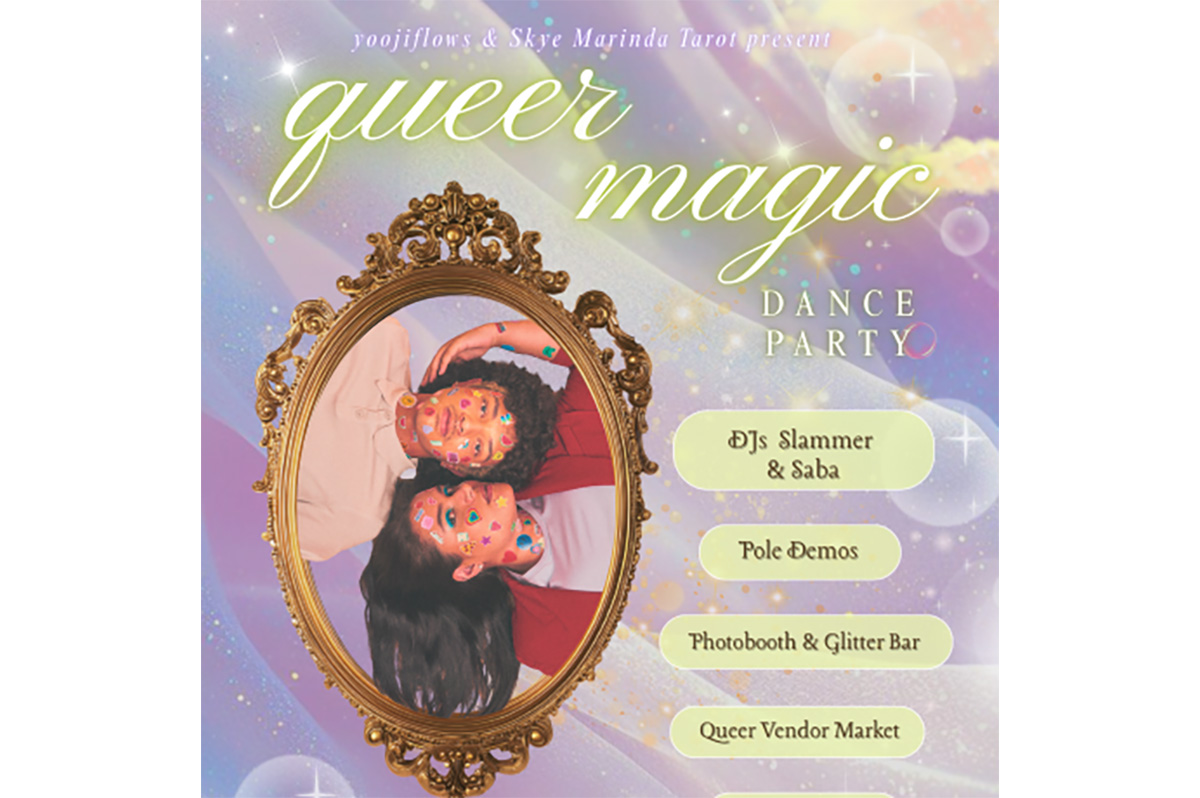
Celebrate the start of Pride month at the Queer Magic Dance Party at the Black Cat on Saturday, June 6. Doors open at 9 p.m.
There will be pole performances and demonstrations, a free photo booth with glitter bar, a queer vendor market, tarot readings by Skye Marinda Tarot, a drag performance by Sapphica, and dancing to a blend of smooth R&B, Afrobeats, hip-hop and pop by Slammer & Saba. Tickets are $20 at the door or $15 (plus fees) in advance, purchased here.
Bars & Parties
Here’s where to watch ‘RuPaul’s Drag Race’ with fellow fans
Entertainers TrevHER and Grey host event with live performance

Spark Social Events will host “Ru Paul’s Drag Race S18 Watch Party Hosted by Local Drag Queens” on Friday, Jan. 23 at 8 p.m.
Drag entertainers TrevHER and Grey will provide commentary and make live predictions on who’s staying and who’s going home. Stick around after the show for a live drag performance. The watch party will take place on a heated outdoor patio and cozy indoor space.
This event is free and more details are available on Eventbrite.

In ‘The Lost Brontë,’ a complicated lie can lead to danger

CAMP Rehoboth Block Party returns Oct. 18

Essential queer horror classics for Halloween

Solidarity beyond the parade: the actual cost of Pride

Physician: addiction doesn’t always look the way you think it does

Bessent says Trump chose him for his qualifications, not his sexuality

10 years later, we still can’t shake Barry Jenkins’s ‘Moonlight’

‘Some Like It Hot’ a wild ride at renovated Bernard Family Theatre

D.C.’s LGBTQ homeless facilities face possible hit from Trump funding cuts

Trump uses anti-trans slur against Democratic Senate candidate
-

 Federal Government5 days ago
Bessent says Trump chose him for his qualifications, not his sexuality
-
Movies4 days ago
10 years later, we still can’t shake Barry Jenkins’s ‘Moonlight’
-
Theater4 days ago
‘Some Like It Hot’ a wild ride at renovated Bernard Family Theatre
-
District of Columbia4 days ago
D.C.’s LGBTQ homeless facilities face possible hit from Trump funding cuts