National
Romney wins big in New Hampshire
Takes lead in South Carolina polls
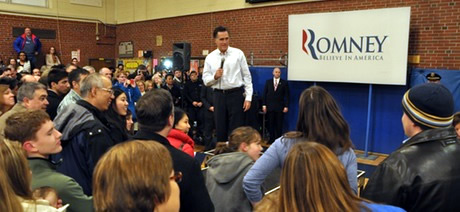
MANCHESTER, N.H. — Former Massachusetts Gov. Mitt Romney earned his second victory in the race for the Republican presidential nomination on Tuesday by trouncing his competition in the New Hampshire primary.
Romney finished with 39.4 percent of the vote. Second place finisher, libertarian Rep. Ron Paul (R-Texas), had 22.8 percent. Media outlets declared Romney the winner shortly after polls closed in the evening, unlike in Iowa, where a winner wasn’t declared until the wee hours of the morning.
Former Utah Gov. Jon Huntsman, Jr., came in third with 16.8 percent of the vote.
Standing before his family during a victory speech at Southern New Hampshire University, Romney accused President Obama of having run out of ideas and excuses in his leadership of the country.
“We still believe in the hope, the promise, and the dream of America,” Romney said. “We still believe in the shining ‘City on the Hill.’ We know that the future of this country is better than that 8 or 9 percent unemployment. It’s better than $15 trillion in debt. It’s better than the misguided and broken promises of the last three years, and the failed leadership of one man. The president has run out of ideas; now he’s running out of excuses.”
Romney concluded by looking to the next contest in South Carolina, saying, “Tonight, we’re asking the good people of South Carolina to join the citizens of New Hampshire and make 2012 the year he runs out of time.”
Former U.S. House Speaker Newt Gingrich finished fourth with 9.4 percent of the vote; former U.S. Sen. Rick Santorum was close behind in fifth place with 9.3 percent.
Santorum encountered an unfavorable reaction from some New Hampshire residents at his town hall meetings for stating his opposition to same-sex marriage. In one town hall, he said children would be better off having parents in prison rather than having parents of the same gender. Prior to his final campaign appearance in New Hampshire, Santorum was denounced as a “bigot” by Occupy protesters.
Gingrich also came under media scrutiny for incorrectly stating during a debate that the legalization of same-sex marriage in Massachusetts and D.C. “forced” the Catholic Church to close charitable services in those places. The church had volunteered to close those services.
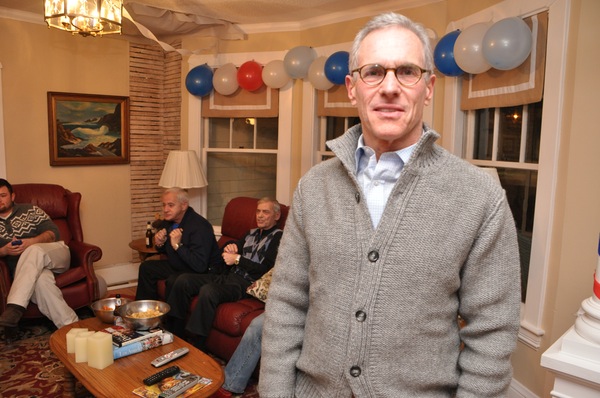
Gay Republican presidential candidate Fred Karger at his N.H. victory party (Blade photo by Michael Key)
Gay GOP candidate Fred Karger — considered a long shot in the race — had earned 294 votes in the New Hampshire primary late Tuesday as results were still being tabulated.
Reflecting on his showing, Karger told the Washington Blade, “I’ve done this on my own. I’ve gotten no help from any organization or big donors.”
Karger said he’s setting his sights now on the Michigan primary, which will take place on Feb. 28. Karger, who touts himself as the only presidential candidate who supports full equality for LGBT people, said he’ll be one of 11 Republicans on the ballot and thinks he could be in a position take part in a debate for that primary.
Romney’s win could be significant because no other non-incumbent Republican candidate since the modern primary system was established has won the contests in Iowa and New Hampshire. According to recent polls, Romney is also polling in the lead in South Carolina, where the next primary will take place next week.
The decisive win for Romney in New Hampshire also stands in contrast to his extraordinarly narrow win in Iowa, where he claimed victory over Santorum by a margin of eight votes.
None of the candidates that Romney beat in the primary announced they would end their race on Tuesday. Despite his third place win, Huntsman vowed to continue his campaign to South Carolina, although polls have him in single digits in the more conservative state.
Gay conservatives lauded Romney for his victory and said the win helps cement Romney as the GOP nominee who’ll take on Obama in the general election.
R. Clarke Cooper, executive director of the Log Cabin Republicans, said the “definitive victory” for Romney in New Hampshire — coupled with the candidate’s win in Iowa — shows he can “unite Republicans and is a clear threat to Barack Obama in November.”
On Romney’s positions on LGBT issues, Cooper recalled remarks in recent debates in which Romney said he supports “full rights” for gay Americans.
“While he continues to support a constitutional amendment banning marriage equality — a position Log Cabin strongly opposes — he is also on record saying that such an amendment has been tried, rejected and is unlikely to ever succeed,” Cooper said. “Romney has also taken a position that the repeal of ‘Don’t Ask, Don’t Tell’ has been settled, and he would not seek to reinstitute the ban on open service.”
Jimmy LaSalvia, executive director of GOProud, said Romney’s win demonstrates that his message of “economic renewal for America is resonating with Republican voters across the country.”
“Governor Romney’s win tonight is good news for all Americans – both gay and straight – struggling to make ends meet in this failed Obama economy and bad news for the president’s re-election prospects,” LaSalvia said.
LaSalvia endorsed Romney in an op-ed piece published last week in the Daily Caller, citing economic and tax policy as reasons to support the candidate. The endorsement was a personal one, and not on behalf on GOProud.
Cooper also praised Paul, saying his second-place showing “underscores New Hampshire’s commitment to the libertarian principles he has consistently championed,” and Huntsman for having “frequently talked about the need for Americans to do more for gay rights.”
But Jerame Davis, executive director of the National Stonewall Democrats, said political observers shouldn’t anoint Romney as the Republican presidential nominee.
“Romney’s prospects are looking up, but he hasn’t clinched the nomination by any means,” Davis said. “Keep in mind, this is only the second contest of many and more than 60 percent of the GOP vote went to someone other than Romney.”
Davis said Romney’s failure to win a majority of the vote demonstrates that the GOP is unable to get behind the candidate.
“Republicans just can’t get excited about him even if they ultimately accept him as their nominee, but can you blame them?” Davis said. “He’ll say anything to get elected. Just look at the way he’s pandered to LGBT voters and then disavowed having ever done so and you get a taste of his lack of conviction.”
Davis was referring to a 2002 Pride flier from Romney’s gubernatorial campaign promising equal rights that was disavowed by his presidential campaign after the candidate said during a debate Saturday he supports full rights for gay people.
The anti-gay National Organization for Marriage also praised Romney.
Brian Brown, NOM’s president, called Romney’s win “an impressive victory” and said the candidate’s opposition to same-sex marriage makes him an ideal candidate.
“We commend Mitt Romney on his impressive victory tonight in New Hampshire, adding to his delegate total following his victory in Iowa,” Brown said. “Mr. Romney has signed NOM’s pledge to take specific actions as president to defend traditional marriage. He has also called for the repeal of same-sex marriage in New Hampshire. Voters rewarded him and we congratulate Mr. Romney on his well-earned victory.”
Romney is among the Republican presidential candidates who’s signed NOM’s pledge to oppose same-sex marriage if elected president. Among other things, signing the document commits the candidate to back a Federal Marriage Amendment and to defend the Defense of Marriage Act in court.
NOM makes no mention in its statement of Paul’s second place showing. The organization had undertaken a $50,000 ad campaign to alert voters to the candidate’s opposition to the Federal Marriage Amendment and belief that government should get out of marriage. NOM had criticized Paul for his third place showing in Iowa after earlier polls showed him doing better there.

National
Remembering Barbara ‘Boo’ Price, a pioneering force in women’s music
Key organizer behind Michigan Womyn’s Music Festival
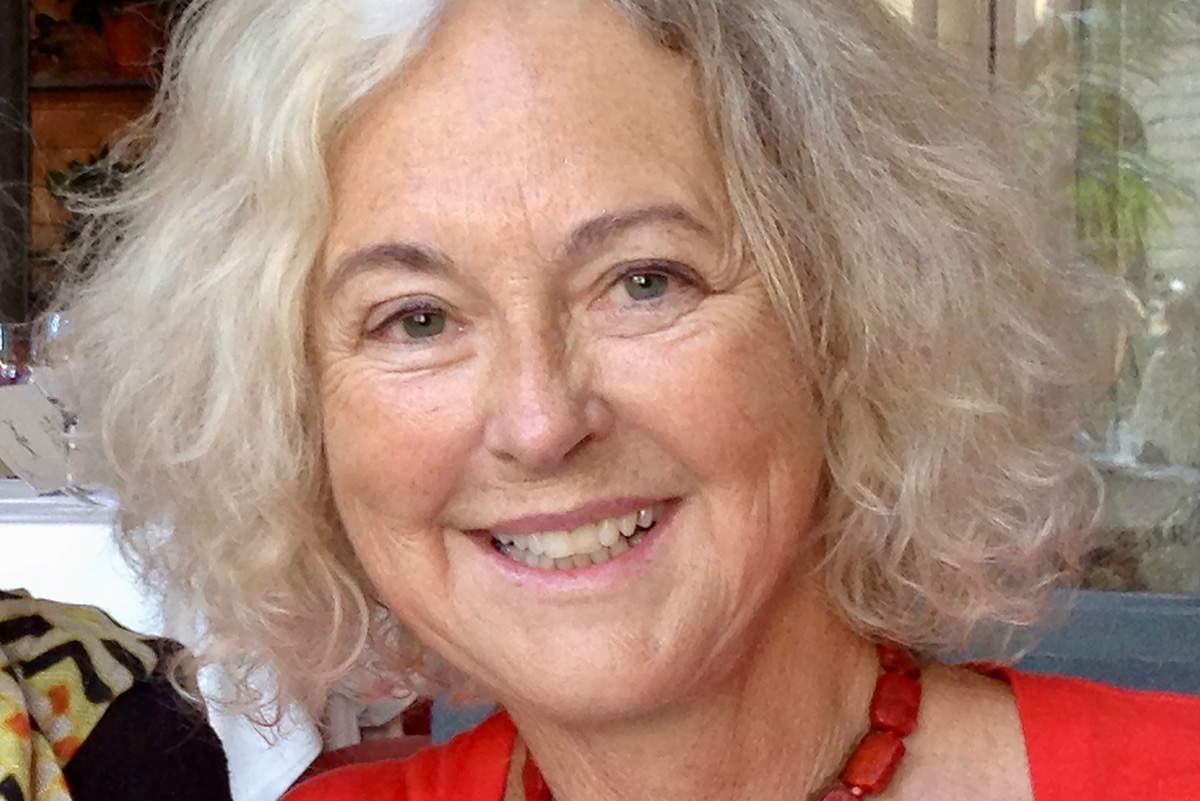
Barbara (“Boo”) Easter Price, a pioneering figure in the women’s music movement, died Tuesday, Aug. 4 in Oakland, Calif. Price produced some of the earliest women’s music concerts as a new lesbian-feminist culture was taking shape, and was a driving force behind the Michigan Womyn’s Music Festival which ran from 1976 to 2015 – a flagship event in the movement, and the largest women’s music festival in North America. Price was 82.
“Her vision from the very beginning was how complex and how wide the whole phenomenon of women’s music could be, and how far we could carry it beyond the multi-purpose rooms and church basements into Town Hall and the Palace of Fine Arts and major media,” says singer-songwriter Margie Adam, for whom Price served as manager, agent, producer and attorney from 1975 to 1984, and, for part of that time, her romantic partner.
“I think when she heard Cris Williamson, Vicki Randle and me sing at the Embassy Theater in 1974, she grasped that this thing we were just beginning to call women’s music could actually be a soundtrack for the women’s liberation movement – that it could be an activator and a healing, empowering tool.”
Arguably, nowhere was that emerging culture of music, feminism and community more fully realized than at the Michigan Womyn’s Music Festival.
At its peak, 8,000 women, predominantly lesbians, came from around the world to gather for a week in August. Camping, music, dance performances, workshops and the requisite tofu and beans were just a few of the innumerable offerings in this rite of passage for a generation of lesbians in a time when there were few safe and free environments available.
Alicia Davis of Michigan remembers the festival foremost for its sense of community. “The feeling of not having to make myself smaller to fit into the world, but rather the feeling that I could be happy, loud and share my opinions and feel valued, even when there were disagreements among people,” she says. “There was a shared respect that I didn’t feel outside of the festival walls. The festival shaped what I thought women could do in the world, the entire camp was made by women: electricians, plumbers, cooks, carpenters, singers, artists of every stripe… “
The sense of shared experience followed women long after they left “the land.”
In the 1980s, drivers across the U.S. would exchange knowing glances when passing a car with the familiar “See you in August!” bumper sticker. It was the original IYKYK.
The Festival was also an important showcase for emerging and established musicians, including Holly Near, Meg Christian, Tracy Chapman, Indigo Girls and Ani DiFranco. The list of alumni is vast and stretches across genres from classical to Afro-centric percussion. To name just a few: Casselberry-DuPree, Phranc, Heather Bishop, Ubaka Hill, big band Deuce, flutist Kay Gardner, Edwina Lee Tyler, Lynn Breedlove-fronted punk band Tribe 8, pianist Mary Watkins, and Cultural Heritage Choir founder Linda Tillery who remembers Boo as the big sister she never had.
“I could go to her with anything, and she would listen and give counsel. She was always supportive of me and usually right,” the singer and arranger says.
And while Michigan wasn’t the only festival in the country, it inspired people like marriage equality activist and comedian Robin Tyler who attended Michigan because of Price, and went on to produce her own West Coast music and comedy festivals, as well as the main stage for three Marches on Washington.
“My last memory of Boo was not about Boo Price, the producer or the magician that could create everything,” says Tyler who was also Price’s lover for a time. “It was how lucky I was to have had her in my life at all, and that we were able to love each other and share. She was one of the most influential people of my life.”
Price’s talents were evident across the festival’s sprawling operation which relocated several times over its 40-year existence. In 1982, together with one of the original founders, Lisa Vogel, Price purchased the land that would become the festival’s permanent 650-acre home near Hart, Michigan; in 1983, she became a co-owner and co-producer, a role she held until the two parted ways in 1994.
From 1976–1994, Price was involved in many aspects of the Michigan Womyn’s Music Festival. But her prowess as producer was perhaps most visible at the Night Stage. Her contemporaries have vivid memories of an opening ceremony with an aerialist swinging on a trapeze from an oak tree, while jazz artist Rhiannon performed on vocals.
“Sometimes it started with a parade or a procession and percussion, and sometimes there were stilt walkers – and so there was always this production about you as you were coming to Night Stage,” remembers Sändra Washington, who performed with her twin sister Sharon as the Washington Sisters. As a performer, Washington recalled the wall of energy rushing at her from the audience.
“It was her desire to create a thing, a space, an event that was really magnificent – and that showed in everything she did, whether or not she was organizing a tour, or she was organizing a party, or events at the [Montclair] club,” says Washington. “Boo really specialized in creating a whole vibe around the event, the space, the production, so that you felt something special when you came into a space that Boo had created.”
“There was never a space that felt as positive, overwhelming, and energetic as the crowd at Michigan.”
Kathryn A. Willmore, co-founder of feminist journal Sojourner, remembers how Michigan grew into something bigger than anticipated – and how instrumental Price was in elevating the rudimentary systems needed to support it. One year, Willmore brought copies of Sojourner to the festival, hoping to connect with other people publishing women’s papers. “But there was no system for communicating any of that really. So I just tacked a note on a tree of that location, and there were about 30 of us that came together.”
Price, Willmore says, helped put systems in place, articulate a vision, and bring in people who could then carry it forward.
“Boo really empowered so many women in so many dimensions. I think that is one of the overarching themes of her life, and certainly in music production… and her confidence was infectious. So people who had never done something grew into becoming experts. I think that she inspired and empowered.”
Willmore first met Price in 1961 at Mt. Holyoke just after the women arrived for the start of college. “There were all these girls in this half-empty dorm in the middle of a hurricane, and Boo started going around to everyone’s room to introduce herself. Then she got to my room… and that was the beginning of this lifelong friendship.”
The importance of what Price created cannot be overstated, nor the reach and durability of the connections formed in the space she helped build.
Just last month, a French woman found this writer on Instagram 40 years after the Festival and claimed I invited her into my tent. We have been corresponding since this improbable reconnection (though the question of who did the inviting is under dispute):
Emmanuelle Gachet, now a writer and professor at Université de Nantes, reflects on her experience:
“In 1986, I step onto an island populated by six thousand women. I come from France, from a rural area, and I am twenty years old. Never before have I felt such a powerful energy. Here, lesbianism is the norm. I don’t have to justify my place. For the first time, I am not a minority. At the time, I am broke. The community welcomes me with sisterhood. I take part in artistic and political workshops, without always realizing their significance. I discover music without male voices. Women playing, singing, improvising, taking the stage. A stage of their own. Music becomes a common language, a way of recognizing one another, of celebrating who we are and what we can create together… I leave with the feeling that I am leaving a world that may never exist again… “
Price’s influence extended beyond the festival arena. The MSU Libraries document the breadth of her production work, including the Women on Wheels Tour in 1976; a celebration for the opening of Judy Chicago’s The Dinner Party in 1979; concert closing the ERA Campaign at Constitution Hall with Margie Adam and Sweet Honey in the Rock; and, decades later, the 2008 San Francisco City Hall memorial for lesbian rights pioneer Del Martin. She also established Women in Production in 1976, which hired and trained primarily lesbian technicians and production staff.
Price co-founded Pleiades Records with Margie Adam in 1975, producing and promoting Adam’s first four albums. She had an eye for the entire presentation – from press kits and photography to album covers – and for how the emerging women’s music movement projected itself to the world. Price produced a 50-city tour promoting Adam’s first album, culminating at the historic National Women’s Conference in Houston in 1977, where Adam performed “We Shall Go Forth!” as 10,000 women joined in three-part harmony.
“When Boo and I began to work together, both of us were convinced that we should have that phrase, ‘Women’s music by women about women for everyone.’ And that was not a point of view that was agreed upon by everybody in women’s music,” Adam says. “We had wiggle room in there, and we had controversy, and we had continuums.” Ultimately, Price wanted the music “to get out as far as it can go.”
Barbara Easter Price was born on Oct. 8, 1943 in Lafayette, Ind. She received a bachelor’s degree in political science from Mount Holyoke College in 1965, and Juris Doctor from UC Davis in 1976.
She brought her legal background, organizational skills and business acumen to everything she touched – including the justice system, most notably through her work on child custody cases, a focus that grew out of her own experience.
In 1978 she co-authored a law review article on lesbian custody proceedings and how attorneys could best prepare, at a time when lesbians were viewed unfavorably by the courts and “Sexual Orientation Disturbances” remained a psychiatric diagnosis.
“People forget what it was like,” says attorney Diane Gelon, who first met Price in 1977 at the women’s conference in Houston. “The lesbian mother would not have even had what we would look at now as normal access to that child because the fear was that the kids would be gay or lesbian, or there would be some amount of gender confusion, or they would suffer some kind of psychological harm… These are the myths that Boo wrote about and tried to address.”
Earlier in her career, she also worked at the White House for the Food for Peace Program, where she helped organize a Latin American tour for First Lady Lady Bird Johnson. She also worked with the President’s Commission on Civil Disorders. Price later became active in Bay Area Lesbians in Law, the Lesbian Rights Project, Lyon-Martin Clinic, the National Lesbian Feminist Organization, National Organization for Women, the National Women’s Political Caucus, and Women and the Law.
Whether through politics, advocacy or music, much of Price’s work was centered around creating spaces for women.
Following her tenure with the Michigan Womyn’s Music Festival and a brief hiatus, Price couldn’t help but create another gathering place. She had been regularly driving past an old building, originally established as a social and literary club in 1928. It still had its projection room, stage and lightboard. She knew she had to have it.
“She just was always producing, even when she had stopped,” says Sharon J. Washington.
Price purchased the building in 1996 and, after a thorough renovation, opened the Montclair Women’s Cultural Arts Club, which became home to the Montclair Women’s Big Band, which she co-founded with trumpeter Ellen Seeling in 1998. Over the next two decades, the predominantly lesbian space became a vital gathering hub, hosting more than 2,000 events – high-toned parties, workshops, theater, dance, concerts, and more.
“Her Valentine’s Day dances were extraordinary,” says Sändra Washington, who remembers four-course plated meals and, like many of Price’s friends, volunteered at the club.
When the club closed in 2015, luminaries of women’s music came together for farewell performances, and the San Francisco Bay Times chronicled the extraordinary range of what had taken place there: more than 500 birthday celebrations, 150 concerts (“which we can attest were fabulous,” the paper wrote), countless workshops, arts and cultural events.
“Whatever Boo had built, whether it was the club or her home – that was our second home,” says Sändra Washington.
“Buying that club was in some ways a transgressive action, but at the same time, it was saying we belong here,” says Margie Adam. “We belong everywhere. Women’s music belongs everywhere, and that was her vision from the moment that I met her.”
“I think of Boo as someone who inspired and empowered women everywhere,” says Kathryn Willmore. “She herself was a fearless explorer, and she instilled that spirit into so many other women who would never imagine themselves doing the things that they did. And it wasn’t just in music.”
Willmore remembers Price’s first foray into scuba diving. “She was a good swimmer, but there she was, completely underwater with this mask on, not being able to see much in front of her. So she just kept her eyes on the fins of the guide in front of her.”
She woke up the next morning and said, “Let’s do that again.”
“And she just fell in love with it, became an expert diver, and then inspired so many other women – including me,” says Willmore, who would never have imagined venturing into the sea’s depths had it not been for Price.
Price soon convinced others to join her, and organized trips over the years to explore earth’s bounteous ocean offerings – women traveling the world from the Caribbean to the Solomon Islands and sharing in the joy that Price found amid the coral reefs of Indonesia.
Price is survived by her son, Andrés Garcia Price; daughter-in-law, Katie Garcia; granddaughter, Tallulah Katherine Garcia; nieces Melissa Price and her husband, Donal, and Cynthia Price Czabala and her husband, Tom; and an expansive community of chosen family, friends, and beneficiaries of her generous and unstoppable spirit.
“Many of you know that Boo’s health had been in decline for some time,” Kathryn Willmore, Sharon J. Washington, and Margie Adam wrote in announcing their friend’s passing. “Over this past weekend, she had a serious heart attack and was being cared for in the hospital, with her son Andrés and family with her much of the time. Yesterday afternoon, she noticed a partially open door in her room and asked the nurse if that was the exit, because she was ready to leave. A few hours later, she did just that – moving on to another realm, but never out of our hearts.”
Pentagon
Supreme Court ruled Boy Scouts could exclude James Dale. Now he says that same rule protects LGBTQ scouts from Trump
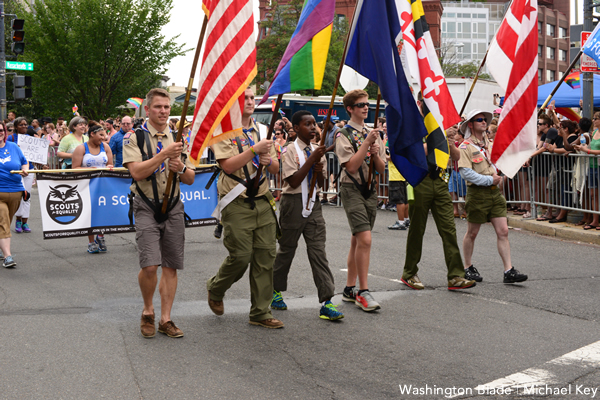
James Dale, the gay former Boy Scout whose landmark Supreme Court case established the organization’s First Amendment right to exclude him, has filed a second federal lawsuit against the Department of Defense over its relationship with Scouting America.
The Aug. 3 lawsuit, which is being exclusively reported by the Blade, seeks records about how the Pentagon is enforcing its ongoing compliance reviews with Scouting America, escalating Dale’s legal challenge to what he and his attorney, Isaac Park, characterize as government pressure on a private organization to change its policies.
The filing, which has not previously been reported, comes months after Dale sued the Pentagon under the Freedom of Information Act to obtain the memorandum outlining the department’s agreement with Scouting America. That first lawsuit resulted in the Pentagon releasing the memorandum just three weeks after Dale filed his complaint.
Now, Dale and Park want to know what happened after the memorandum was signed — including how the Pentagon is conducting its 90-day compliance reviews and whether those reviews are being used to pressure Scouting America to make additional changes.
The second lawsuit cites the Supreme Court’s 2024 ruling in NRA v. Vullo, which addressed when government officials cross the constitutional line by using their authority to pressure private organizations or entities into taking action the government itself could not directly require.
“I find myself in this interesting, ironic place where I’m defending the decision that expelled me,” Dale told The Washington Blade. “That said, Scouts, you have a First Amendment shield to protect yourselves from the DOD.”
Dale’s legal fight comes as Scouting America faces pressure from Defense Secretary Pete Hegseth, who has criticized the organization’s embrace of LGBTQ youth, girls and Scouts of color.
In recent years, Scouting America has made significant progress toward becoming a more inclusive organization — from removing its bans on LGBTQ Scouts and leaders, to providing opportunities for women and girls to participate in Scouting, to making Scouts of color feel more supported and visible within the organization.
Those changes angered Hegseth, who has never been a Scout, to the point that he threatened to sever the military’s longstanding ties with the organization.
Such a move would mean that the U.S. military would no longer provide medical and logistical support for the National Jamboree, the massive gathering of Scouts in West Virginia that typically draws about 20,000 participants. It would also prevent Scout troops from meeting on U.S. or overseas military installations, where many bases host active Scouting programs.
In February, before that threat was carried out, Hegseth announced that the Pentagon had reached an agreement with Scouting America that he said would refocus the organization away from diversity initiatives and other policies he characterized as “woke.” He again threatened to end the military’s longstanding support for the organization if it failed to comply within six months.
Hegseth also placed particular emphasis on Scouting America’s policies regarding transgender youth, saying the organization would require members to use their “biological sex at birth and not gender identity.”
But Scouting America President and CEO Roger Krone struck a different tone.
“We have transgender people in our program and we’ll have transgender people in our program going forward,” Krone told The Associated Press in February.
The conflicting messages prompted Dale to dig deeper.
“I wanted to get to the bottom of what deal had been struck with Scouting America under pressure,” Dale said. “What pressure did the Pentagon apply on a private youth organization that had a right to determine their own members?”
Dale filed a Freedom of Information Act request seeking the memorandum between the Pentagon and Scouting America. When the Defense Department did not provide the document, he turned to Park, a former Supreme Court clerk, and sued the department for its release.
Park said they deliberately took a narrow approach to the FOIA lawsuit, seeking a single document rather than launching a broader fight over thousands of pages of government records.
“We had one document that we really wanted, which was this memorandum, and we were going to ensure that there’s like a lead-pipe, stone-cold case for disclosure,” Park said.
The strategy worked quickly. Three weeks after the lawsuit was filed, the Pentagon released the memorandum.
But the document did not end Dale and Park’s questions. Instead, they said, it raised new ones.
Hegseth had publicly described a six-month window for Scouting America to make changes. But the memorandum provides for an ongoing compliance mechanism, with reviews taking place every 90 days.
For Dale and Park, that raises the possibility that the Pentagon could continue pressing Scouting America to change its policies long after the February agreement was announced.
Park described their concern as “jawboning” — the use of government power or influence to pressure a private organization into changing its policies without the government directly ordering it to do so.
“We saw in the weeks after the announcement of the memorandum changes being made to Scouting America’s policies,” Park said. “Them saying one thing, the department saying a slightly different thing, and our first question then was, of course, like, what is actually in this memorandum? Is this how they kind of got what they wanted?”
The memorandum, Park said, “clarified certain questions, but definitely also didn’t contain other changes” that Scouting America had made.
“That naturally arises: Well then, how did those changes come about?” he said.
Dale points to changes at Scouting America’s National Jamboree as an example of what he believes could be the result of the pressure.
The organization removed dedicated spaces for girls, Scouts of color and LGBTQ Scouts at the flagship event, which concluded last week.
“We see spaces for girls being eradicated, spaces for kids of color, spaces for gay people, for trans kids,” Dale said. “It happened at the flagship event of scouting, the jamboree.”
Dale said he fears similar changes could occur at the local level, including at Scout meetings and council events.
“All this document is empowering the government to keep pressing, keep putting pressure on Scouting America,” Dale said. “And what is that doing to American kids?”
The dispute is particularly striking because of Dale’s own history with the organization.
Dale had a long history with Scouting before the organization expelled him in 1990. At the time, he was a 19-year-old student at Rutgers University in New Jersey and was serving as an assistant Scoutmaster for Troop 73.
While attending Rutgers, Dale became co-president of the university’s Lesbian/Gay Student Alliance and was interviewed by The Star-Ledger about the health and well-being of LGBTQ students.
The interview made its way to Boy Scouts officials. The organization subsequently expelled Dale after learning that he was gay, describing him as an “active sodomite.”
Dale sued the Boy Scouts under New Jersey’s public accommodations law and initially won. The New Jersey Supreme Court ruled in his favor, finding that the state’s interest in preventing discrimination outweighed the organization’s claimed right to exclude him.
The Boy Scouts appealed to the U.S. Supreme Court.
In a 5-4 decision in 2000, the Supreme Court reversed the New Jersey ruling, holding that forcing the Boy Scouts to accept Dale as an openly gay assistant scoutmaster would violate the organization’s First Amendment right to freedom of expressive association.
The Scouts had argued that homosexual conduct was inconsistent with the values it sought to instill in young people.
Dale was devastated by the ruling.
“I thought it was the wrong decision at the time,” he said.
But the constitutional protection the Supreme Court recognized in his case is now at the center of Dale’s argument against the Pentagon.
The Boy Scouts’ policies have changed dramatically since Dale’s case. The organization began allowing openly gay youth in 2013 and gay adult leaders in 2015. It later expanded its policies to include transgender youth and adults.
The Boy Scouts of America formally changed its name to Scouting America in 2025.
Dale said those changes were made voluntarily — precisely the kind of private organizational decision that the Supreme Court’s ruling in his case protected.
“They did it voluntarily,” Dale said. “They won the Supreme Court case against me.”
Now, he argues, Scouting America should invoke that same protection against the government.
Park said that is the central constitutional question behind their efforts.
“In 1990, when he was expelled from the Scouts for being gay, and in 2000, after a narrow 5-4 loss at the court, we were told that a private entity, an organization like Scouting, are allowed to set their own membership policies,” Park said.
Over the following two decades, Park said, Scouting America changed those policies on its own.
“We won the culture war,” Park said. “Organizations like Scouting America decided on their own, of their own free will, that actually what they want is to be inclusive with respect to gay youth, with respect to trans youth.”
The question now, Park said, is whether the government can pressure an organization to reverse those voluntary decisions.
“I think that the story here is that of jawboning,” Park said. “Our question has always been the how of how this administration is achieving whatever policy goals, whatever ideological outcomes that they want.”
Dale sees the issue as extending well beyond Scouting America.
“It’s not even about the scouting program,” Dale said. “It is, but it’s much bigger than that. It’s about really what the executive branch is doing to private organizations that have a right to set their own policies for membership.”
Park said the argument could appeal to people across the political spectrum.
“During the Biden administration, it was COVID policy, and it was the NRA that the right was screaming about jawboning,” Park said. “This is a bipartisan issue in the sense that no one thinks the government is allowed to do this.”
For now, Dale and Park are seeking more information.
Park said their review of the memorandum left them with additional questions about the Pentagon’s relationship with Scouting America and whether the 90-day compliance mechanism is being used to continue influencing the organization.
“Disclosure or transparency is the right remedy for this,” Park said.
Dale’s interest in Scouting is not merely legal.
He said he still believes deeply in the organization and had returned to involvement with Scouting only recently, after years away.
“I love scouting,” Dale said. “I fought for a decade to get back in scouting.”
That makes his current position all the more unusual.
The organization that once fought him in court is now the organization he is trying to defend from government interference.
“I never thought that would be the case,” Dale said. “That would be saving queer kids.”
Dale said he hopes Scouting America will ultimately stand up for the policies it adopted after his Supreme Court case.
“They didn’t want gay people in the ’90s. Fine, I thought that was wrong,” Dale said. “But now they want to have trans kids. They want to have girls. They want to have kids of color.”
“But Donald Trump and Pete Hegseth don’t want them to,” he said.
The Pentagon declined to comment on Dale’s allegations or the ongoing litigation.
“As a matter of policy, we do not comment on ongoing litigation,” a Pentagon spokesperson told The Washington Blade via email.
The Blade also contacted Scouting America seeking clarification about its agreement with the Pentagon, including whether Hegseth or other Defense Department officials had pressured the organization to remove or alter policies protecting LGBTQ Scouts, girls, or Scouts of color.
Scouting America did not respond to a request for comment.
For Dale, the fight has brought his long-running legal battle with the Scouts full circle.
He spent the 1990s arguing that the organization should not be permitted to exclude him because he was gay. The Supreme Court ultimately said the Scouts had a constitutional right to make that choice.
Now Dale is arguing that the government cannot force the organization to make a different choice.
“I realized over the course of my life that I expected the institution to save me,” Dale said. “I expected the Boy Scouts of America to do the right thing. I expected the legal system, the Supreme Court, to do the right thing.”
“Neither one did,” he said. “You got to fight for yourselves.”
Minnesota
Flanagan beats Craig in Minn. Senate primary after winning key LGBTQ endorsements
The race highlights a growing ideological shift within the Democratic Party, as Democrats increasingly seek a more robust pushback against Trump.
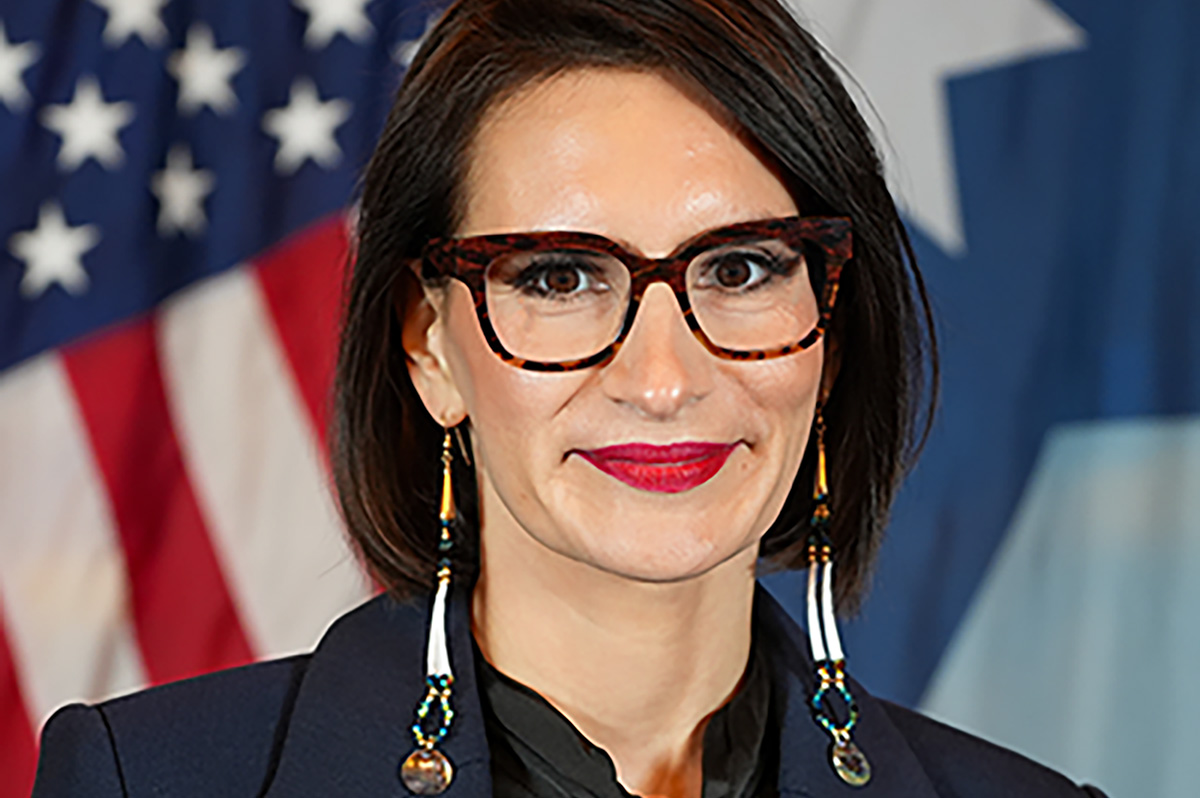
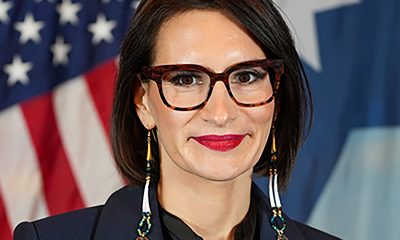
Lt. Gov. Peggy Flanagan won the Democratic primary for the Senate in Minnesota, as progressive Democrats continue to clinch nominations across the country.
On Tuesday night, NBC News called the race for Flanagan, who received 59.0% of the state’s Democratic primary vote, while her opponent, Rep. Angie Craig, received 39.4%. Flanagan ran against Craig for retiring Sen. Tina Smith’s seat.
Smith, along with Sens. Bernie Sanders, I-Vt., and Elizabeth Warren, D-Mass., endorsed Flanagan, while House Minority Leader Hakeem Jeffries, D-N.Y., and former House Speaker Nancy Pelosi, D-Calif., backed Craig.
Flanagan also received the endorsement of the Christopher Street Project, a transgender rights organization that has been at the center of efforts to counter the Republican Party’s push against transgender rights. The group chose Flanagan over Craig in part because Craig has not co-sponsored the Trans Bill of Rights, legislation that has been introduced multiple times in Congress and seeks to establish federal protections for transgender Americans.
The endorsement underscored a key difference between the two Democrats on LGBTQ issues. While Craig is the first openly lesbian mother in Congress, the Christopher Street Project said LGBTQ identity alone is not enough without a strong commitment to transgender rights as they are increasingly debated in legislative offices around the country.
In 2022, the Human Rights Campaign, the largest LGBTQ advocacy organization in the U.S., endorsed Flanagan’s re-election campaign for lieutenant governor alongside Tim Walz, calling the duo “Champions of Equality.”
Flanagan called the race an expensive fight of the “many versus the money,” Flanagan told NBC News’ “Meet the Press Now.” Craig and her allies combined to spend nearly $20 million on the airwaves, while Flanagan and her allies spent $4.7 million, according to AdImpact and NBC.
“I’m running to make sure that people can afford the lives they want to live,” Flanagan said. “I want to get big money out of our politics, and I want to fight for things like ‘Medicare for All’ so that people aren’t just paying for health insurance but actually have access to health care.”
Flanagan criticized Craig, who is in her fourth term, for not standing up enough to President Donald Trump’s administration, a characterization Craig disputed. Craig flipped a competitive House seat in the Twin Cities metro area and had argued that she was the best candidate to win in November.
Craig faced criticism for voting for the Laken Riley Act, an immigration detention measure that Trump signed into law shortly after he started his second term in January 2025. Craig said she later regretted that vote.
Flanagan has been vocal about her stance on abolishing U.S. Immigration and Customs Enforcement. In a recent Minnesota Public Radio debate she said that ICE “has to be ripped apart.” Flanagan said she does support immigration enforcement to ensure secure borders.
Immigration and ICE debates are especially pertinent in the Twin Cities, as ICE agents fatally shot two U.S. citizens, Renee Good and Alex Pretti, in Minneapolis during an enforcement crackdown at the behest of President Trump.
Despite the contested race, Craig made it clear that Democrats are committed to unifying.
“We have an existential crisis in our nation with Trump and Republicans, and so I would be right by the lieutenant governor’s side asking my supporters to support her,” Craig said. “The most important thing in this election is that we beat Republicans. That’s what matters.”
On the Republican side, former NFL sideline reporter Michele Tafoya won the Senate primary. Considered an outsider to the Republican Party structure, she did not win the state GOP’s endorsement at the May convention, where delegates instead backed retired Navy SEAL Adam Schwarze.
She has run her campaign on a slew of issues Republicans have deemed worthy — including transgender sports participation, corruption, and minimizing illegal immigrants in the area.
This recent pattern of moderate and centrist Democrats raising huge funds — in many instances backed by major PACs — only to lose to more progressive and less experienced candidates is growing as more people grow disillusioned with the Democratic Party’s inability to push back against Trump and Republicans. A similar outcome happened in Michigan’s Democratic primary last week when progressive physician Abdul El-Sayed won over incumbent U.S. Rep. Haley Stevens (D-Mich.).
Democratic Gov. Tim Walz, who decided not to run for re-election, stayed neutral in the Senate primary but his wife, Gwen, backed Craig over Flanagan, the governor’s ticketmate.
The Senate seat will be determined in the election on Tuesday, November 3, later this year.

Madonna nominated for 11 MTV VMAs

White House targets gender-affirming care funding, states fight back

Winsome Earle-Sears ‘Life and Marriage Tour’ to include Northern Va. stops

Russian LGBTQ rights group to shut down