Arts & Entertainment
Menzel’s magic
Broadway powerhouse brings summer tour to Wolf Trap next week
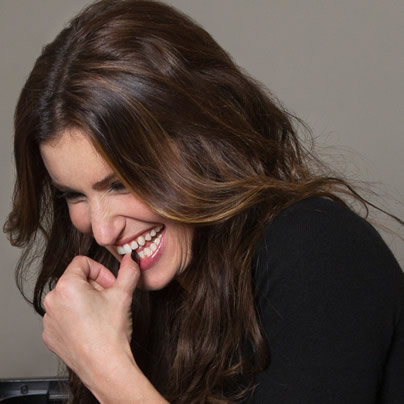
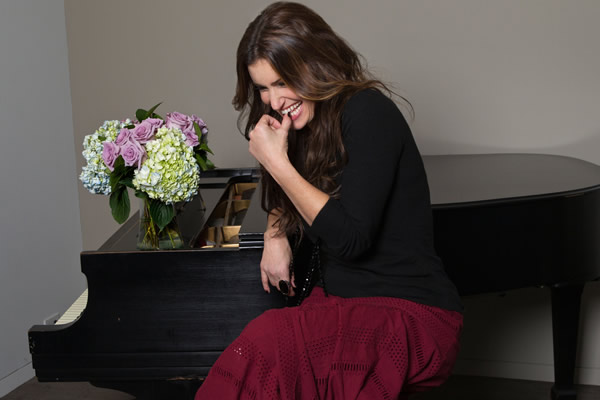
Singer Idina Menzel balances motherhood, touring, Broadway and Hollywood in a busy career but says she enjoys the concerts most. (Photo courtesy Concord Music Group)
‘An Evening with Idina Menzel’
Aug. 3, 8:15 p.m.
Wolf Trap Filene Center
1551 Trap Rd.
Vienna, VA
Tickets range from $20 (lawn) to $100 (orchestra pit)
Idinamenzel.com
Pretty much any veteran live performer will say they have some little personal “trick” they use to keep their most oft-performed material fresh. For Idina Menzel and her trademark “Wicked” showstopper “Defying Gravity,” it’s sometimes a gay teen — perhaps with a little projecting — that helps get her through the song.
Well, that and what she describes as kind of obligation she has to the star-making material.
“That song is a personal gift to me,” she says. “I have a personal debt I owe to that music. Because I have to sing it so much, people ask if it gets monotonous. I can truthfully say that doesn’t happen because every time I sing it, I come from a different place. It could be the young 14-year-old boy in the front row singing it along with me who may not have come out yet. I know how much the song means to him, so I can sing it to him that night. I think it’s a testament to how well written a song it is that it can speak to so many different people.”
Menzel brings her summer tour to Wolf Trap next week for her only D.C.-area appearance. The Tony winner, who’s become a household name since she debuted in “Rent” in 1996 and later in “Wicked” in 2003, also varies her set list slightly from city to city, another show-freshening trick she swears by. She’ll perform in Virginia with the National Symphony Orchestra under the direction of Steven Reineke.
“I’m excited about the show not only because of the material I’m doing, but because I feel like I’ve found a way to make every city have a show that’s unique to them,” Menzel, 41, says. “People should know when they come to see the show they can leave feeling like they got to know a little piece of who I am and it’s not the same everywhere. Every city’s just a little bit different.”
“I’ve been doing it with the symphony for almost three years already, which I truly love. It’s been a wonderful experience for me, which is why I continue to do it,” Menzel says. “There’s an intimacy I’m able to maintain even though I have all these musicians behind me. I had to strike a balance with it early on. It was a little bit of work for me to figure out how to do that, but now it’s pretty natural and organic.”
Even after appearing in two seasons of “Glee” and in films like “Rent” and Disney’s “Enchanted,” Menzel still finds singing live to be her favorite brand of performance.
“I definitely thrive off of the live audience and the adrenaline of being in the moment,” she says.
In 2009, Menzel had her first child, son Walker, with fellow Broadway actor and husband Taye Diggs. Before motherhood, Menzel had a strict regimen for keeping her vocals up, but now being more flexible with her schedule as a mother has only enhanced her performance experiences, she says.
“The more I sing the better for me. I’m like a marathon runner as far as running everyday. So that’s kind of how I approach it — athletically. And I’m just finding that being a mom and having a little boy now has changed my whole perspective on that. I used to have such a ritual and routine that I still try to keep, but if I deviate from it I’m a little less hard on myself, and in return I feel like the rewards are greater for me professionally. I may not be as prepared vocally, but then I’m on stage and I feel more free.”
Menzel’s summer tour includes old favorites from her roles on Broadway in “Wicked” and “Rent,” as well as other hits featured in her concert “Barefoot at the Symphony” that aired on PBS and has now been released on DVD.
“There are a few songs I wouldn’t leave stage without singing. I’m constantly changing [the set list], trying to tell different stories,” Menzel says. “It’s half and half music people would expect and the other stuff is new stuff I want to challenge myself with.”
Looking back, Menzel finds that she was in very different places in life during her appearances on “Glee” in the show’s first and third seasons. She was still adjusting to being a mom while filming the first season, but during the filming of the third season was more used to juggling parenthood and her career.
“The last season I was on I enjoyed it a lot more. I was learning how to balance motherhood and work for myself. I was enjoying the cast and I didn’t have to run home every second to pump my boobs or whatever,” Menzel says. “I hope [the cast] are all really appreciating it and enjoying it in the moment because you can easily lose sight of how incredible it is. I would love to do more TV, but my definitive wish was to get back to New York and do another show.”
In addition to touring, Menzel is working on a number of projects. She’s working alongside composers of original pieces for new musicals to act as a “muse,” singing and doing readings of their work so they can hear the results of their writing. She’s also thrilled to start work as Elsa in a new Disney movie called “Frozen” set for release in 2013.
“It’s amazing for me, like a dream,” she says. “It’s an animated Disney movie and there’s lots of music in it. It’s a beautiful story, and we just got started.”
And yes, as clichéd as it might sound for a Broadway powerhouse, Menzel is aware and appreciative of her gay following.
“I did the Atlantis cruise ship with 1,000 gay men and I had probably the greatest time I’ve ever had,” she says.
Though on one hand she says it makes no difference — “an audience is an audience, made up of all different kinds of people” — she says the gay kids who tell her “Wicked” helped them come out mean a lot.
“All that kind of stuff is part of the benefits I reap from what I do for a living. It enriches me as a person and I feel like everyone’s in it together out there.”
Gay conductor to lead NSO for Menzel show
By BRIAN T. CARNEY
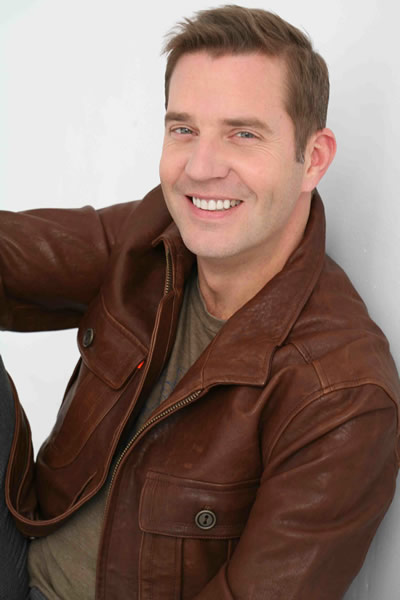
Steven Reineke conducts for Idina Menzel next week at Wolf Trap. (Photo by Michael Tammaro)
Maestro Steven Reineke says his friend Idina Menzel wouldn’t want him to say too much about what she’ll be singing at their upcoming performance with the National Symphony Orchestra at Wolf Trap.
But he does mention, “She covers a lot of material in her set. And she tells great stories. She’s very interactive with the audience. There’s even some audience participation.”
He’s more forthcoming about the first half of the program, which will start with one of his own compositions. The gay composer and conductor wrote “Celebration Fanfare” when he was 25 (he turns 42 in September) and notes that the piece is still performed frequently by orchestras and concert bands across the country. The work is dedicated to Erich Kunzel, conductor of the Cincinnati Pops, who served as a mentor to Reineke and encouraged his career as both composer and conductor.
Reineke resisted the temptation to start the evening with his own version of “Defying Gravity,” though Reineke’s piece was written to celebrate another kind of flight — the centennial of the Wright Brother flight. He says it’s a funny coincidence that Broadway composer Stephen Schwartz used the same title for the Act I finale of “Wicked,” a number that has become a signature piece for Menzel.
“We just happened to come up with the same title. They have nothing to do with each other whatsoever,” he says.
Reineke started composing when he was a teenager. He remembers, “I had all this music running around my head. I started to plunk things out on the piano because I just needed to get these songs out. It wasn’t really a conscious choice.”
It was also about that time he realized he was gay.
”I came out to myself when I was 17 years old, a senior in high school getting ready to go off to college. I’ll never forget having that cathartic moment when I stared in the mirror and said the words out loud, ‘I am gay.’ That was the hardest part about the process.”
As he began his professional life, Reineke remained open about his sexuality and says it was “a no brainer” because “I was never really in. The more notoriety I got, the more it came up, and I’m just not the kind of person to deny it. I just treat it as a very normal part of life. There was no big coming out.”
Reineke isn’t sure why the “classical closet” (cultural critic K. Robert Schwarz’s term for the dearth of classical musicians who are openly LGBT) still persists so strongly. He does note, “I do wish that more people would treat is as a non-issue, whether they’re in the arts, or sports figures, or television or whatever.”
Staying in the closet, he says, only perpetuates myths.
“That’s one thing that keeps the stigma about it. People staying buried instead of saying, ‘Here I am, deal with it.’”
His sexuality has not played a major role in his musical career. As a composer, he often takes his cue from the visual and visceral imagery he finds in mythology and nature. Reineke, who initially wanted to be a film composer, says he needs a visual image in mind before he starts composing: “Basically I’m creating a soundtrack to my own movie in my own head.”
As a conductor and music director (he’s also music director of the New York Pops and the principal pops conductor for the Toronto Symphony Orchestra and the National Symphony Orchestra here in Washington), Reineke says his focus is on the audience and the musicians.
“I have no particular agenda other than the health and success of the orchestra and the good times had by an audience.”





Television
‘Lizzie Borden’ might be the best ‘Monster’ yet
Exquisitely realized, shrewdly written with outstanding performances
“When the legend becomes fact, print the legend.”
That famously cynical quote from the 1962 Western movie “The Man Who Shot Liberty Valance” could easily have been the mission statement behind the latest season of Ryan Murphy’s controversial anthology series, “Monster,” which retells the story of America’s most famous axe murderer – Lizzie Borden, who, in 1892, “took an axe” to her father and stepmother at their family home in Fall River, Mass.
Except, officially, she didn’t. Borden was acquitted of the killings in a trial that was a national sensation; the crime remained unsolved, and despite rumors and theories that have proliferated over the last century, nobody really knows what actually happened nor who was responsible for it.
Yet in the popular imagination, Lizzie is still remembered as a killer who got away with one of the most notorious murders in American history. Though she walked free and lived a life of wealth and high social position for another three decades after her trial, she never truly escaped the scandal; she would be forever branded as guilty, her alleged crime even immortalized in a children’s schoolyard rhyme, and all but a few die-hard theorists assume, unequivocally, that she was the killer. In other words, the legend of Lizzie Borden, axe-murderer, has “become fact.”
“Monster: The Lizzie Borden Story,” like most other retellings of this gruesome crime saga, “prints” the legend – and indeed, goes even further to canonize her into something like a radical feminist saint.
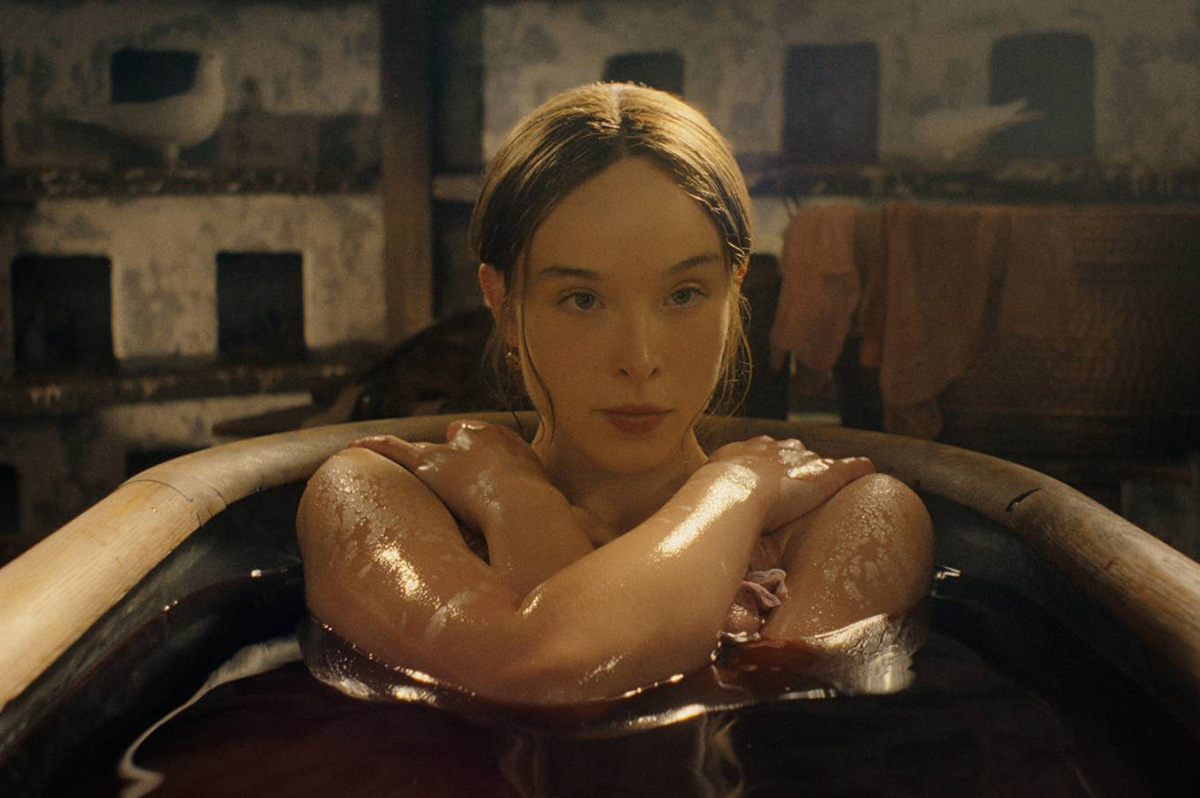
With Ella Beatty (daughter of Hollywood royalty Warren Beatty and Annette Bening) in the title role, the show frames Lizzie as the repressed and disregarded adult child of wealthy businessman Andrew Borden (Charlie Hunnam) and stepmother Abigail (Rebecca Hall), who married her father after her mother’s death; both of them treat her – and indeed, almost everyone around them – with dismissive cruelty. Andrew is an alcoholic who openly disdains both wife and daughter, while Abigail takes out her own frustration with the marriage on Lizzie, whom she has branded as a “simple” child that she never wanted to have – and a difficult one at that.
The arrival of a new household maid — Bridget Sullivan (Vicki Krieps), who goes by the name “Maggie” — changes Lizzie’s outlook and her destiny. Well-traveled, worldly, and deeply independent, Maggie befriends her and becomes both her companion and mentor, introducing her to new ideas and cultivating her sense of self-worth; they become lovers, their bond deepened by a dissatisfaction with the cultural limits imposed upon them by their status as women. As conditions within the household grow increasingly unbearable, they formulate a gruesome plan which, if they can succeed, will liberate them from the patriarchal subjugation that relegates them to the level of chattel while puffing a pipe full of expensive tobacco.
From there, writer/creator Ian Brennan takes us through an effectively grisly re-enactment of the famous murders and onward through the trial in which Lizzie, ironically benefitting from stereotyped male assumptions about what women are or are not capable of doing, is ultimately acquitted of the gruesome crime she absolutely DID commit. It then follows her – and Bridget – into the aftermath of the scandal, where a kind of imprisonment awaits them both, anyway.
Boldly crafted with cinematic flourish (six episodes were directed by Max Winkler, the two others by Sarah Adina Smith) and continuing the series’ tradition of lavishly depicted violence, one can’t deny that it’s a wild ride. It flaunts its contemporary attitude through fiercely eclectic musical choices in the soundtrack, from the lushly romantic classical tones of its late 19th-century period to ferociously feminist ‘90s punk; it includes graphic sex both tender and aggressive, juxtaposed with scenes of pastoral beauty and genteel refinement; and, as always in Ryan Murphy’s “true story” productions, it plays fast-and-loose with the facts, choosing instead to lean into artistic license in order to expand on the “hotbed” themes woven into the narrative.
In this case, Brennan’s version of Lizzie’s tale mines the historical record to incorporate lesser-known factual details while veering into speculation to fill the blanks elsewhere; it creates incidents that didn’t happen, alters incidents that did, and embellishes what’s known of its characters’ private lives with details that no one could know; and, like other seasons of “Monster” have done, it finds a way to introduce extra real-life killers into the mix – blood-bathing 16th-century Countess Elizabeth Báthory (also played by Krieps) and hitchhiking 20th-century serial murderer Aileen Wournos (Sarah Paulson) – for good measure. The result, of course, is a work of complete fiction.
These are the things that have consistently made “Monster” one of Murphy’s most controversial television franchises. The excesses of gore and brutality, though they might seem gratuitous to some and are certainly hard to watch for many, are arguably justified by the show’s branding as a “horror” series; less easy to write off, however, is the criticism of many detractors that the series spreads false information and perpetuates myths, whether to “push” an agenda or in the name of “artistic interpretation.”
“The Lizzie Borden Story,” consequently, has already been met with such objections – though in today’s political climate, it’s hard to know if they are really about the blending of fact and fiction or the feminist social commentary that runs through the show like a vein of molten lava. Brennan’s vision of Lizzie’s presumed crime casts her as woman suffering from a life of psychological torment by her parents, and Bridget – who has experienced more than her own fair share of mistreatment at the hands of aggressively toxic men – as her savior; the crime they concoct and execute together is a radical act of defiant rebellion against an ingrained system of patriarchal domination, and we are set up from the start to be completely on their side.
That radical feminist thread pops up everywhere: through Lizzie’s stepmother (despite her own monstrosity), who is granted a share of empathy for the sake of her own stifled existence; through famous actress Nance O’Neil (Jessica Barden), who steps in to become an ally at a crucial juncture of Lizzie’s trial; even through her estranged sister (Billie Lourd), who sets aside her own doubts to support Lizzie in sisterly solidarity. Brennan even imagines Lizzie as an activist in the fight for women’s suffrage.
Of course, if one is inclined to view “Monster” as a documentary crime series, occupied with discerning facts and providing an objective overview of the case, that’s a perfectly good reason not to watch its latest installment. For those who realize that it is instead a vehicle for artistic expression, a series devoted to finding the kind of truth that transcends facts and challenges viewers to examine the cultural conditions that create these “monsters” in the first place, this might be its best season yet.
Exquisitely realized, shrewdly written, and featuring outstanding performances across the board, it’s not really a crime story, nor really even horror: it’s an exhilarating, satisfying, and thoroughly transgressive fantasia on an American legend that puts the blame for the Borden family murder squarely where it belongs – on the oppressive cruelty that drives otherwise good-hearted women to commit unspeakable acts.
Out & About
Tyler Clementi Foundation to host fundraiser in Rehoboth
Special remarks to be given by Jane Clementi, Rep. McBride
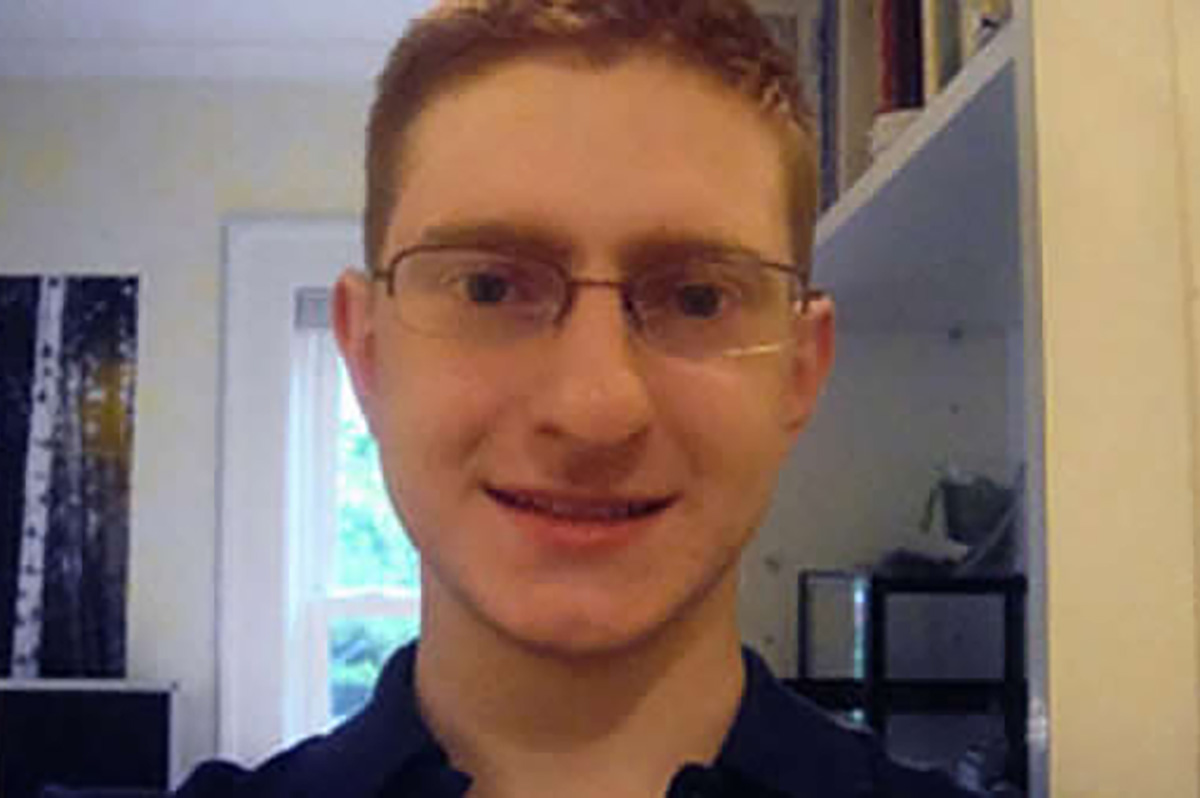
To kick off National Coming Out Month, the Tyler Clementi Foundation will host a fundraiser on Thursday, Oct. 1 at 6 p.m. at CAMP Rehoboth in Delaware.
The event will feature special remarks by Jane Clementi and Rep. Sarah McBride. If you are unable to attend, please consider making a donation to support the work of the Tyler Clementi Foundation to end online and offline bullying and harassment in schools, workplaces, and faith communities.
For more details, visit the Tyler Clementi Foundation’s Facebook page.

Friday, September 25
Go Gay DC will host “LGBTQ+ Community Happy Hour” at 7 p.m. at DIK Bar. This is a chance to relax, make new friends, and enjoy happy hour specials at this classic retro venue. Attendance is free and more details are available on Eventbrite.
Trans Discussion Group will be at 7 p.m. on Zoom. This event is intended to provide an emotionally and physically safe space for trans people and those who may be questioning their gender identity/expression to join together in community and learn from one another. For more details, email [email protected].
Saturday, September 26
Go Gay DC will host “LGBTQ+ Community Brunch” at 11 a.m. at Freddie’s Beach Bar & Restaurant. This fun weekly event brings the DMV area LGBTQ+ community, including allies, together for delicious food and conversation. Attendance is free and more details are available on Eventbrite.
Black Lesbian Support Group will be at 1 p.m. on Zoom. This is a peer-led support group devoted to the joys and challenges of being a Black Lesbian. For more details, email [email protected].
Sunday, September 27
“Nellie’s DC Drag Brunch” will be at 12 p.m. at Nellie’s Sports Bar. Come get served like a queen by a queen. Join Sapphire Blue, Deja Diamond and their team of amazing drag performers for the most fun you’ll have all weekend. Tickets cost $58.51 and are available on Eventbrite.
Monday, September 28
“Center Aging: Monday Coffee Klatch” will be at 10 a.m. on Zoom. This is a social hour for older LGBTQ+ adults. Guests are encouraged to bring a beverage of choice. For more information, contact Adam ([email protected]).
Queer Book Club will be at 7 p.m. on Zoom. The Queer Book Club meets on the fourth Monday of the month to discuss queer books by queer authors. This month’s reading is “Happy Iceland” by Anne Marie Wells. For more details, visit the DC Center for the LGBTQ+ Community’s website.
Tuesday, September 29
The DC Center for the LGBTQ+ Community will host “Center Aging: Painting Class” at 1 p.m. This is a free watercolor painting workshop that will be held in the community room and led by Laya Monarez. All supplies and light snacks will be provided. This workshop involves paint, so please dress accordingly. Email Mac at [email protected] for more details.
Wednesday, September 30
Job Club will be at 6 p.m. on Zoom upon request. This is a weekly job support program to help job entrants and seekers, including the long-term unemployed, improve self-confidence, motivation, resilience and productivity for effective job searches and networking — allowing participants to move away from being merely “applicants” toward being “candidates.” For more information, email [email protected] or visit www.thedccenter.org/careers.
Thursday, October 1
The DC Center for the LGBTQ+ Community’s Fresh Produce Program will be held all day at the Center. People will be informed on Wednesday at 5:00 pm if they are picked to receive a produce box. No proof of residency or income is required. For more information, email [email protected] or call 202-682-2245.
API Queer Support Group will be at 7 p.m. on Zoom. This is a support group for the Asian and Pacific Islander queer community. The support group is co-sponsored by APIQS (Asian Pacific Islander Queer Society DC) and AQUA (Asian Queers United for Action). For more details, email [email protected].

‘Lizzie Borden’ might be the best ‘Monster’ yet

Comings & Goings

Tyler Clementi Foundation to host fundraiser in Rehoboth

Calendar: September 25-October 1

Former Capital Pride board member reiterates sexual harassment allegation

For lesbian victims of domestic violence, competent care is scare

United States Conference on HIV/AIDS grapples with federal budget cuts

UN human rights chief sounds alarm over ‘comprehensive onslaught’ against LGBTQ rights

Gov. Whitmer to serve as keynote speaker for Saturday’s HRC National Dinner

Washington Blade responds to concerns over White House pool duties
-

 National4 days ago
For lesbian victims of domestic violence, competent care is scare
-
Health4 days ago
United States Conference on HIV/AIDS grapples with federal budget cuts
-
United Nations5 days ago
UN human rights chief sounds alarm over ‘comprehensive onslaught’ against LGBTQ rights
-
LGBTQ Non-Profit Organizations3 days ago
Gov. Whitmer to serve as keynote speaker for Saturday’s HRC National Dinner