National
Anti-gay groups speak out in Prop 8, DOMA briefs
‘Gov’t should not put its seal of approval on that unholy union’
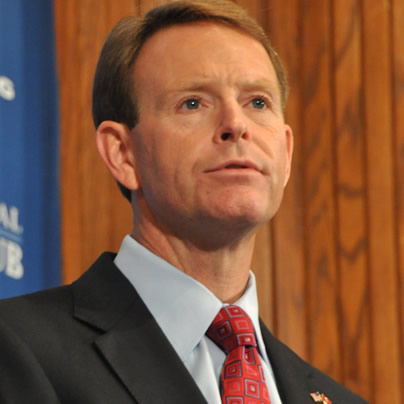
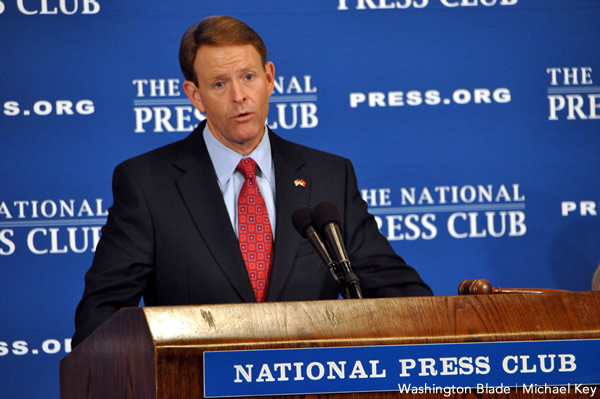
The Family Research Council, headed by Tony Perkins, filed briefs in the Prop 8 and DOMA cases. (Blade file photo by Michael Key)
Anti-gay groups — ranging from the Family Research Council to the Westboro Baptish Church — filed friend-of-the-court briefs before the Supreme Court this week asking justices to uphold California’s Proposition 8 and the Defense of Marriage Act.
The briefs filed on Tuesday assert the same arguments seen repeatedly in opposition to a fundamental right to same-sex marriage, such as the inability of gay couples to procreate and the argument that being gay isn’t an immutable characteristic.
The Family Research Council, one the more prominent anti-gay groups opposed to same-sex marriage, filed briefs in both the Prop 8 and DOMA cases. In the Prop 8 brief, the group argues that the California ban on same-sex marriage isn’t discriminatory, among other reasons, because it enables any person to marry — so long as the other person is of the opposite sex.
“Proposition 8 treats men and women the same,” the brief states. “Both may marry someone of the opposite sex; neither may marry someone of the same sex.”
As Right Wing Watch points out, Family Research Council makes arguments on the political power of gays and lesbians that are contradictory. In the Prop 8 brief, the group notes that 30 states have amendments defining marriage as one man, one woman while arguing that “there is no ‘emerging awareness’ that the right to marry extends to same-sex couples.”
But in the DOMA brief, the group notes that three states voted in favor of marriage equality and Minnesota rejected an anti-gay marriage amendment to argue gay people aren’t a “politically powerless” group that need protection from discrimination.
“So when voters reject gay rights at the ballot box, they are reflecting public opinion,” concludes Right Wing Watch blogger Miranda Blue. “But when they vote in favor of gay rights, they have been ‘enlisted’ to the cause by powerful gay rights lobbyists.”
William Duncan, director of the Marriage Law Foundation, filed a brief on behalf of the National Organization for Marriage in the DOMA case, but identifies himself as a “scholar of history and related disciplines” in the Prop 8 case.
“When the People of California adopted Proposition 8, they acted to retain in their law an understanding of marriage that, until very recently, was recognized universally and without exception throughout time and across cultures,” Duncan said. “That conception of the institution of marriage has consistently been understood to advance crucial social interests in procreation, understood as the bearing and rearing of children.”
Duncan cites in his arguments a series of philosophers who’ve had an impact on American thinking, including Noah Webster and David Hume. The brief also cites a 1690 piece of writing from British philosopher John Locke, who said marriage “has no necessary form or function beyond this ‘chief end’ of procreation.”
Another brief in the Prop 8 case was filed by a coalition of black pastors, including the Coalition of African-American Pastors USA and the Frederick Douglass Foundation. That brief argues at length that the 1967 Supreme Court ruling in Loving v. Virginia striking down bans on interracial marriage shouldn’t be applied to gay couples.
“Loving can be distinguished from the current dispute over same-sex marriage,” the brief states. “Laws against miscegenation were designed to segregate the races, reinforcing the socially disadvantaged position of African-Americans. … By contrast, the traditional definition of marriage calls for mixing of the genders — integration not segregation — and therefore cannot be understood as an attempt to disadvantage either gender.”
During a news conference in September, Rev. William Owens, founder and president of the Coalition of African-American Pastors, admitted that he has limited financial ties to NOM. Owens said the group provides him and his wife a salary of $20,000 a year.
Notably, the brief isn’t signed by black pastors. The attorneys who signed the brief are Lynn Wardle, a law professor at Brigham Young University, and Stephen Kent Ehat, an attorney who does business as the Utah-based California Research Inc., and is a graduate of BYU law school.
Yet another brief was filed by three gay individuals who believe same-sex couples shouldn’t have the right to marry. They are David Benkof, ex-owner of the gay press syndicate Q Syndicate and now a resident of Israel; Robert Oscar Lopez, a bisexual award-winning writer who’s written comedies about same-sex couples raising children; and Doug Mainwaring, a gay writer who rethought the capability of same-sex unions to raise children after realizing the importance to his teenage sons of their mother’s presence in their lives. The brief is signed by Herbert Grey, a private attorney based in Beaverton, Ore.
“We, and they, believe gay people should be free to love and live as they choose but we also recognize that society has a right to express a rational preference for the kind of unions necessary to the survival of the whole society, and to the well-being of children,” the brief states. “Some gay, lesbian and bisexual people will benefit from this preference as they may marry a person of the opposite-sex.”
The brief by the Westboro Baptist Church, a virulently anti-gay Kansas-based organization known for picketing the funerals of service members with signs reading, “God Hates Fags,” makes arguments characteristic of its organization in briefs both for the Prop 8 case and DOMA case.
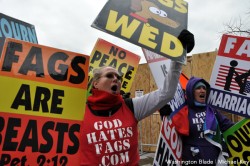
Members of the Westboro Baptist Church. (Washington Blade file photo by Michael Key)
“This nation has gone astray, letting fornication, adultery, abortion-for-convenience-on-demand, divorce, remarriage and sodomy become the norm,” the church says in its DOMA brief. “Homosexuality is destructive in every way, to the individual and to the nation. Government should not put its seal of approval on that unholy union by issuing a marriage license. Government’s interest is in doing the opposite, for the good of the people and the nation.”
The brief is signed by Margie Phelps, daughter of church founder Fred Phelps, who has represented the church in a lawsuit against it before the Supreme Court.
Mary Bonauto, civil rights director for Gay & Lesbian Advocates & Defenders, said the “anti-gay machine is alive and well,” but noted that each of the briefs takes a different approach to supporting Prop 8 and DOMA.
“As you would expect, some of the briefs were based a particular religious view,” Bonauto said. “Others claimed they were secular but simply reasoned based on certain religious principles. Others raised the religious freedom argument that it is a burden for objecting members of the public to have to deal with the existence of married gay people.”
Bonauto added, “Overall, none of these briefs raise a new issue and several are helpful to us.”

National
Lou Chibbaro Jr. documentary wins award from NLGJA
‘Lou’s Legacy’ produced by D.C.’s Mattachine Society

“Lou’s Legacy: a Reporter’s Life at the Washington Blade,” a documentary produced by The Mattachine Society of Washington, D.C., will receive an Excellence in Journalism Award from NLGJA, the Association of LGBTQ+ Journalists.
The film premiered on WETA PBS in D.C. and Maryland Public Television (MPT) in June of 2025. The documentary’s Emmy-nominated director and producer Patrick Sammon will accept the award for Excellence in Local Television on Sept. 11 at NLGJA’s National Convention in San Francisco.
“Lou’s Legacy” was produced in association with the Mattachine Society of Washington, D.C., a non-profit LGBTQ history society dedicated to conducting original archival research. Aside from Sammon, the NLGJA is recognizing other members of the film’s production team including Producer Julianne Donofrio, Editor Amir Jaffer, Executive Producer Charles Francis, and Executive Producer Pate Felts.
“Lou’s Legacy” tells the story of two D.C. icons — legendary Washington Blade reporter Lou Chibbaro Jr. and beloved drag performer Donnell Robinson, known to generations of Washington audiences as “Ella Fitzgerald.” Through Lou’s nearly five-decade career at the Blade and Ella’s return to the stage after a three-year hiatus following COVID, the 29-minute documentary explores the history of Washington’s LGBTQ community and today’s rising backlash against LGBTQ rights, including laws targeting drag performers.
“All students of journalism can learn a lot from the story of Lou Chibbaro, Jr. Lou has chronicled nearly five decades of LGBTQ+ life and the community’s struggle for equality in Washington, D.C. Lou’s work and the role of the queer press has been essential in covering stories the mainstream media would often ignore or erase,” said Ryan Levi, president of the D.C. chapter of the NLGJA.
“We are thrilled to receive this award from the NLGJA,” said the film’s director Patrick Sammon. “Lou Chibbaro’s nearly five decade career at the Washington Blade demonstrates the essential role LGBTQ journalism plays in telling our community’s stories and documenting its history. This recognition from journalists who follow in Lou’s footsteps is particularly meaningful to me and the rest of our production team.”
Arizona
Shooting outside gay bar in Ariz. leaves three dead
Tucson police investigating double murder-suicide as a hate crime
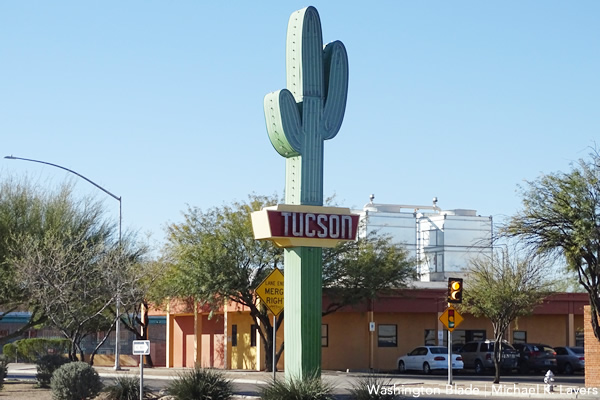
Three people were fatally shot outside a gay bar in Tucson, Ariz., early Monday morning, about a mile from the city’s nightlife district.
Police have said the shooting, which took place in the parking lot of Venture-N bar at 1239 N. 6th Ave., was likely a hate crime and a double murder-suicide following a verbal altercation.
The suspect, Ousman Ceesay, allegedly shot Vincent Anthony Siqueiros and Cameron Davis Capara while they were outside the club around 12:30 a.m. Monday.
Reports show Capara and Siqueiros were pronounced dead at the scene. Ceesay died after being taken to a local hospital with gunshot wounds.
Police have also said that Ceesay was carrying a list of LGBTQ businesses at the time of the shooting.
Arizona Public Media has said police are investigating the case as a hate crime because the suspect was carrying a note containing the names of multiple LGBTQ-associated businesses.
“I am deeply saddened that another senseless loss of life has happened in our community,” Tucson Police Chief Monica Prieto said in a statement. “Bias-based crimes are especially heinous and have no place in our community.”
According to Prieto, there is no imminent threat to the community, and the Tucson Police Department is working to provide extra protection to various LGBTQ businesses across town.
Congresswoman Adelita Grijalva, who represents the area, issued a statement condemning the act of violence, which appears to have been at least in part motivated by homophobia.
“I am disgusted and deeply saddened to learn of a targeted act of hate and the cold-blooded murder of two members of our LGBTQIA+ community, Vincent Siqueiros and Cameron Capara, at the Venture-N bar in Tucson last night. This horrific attack is a painful reminder that even in welcoming communities like Tucson, hate and violence against the LGBTQIA+ community still exist.”
“When that hate is combined with easy access to firearms, the consequences can be deadly. I am sick and tired of Congress refusing to lift a finger to protect our communities while, every day, dozens of people are shot and killed across the country. It does not have to be this way. The House of Representatives is returning to session this week, and our first action should be passing common-sense gun safety reforms that we know can save lives.”
Other federal lawmakers also condemned the shooting.
The Congressional Equality Caucus, which is made up of federal legislators advancing LGBTQ interests, issued a statement after news broke.
“Our hearts are with the friends and loved ones of the victims of this devastating attack outside a Tucson gay bar and with the Tucson LGBTQI+ community,” it said on X. “No one should fear violence because of who they are — and we’re going to continue fighting to build a world where no one does.”
The Human Rights Campaign, the largest LGBTQ organization in the country, released a statement following the shooting.
“We are heartbroken by the loss of Vincent Anthony Siqueiros and Cameron Davis Capara and our hearts are with their families, loved ones, and the entire Tucson LGBTQ+ community. Once again, we are reminded that gun violence robs people of their lives, destroys families, and devastates communities.”
A candlelight vigil honoring the victims is planned for Sept. 2 at 6:30 p.m. at Catalina Park in North Tucson.
Congress
HRC president campaigns for Chris Pappas in NH
Gay congressman running to succeed retiring U.S. Sen. Jeanne Shaheen

Human Rights Campaign President Kelley Robinson on Sunday campaigned for U.S. Rep. Chris Pappas (D-N.H.) in New Hampshire.
Robinson traveled to Manchester, the state’s largest city, nine days before the Sept. 8 primary that will determine who will vie for retiring U.S. Sen. Jeanne Shaheen (D-N.H.)’s seat.
We’re hitting the pavement across New Hampshire to fight for a freer, fairer future for everyone.
Glad to have Human Rights Campaign President @KelleyJRobinson join us for a canvass launch in Manchester today. pic.twitter.com/XWCEaQxy4o
— Chris Pappas (@ChrisPappasNH) August 30, 2026
Former U.S. Sen. John E. Sununu, who represented New Hampshire in the U.S. Senate from 2003-2009, will face off against former U.S. Sen. Scott Brown, who represented Massachusetts in the U.S. Senate from 2010-2013, in the Republican primary.
Karishma Manzur is among the Democrats challenging Pappas.
A poll the University of New Hampshire Survey Center released on Aug. 26 shows Sununu is ahead of Brown. The same survey shows Pappas ahead of Manzur and his other Democratic challengers.
The UNH Survey Center poll shows Sununu ahead of Pappas by a 45-43 percent margin if they were to face off in the general election. The margin of error is +/-2.1 percent.
Pappas would become the first openly gay man elected to the U.S. Senate if he were to win in November.

Markey’s primary win deemed success for LGBTQ activists

Top Bulgarian court rules government must legally recognize trans people

Lou Chibbaro Jr. documentary wins award from NLGJA

Beloved D.C. ‘Old Catholic’ Bishop Charles Braun dies at 86

Blade welcomes fall intern

San Francisco, long a queer safe haven, remains competitive for homebuyers

E-INFOSOL leaders encourage youth to pursue tech careers

Milo Yiannopoulos deported to UK

New book examines Trump cuts to LGBTQ healthcare