Politics
HISTORIC: Senate panel advances trans-inclusive ENDA
In first, committee reports out trans-inclusive LGBT anti-bias bill
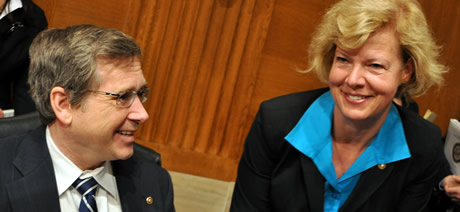
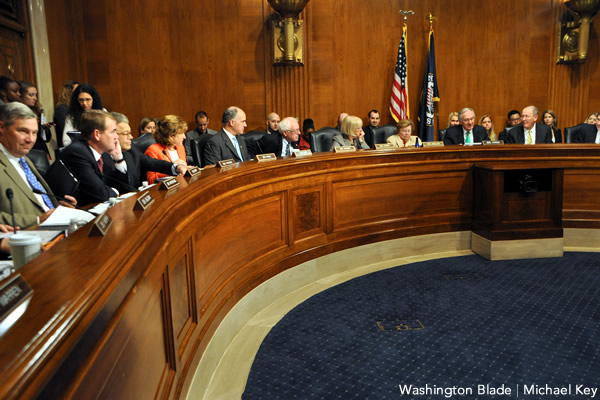
Senate Health, Education, Labor & Pensions Committee approved a trans-inclusive ENDA on Wednesday (Washington Blade photo by Michael Key)
A Senate committee made history on Wednesday by approving for the first time a trans-inclusive version of the Employment Non-Discrimination Act and picking up key Republican support from Sens. Orrin Hatch (R-Utah) and Lisa Murkowski (R-Alaska).
Lawmakers on the Senate Health, Education, Labor & Pensions Committee reported out ENDA by a 15-7 vote after a short period of discussion. No amendments were offered except for a manager’s amendment, although Sen. Lamar Alexander (R-Tenn.) said he’ll reserve three that he planned for consideration on the Senate floor.
Senate HELP Committee Chair Tom Harkin (D-Iowa) noted the historic nature of the committee’s action prior to the vote and said it’s “time, long past time” for Congress to take action against LGBT workplace discrimination.
“Qualified workers should not be turned away or have to fear losing their livelihood for reasons that have nothing to do with their qualifications, skills or performance,” Harkin said. “Let’s not mince words: such practices are un-American. They should have no place in any American workplace.”
All 12 Democrats on the committee, including lesbian Sen. Tammy Baldwin (D-Wis.), are co-sponsors of the bill as well as one Republican, Sen. Mark Kirk (R-Ill.). They each voted in favor of ENDA during the final vote.
At the start of the markup, Kirk explained he has supported ENDA — both in his capacity as a U.S. House member and a U.S. senator — because gay people should “not have that cloud of potential discrimination” in the workplace.
Speaking with reporters afterwards, Kirk explained his support for ENDA derives in part from his work as an officer in the Navy Reserve.
“For me, as you guys know, I’m a military guy,” Kirk said. “We think about how blindingly idiotic it was for Adolf Hitler to discriminate against the Jews. When you think about all the Senate pieces of the Manhattan Project, we actually developed a war-winning weapon because we were protecting creativity and science, and we became a much stronger society that allowed us to prevail. The society that is more open will be stronger, in my view, probably economically and militarily.”
Sen. Mark Kirk (R-Ill.) and Sen. Tammy Baldwin (D-Wis.) (Washington Blade photo by Michael Key)
New support for ENDA also came from Republicans on the panel: Hatch and Murkowksi. Hatch voted “yes” by proxy and Murkowski voted “yes” in person. The Alaska senator is the third sitting Republican U.S. senator to come out in favor of marriage equality.
In a statement after the markup, Murkowski said she voted “yes” because “discrimination should never be tolerated in the workplace.”
“I am a strong believer that individuals should be judged on whether they can do the job, not their sexual orientation – and I appreciate the hundreds of Alaskans who shared their thoughts with me and my staff as we considered this bill,” Murkowski said.
While she said improvements to the bill “might be in order in the form of floor amendments,” Murkowski added she’s pleased ENDA addresses “employers’ needs to run efficiently and reduce compliance costs” by prohibiting discrimination claims based on disparate impact.
In a statement provided to the Washington Blade, Hatch explained he was able to support ENDA because of the strong religious exemption in the bill.
“I appreciate that the authors of the bill were willing to include a robust religious exemption in this bill,” Hatch said. “I voted for it because it prohibits discrimination that should not occur in the workplace, it protects the rights of religious entities, and minimizes legal burdens on employers.”
The bill now heads to full Senate for passage on the floor, where 60 votes will likely be necessary to overcome a Senate filibuster. During the markup, Harkin said he expects ENDA to come to the floor “sometime in the fall,” but not before lawmakers leave for August break.
Asked by the Washington Blade after the committee vote whether he’s confident that ENDA will find 60 votes on the Senate floor, Harkin replied, “Yeah, I think we’ll have 60 votes.”
“As you saw, we had some very key Republicans on the committee, and that will be very helpful,” Harkin said. “As I said, I think society is there, and the things that have recently happened with the Supreme Court decision and others, I think we’re ready to move on in a way that we haven’t been ready move on in the past. Keep your fingers crossed.”
But Senate Majority Leader Harry Reid (D-Nev.) is responsible for scheduling what comes to the floor in the Senate. His office didn’t immediately respond to a request for comment on when an ENDA floor vote would take place. In his Pride statement issued last month, Reid said he looks forward to bringing up ENDA “soon.”
White House Press Secretary Jay Carney issued a statement saying President Obama “welcomes” the bipartisan support ENDA received in committee and looks forward to further action.
“The President has long supported an inclusive ENDA, which would enshrine into law strong, lasting and comprehensive protections against employment discrimination on the basis of sexual orientation or gender identity,” Carney said. “We look forward to the full Senate’s consideration of ENDA, and continue to urge the House to move forward on this bill that upholds America’s core values of fairness and equality.”
It was the first markup of ENDA in the Senate since 2002 and the first time ever a committee in either chamber of Congress approved a version of ENDA that protects not only gay, lesbian and bisexual people from workplace discrimination, but also transgender people.
Mara Keisling, executive director of the National Center for Transgender Equality, said a trans-inclusive ENDA has been advancing all along, but committee approval of the bill with gender identity protections is “really amazing.”
“This is a life-or-death issue for trans people, and I think this shows that we’re moving, we’re going to get it done,” Keisling said. “Next, we’re going to get it passed in the Senate, and we’re going to try to figure out how to get it through the dysfunctional House of Representatives. But it’s really important and shows trans people everywhere that this is going to happen — whether it’s this year or another year — it’s going to happen. We are going to get relief from job discrimination.”
Transgender inclusion in ENDA has been a sensitive issue in the LGBT community. In 2007, gay former Rep. Barney Frank (D-Mass.) removed ENDA’s gender identity provisions before holding a House vote on the bill because he said the votes were lacking to pass the legislation with those protections on the House floor. The decision led to an outcry and ENDA advanced no further even though Democrats controlled both chambers of Congress.
Tico Almeida, president of Freedom to Work, praised the Senate committee approval of ENDA, calling the vote “fantastic.”
“It was a big, bipartisan win, and we’re going this ride momentum to 60 votes by September,” Almeida said. “We think we can get to 60 votes in the Senate in September — possibly October if it takes that long. We could actually get between 60 and 65 votes in the end in the Senate, and that huge momentum will allow us to do some real campaigning with members of the House.”
Despite the support ENDA’s religious exemption has received from Republicans like Hatch, there are differing opinions on the language within the LGBT community.
Unlike existing employment discrimination law under Title VII of the Civil Rights Act, ENDA’s religious exemption provides leeway for religious organizations, like churches or religious schools, to discriminate against LGBT employees.
Some ENDA supporters, like the Center for American Progress, say ENDA’s religious exemption is politically necessary for the bill to pass Congress, while others, like the American Civil Liberties Union, say it allows for continued LGBT workplace discrimination. No action was taken on the religious exemption during the markup.
Ian Thompson, legislative representative for the ACLU, said after the markup he’s pleased with the progress on ENDA, but added the growing support for LGBT rights demonstrates the bill’s religious exemption may no longer be necessary.
“Today’s vote clearly demonstrates that the tide has turned on LGBT rights,” Thompson said. “What was true five, 10, and 20 years ago is no longer the case. To that end, I think it is becoming increasingly clear that there is no reason to adopt an exemption that would needlessly dilute ENDA’s critical protections.”
Before final passage, the committee approved by unanimous consent a manager’s amendment that made technical changes to ENDA.
Some changes were made at the behest of GOP supporters who wanted clarification on certain issues. Among them is ensuring under ENDA disparate impact claims are not allowed; a plaintiff cannot recover for the same offense under both Title VII of the Civil Rights Act and ENDA; and an employer can amend an existing poster notifying employees of the non-discrimination policy, rather than creating a separate poster.
The manager’s amendment also updates ENDA in the wake of Supreme Court rulings on employment non-discrimination law. Following the Supreme Court’s decision in the 2009 case of Gross v. FBL Financial, the bill now includes language to ensure that the burden of proof in mixed motive cases is the same under ENDA as it is under Title VII.
Almeida, who had called for an update to ENDA in the wake of the Gross ruling, commended Harkin and his counsel for “fixing the loopholes and technical mistakes” that existed in the original version of ENDA.
“Some were on the left, and some were on the right,” Almeida said. “By making these corrections, Chairman has shown respect for Republicans on the committee and created a smarter, better Employment Non-Discrimination Act.”




Congress
HRC president campaigns for Chris Pappas in NH
Gay congressman running to succeed retiring U.S. Sen. Jeanne Shaheen

Human Rights Campaign President Kelley Robinson on Sunday campaigned for U.S. Rep. Chris Pappas (D-N.H.) in New Hampshire.
Robinson traveled to Manchester, the state’s largest city, nine days before the Sept. 8 primary that will determine who will vie for retiring U.S. Sen. Jeanne Shaheen (D-N.H.)’s seat.
We’re hitting the pavement across New Hampshire to fight for a freer, fairer future for everyone.
Glad to have Human Rights Campaign President @KelleyJRobinson join us for a canvass launch in Manchester today. pic.twitter.com/XWCEaQxy4o
— Chris Pappas (@ChrisPappasNH) August 30, 2026
Former U.S. Sen. John E. Sununu, who represented New Hampshire in the U.S. Senate from 2003-2009, will face off against former U.S. Sen. Scott Brown, who represented Massachusetts in the U.S. Senate from 2010-2013, in the Republican primary.
Karishma Manzur is among the Democrats challenging Pappas.
A poll the University of New Hampshire Survey Center released on Aug. 26 shows Sununu is ahead of Brown. The same survey shows Pappas ahead of Manzur and his other Democratic challengers.
The UNH Survey Center poll shows Sununu ahead of Pappas by a 45-43 percent margin if they were to face off in the general election. The margin of error is +/-2.1 percent.
Pappas would become the first openly gay man elected to the U.S. Senate if he were to win in November.
Congress
Chris Van Hollen says the Democratic Party needs change. Is he the one to lead it?
Senator is backing anti-establishment Democrats across the country
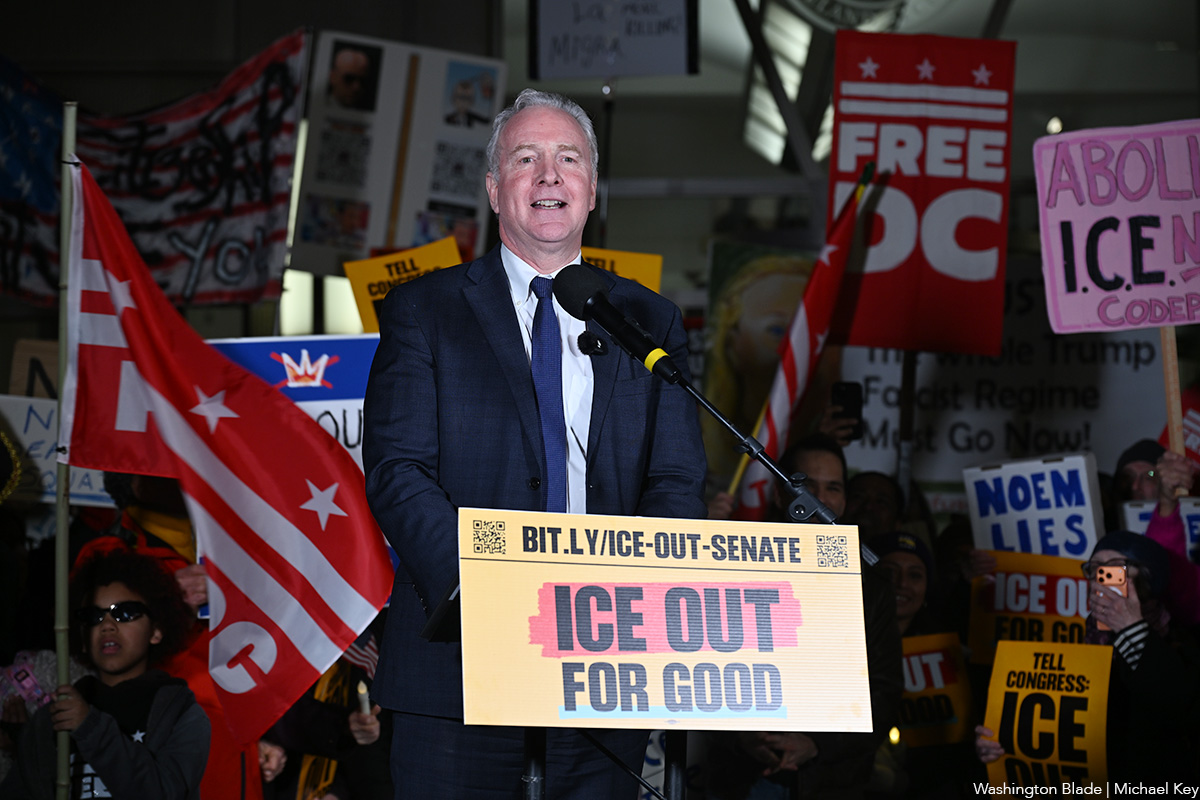
By LEE O. SANDERLIN | The Democratic Party is having something of an identity crisis — losing to President Donald Trump twice in three elections will do that.
Should the party embrace anti-establishment figures who espouse progressive policy ideas like Medicare for all and rhetoric about unrigging the economy for the 1 percent? Or should Democrats try to appeal to moderates who want to return to semi-normalcy in a time of political upheaval?
Although he’s been in Congress since 2002, with key leadership roles throughout his tenure, Maryland Sen. Chris Van Hollen, 67, counts himself firmly in the anti-establishment camp.
The rest of this article can be found on the Baltimore Banner’s website.
Politics
Log Cabin Republicans remove transgender rights from mission
Decision made after ‘significant discussion’ with members, board

Log Cabin Republicans, an organization that formerly represented LGBTQ conservatives, has removed advocating for transgender and queer rights from its “renewed” national advocacy focus.
In an opinion piece written by Log Cabin Republicans President Ross Hemminger for the conservative media outlet Town Hall, he announced that trans rights would no longer be part of what the organization advocates for through conservative leadership and candidates.
In his piece, Hemminger wrote that after “significant discussion” with members and Log Cabin Republicans’ board of directors, the organization’s leadership voted to “refine Log Cabin Republicans’ national advocacy focus to concentrate specifically on issues of sexual orientation and conservative values,” a focus that does not include trans people.
“We have fought for the right to legally marry who we love, serve our country and our communities openly and proudly, and to enjoy the same inalienable rights afforded to all law-abiding Americans — and we succeeded,” Hemminger wrote. “However, the new era of gender identity politics is not the movement we supported and fought for. Gay men and women are losing public support across the country, and support for gay marriage and other once-widely accepted rights is eroding. Why? Because many voters today weren’t alive or cognizant of the politics of gay marriage winding its way through the courts and gaining ground in public opinion. Their view of the gay community is based on today’s radical transgender activists with their unnecessary and discomfiting focus on America’s youth.”
Hemminger then went on to argue that trans advocacy has shifted to focusing primarily on minors — a characterization that does not reflect the breadth of issues trans advocates address.
“They push schools to teach radical gender ideology; they want biological men in women’s sports regardless of the consequences; perhaps most offensively, they support gender reassignment treatments for minors, often without the knowledge or consent of the parents, knowing full well these treatments are mostly irreversible,” he wrote.
Hemminger and many right-wing political leaders have continued to assert this false reality as fact.
A Harvard-affiliated study found approximately 2.1 gender-affirming surgeries occur per 100,000 trans and gender-diverse minors diagnosed with gender dysphoria, underscoring how uncommon these procedures are among minors. In addition to the option of surgery for those who think it’s right for them, there is an array of other medically sound options to treat gender dysphoria, which according to KFF, an independent source for health policy research and polling, includes “medical, surgical, mental health, and non-medical services for transgender and nonbinary people.”
Additionally trans advocacy is not as narrow as Hemminger makes it seem in his opinion piece.
There are a slew of issues the trans community faces — and fights for — on a daily basis that have nothing to do with healthcare. Those include obtaining government documents that accurately reflect one’s gender identity, multiple elements of family law that include the right to marry and adopt children as straight couples can, protections from violence, hate crime protections, the right to serve in the military, access to bathrooms corresponding with their gender, and the right to education.
Despite the overwhelming number of issues trans people — regardless of political affiliation — have to struggle with as a result of systemic gaps in protections that are supposed to be afforded to everyone under the law, they remain vulnerable to unequal treatment.
Despite this shift, Log Cabin Republicans has committed to standing with the Republican Party rather than LGBTQ people as a whole. The organization was initially founded as a loosely connected network of local California social clubs made up of LGBTQ conservatives in the late 1970s before eventually emerging as a national political organization in the early 1990s under its founding executive director, Rich Tafel.
As the organization continued to gain momentum, it endorsed a handful of Republicans who voted against the Respect for Marriage Act, the 2022 law that federally recognized marriage equality for same-sex couples.
The Washington Blade reached out to Log Cabin Republicans for comment but did not hear back by the time of publication.

PHOTOS: Miss Gay Old Bay

SUNFESTIVAL takes center stage as Rehoboth Beach closes out summer

Anne Arundel schools now need parent permission to call trans students by preferred names

Shooting outside gay bar in Ariz. leaves three dead

‘People don’t see me. They see a trend’

San Francisco, long a queer safe haven, remains competitive for homebuyers

Calendar: August 28-September 3

Trans, nonbinary Americans find refuge in the Netherlands

‘Teenage Sex and Death’ has never been more entertaining

Actor Tim Curry dies at 80
-

 California5 days ago
San Francisco, long a queer safe haven, remains competitive for homebuyers
-
Calendar5 days ago
Calendar: August 28-September 3
-
Netherlands5 days ago
Trans, nonbinary Americans find refuge in the Netherlands
-
Movies5 days ago
‘Teenage Sex and Death’ has never been more entertaining