Politics
What’s the White House strategy for passing ENDA?
Carney tight-lipped on way forward for LGBT legislation
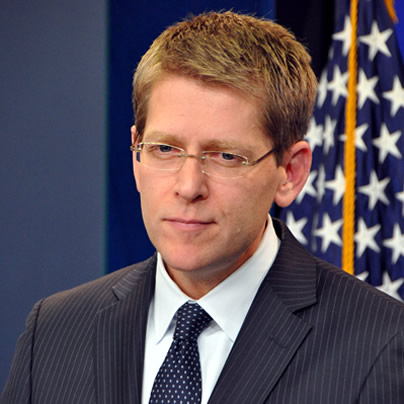

White House Press Secretary Jay Carney is tight-lipped on White House strategy for ENDA (Blade file photo by Michael Key).
White House Press Secretary Jay Carney was tight-lipped Wednesday on the White House strategy for passing ENDA as he praised the Senate for advancing the bill earlier in the day.
Under questioning from NBC News’ Kristen Welker, Carney wouldn’t disclose the plans for ENDA or say whether they’d be similar to what President Obama has done to push forward on immigration reform.
“If you talk about your strategy in advance, you’re not a very good strategist,” Carney said. “So we have supported it. We have made our support clear for it. We’ll continue to work with Congress in the effort to translate that support into law, to work to build on the bipartisan passage out of committee of ENDA legislation, and hopefully that process will result in a law that the president can sign.”
Carney also said the White House will continue to withhold the executive order prohibiting federal contractors from engaging in LGBT workplace discrimination even after the successful vote on ENDA in the Senate Health, Education, Labor & Pensions Committee. Still, he acknowledged LGBT workers continue to face discrimination as ENDA progresses through Congress.
“We understand that and we have had the position we’ve had,” Carney said. “And that position — some criticism of that has been, well, there’s not going to be progress on ENDA, but in fact we did see progress today, and we welcome that.”
A partial transcript of the exchange between NBC News and Carney follows:
NBC News: And I want to go back to ENDA for a moment. The president is working on immigration reform, the student loan bill. Where does getting ENDA passed fall on his list of legislative priorities? How much urgency will he bring to it?
Jay Carney: We have long supported past — well, I mean, we have long supported comprehensive nondiscrimination legislation that is reflected in what the bill that passed the Senate committee today. And I think our support is helpful to that process, and we’ll continue to push it forward.
NBC News: Will we see the type of public statements that we saw, for example, today on immigration reform? What will he do specifically to get this — to the Senate?
Carney: Well, I don’t — again, as I said earlier, if you talk about your strategy in advance, you’re not a very good strategist. So we have supported it. We have made our support clear for it. We’ll continue to work with Congress in the effort to translate that support into law, to work to build on the bipartisan passage out of committee of ENDA legislation, and hopefully that process will result in a law tat the president can sign.
NBC News: And if the President believes in this, why not sign the executive order and put more pressure on Republicans to act?
Carney: We believe, and I’ve said this all along, that the president believes and we believe that as we’ve looked at this, that the best path forward was through comprehensive — more comprehensive legislation, and that is the path we’ve been on and which we believe has helped achieve the passage with bipartisan support through a committee today.
NBC News: The people who support the executive order and this legislation would say that in the meantime, while this is going through Congress —
Carney: I understand, and I’ve —
NBC News: — members of the LGBT community are being discriminated against. So —
Carney: Kristen, I know you’ve been here when I’ve answered the question at least a half dozen or a dozen times.
I mean, we understand that and we have had the position we’ve had. And that position — some criticism of that has been, well, there’s not going to be progress on ENDA, but in fact we did see progress today, and we welcome that. We’re a long way from the end here, but we welcome the progress we’ve seen today.
Watch the video here:



2026 Midterm Elections
Annie Andrews denounces trans athletes after Trump targets her
President used anti-trans slur to describe SC Senate candidate

Days after President Donald Trump called Annie Andrews, the cisgender Democratic nominee for South Carolina’s U.S. Senate seat, an anti-transgender slur on social media, Andrews came out against transgender girls and women participating in sports.
Trump called Andrews a “trannie” on Truth Social while attempting to garner support for her opponent, U.S. Sen. Darline Graham (R-S.C.), the incumbent seeking reelection in South Carolina.
After the president’s use of the slur was widely reported, the incident provided an opportunity for Andrews to explain her position on the ongoing trans debate that has shaped political discourse in the 2020s, despite trans people making up only 1 percent of the U.S. population, according to the Williams Institute.
She used the opportunity to denounce trans rights and pointed out that, as a physician, she had never performed gender-affirming surgery on minors.
“I want you to hear me loud and clear: I don’t support biological men playing women’s sports, and I don’t support and haven’t ever performed gender surgery for minors,” Andrews said in a political ad.
Despite these recent developments, Andrews has previously voiced support for trans South Carolinians. In 2022, she posted on her X account, criticizing the Save Women’s Sports Act, which was signed into law by Republican Gov. Henry McMaster and restricts trans girls from participating on girls’ sports teams.
“This is shameful legislation that does nothing to protect or support women or children in SC. In fact, it is actively harmful. I will always support trans youth,” Andrews wrote in after the legislation passed.
The Washington Blade reached out to Andrew’s campaign about the comments, and asked if she supports trans rights but did not receive a response.
2026 Midterm Elections
On Republican Long Island, gay Democrat Chris Gallant bets on public service over politics
Chris Gallant sat down with the Blade ahead of his race for NY’s 1st congressional district.
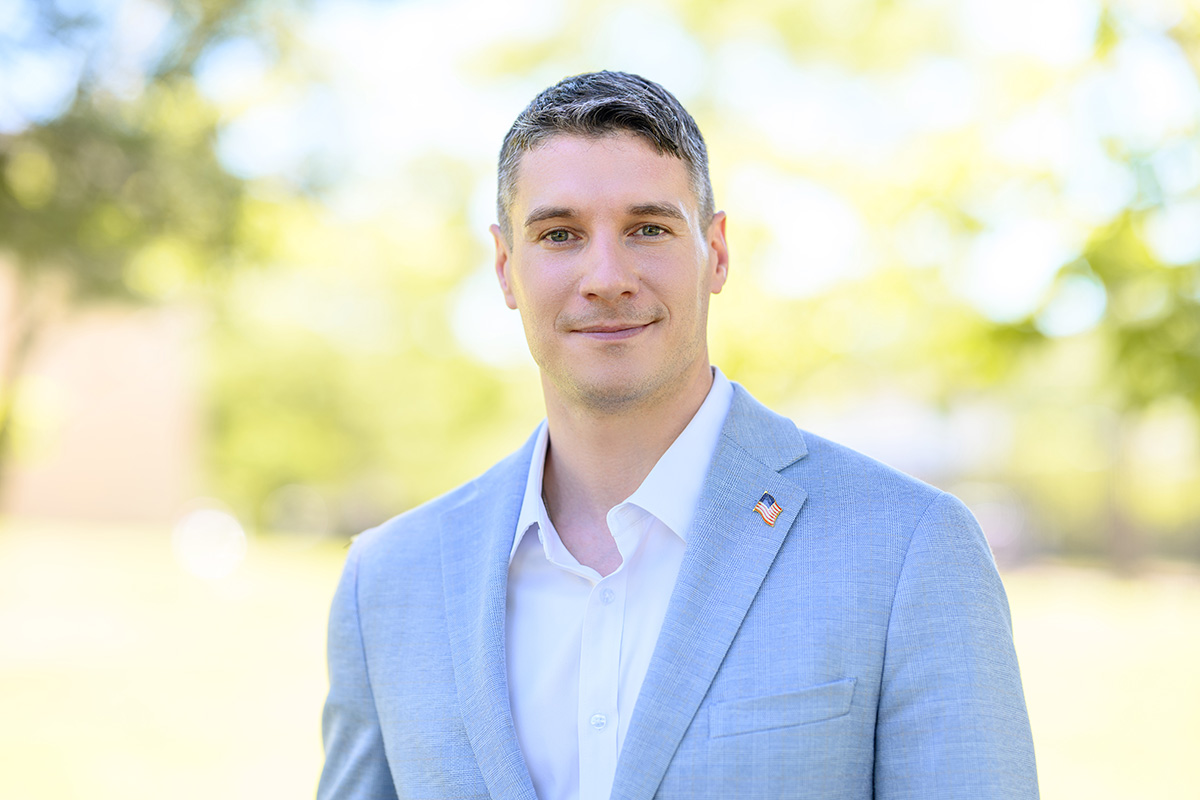
New York’s Long Island, which is just 50 miles from the Stonewall Inn, is a reliably red enclave where President Trump won easily in 2024.
Chris Gallant, an openly gay Democrat running for New York’s 1st Congressional District, which includes Nassau and Suffolk counties, is trying to capitalize on what he sees as growing frustration with the Republican Party and its ability to deliver for everyday Americans.
The Blade sat down with Gallant to discuss his move from civil servant to the fight for public office, how he has been personally impacted by the changes from the Trump administration, and the recent release of photos from his past that have brought the national spotlight his way.
Gallant has a long record of public service that, on paper, would make him an unconventional but compelling candidate for a heavily Republican district. His résumé includes New York Army National Guard service that began when he was 17, multiple overseas deployments, including multiple tours in Kuwait, work as an FAA air traffic controller, union leadership and service as a volunteer firefighter.
That record of service is central to how Gallant describes himself — particularly as he navigates the unusual combination of being an openly gay candidate, a military veteran, and a Democrat running in a district where Republicans have historically held the advantage.
“My fiancé and I both serve in the military and we built our relationship through trust, timing, and a lot of miles between us,” his campaign website says, highlighting the idea of family values that has become a central part of winning the area. “I’ve been openly gay in the military since just after ‘Don’t Ask, Don’t Tell’ ended, and I’ve learned to speak plainly, hold the line, and back up what I say. I’ve also learned how to listen — and how to bring people with very different views to the table and actually make progress.”
Gallant said that record, rather than his sexual orientation, is what should define his candidacy.
“I think who I am as a person is an asset,” he told the Blade when asked if his sexuality has played any role in his decision to run. “I’m not running because I’m gay. I’m running, and,’Oh, I’m gay.’ It’s part of my identity. It’s just a part of who I am. But it’s not necessarily on the table because that shouldn’t make a difference on how I’m going to respond in Congress or how I’m going to run into a burning building. I don’t think those things necessarily matter so much.”
For Gallant, the campaign is ultimately about something broader than identity politics. He said he is running because he wants to restore Americans’ confidence in a government that he says has become less about its people and more about the wealthy leaders in charge.
“I’ve always said that part of the reason why I am running for Congress is because I want to restore faith in our government,” he said. “We’re all drastically exhausted with what’s going on in this world, and particularly with Donald Trump being in office, [his] type of politics, and the way he works, essentially. When Biden got into office after Trump won, it was like the release of a pressure cooker… the pressure cooker is just even worse now this second time around.”
He also explained that his experience working inside the federal government has shaped how he believes Washington should approach its problems. Gallant pointed specifically to the Trump administration’s efforts to reduce the size of government and the role of the Department of Government Efficiency (DOGE), arguing that cutting government spending should not mean indiscriminate cuts.
“I understand that we as a nation need to save money, or at least fix the budget or balance it. We are getting further and further in debt … The budget is always a huge issue and something that we definitely 100% need to fix. But we need to do it with experts and, you know, attack these issues with a scalpel, not a chainsaw.”
The chainsaw Gallant mentioned is a clear reference to controversial Trump supporter Elon Musk, who announced he would be heading the highly politicized DOGE agency, where he, the first-ever trillionaire, brandished a shiny chainsaw symbolic of them cutting government spending with no regard for the impact on everyday Americans.
That philosophy, of scalpel over chainsaw, is also part of Gallant’s argument to voters who may be more accustomed to voting Republican. He does not present himself as a traditional politician, but rather as someone whose career outside politics could be an asset in Congress.
“I’m not a politician. This is my first foray into politics, and I think that’s what our politics need. We need fresh new faces, not career politicians. Someone who has brand new ideas, not tainted by politics. So I would say, give me the opportunity to prove myself, because, you know, until I actually get there and I can actually do a job, we won’t know.”
Gallant also shared signs that the political landscape on Long Island may be shifting. He pointed to gains Democrats made across the district last November and said economic concerns could further erode Republican support.
“Last November, in this district we [Democrats] gained 13 and 14 points across the district..And this district lost by 10 points last year. So even just in one year, you can tell that there’s a difference.”
The swapping of support from the Republican side to Democratic reflects the real concern voters have about the economy — impacted by the war in Iran, tariffs, and growing inflation.
“People are feeling it here in their pockets. The cost of living here on Long Island is already high, and things are just getting worse. There’s a lot of promises that were made with this administration that weren’t kept.”
Gallant said that frustration has directly translated into support from some voters who previously backed President Donald Trump.
“I know a lot of people who have voted for Donald Trump that have my lawn sign on their front lawn today. If that’s the change that they’re looking for, I’m going to provide it.”
But Gallant’s campaign has been complicated by a very different kind of political issue: the publication of photos from his past that have become a national story.
The photos, which include pictures of Gallant wearing various fetish gear for Mr. S Leather — including a harness and a collar — were shared with the New York Post.
Gallant has consistently rejected the idea that he should be ashamed of the images or that they undermine his qualifications for public office since their Sept. 13 publication. Instead, he has argued that his record of service should be considered alongside a private chapter of his life from 15 years ago.
“I mean, look, I’m totally not ashamed of who I am as a person. Those pictures were taken in my private life. I can still run into a burning building faster than most people. I can still fly a helicopter. And those are from 15 years ago, right? I built an entire life based around my commitment to the military and the Army National Guard.”
Rather than allowing the controversy to define him, Gallant said he hopes it can become part of a broader conversation about privacy and the consequences of living in a digital age — and indicated that this sort of scenario would become something semi-regular for those who grew up with technology.
“The reality is that we live in a digital age.This is what our generation is going to be stuck with. I laugh all the time because this is the reason why Congress and the Senate are about to die in their chairs. They didn’t have cameras and pictures and photos like that.”
“If I have to be the person to wave the banner now to fight and advocate for not only our community but anybody that could be put in this situation, that realizes now that we’re living in a digital age and this is what the future is going to be. It’s, you know, everything’s left online now.”
That argument extends beyond his own campaign. Gallant said he worries that the prospect of having a digital footprint scrutinized could discourage highly qualified and passionate potential public servants from seeking office.
“I understand that getting into public life means that the rest of your life becomes public. I get it, I do. But I also feel bad because there’s a lot of good people out there wanting to do a job in the public world, and they’re just afraid of what their digital footprint might have on them or might—what might exist because we’ve done things when we’re 12 or 15, or 20, or 30, or whatever.”
“I think living in this digital world, I would love to advocate for people to say, ‘How do we prevent some of these things from coming out into the public view so people can still maintain some kind of a private life?’”
For an openly gay candidate, the issue also carries a particular significance. Gallant said his experience has made him more interested in advocating for other LGBTQ people who may hesitate to enter public life because of what could eventually surface online.
His own LGBTQ policy priorities are relatively focused. He said adding further protections for same-sex marriage in federal law would be one of the issues he would want to pursue if elected, particularly as questions about the Supreme Court’s future approach to marriage equality continue to loom.
“My partner, who’s my fiancé, is currently deployed. We got engaged before he left in December because if the question came up to the Supreme Court– whether gay marriage was going to be a thing– we had to question whether, when he got back from deployment after Christmas this year, whether we were actually going to be able to legally get married.”
“I mean, these are questions that shouldn’t even be questions anymore. So if we can put something like [codifying same-sex marriage] into law, where it’s just not a Supreme Court decision and it can get overturned, like Roe v. Wade, then let’s do it.”
Gallant’s opponent, Rep. Nick LaLota (R-N.Y.), is the two-term incumbent and has a mixed record on LGBTQ rights. LaLota has been vocal in his opposition to overturning Obergefell v. Hodges, the Supreme Court case that established the constitutional right to same-sex marriage, but he has also been outspoken in his opposition to transgender rights. He co-sponsored and voted for H.R. 28, the Protection of Women and Girls in Sports Act, which would restrict participation in women’s sports based on sex assigned at birth rather than gender identity.
Gallant, on the other hand, has few official positions on LGBTQ issues but assured the Blade that, if elected, he would become “an advocate, particularly for the LGBTQ community.”
He also said he believes same-sex marriage should be codified into law and that nondiscrimination protections should be expanded. “I would definitely be pushing no discrimination against anyone for any reason — and that should not have any place in any workplace — especially on the federal government level.”
For Gallant, however, LGBTQ rights are only one part of a broader platform centered on public service, affordability and restoring trust in government.
He repeatedly returned to the idea that a member of Congress should be accessible to the people they represent — something he believes his experience holding town halls and working directly with members of his community demonstrates.
“I always find that a record of service and showing up every day at work and in our communities is what’s going to be key and important. And I think that’s what a representative needs to do. As a representative you’re supposed to represent and work with the people that elect you to office. And so that’s what I’m going to make sure I start today.”
Current prediction markets give LaLota a significant advantage over his challenger, with the incumbent holding an 81 percent chance of winning compared with Gallant’s 19 percent.
2026 Midterm Elections
Trump uses anti-trans slur against Democratic Senate candidate
President mocked Annie Andrews

President Donald Trump used an anti-trans slur against Democratic South Carolina Senate candidate Annie Andrews on Monday as he sought to rally support for Republicans in the state’s Senate race.
In a post on Truth Social, Trump attacked Andrews three times, referring to her as “trannie” while promoting U.S. Sen. Darline Graham (R-S.C.)’s campaign.
Andrews is running against Graham for a Senate seat in the solidly Republican state.
Earlier this year, Graham was specially appointed to the seat following the death of her brother, Lindsey Graham, who represented South Carolina in the Senate from 2003 to 2026.
Andrews, the Democratic nominee from the state, is a pediatrician that lives in Charleston with her three children. She told NBC News that she will “work with anyone to put South Carolina first.”
“As a mom and a pediatrician, I’m in this race to fight for my patients, my three kids, and South Carolina,” Andrews said, adding that “lowering costs and making life better for families across our state is going to take all of us working together.”
Andrews used the attention from the president’s attack to emphasize what she described as a focus on policy issues rather than the culture wars that have dominated much of the political debate.
“If you care more about your bills than the politics in Washington, this campaign is for you,” she added.
Trump’s remarks have drawn criticism from leaders on both sides of the aisle.
Senate Minority Leader Chuck Schumer (D-N.Y.) condemned Trump’s words Monday night on social media, calling his attacks on Andrews “despicable.”
“Annie Andrews is a mom and pediatrician who’s always put her community first — and she’s exactly who South Carolina needs representing them in the Senate,” Schumer said on X.
Former South Carolina Gov. David Beasley, a Republican, also criticized the president’s attack on Andrews, urging voters to “reject politics based on division and hate.”
“This is abhorrent. Elections don’t have to be about cruelty and lies. South Carolina deserves better,” Beasley wrote Monday night on X.
South Carolina has not elected a Democratic senator in nearly three decades.
Andrews’s campaign website does not mention her positions on LGBTQ issues.
The Washington Blade reached out to Andrews’s campaign for comment on Trump’s attack and her positions on transgender rights but did not hear back by time of publication.

Annie Andrews denounces trans athletes after Trump targets her

On Republican Long Island, gay Democrat Chris Gallant bets on public service over politics

Report: LGBTQ exclusion costs Japanese economy billions a year

Center for Black Equity honors leaders, activists at BE. Gala

In ‘The Lost Brontë,’ a complicated lie can lead to danger

U.S. int’l trade negotiator, consultant James Bedore dies at 82

Campaign urges Virginia High School League to reverse stance on trans athletes

Trump, Netanyahu, and Putin are all war criminals

Center Arts Gallery celebrates 10 years with reception, auction

Calif. GOP gubernatorial candidate ad ‘disgusting attempt to exploit lesbian intimacy’
-

 Obituary5 days ago
U.S. int’l trade negotiator, consultant James Bedore dies at 82
-
Virginia5 days ago
Campaign urges Virginia High School League to reverse stance on trans athletes
-
Opinions5 days ago
Trump, Netanyahu, and Putin are all war criminals
-
California5 days ago
Calif. GOP gubernatorial candidate ad ‘disgusting attempt to exploit lesbian intimacy’