National
HRC president on the road ahead for LGBT movement
‘You don’t give up anywhere, and we’re going to have opportunities everywhere’
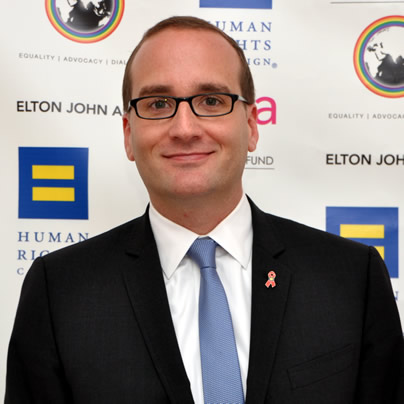
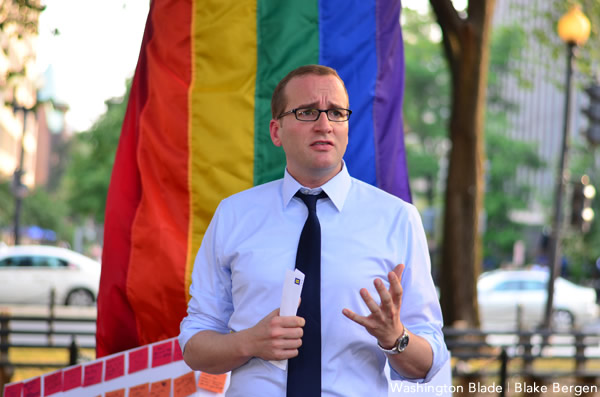
Human Rights Campaign President Chad Griffin sees progress on ENDA and marriage equality ahead. (Washington Blade file photo by Blake Bergen).
From advancing marriage equality to building support for the Employment Non-Discrimination Act, Human Rights Campaign President Chad Griffin sees significant progress ahead on LGBT issues across the country.
Immediately after the Senate committee vote Wednesday in favor of ENDA, Griffin spoke with the Washington Blade about moving forward in the aftermath of the historic vote and the U.S. Supreme Court decisions two weeks earlier in favor of marriage equality.
Griffin also talked about the Southern tour on which he’s embarked — in particular his visit to his home state of Arkansas — which he said is an attempt to reach out to LGBT people away from the coasts to ensure progress reaches them.
“If you look at the map of equality right now, you’ve got the coasts — largely, not completely — colored in, and then you’ve got everything in the middle with two little amazing dots that I’m really proud of: one in Minnesota, and one great Supreme Court decision in Iowa, ” Griffin said. “But the rest of this country has to be colored in as well.”
Arkansas was also an important stop for Griffin because Sen. Mark Pryor (D-Ark.) is one of three Senate Democrats who have yet to sign on in support of ENDA. Griffin emphasized poll numbers showing 61 percent of Arkansas resident support a transgender-inclusive federal law protecting workers against discrimination.
“Sen. Pryor is a key vote, and Sen. Pryor has yet to announce his position on ENDA, and it’s important for him to hear from Arkansans, for him to hear from folks all over the state on why this is important to them,” Griffin said.
Asked whether a discharge petition would be an appropriate course of action for ENDA in the House, Griffin said, “I don’t know the answer. I think as we get closer and as we make progress in the Senate, we’ll see, as we get closer, what the right strategies will be ultimately to get this done.”
Griffin also identified LGBT youth homelessness as an issue that doesn’t get enough attention in the media compared to others like marriage equality — noting 40 percent of homeless youth in Salt Lake City identify as LGBT.
“Just yesterday, I was talking to a number of folks in North Carolina about the homeless youth issue, and the issue of homelessness,” Griffin said. “There are a number of ways to combat that problem. One of them is direct service providing and the need for public funds to do that.”
The full transcript of the interview follows:
Washington Blade: What do you hope to accomplish during your Southern tour?
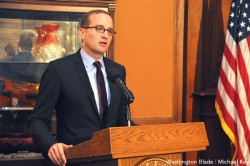
Chad Griffin at the ceremony for the signing of the D.C. anti-bullying bill. (Washington Blade file photo by Michael Key)
Chad Griffin: Look, I said this the moment I walked down the steps of the Supreme Court, and then I said it on the phone with the president about 10 minutes later that there’s certainly a moment of celebration. We have to acknowledge the historic significance of those two decisions, of the fact that two of the grandest symbols of discrimination in this country — in many ways, quite frankly, around the world — were struck down by the Supreme Court, and, with that decision, thousands upon thousands, and ultimately millions of people are going to be treated more equal, and with dignity and respect.
Families are going to have protections that they didn’t have before, and we doubled the number of Americans in states with marriage equality, which is incredible. We went from 14 percent to 30 percent.
But the moment you finish those words, you immediately have to pivot to the 37 states that didn’t feel the reach of justice by those decisions. Now, they provided great help to the young person who was able to see on TV, and read on the Internet and Twitter and so forth — it gave great hope and it said some day, those people are going to grow up with the same hope, dreams and aspirations. But in 37 states, they didn’t feel the reach of justice.
… That night, I never went to bed. I was on a 6 a.m. flight to Salt Lake City the very next morning. The Thursday morning after the decisions to highlight just that. And that’s where we have to work, and have to organize like we’ve never organized before, and work harder than we’ve ever worked before in states across this country. Because if you look at the map of equality right now, you’ve got the coasts — largely, not completely — colored in, and then you’ve got everything in the middle with two little amazing dots that I’m really proud of: one in Minnesota, and one great Supreme Court decision in Iowa.
But the rest of this country has to be colored in as well, and that’s why I’ve been meeting with folks — in Arkansas, in particular. We released a bipartisan poll — I assume you know about that — that’s incredible. All the focus is always on the national numbers, and where the movement is, and whether we’re 56 or 57 or 55, whatever national poll you look at. But in Arkansas, we’re almost 40 percent in support of marriage equality, and for those under 30, we’re at 61 percent in support for marriage equality.
And then, in that state in particular, we highlighted the ENDA numbers. Over 60 percent of Arkansans support a fully inclusive Employment Non-Discrimination Act. And that’s an important message to get out. … We did two events. The first one, we had about 400 people. The next one, on the same day, about 300 people. I met with folks in Hot Springs a couple days before that when I was with my family.
But Sen. [Mark] Pryor is a key vote, and Sen. Pryor has yet to announce his position on ENDA, and it’s important for him to hear from Arkansans, for him to hear from folks all over the state on why this is important to them.
I then went to North Carolina, and, unfortunately, Sen. Burr voted via proxy, he wasn’t here today, via proxy “no.” But I think that you give up on no one. We still have several weeks, and months, to work before this on the Senate, and I think we don’t give up on anyone. There were a lot of folks who were surprised by the bipartisan votes that came out of this markup this morning. And I’m optimistic that we can have more Republicans and undecided Democrats join us. And that’s why I’m spending time in these states, so that these folks can hear from their constituents, and can hear from them in loud and bold ways.
And for us to really begin, and for me to spend time, quite frankly. In my first year, I think I’ve been to 23 states, and it’s time to spend a lot more time in the states, like Arkansas, my home town, where I grew up my entire life, where my entire family still is. And Arkansas looks a lot like the other 37 states.
Blade: What do you think are the most immediate prospects for marriage equality in those remaining 37 states?
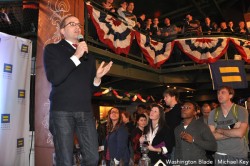
(Washington Blade file photo by Michael Key)
Griffin: Well, like I said, it took us less than five years to take down Proposition 8 from the day it was passed. I think within these next five years, and I think it’s an important goal to set that we, as a community, can bring marriage equality to all 50 states within five years. And there a number of opportunities. There’s no silver bullet that goes from state to state. It’s very different in the states.
In a state like Illinois, we have all been organizing in a great coalition of in-state organization and national organizations like the Human Rights Campaign, Lambda, the ACLU and HRC. We’ve had, I think, 15 field team members on the ground there for months. That legislature should have already passed it. I think, very soon, it will.
In Oregon, there’s a ballot opportunity coming up where we also have folks on the ground and strong chapters. In Nevada, we have real opportunities there. It’s a bit more of a complicated process with two legislative votes, and then a public vote, to make progress. It’s the only state, I think, by the way, that’s like that.
And then, there are other states that, I think, where opportunities are going to present themselves. There are states — people were shocked that opposition to marriage equality was 55 percent. “55 percent? That means you’re losing!” Yeah, but look at the movement each year. Well, in two years, in three years, in four years, I don’t know how many years that is, we’re a few years away from crossing the 50 percent point in a state like Arkansas.
So, I really think that you don’t give up anywhere, and we’re going to have opportunities everywhere. Now, at the end of the day, just like in the civil rights movement in the ’50s and ’60s, there are going to be states that, unfortunately, the electorate might move, but elected officials might not in some of the places. And, I think, ultimately, they will regret it as most of them did during the civil rights movement, and for those states, it will take another federal court decision.
And I suspect, you’ve already seen several announced, I suspect you’ll probably see dozens in the months to come, as legal organizations as well as just everyday folks filing lawsuits with the momentum they saw out of those decisions.
What’s important is that we’re strategic and smart in all those ways, but what’s also important [is] that we acknowledge what might have been impossible just a few years ago, is perhaps possible today. You know, and as it relates to the Prop 8 case, there were a lot of folks that thought that wasn’t possible and thought that Justice [Anthony] Kennedy would never be there on issues like equal protection today, and argued for waiting a long time. What we saw was the courts catching up with public opinion, and so ultimately, there will be another federal court case or multiple ones that reach the Supreme Court, and that’ll just decide this for the states that don’t move along.
But our job, in the interim, is to move equality forward, where we can advance marriage equality. We need to advance it in all these different ways, continue to change more hearts and minds where we can move forward with employment non-discrimination. Statewide we need to do it. And where we can’t get it statewide, we need to move it at the municipal level in cities and in counties — again, depending on the state, how you can move it forward.
A state like Utah, I think, to date, the number is like 18 municipalities in Utah. There are no statewide protections. but there are 18 cities in Utah that have such protections. My home state of Arkansas has none, has zero protections. Hopefully, some day, in a state like Arkansas, we can move forward on employment protections statewide, but in the meantime, I think it’s an example of a place where we make progress at the city level in a number of places.
Blade: Getting back to ENDA, today we had Hatch and Murkowski voting in favor of it. Did those votes surprise you?
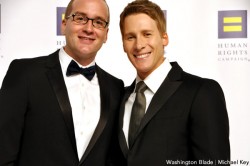
Griffin: I have to say when it comes to issues of equality, nothing surprises me when it comes to Democrats and Republicans on this issue.
The most recent poll shows 9 out of 10 Americans have someone in their close immediate family circle, or close friend circle, that’s LGB or T. And all of the research shows that when you know us, you don’t hate us, you don’t wish less than, you don’t wish upon your loved ones to be treated as less than you, and you don’t wish for them to be intentionally harmed, and, I think, that is a key reason that Democrats and Republicans alike are evolving on these issues. Folks in both parties, but it was particularly significant today that we came out of this markup for those three Republicans joining those Democrats.
I think it’s also important to note that there was also one Republican here who actually voice-voted “no,” and then was the proxy for the other “nos.” But none of the other “nos” were actually even in the room. It’s incredible progress. We’ve seen the incredible bipartisan progress on marriage equality, today we saw bipartisan progress as it relates to ENDA, and I think this is only going to continue.
Our job is to continue to organize to continue to increase the pace of this bipartisan progress, and to ensure that when we get to the Senate floor, we’ve done everything we can to ensure that these senators have heard from their constituents back home, and that they know that this is not a partisan issue at home, and that they know that it’s an issue of basic human dignity.
It’s, quite frankly, the most conservative of issues — basic human dignity, treating everyone equally under the law, hiring them based on their qualifications, keeping them based on their job performances, not based on who they love, how they were born. And so, I’m so excited to sit here today and see the bipartisan collaboration.
But we have to acknowledge we still have a long ways to go. This vote today does not mean this bill is done. It means we’re coming out in a good way, but we’ve got a lot of work to do to push this across the finish line: both in the Senate to get 60 votes, and then we move to the House of Representatives.
Blade: What are some of the details? How are you going to get there? How are you going to achieve that?
Griffin: Well, we’re already doing it, and I said, the examples I gave, we’re organizing in states where we have …targeted votes. Arkansas being an example, and Utah being another example, and Alaska being another example.
[To HRC Legislative Director Allison Herwitt]: Feel free to add here. I didn’t sleep last night. North Carolina? I’ve already told him about that one.
Blade: In the House, do you think a discharge petition would be a good way to go to move forward?
Griffin: I don’t know the answer. I think as we get closer and as we make progress in the Senate, we’ll see, as we get closer, what the right strategies will be ultimately to get this done and work with the leadership, and work with Leader Reid and Chairman Harkin, who have been instrumental, and Sen. Merkley, who have been instrumental in getting us to where we are today. And we’ll work closely with them and take direction from them in terms of the best way to advance this and come up with a law that the president can sign.
Blade: You talked a lot about marriage and ENDA. What LGBT issues aren’t getting enough attention in the media?
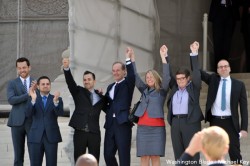
(Washington Blade file photo by Michael Key)
Griffin: Well, look, I never think enough attention can be given to an issue when there’s so much harm done every single day, and I always go back to the young people who suffer day in, and day out because of inequality. There are the laws that impact, and the laws that should be providing protections to them and to their families, but there’s also the bigger impact of those laws giving license to discriminate.
Just yesterday, I was talking to a number of folks in North Carolina about the homeless youth issue, and the issue of homelessness. There are a number of ways to combat that problem. One of them is direct service providing and the need for public funds to do that. But it’s such a disproportionate number of LGBT youth that are homeless.
In Utah, the day before I started this job, I spent a good portion of the day at a homeless shelter, not an LGBT homeless shelter, a homeless shelter. Forty percent of homeless youth in Salt Lake City identify as LGBT. So there’s a lot of work to do there. But you also have to go to the root of the problem of why are these young people homeless, and it’s often two answers. One, they come out of the closet, and their parents reject them because they’re either told by the government, or by their church, that their children are less than and they should be rejected.
Or, often times, the case is they do come out. Young people increasingly have the courage to come out, and then their families reject them and kick them out of their homes, and young people travel to the closest city they can get to where they have a shelter.
So, I don’t want to insinuate that that’s the only issue that should be getting more attention because there are many issues that should be getting more attention both from the media, and public funding and financing, and legislatively.
But we have a long ways to go, and I think, the important point with the question you ask is there are a lot of celebrations over these last two weeks, and it is important finally to celebrate when we’re having some major achievements. You have to be able to celebrate, but you also have to immediately be able to turn the corner and pivot, and acknowledge the road ahead.
Blade: You’ve been on the job at HRC for just more than a year now. Has anything come up over that time that has surprised you, that came up that you didn’t think was going to happen?
Griffin: Look, I’ve been in Washington long enough before I started this job that it’s sort of difficult to surprise, but, I guess, what moves me the most is meeting the thousands and thousands of people. Like I said, I was probably with 800,000 people in Arkansas in a 24-hour period. I venture to say it was 60 percent LGBT folks and 40 percent straight allies who showed up because they cared and they want to advance equality. Those are the folks that are good reminders every single day of why we fight this fight.
In this town, we so often get caught up in the partisan and political bickering, and it’s important for all of us to spend as much time as we can outside this city, So, I guess perhaps, I don’t know if surprise is the right word, but certainly the most gratifying part of this job is getting to spend time with those folks that need equality the most.

National
Lou Chibbaro Jr. documentary wins award from NLGJA
‘Lou’s Legacy’ produced by D.C.’s Mattachine Society

“Lou’s Legacy: a Reporter’s Life at the Washington Blade,” a documentary produced by The Mattachine Society of Washington, D.C., will receive an Excellence in Journalism Award from NLGJA, the Association of LGBTQ+ Journalists.
The film premiered on WETA PBS in D.C. and Maryland Public Television (MPT) in June of 2025. The documentary’s Emmy-nominated director and producer Patrick Sammon will accept the award for Excellence in Local Television on Sept. 11 at NLGJA’s National Convention in San Francisco.
“Lou’s Legacy” was produced in association with the Mattachine Society of Washington, D.C., a non-profit LGBTQ history society dedicated to conducting original archival research. Aside from Sammon, the NLGJA is recognizing other members of the film’s production team including Producer Julianne Donofrio, Editor Amir Jaffer, Executive Producer Charles Francis, and Executive Producer Pate Felts.
“Lou’s Legacy” tells the story of two D.C. icons — legendary Washington Blade reporter Lou Chibbaro Jr. and beloved drag performer Donnell Robinson, known to generations of Washington audiences as “Ella Fitzgerald.” Through Lou’s nearly five-decade career at the Blade and Ella’s return to the stage after a three-year hiatus following COVID, the 29-minute documentary explores the history of Washington’s LGBTQ community and today’s rising backlash against LGBTQ rights, including laws targeting drag performers.
“All students of journalism can learn a lot from the story of Lou Chibbaro, Jr. Lou has chronicled nearly five decades of LGBTQ+ life and the community’s struggle for equality in Washington, D.C. Lou’s work and the role of the queer press has been essential in covering stories the mainstream media would often ignore or erase,” said Ryan Levi, president of the D.C. chapter of the NLGJA.
“We are thrilled to receive this award from the NLGJA,” said the film’s director Patrick Sammon. “Lou Chibbaro’s nearly five decade career at the Washington Blade demonstrates the essential role LGBTQ journalism plays in telling our community’s stories and documenting its history. This recognition from journalists who follow in Lou’s footsteps is particularly meaningful to me and the rest of our production team.”
Arizona
Shooting outside gay bar in Ariz. leaves three dead
Tucson police investigating double murder-suicide as a hate crime
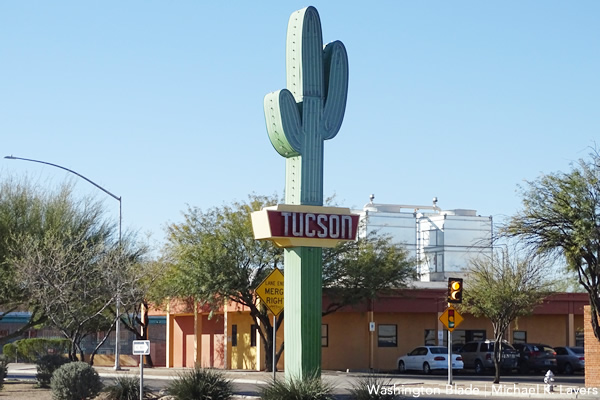
Three people were fatally shot outside a gay bar in Tucson, Ariz., early Monday morning, about a mile from the city’s nightlife district.
Police have said the shooting, which took place in the parking lot of Venture-N bar at 1239 N. 6th Ave., was likely a hate crime and a double murder-suicide following a verbal altercation.
The suspect, Ousman Ceesay, allegedly shot Vincent Anthony Siqueiros and Cameron Davis Capara while they were outside the club around 12:30 a.m. Monday.
Reports show Capara and Siqueiros were pronounced dead at the scene. Ceesay died after being taken to a local hospital with gunshot wounds.
Police have also said that Ceesay was carrying a list of LGBTQ businesses at the time of the shooting.
Arizona Public Media has said police are investigating the case as a hate crime because the suspect was carrying a note containing the names of multiple LGBTQ-associated businesses.
“I am deeply saddened that another senseless loss of life has happened in our community,” Tucson Police Chief Monica Prieto said in a statement. “Bias-based crimes are especially heinous and have no place in our community.”
According to Prieto, there is no imminent threat to the community, and the Tucson Police Department is working to provide extra protection to various LGBTQ businesses across town.
Congresswoman Adelita Grijalva, who represents the area, issued a statement condemning the act of violence, which appears to have been at least in part motivated by homophobia.
“I am disgusted and deeply saddened to learn of a targeted act of hate and the cold-blooded murder of two members of our LGBTQIA+ community, Vincent Siqueiros and Cameron Capara, at the Venture-N bar in Tucson last night. This horrific attack is a painful reminder that even in welcoming communities like Tucson, hate and violence against the LGBTQIA+ community still exist.”
“When that hate is combined with easy access to firearms, the consequences can be deadly. I am sick and tired of Congress refusing to lift a finger to protect our communities while, every day, dozens of people are shot and killed across the country. It does not have to be this way. The House of Representatives is returning to session this week, and our first action should be passing common-sense gun safety reforms that we know can save lives.”
Other federal lawmakers also condemned the shooting.
The Congressional Equality Caucus, which is made up of federal legislators advancing LGBTQ interests, issued a statement after news broke.
“Our hearts are with the friends and loved ones of the victims of this devastating attack outside a Tucson gay bar and with the Tucson LGBTQI+ community,” it said on X. “No one should fear violence because of who they are — and we’re going to continue fighting to build a world where no one does.”
The Human Rights Campaign, the largest LGBTQ organization in the country, released a statement following the shooting.
“We are heartbroken by the loss of Vincent Anthony Siqueiros and Cameron Davis Capara and our hearts are with their families, loved ones, and the entire Tucson LGBTQ+ community. Once again, we are reminded that gun violence robs people of their lives, destroys families, and devastates communities.”
A candlelight vigil honoring the victims is planned for Sept. 2 at 6:30 p.m. at Catalina Park in North Tucson.
Congress
HRC president campaigns for Chris Pappas in NH
Gay congressman running to succeed retiring U.S. Sen. Jeanne Shaheen

Human Rights Campaign President Kelley Robinson on Sunday campaigned for U.S. Rep. Chris Pappas (D-N.H.) in New Hampshire.
Robinson traveled to Manchester, the state’s largest city, nine days before the Sept. 8 primary that will determine who will vie for retiring U.S. Sen. Jeanne Shaheen (D-N.H.)’s seat.
We’re hitting the pavement across New Hampshire to fight for a freer, fairer future for everyone.
Glad to have Human Rights Campaign President @KelleyJRobinson join us for a canvass launch in Manchester today. pic.twitter.com/XWCEaQxy4o
— Chris Pappas (@ChrisPappasNH) August 30, 2026
Former U.S. Sen. John E. Sununu, who represented New Hampshire in the U.S. Senate from 2003-2009, will face off against former U.S. Sen. Scott Brown, who represented Massachusetts in the U.S. Senate from 2010-2013, in the Republican primary.
Karishma Manzur is among the Democrats challenging Pappas.
A poll the University of New Hampshire Survey Center released on Aug. 26 shows Sununu is ahead of Brown. The same survey shows Pappas ahead of Manzur and his other Democratic challengers.
The UNH Survey Center poll shows Sununu ahead of Pappas by a 45-43 percent margin if they were to face off in the general election. The margin of error is +/-2.1 percent.
Pappas would become the first openly gay man elected to the U.S. Senate if he were to win in November.

Markey’s primary win deemed success for LGBTQ activists

Top Bulgarian court rules government must legally recognize trans people

Lou Chibbaro Jr. documentary wins award from NLGJA

Beloved D.C. ‘Old Catholic’ Bishop Charles Braun dies at 86

Blade welcomes fall intern

E-INFOSOL leaders encourage youth to pursue tech careers

New book examines Trump cuts to LGBTQ healthcare

Immersive ‘Nation-State’ imagines a society free of authoritarianism

Poland begins to legally recognize same-sex marriages from other countries

HRC president campaigns for Chris Pappas in NH
-

 Technology5 days ago
E-INFOSOL leaders encourage youth to pursue tech careers
-
Books5 days ago
New book examines Trump cuts to LGBTQ healthcare
-
Theater3 days ago
Immersive ‘Nation-State’ imagines a society free of authoritarianism
-
Poland3 days ago
Poland begins to legally recognize same-sex marriages from other countries