Local
Maryland Senate committee holds hearing on transgender rights bill
Heather Mizeur among those who testified
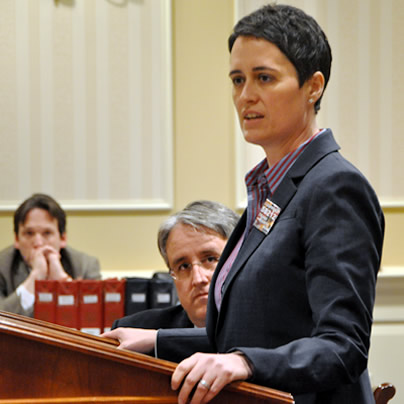
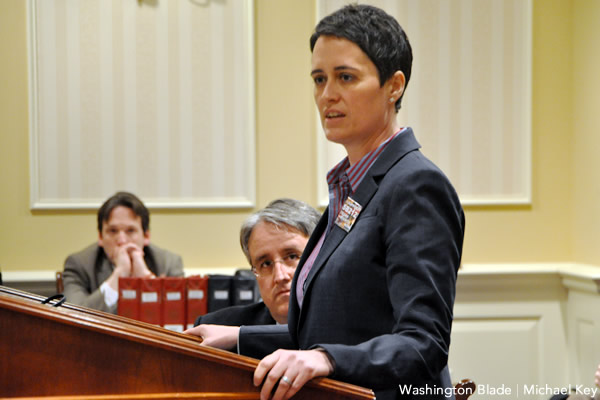
State Del. Heather Mizeur (D-Montgomery County) on Tuesday testified in support of a transgender rights bill. (Washington Blade photo by Michael Key)
ANNAPOLIS, Md.—Maryland lawmakers on Tuesday held a hearing on a bill that would ban anti-transgender discrimination in the state.
Members of the Senate Judicial Proceedings Committee heard testimony from supporters and opponents of Senate Bill 212 that state Sen. Rich Madaleno (D-Montgomery County) introduced last month. The measure would ban discrimination based on gender identity and expression in employment, housing, public accommodation and credit.
“At its core, SB 212 is about securing basic civil rights for transgender Marylanders: the right to a job, a place to live and fair treatment in public spaces,” said Madaleno.
Gov. Martin O’Malley is among those who submitted testimony in support of SB 212.
Gubernatorial candidate Heather Mizeur pointed out during her testimony that the Baltimore County Council passed a trans rights bill after two teenagers attacked Chrissy Lee Polis at a Rosedale McDonald’s in 2011.
“This is a protection we want to make sure gets extended statewide,” said Mizeur. “Protection against discrimination shouldn’t depend on your zip code.”
Mizeur’s Democratic challengers and their running mates — Lieutenant Gov. Anthony Brown and Howard County Executive Ken Ulman and Attorney General Doug Gansler and state Del. Jolene Ivey (D-Prince George’s County) — back SB 212.
Brown and Gansler both submitted written testimony in support of the measure.
“The Fairness for All Marylanders Act of 2014 is critical to our ability to move forward as a state because no Marylander should face discrimination based on gender identity or sexual orientation,” said Brown. “Whether they’re using a public accommodation or finding housing, looking for private sector employment, leasing a commercial space for their business or deciding what to wear for work, all Marylanders deserve to be treated equally.”
Senate President Thomas V. “Mike” Miller (D-Prince George’s and Calvert Counties) and House Speaker Michael Busch (D-Anne Arundel County) also back SB 212.
“The protections in Senate Bill 212 are needed in real people’s lives,” said Equality Maryland Executive Director Carrie Evans. “These individuals are our spouses, our friends, our co-workers and our fellow Marylanders.”
Francis DeBernardo, executive director of New Ways Ministry in Mount Rainier, and Sister Jeannine Gramick, executive co-director of the National Coalition of American Nuns, also testified in support of SB 212.
“We need to incorporate the vulnerable members of our society into our laws and our customs,” said Gramick.
The Maryland Catholic Conference is among the organizations that submitted testimony in opposition to SB 212.
“The church firmly opposes undue harassment or discrimination against any person,” said the group. “That principle does not, however, warrant creating a new class of protected individuals in the state’s anti-discrimination statute, especially when the extension of the law would presumably apply to only a small number of individuals.”
Elaine McDermott of Maryland Citizens for a Responsible Government and Peter Sprigg of the Family Research Council are among those who also spoke against the measure.
“I am here to stand up for women, children and their safety,” said McDermott, who submitted to the committee newspaper articles that detail men who allegedly targeted women and girls in restrooms and locker rooms. “Women worry about their safety in bathrooms and locker rooms. Proponents of this bill deny that there will be problems with restrooms and locker rooms.”
Zane Walsh, 13, of Baltimore County countered McDermott.
“I am not a pervert lurking in the bathroom,” he said. “I’m pretty much a normal kid.”
The Senate Judicial Proceedings Committee last year narrowly killed an identical bill that Madaleno introduced.
State Sens. C. Anthony Muse (D-Prince George’s County) and James Brochin (D-Baltimore County), who voted against the aforementioned measure in 2013, asked Madaleno and other SB 212 supporters about access to restrooms and locker rooms during the hearing. Michael Lore, an aide to state Sen. Norman Stone (D-Baltimore County), told the Washington Blade on Monday that LGBT rights advocates should not expect the lawmaker’s position on the issue to change unless SB 212 supporters address his concerns over employment contracts.
“He was certainly sympathetic to some of the concerns,” said Lore, discussing Stone’s vote against the 2013 bill. “He’s willing to listen to all sides.”
Baltimore City and Baltimore, Montgomery and Howard Counties have already added gender identity and expression to their non-discrimination laws. Hyattsville in December became the first jurisdiction in Prince George’s County to pass a trans-inclusive anti-discrimination ordinance.
“It is time for Maryland to pass this legislation,” said Madaleno.
Gender Rights Maryland Executive Director Dana Beyer, who announced last week she will challenge Madaleno in the June Democratic primary, noted only 47 percent of Marylanders live in jurisdictions that have adopted trans-inclusive anti-discrimination laws.
“This situation is patently unfair,” said Beyer in written testimony. “I ask you to favorably report SB 212 to the floor to remedy that situation.”
Neighboring Delaware is among the 17 states along with D.C. and Puerto Rico that ban discrimination based on gender identity and expression. Lawmakers in Pennsylvania, New York and other states have introduced similar measures.
The Maryland House of Delegates in 2011 approved a trans rights bill. There are enough votes in the state Senate to ensure passage of SB 212 if it advances out of committee.



Baltimore
Popular Mount Vernon gay bar Leon’s to temporarily close after owner’s death
Ron Singer passed away on July 7
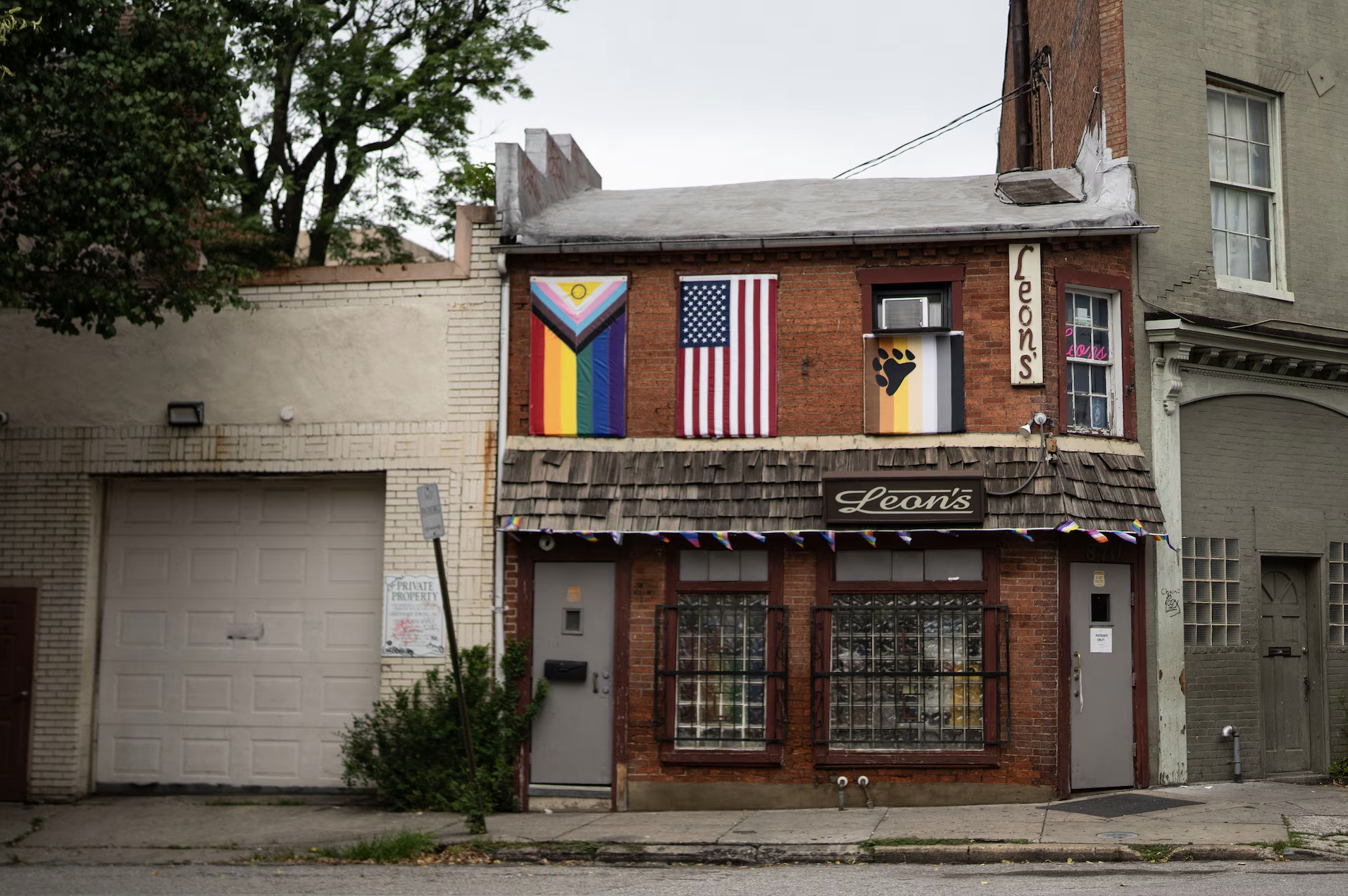
By WESLEY CASE | Leon’s Backroom, Baltimore’s oldest gay bar, temporarily shut down after service on Wednesday night, according to a post on the business’s Instagram page.
The announcement comes a little more than a week after the death of the Mount Vernon bar’s owner, Ron Singer, who died at 66 on July 7.
The rest of this article can be found on the Baltimore Banner’s website.

The Comings & Goings column is about sharing the professional successes of our community. We want to recognize those landing new jobs, new clients for their business, joining boards of organizations and other achievements. Please share your successes with us at [email protected].
Congratulations to Stuart Ortel and Scott Marker, and Dave Lyons and Rick Hardy, on the recent opening of their garden center on Route 1 in Rehoboth Beach, in the former Farmer Girl site. It is called Bay Laurel Home and Garden and debuted earlier this year. The four owners are all well known to the denizens of Rehoboth Beach.
Stuart and Scott have been active members of the Rehoboth Beach community since 1999. Stuart is a landscape architect, and has established relationships with many local folks in the building and landscape industry. When this opportunity for Bay Laurel Home & Garden presented itself, and they had the perfect team of people in place, he and Scott were committed to making it a reality. So, when Scott and Stuart introduced this opportunity to create a new garden center to Dave and Rick, they embraced the chance to cultivate a business where beautiful plants, inspiring home and garden products, and outstanding customer service come together. Dave and Rick knew about owning a business in Rehoboth as they previously owned Coho’s Market, where they discovered firsthand the value of serving their community, and the rewards of running a locally owned business.
The garden center launched with a refreshed brand identity, updated merchandising, and expanded product lines, all designed to create an inspiring and welcoming environment for your home. Bay Laurel Home & Garden offers a beautifully appointed garden center and curated home and gift shop.
The new center features a full nursery with annuals, perennials, shrubs, trees, and seasonal selections; a garden center offering pottery, fountains, and garden ornamentation, and essential tools and garden supplies. It has a garden shop featuring unique indoor/outdoor furnishings and accessories, and a gift shop featuring botanical and coastal style items for home and entertaining.
Rehoboth Beach
Celebrate Pride in Rehoboth Beach this weekend
‘A vital space for community, healing, and connection’
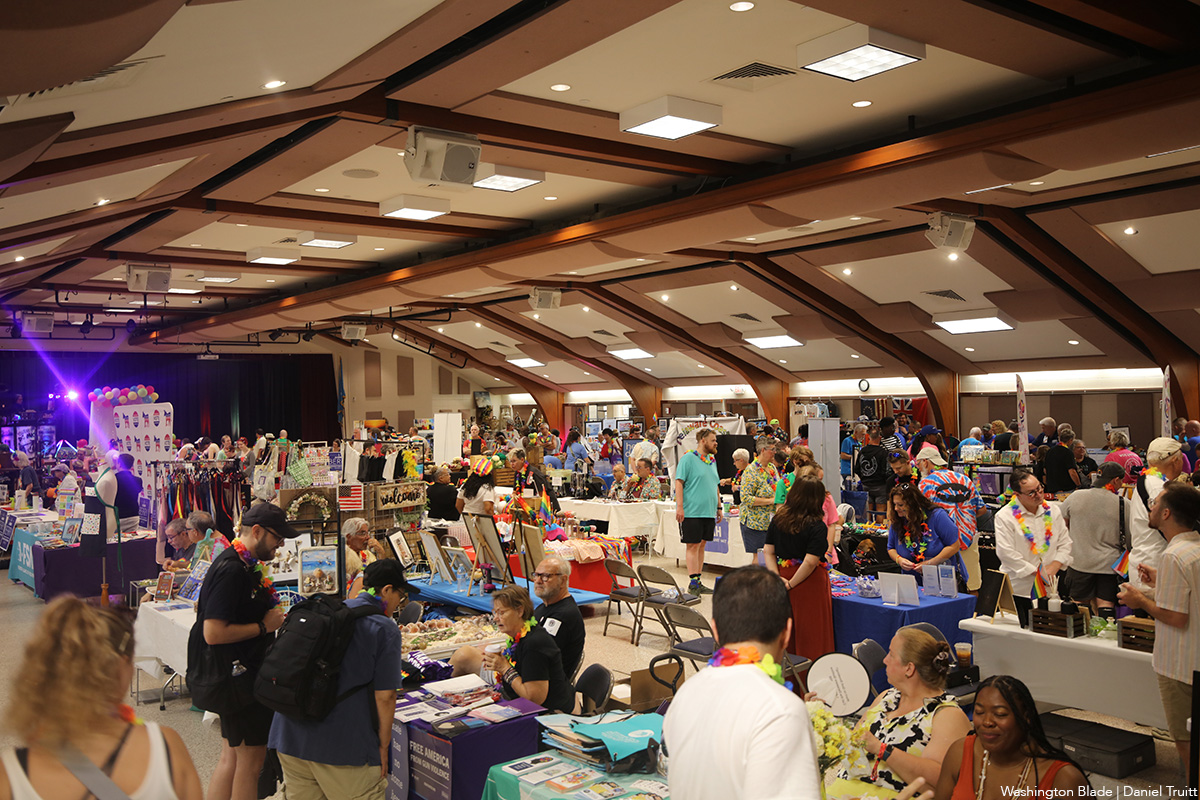
Pride in Rehoboth Beach is kicking off this week on Friday, July 17, with events happening throughout the weekend.
“Rehoboth Beach Pride is more than a festival — it is a vital space for community, healing, and connection,” said David Mariner, director of Sussex Pride, which organizes many of the events.
The weekend will begin with the Grand Opening & Community Preview from 1-4 p.m. on Friday, July 17, celebrating the opening of Novus Medical Services and the new Sussex Pride Community Center.
This will be followed by an Interfaith Pride Service at 6 p.m. at the Metropolitan Community Church Rehoboth to gather for healing and the affirmation of queer spirituality with Rev. Carla Christopher, chair of Sussex Pride Faith.
Members of the community are then invited to head over to join the Rehoboth Beach Bears at the Pines to have dinner, mingle, and give back to local initiatives.
End the first night of Pride in Rehoboth at Diego’s Bar & Nightclub with music by DJ Joey P from 9 p.m.-1 a.m.
Rehoboth Beach Pride Festival will take place on Saturday, July 18, 2026, from 9 a.m.- 3 p.m. inside the Rehoboth Beach Convention Center. A full list of events is available at rehobothbeachpride.org.
Roxy Overbrooke will host on the main stage as live performances take place throughout the day, featuring music from DJ MK and Tribe 9 Entertainment.
The festival will include educational workshops, community meetups, and a raffle dedicated to raising funds for unhoused LGBTQ+ youth across Delaware.
Feature workshops include panels discussing topics such as unhoused LGBTQ+ youth in Delaware, the needs of trans and non-binary youth, as well as the increase in HIV and syphilis diagnoses amid federal budget cuts, in a panel moderated by Blade Editor Kevin Naff.
Saturday night will also feature an evening comedy and entertainment show at the Convention Center presented by the Gay Women of Rehoboth. Performers will include comedians Suzanne Westenhoefer and Karen Mills as well as musician Kristen Merlin. Tickets are available at gaywomenofrehoboth.org.
The Rehoboth Beach Pride Ride will take place at 10 a.m. on Sunday, July 19, hosted by the Dykes on Bikes Rehoboth Beach Women’s Motorcycle Club, starting at Lefty’s.
Goolee’s Drag Brunch will also take place on Sunday from 12-2 p.m at Goolee’s Grille. This is a family-friendly event hosted by Regina Cox and Ruby, featuring Aurora Sterling, Michelle Leigh Sterling, Scarlet St. Cartier, and Joanna Blue. Tickets can be purchased online.
Pride in Rehoboth will conclude at 2 p.m. with the official Rehoboth Beach Pride Closing Party at Aqua Bar & Grill, celebrating the venue’s landmark 20th anniversary with DJ Biff until 7 p.m.
Due to an influx of visitors for the summer season, those coming from out-of-town are encouraged to use the Park & Ride.

PHOTOS: Vitamin C at JR.’s

PHOTOS: Rehoboth Beach Pride Festival

Liza’s book a tale that’s better than most celebrity memoirs

Hot hatchbacks: Honda Civic, Subaru Impreza

When buying a home, it’s decisions, decisions, decisions

Celebrate Pride in Rehoboth Beach this weekend

Expected India Supreme Court ruling could shape future LGBTQ rights cases

Christa Tichy hopes to preserve LGBTQ representation in Md. House of Delegates

Advocacy groups join Venezuela earthquake relief efforts

Rehoboth’s Aqua to celebrate 20th anniversary Sunday
-

 Rehoboth Beach4 days ago
Celebrate Pride in Rehoboth Beach this weekend
-
India4 days ago
Expected India Supreme Court ruling could shape future LGBTQ rights cases
-
Maryland5 days ago
Christa Tichy hopes to preserve LGBTQ representation in Md. House of Delegates
-
Venezuela4 days ago
Advocacy groups join Venezuela earthquake relief efforts