Local
D.C. requires insurers to cover gender reassignment
Mayor bans insurance discrimination against trans residents
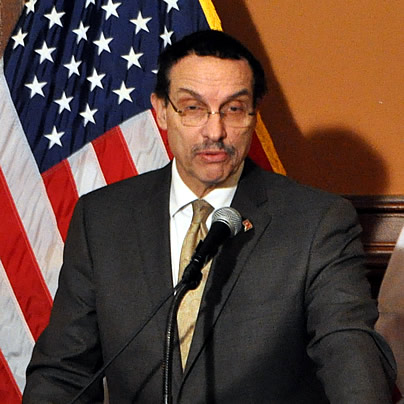
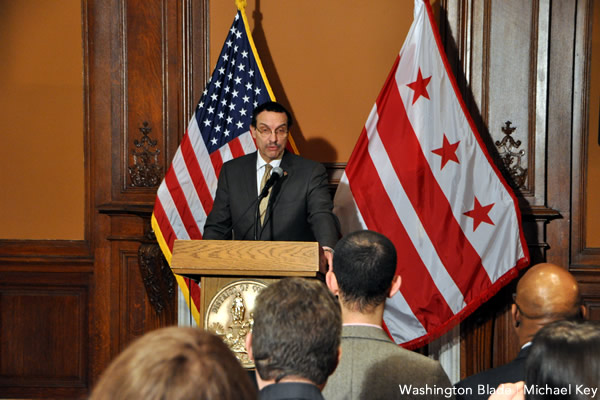
‘Treatment of individuals diagnosed with gender dysphoria is a covered benefit in all individual and group insurance plans in the District of Columbia, including Medicaid,’ said Mayor Vincent Gray. (Washington Blade photo by Michael Key)
D.C. Mayor Vincent Gray announced on Thursday that health insurance companies doing business in the District must provide full coverage for medically recognized treatments to help transgender people change their gender, including gender reassignment surgery.
At a news conference in a meeting room outside his office, Gray said the city’s Department of Insurance, Securities, and Banking issued a bulletin directing insurers to recognize a condition known as gender dysphoria, or gender identity disorder, as a medical condition to be covered by insurance plans.
Transgender advocates note that the American Medical Association and the American Psychiatric Association recognize gender dysphoria as a diagnosable condition through which physicians and other health care professional provide a wide range of approved medical treatments to assist people in transitioning from one gender to another.
“Today, the District takes a major step toward leveling the playing field for individuals diagnosed with gender dysphoria,” Gray said. “These residents should not have to pay exorbitant out-of-pocket expenses for medically necessary treatment when those without gender dysphoria do not,” he said.
“I’m clarifying today that treatment of individuals diagnosed with gender dysphoria is a covered benefit in all individual and group insurance plans in the District of Columbia, including Medicaid,” Gray said.
Gray’s remark drew a prolonged, standing ovation from LGBT activists, including transgender advocates, who gathered in the mayor’s ceremonial bill-signing room where Gray held his news conference.
“Those who know me know how proud I am that the District continues to be on the cutting edge and on the forefront when it relates to equality and fairness for its LGBTQ residents,” Gray said.
The bulletin, which the city sent to insurance companies on the day of Gray’s announcement, cites the D.C. Human Rights Act as among the legal grounds being used to require insurers to cover transgender related treatments. The Human Rights Act, among other categories, bans discrimination based on gender identity and expression as well as sexual orientation.
The bulletin cites the D.C. Unfair Insurance Trade Practices Act of 2001 as further grounds for not allowing insurers to exclude coverage of trans-related treatments from their insurance plans.
Among those speaking at the news conference was Mara Keisling, executive director of the D.C.-based National Center for Transgender Equality, which worked with the mayor’s office and insurance department officials to help draft the four-page bulletin.
Keisling said Gray’s action places D.C. among just five states that have adopted similar policies requiring insurers to cover treatments such as gender reassignment surgery and hormone therapy to assist an individual’s transition to another gender.
Those states are California, Oregon, Colorado, Vermont and Connecticut.
“This is really significant,” Keisling told the Blade after the news conference. “It means that transgender people in D.C. now can make their health care decisions with their doctor rather than with their insurance companies,” she said.
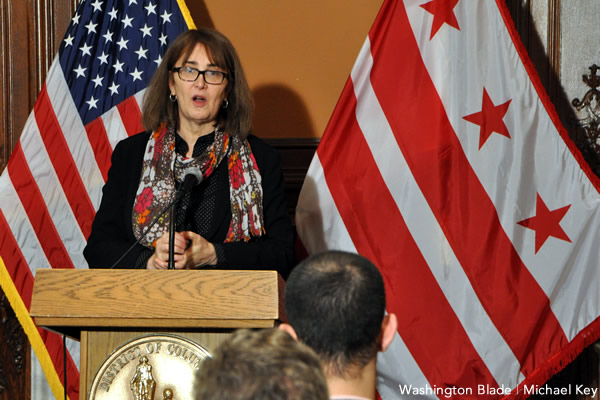
Mara Keisling, executive director of the National Center for Transgender Equality. (Washington Blade photo by Michael Key)
Asked what treatments are involved in a gender transition, Keisling said experts with the World Professional Association for Transgender Health Standards of Care (WPATH) have developed a wide range of treatments that may vary from person to person depending on individual needs.
“It’s a whole range of transition-related care — everything from diagnostic visits to experts in the field,” Keisling said. “It can mean hormone treatments. It can mean lab tests to make sure your hormones are working correctly and not causing any harm. There are various kinds of surgeries that transgender people may need. So it covers a whole range of things.”
D.C. transgender activist Andy Bowen, who recently joined the staff of the NCTE as a policy associate, called the D.C. initiative announced by Gray the most comprehensive among the states that have adopted similar policies.
“If you look at some of the other states they say they’re not going to cover some treatments,” Bowen said. “D.C. has not done that. It just said that if it’s one of the WPATH treatments we’re going to cover it. And that’s amazing to hear a government be that unequivocal about it.”
Philip Barlow, the city’s Associate Commissioner of Insurance, said after the news conference that requiring health insurance companies to cover the medical treatments for transgender people would likely result in a small increase in premiums over a period of time.
“It will just be incorporated into the general cost and utilization that insurers use in coming up with future rate increases,” he said. “But we don’t really anticipate it to have a significant impact on the rates.”
Michael Silverman, executive director of the New York-based Transgender Legal Defense and Education Fund, praised Gray for taking action that he said would “end health care discrimination against transgender residents of Washington, D.C.”
The bulletin issued by the city’s Department of Insurance that directs insurers to provide full coverage for medically approved treatments to transgender individuals in D.C. can be obtained here.




Baltimore
Transgender woman killed in Barclay community mourned by friends, advocates
Sophie Lee shot to death on Friday morning

By DARREONNA DAVIS | Denise Johnson imagined spending Sunday with her daughter, Sophie Lee, eating crabs at the park. Instead, she stood on a Barclay street corner Sunday evening surrounded by nearly 100 people who came to remember her daughter, a transgender woman who was fatally shot there Friday.
The 27-year-old woman was found in the 2400 block of North Calvert Street around 1:15 a.m. Friday, Baltimore Police said in a news release.
Lindsey Eldridge, a police department spokesperson, said it’s unclear if her identity had anything to do with her death and the investigation is ongoing.
The rest of this article can be read on the Baltimore Banner’s website.

The Comings & Goings column is about sharing the professional successes of our community. We want to recognize those landing new jobs, new clients for their business, joining boards of organizations and other achievements. Please share your successes with us at [email protected].
The Comings & Goings column also invites LGBTQ+ college students to share their successes with us. If you have been elected to a student government position, landed an exciting internship, or are graduating and beginning your career with a new job, let us know so we can share your success.
Congratulations to Jaime Christopher Pierce on their appointment to serve as a member of the Virginia Governor’s LGBTQ+ Advisory Board. Pierce was sworn in on Sept. 3 by Greg Parks, clerk of the Alexandria Circuit Court.
Pierce currently serves as vice chair of the Alexandria City LGBTQIA+ Task Force and as a member of the Alexandria Pride planning committee. They previously served on the board of directors of Equality Virginia.
Upon being sworn in, Pierce said, “Public service has been a central part of my life for more than 30 years, and this appointment gives me an opportunity to serve the Commonwealth in a different and very personal way. My career has allowed me to work with people and communities throughout Virginia, and I hope to bring that experience, along with my own lived experience and my involvement in the LGBTQ+ community, to the work of the Board.” They added, “Having Greg administer the oath makes the occasion even more meaningful because of his own historic role as Virginia’s first openly gay elected circuit court clerk.”
Pierce also serves as Circuit Court Services Manager for the Department of Judicial Services, at the Office of the Executive Secretary of the Supreme Court of Virginia. They began their career in Virginia’s judiciary in 1994 as a deputy clerk with the Virginia Beach Circuit Court and have since held several professional and leadership positions within the court system. Pierce is a member of the National Association for Court Management (NACM) and the Mid-Atlantic Association for Court Management. At the national level, Pierce participated in the workgroup that developed the National Association for Court Management’s Diversity, Equity, and Inclusion Guide, a resource designed to help court professionals advance inclusive practices and strengthen access, fairness and belonging within the justice system.
Pierce earned a degree in Criminal Justice from Liberty University, and a certificate in Paralegal Studies from Norfolk State University.
Maryland
Md. groups receive state grants to fight hate crimes
Pride Center of Maryland among recipients

Maryland Gov. Wes Moore and the Governor’s Office of Crime Prevention and Policy are awarding a total of $10 million in grants in the 2027 fiscal year to nonprofit organizations that work to prevent hate crimes in the state.
The funds will be used to support those who feel targeted or discriminated against because of their race, religion, sexual orientation, gender identity, or disability status.
The Pride Center of Maryland is among the recipients. Churches, synagogues, mosques, and LGBTQ organizations are all eligible to receive grants
“The safety and security of all Marylanders is my top priority, so we are drawing a hard line because we have no tolerance for hate,” said Moore, according to media reports. “We are committed to protecting and ensuring safe and sacred spaces stay that way by investing in non-profit organizations, houses of worship, and community centers to protect and honor every community that makes our state so diverse and special.”
“Protection Against Hate Crime funding has strengthened the Pride Center of Maryland’s ability to protect, educate, and support the communities we serve … at a time of heightened concern associated with the Trump administration’s anti-LGBTQ/SGL (same-gender-loving) policies and pressures,” Pride Center of Maryland CEO Cleo Manago said. “PAHC funding helps us do more than improve physical security — it strengthens our community’s knowledge, preparedness, connection to resources, and ability to respond to hate with greater awareness and support.”
Maryland’s hate crimes law includes both sexual orientation and gender identity. The state’s nondiscrimination statute is also LGBTQ-inclusive.

New Hungarian government to scrap anti-LGBTQ adoption law

Fashion icon Bob Mackie dead at 87

Transgender woman killed in Barclay community mourned by friends, advocates

Dozens detained after Turkish authorities raid LGBTQ groups, businesses

PHOTOS: SMYAL Fall Brunch

How Dolly became a folk saint for Appalachian queers

Remembering the LGBTQ heroes of 9/11 terrorist attacks

Historiography with heart

Ind. prosecutor declines to press charges over false Buttigieg child welfare complaint

LGBTQ Military Happy Hour set for Sept. 15
-

 Arts & Entertainment5 days ago
How Dolly became a folk saint for Appalachian queers
-
National5 days ago
Remembering the LGBTQ heroes of 9/11 terrorist attacks
-
Books5 days ago
Historiography with heart
-
Politics4 days ago
Ind. prosecutor declines to press charges over false Buttigieg child welfare complaint