News
Will the 6th Circuit allow Michigan marriages to continue?
Weddings halted until at least Wednesday, but no decision on stay pending appeal

The Sixth Circuit will consider whether to stay marriages in Michigan this week. (Image courtesy Wikimedia Commons)
Marriage equality advocates are watching the U.S. Sixth Circuit Court of Appeals this week as it decides whether to stay same-sex weddings in Michigan or allow them to continue as the court considers marriage equality litigation.
Experts say the Sixth Circuit — and the Supreme Court if the stay request is appealed — have room to allow the Michigan same-sex weddings to continue because the Supreme Court’s stay on weddings following a similar ruling in Utah isn’t controlling and many district courts have now ruled in favor of marriage equality.
Shannon Minter, legal director for the National Center for Lesbian Rights, was among those saying he doesn’t believe a stay is warranted in the case, known as DeBoer v. Snyder.
“The Supreme Court did not explain the reasons for its stay in the Utah case, so it provides little guidance and certainly should not be construed as requiring stays in other cases,” Minter said. “Utah was the first federal court in the country to strike down a state marriage ban post-Windsor, but many others have since followed suit, so the legal landscape is already quite different than when the Supreme Court issued a stay in that case.”
U.S. District Judge Bernard Friedman, a Reagan appointee, issued the ruling striking down Michigan’s 2004 constitutional ban on same-sex marriages on Friday, but unlike similar rulings against laws in Texas, Virginia and Oklahoma, Friedman didn’t include a stay in his ruling.
Vickie Henry, a senior staff attorney at Gay & Lesbian Advocates & Defenders who helped plaintiffs for the Michigan trial, said the lack of a stay from the judge came as no surprise given the concern he stated in his ruling for children raised by same-sex couples.
“At this point, all the recent decisions have all come out the same way,” Henry said. “So at some point I think you recognize there’s a high human cost, a high people cost, in the denial of these rights. I can’t speculate what he was thinking, but that seems like a great reason to not enter a stay.”
But Attorney General Bill Schuette filed a stay request before the Sixth Circuit to halt the same-sex marriages in Michigan as he and Gov. Rick Snyder filed notice they would file an appeal to the court.
After allowing plaintiffs the opportunity to respond to the stay request by Tuesday, the Sixth Circuit issued a temporary stay on the same-sex weddings until at least Wednesday — but only after an estimated 315 gay couples received marriage licenses on Saturday.
A similar situation has happened before just recently. After U.S. District Judge Robert Shelby struck down Utah’s marriage ban in the case of Kitchen v. Herbert, Gov. Gary Herbert sought a stay request from the U.S. Tenth Circuit Court of Appeals. The appeals court denied the stay, but the Supreme Court later instituted it after U.S. Associate Justice Sonia Sotomayor referred the matter to the entire bench.
Henry said she thinks the same outcome won’t necessarily befall Michigan despite the stay from the Supreme Court in the Utah case.
“It’s not directly controlling,” Henry said. “In other words, the Sixth Circuit’s not bound by it, but it’s certainly suggestive to the court of what at least one member of the Supreme Court would want them to do.”
Equality Michigan is circulating a petition calling on Snyder and Schuette to drop their appeal of the ruling. As of Monday afternoon, the petition had more than 10,000 signatures.
“We must end the second-class treatment of LGBT families in Michigan,” the petition states. “Rather than siding with the people of Michigan, Schuette and Snyder are wasting taxpayer dollars defending a ban on marriage equality that harms Michigan families — and that the people of Michigan no longer even want.”
But now that the Michigan case has been appealed, all four states in the Sixth Circuit — Michigan, Ohio, Tennessee and Kentucky — have marriage equality cases before the appeals court.
The Sixth Circuit has ruled on an LGBT-relevant case before, but the outcome and the precedent it set wasn’t favorable to LGBT people.
In the case of Equality Federation v. Cincinnati, the court in 1996 upheld an anti-gay ordinance in Cincinnati forbidding the city from enforcing civil rights ordinances based on sexual orientation. The judges issued this decision despite the Supreme Court ruling in 1992 in Romer v. Evans, which found that a similar measure, Colorado’s Amendment 2, was unconstitutional.
But the Cincinnati ordinance has since been repealed in 2004, and that ruling was delivered years ago before the Supreme Court issued precedent protecting gay people in Lawrence and Windsor.
If the Sixth Circuit denies a stay, state officials could appeal the stay request to the Supreme Court justice responsible for stays in the Sixth Circuit: U.S. Associate Justice Elena Kagan. In that event, Kagan could refer the request to the entire court. If she declines a stay on her own, the state could ask any justice on the court for a stay, including anti-gay U.S. Associate Justice Antonin Scalia.
Jon Davidson, legal director for Lambda Legal, expressed uncertainty about whether the Supreme Court would take similar action as it did with the Utah same-sex marriages.
“The Supreme Court did not explain why they issued the stay in Kitchen previously, however, so there is no way of knowing for sure what motivated them to do that or whether a majority of them would do the same thing in the face of the tidal wave of decisions in favor of marriage equality that we are seeing in the lower courts,” Davidson said.
Not all legal experts foresee a possibility in which neither the Sixth Circuit nor the Supreme Court would refuse to grant a stay on same-sex weddings.
Nan Hunter, a lesbian law professor at Georgetown University, predicted the Supreme Court would continue to issue stays on same-sex marriages throughout the country until it delivers it final determination on same-sex marriage.
“My view is that the Supreme Court will continue to grant stays until they resolve a case on the merits,” Hunter said. “Earliest that is likely to happen is June 2015.”
In the event a stay is granted by either the Sixth Circuit or the Supreme Court, another question would emerge similar to the situation in Utah: Would the federal government and state of Michigan recognize the same-sex marriages already conducted in the state?
In Utah, the decision was split. Herbert announced that his state wouldn’t recognize the estimated 1,300 same-sex marriages conducted in Utah pending the final outcome of the litigation. But U.S. Attorney General Eric Holder announced the Obama administration would consider those marriages valid for the purposes of federal benefits. Several state attorneys general, including Maryland’s Doug Gansler, announced their states would also recognize the marriages.
According to the Associated Press, Michigan Gov. Rick Snyder is holding off on the determination on whether his state will recognize the unions. His spokesperson is quoted as saying the governor will wait for a stay decision to be reached before deciding whether Michigan will recognize the marriages.
Ingham County Clerk Barb Byrum and East Lansing Mayor Nathan Triplett, who performed same-sex marriages in Michigan over the weekend, sent a letter Monday to Holder insisting the federal government should recognize those unions.
“Many of the couples that were married on March 22 waited decades for that opportunity,” Byrum and Triplett write. “Their marriages complied with Judge Friedman’s order and all relevant provisions of Michigan law and should be recognized as such by state and federal authorities without delay.”
The Justice Department didn’t yet have a definitive answer in response to the Washington Blade’s request to comment on whether the federal government will recognize same-sex marriages performed in Michigan.
“We are closely monitoring the situation,” said Allison Price, a Justice Department spokesperson.


District of Columbia
Over 2,000 turn out for Hands Around the Kennedy Center protest
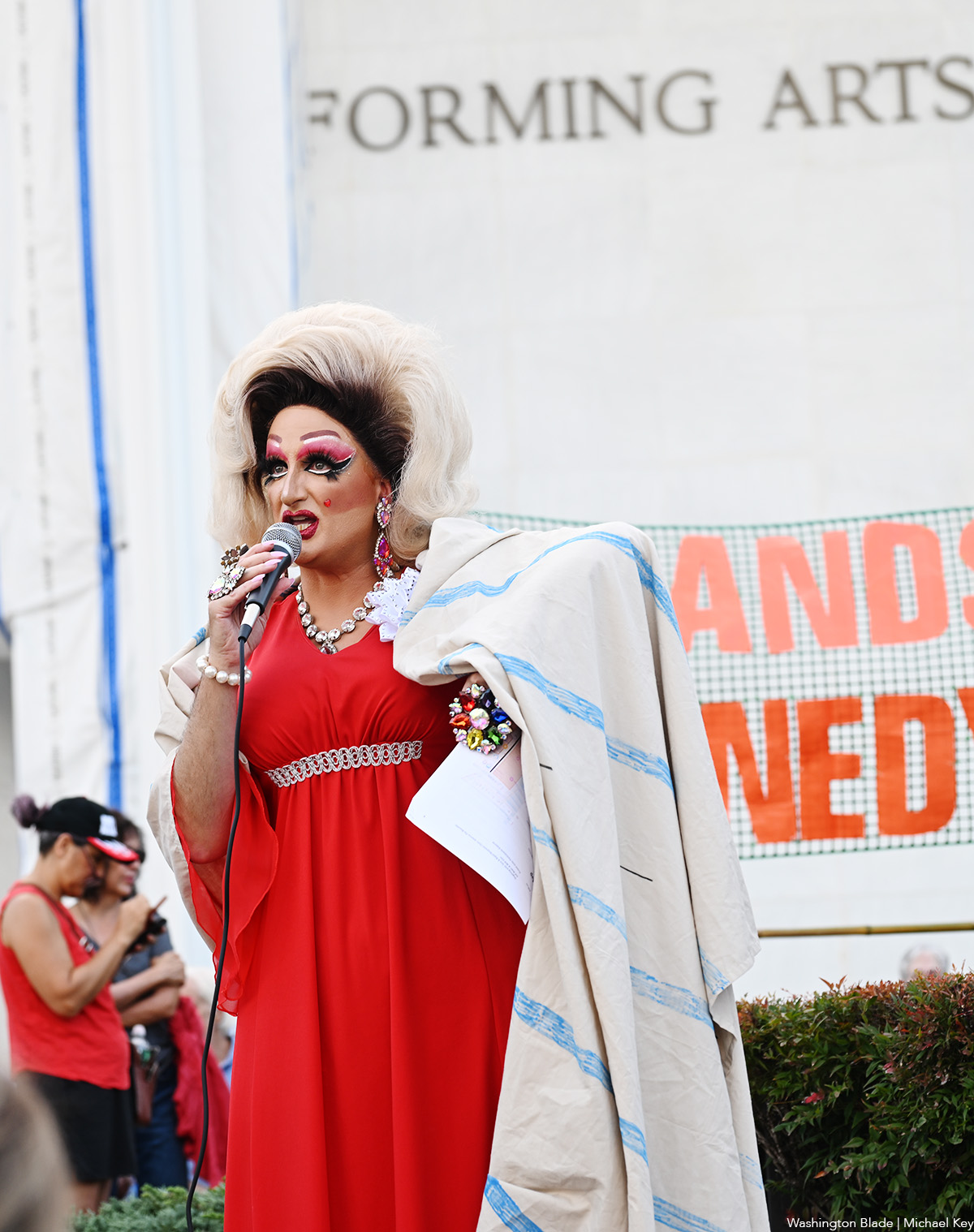
Drag performer Tara Hoot serves as MC, Gay Men’s Chorus of DC performs, attendees shout for Trump to keep ‘hands off’ Kennedy Center
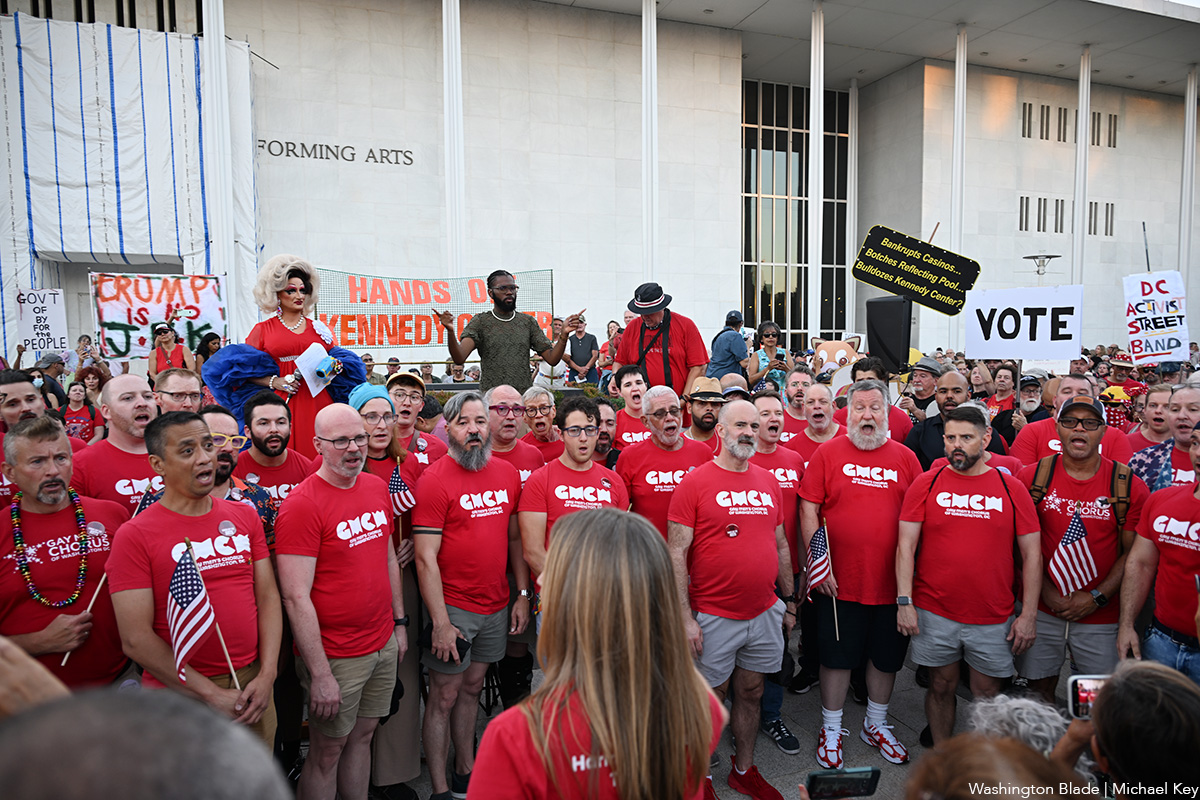
More than 2,000 supporters of the John F. Kennedy Center for the Performing Arts turned out on Sept. 18, for a rally in support of the performing arts center and a vocal protest against President Donald Trump’s threats to permanently close the center and possibly demolish it.
The event was organized by a group called Hands Off the Arts, which initially called for participants to form a “human chain” around the Kennedy Center’s main building following a rally on the plaza in front of the building.
However, due to a decision by the Trump-controlled Kennedy Center’s board of trustees to close the center earlier in the week and install fencing around part of the building, participants could only form the chain around part of the building, according to organizers.
Drag performer Tara Hoot, who co-organized the event and served as master of ceremonies for the rally preceding the “human chain,” said the large turnout could have fully surrounded the building at least twice had the fencing not prevented a full encirclement.
Among the musicians and singing groups that performed at the rally was the Gay Men’s Chorus of Washington, which, like other rally performers, had performed at the Kennedy Center in past years. They drew loud applause after singing one of their favorite songs from the Broadway musical show Ragtime, which includes the lyrics, “Will justice be demanded by 10 million men? Make them hear you. When they hear you, I’ll be near you again.”
View on Threads
Prior to their performance, Gay Men’s Chorus of Washington’s artistic director, Thea Kano, spoke at the rally, reminding participants that shortly after the Trump takeover of the center last year, Kennedy Center officials cancelled a concert the chorus was scheduled to perform there for World Pride 2025.
A Kennedy Center spokesperson said the cancellation was due to a scheduling conflict, but chorus members and LGBTQ activists believe it resulted from policies put in place by Trump and his leadership team at the Kennedy Center following Trump’s statements that he would end controversial “woke” performances that he claimed the majority of Americans disapprove of.
“Now this building sits empty in silence,” Kano told the crowd at the rally. “Let us raise our voices together and bring back the Kennedy Center as it was intended, a place where American culture could be celebrated and elevated, embracing the vibrancy with the spectrum of identify without censure and without politics,” she said.
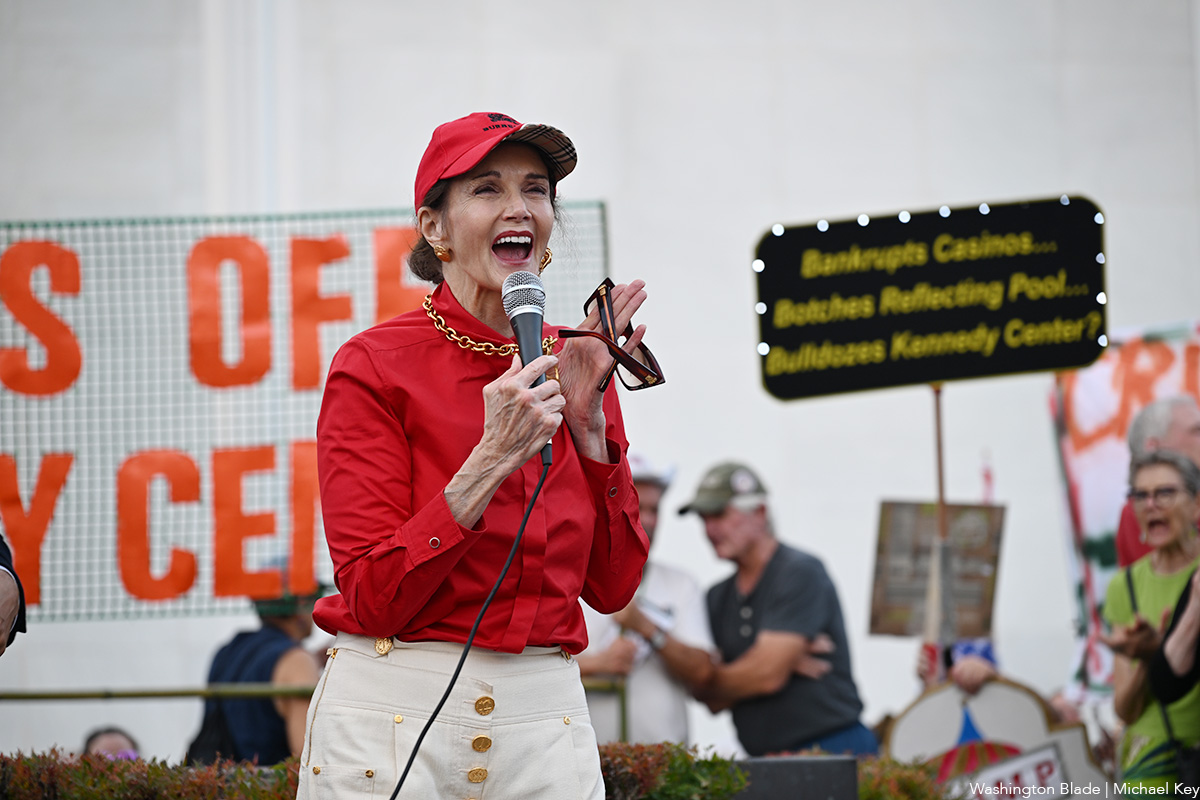
Among the others who spoke at the rally were U.S. Rep. Don Beyer (D-Va.), U.S. Rep. Jonathan Jackson (D-Ill.), and D.C. Councilmember Robert White (D-At-Large).
Most speakers, along with LGBTQ participants in the hands-around-the-building event expressed strong opposition to Trump’s demand that the Kennedy Center name be changed from the John F. Kennedy Center for the Performing Arts to the Donald J. Trump and the John F. Kennedy Center for the Performing Arts.
At Trump’s request, his appointed board initially made that name change and placed Trump’s name on the front wall of the building along with the Kennedy name. But following legal action taken by opponents who pointed out that Congress must approve such a name change, a judge ordered the removal of Trump’s name from the building. Trump has said he will take steps to reverse that order and has said he will stop plans to renovate the Kennedy Center building and possibly demolish it if his name is not restored in the Kennedy’s Center’s official name.
Throughout the Sept. 18 rally, LGBTQ participants repeatedly responded to the Trump threats by shouting, “Hands Off!”
Chris Raleigh, one of the founders of Hands Off the Arts and a lead organizer of the Sept. 18 event at the Kennedy Center who spoke at the event told the Washington Blade that more similar events are being planned and he welcomes the support the event has received from the LGBTQ community.
“The LGBTQ community was here first, and we’re following them,” he said. “They’ve been the spearhead; they’ve been the vanguard. And I’m so thankful for heroes like Tara Hoot,” he said, adding, “It’s because they know what it means and how this is a safe place – the theater – for many LGBTQ people.”
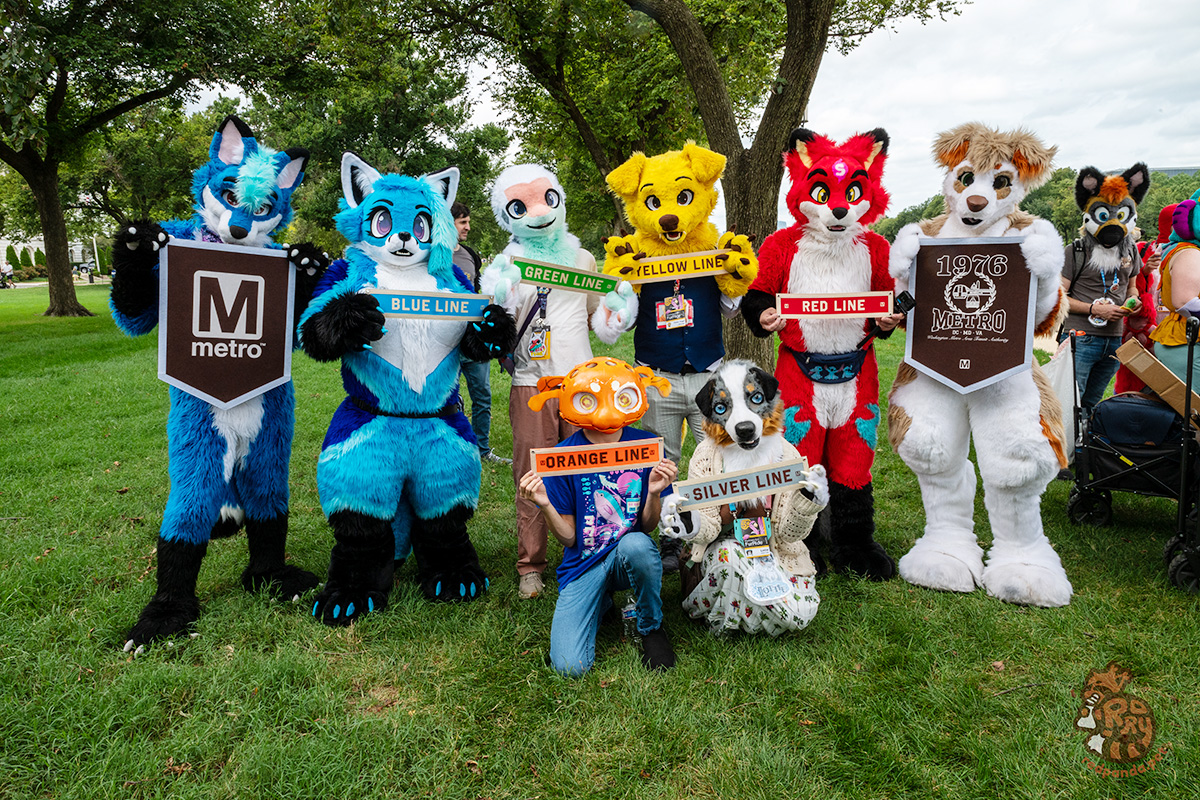
The DMV’s own furry group was on full display on the Metro on Sept. 12.
Shutterpaws is a volunteer-led 501(c)(3) non-profit organization located in Maryland.
The furry group has been doing the FurRide event since 2024 and has blown up in popularity for furries around DMV. They showcased themselves on the Silver and Blue Lines near the Smithsonian on Sept. 12.
“A lot of careful planning goes into running these events, with the goal being a seamless and enjoyable experience for everyone who attends,” says Zayre, a Shutterpaws staff member. “There’s a lot that you learn just by trial and error, and as Shutterpaws hosts more and more events, our team of event organizers continues to learn and refine our approach to keep things running smoothly and finding new ways to engage with our community.”
With a larger growth of participation in the community comes many challenges with the group, especially when it comes to the Metro rides and organizing.
“The biggest challenge that we face as organizers is keeping things fresh and finding new and engaging venues to host events,” says Zayre. “Recently we saw a lot of success hosting a meet at On Target Battlezone, an indoor NERF gun battle arena where our crew was welcome to show up and play both with and without a fur suit.”
Nevertheless, Shutterpaws receive overwhelming support from the community and partners.
“Across the DMV there are so many amazing places to host a Shutterpaws event so we can pursue our mission of helping connect fur suiters and photographers, and we’re blown away with the amount of support we’ve received from our community partners,” says Zayre.
Shutterpaws plans to do more events for anyone in the DMV who is interested.
Their next event in collaboration with DC Fur Meet will take place at Pitchers (2317 18th St., N.W.) on Saturday. Visit Shutterpaws’ website for more information.
Turkey
Activists protest outside Turkish Embassy in D.C.
Dozens detained during anti-LGBTQ ‘My Family Is Safe’ campaign raids
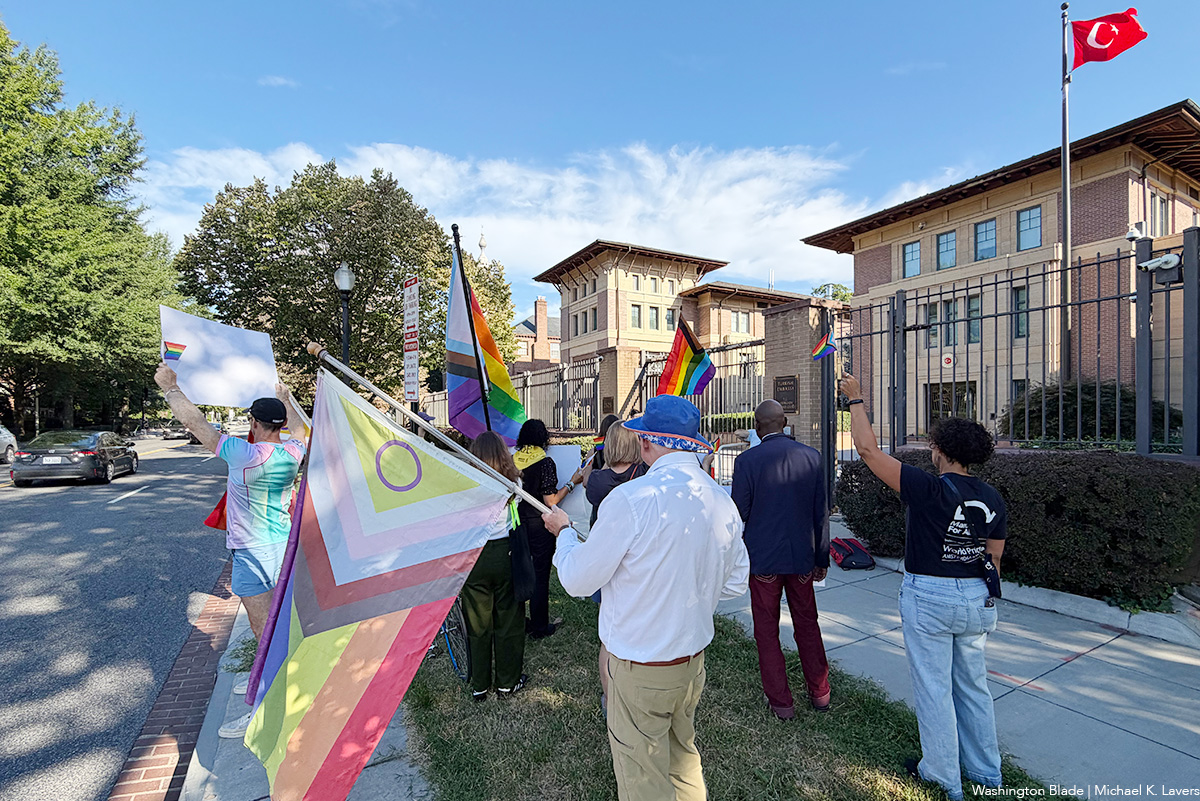
A group of activists on Friday gathered in front of the Turkish Embassy in D.C. to protest the country’s anti-LGBTQ crackdown.
The protest — which the Council for Global Equality, Amnesty International USA, Outright International, and Health GAP organized — took place less than a week after Turkish authorities detained dozens of people during raids that targeted the country’s LGBTQ community and advocacy groups and HIV/AIDS service organizations.
Authorities in Istanbul on Sept. 15 detained more than 150 people who gathered outside a courthouse to protest the raids that are part of the government’s “My Family Is Safe” campaign. Journalists are among those who were taken into custody.
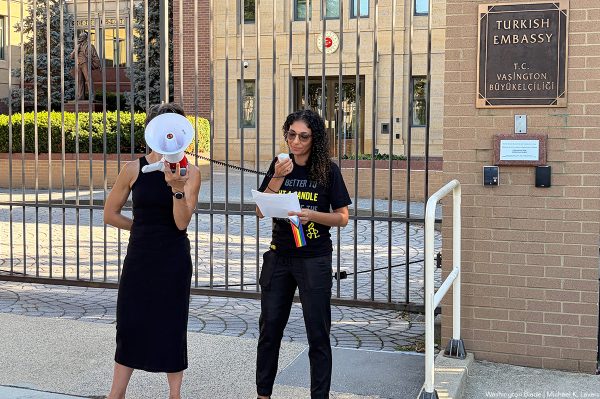
“This crackdown is not making families safer,” said Amnesty International USA Executive Director Nadia Daar, speaking in front of the Turkish Embassy.
Council for Global Equality Managing Director Keifer Buckingham stressed that “homosexuality is not a crime in Turkey.” Health GAP Executive Director Asia Russell and Outright International Senior Director of Law, Policy, and Research Neela Ghoshal also spoke.
View on Threads
Activists in Madrid and in other cities around the world held similar protests on Friday.

What LGBTQ veterans are building after ‘Don’t Ask, Don’t Tell’

Over 2,000 turn out for Hands Around the Kennedy Center protest

Furries take over the Metro

A roundup of fall events not to be missed

Activists protest outside Turkish Embassy in D.C.

78th annual Emmy Awards recapped

Advocate, Out parent company adds Trump supporter to board, prompting outrage

Trump’s Cabinet: Dumb, dumber, dumbest, and evil

More than 150 people detained outside Istanbul courthouse