Maryland
Hyattsville mayor dies by suicide
Kevin Ward and husband adopted son in D.C. in 2012
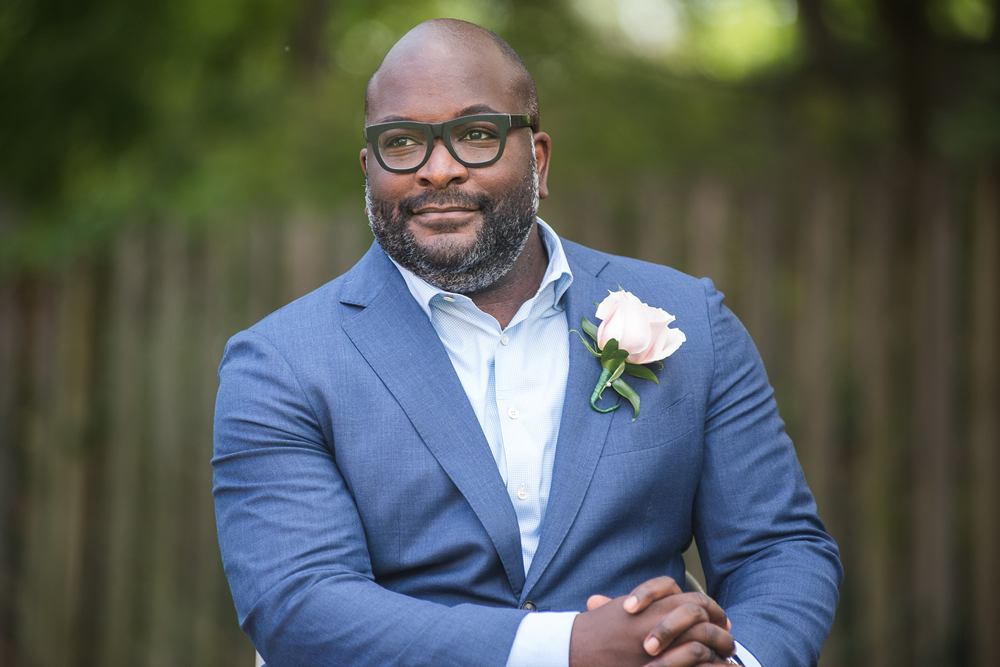
The city of Hyattsville released a statement on Wednesday afternoon announcing that their city’s openly gay Mayor Kevin Ward had died one day earlier by an apparent suicide.
“The city of Hyattsville reports with great sadness that our beloved Mayor Kevin Ward passed away yesterday, Jan. 25, from an apparent self-inflicted gunshot wound,” the statement says.
“Mayor Ward was a valued and trusted leader and a fierce advocate for all the people of Hyattsville,” the statement continues. “We are heartbroken at this loss and extend our deepest sympathy to the mayor’s family,” it says.
“No further information is available at this time,” the statement adds. “Details about services and remembrances will be shared when they are available.”
The Washington Post reported that U.S. Park Police disclosed that Ward was found deceased in Fort Marcy Park in McLean, Va., with a “self-inflicted gunshot wound.”
Ward, 44, became acting mayor of Hyattsville on Jan. 1, 2021, following the resignation of former Mayor Candace Hollingsworth. He was next in line to become mayor under the city’s political system in his then-position as president of the Hyattsville City Council.
He won election to complete the remainder of Hollingsworth’s term through 2023 in a May 11, 2021, special election, receiving 57.8 percent of the vote in a three candidate race, according to the Hyattsville election board. His closest opponent, Joseph Solomon, received 31.7 percent of the vote.
Nearby fellow gay mayors — Patrick Wojahn of College Park and Jeffrey Slavin of Somerset — said they got to know Ward through Maryland political circles and thought very highly of him.
“He was insightful, smart and dedicated,” Wojahn said. “He always seemed very confident and together as a person. And he had a great sense of humor.”
Slavin said he shared that remembrance of Ward, adding that he found Ward to be a “very nice person” dedicated to the people he served both as mayor and during his two terms on the Hyattsville City Council.
“There was noting in his public life that would have predicted this,” said Slavin in referring to Ward’s sudden passing.
The Washington Blade first reported on Ward in 2012 in a feature story on Ward and his then-domestic partner Chad Copeland when the two attended a ceremony at the D.C. Superior Court to complete the process of adopting their then-5-year-old son Norman. Ward and Copeland were among several gay couples who had their adoption papers signed by a judge at the ceremony.
On the website for his mayoral election campaign last year Ward said he and his family made Hyattsville their home in 2014 after he and his husband adopted their two sons.
“I am a pretty straightforward person,” he said in message to voters on his campaign website. “I believe in listening more than talking. But when I talk, I am not one to mince words or tell people what they want to hear,” he said. “I believe in doing the work. I believe that if I can help someone, then I can change her or his life,” he continued.
“This is why I dedicated my career to providing the best technology to education and to human services, to help as many people as I can,” he said.
Ward was referring to his career in the field of educational and human services technology.





Maryland
Girlfriends charged with Silver Spring murder to go on trial in 2027
Prosecutors charged both women with killing mother of one of them

Two women identified as a couple who are charged with the May 22, 2026, murder of the mother one of them in her Silver Spring home and who were arrested three weeks later in Ohio are scheduled to go on trial for murder April 19, 2027.
According to online records filed with Montgomery County Circuit Court in Rockville, Vanessa Tjongarero-Henderson, 29, of Clarksburg, Md., and Samantha Raebel, 36, of Phoenix are being held without bond in the Montgomery County Correctional Facility until the time of their trial.
Statements from Montgomery County police show the two women were arrested June 10 in Genoa, Ohio, after fleeing from the scene of the murder in Silver Spring. Police statements and court records show they were extradited back to Maryland in July, where prosecutors with the Montgomery County State’s Attorney’s Office obtained indictments against them for murder.
Earlier statements from Montgomery County police say their investigation into the murder led to their decision to initially charge the two women with first-degree murder for the death of Hilde Henderson, 67, who was Tjongarero-Henderson’s mother.
“Through the course of the investigation, detectives identified Henderson’s daughter, Vanessa Tjongarero-Henderson, and Vanessa’s girlfriend, Raebel, as the suspects,” one of the police statements says. It says police obtained arrest warrants for both women and launched a nationwide search seeking help from the public in in locating them.
One of the police statements says an autopsy determined the cause of Hilde Henderson’s death was blunt-force trauma injuries brought about by a murder. Police and the State’s Attorney’s Office, which is prosecuting the case, have yet to disclose whether they have determined a motive for the murder.
Court records show that prior to the start of the April 19, 2027, trial a “motion” hearing was scheduled for Oct. 30, 2026, a pre-trail conference was scheduled for Feb. 12, 2027, and another motion hearing and a status hearing were scheduled for March 12, 2027.
Court records also show that Tjongarero-Henderson is being represented by attorneys with the Montgomery County court system’s public defender service. The records show that Raebel initially had been represented by a public defender service attorney, but updated records show Aug. 14 is listed as the “removal date” for that attorney.
The docket shows that on Aug. 20, two new attorneys with the prominent D.C. law firm of Covington & Burling made their official appearance as her attorneys in the murder case. One of them, Daniel Solomon, told the Washington Blade in response to an inquiry that the defense has no comment at this time on the case.
He confirmed that Covington & Burling is representing Raebel on a no-cost, pro bono bass.
The office of the Montgomery County public defender service didn’t immediately respond to a phone message from the Blade asking for a comment on the Tjongarero-Henderson case.
Congress
Chris Van Hollen says the Democratic Party needs change. Is he the one to lead it?
Senator is backing anti-establishment Democrats across the country
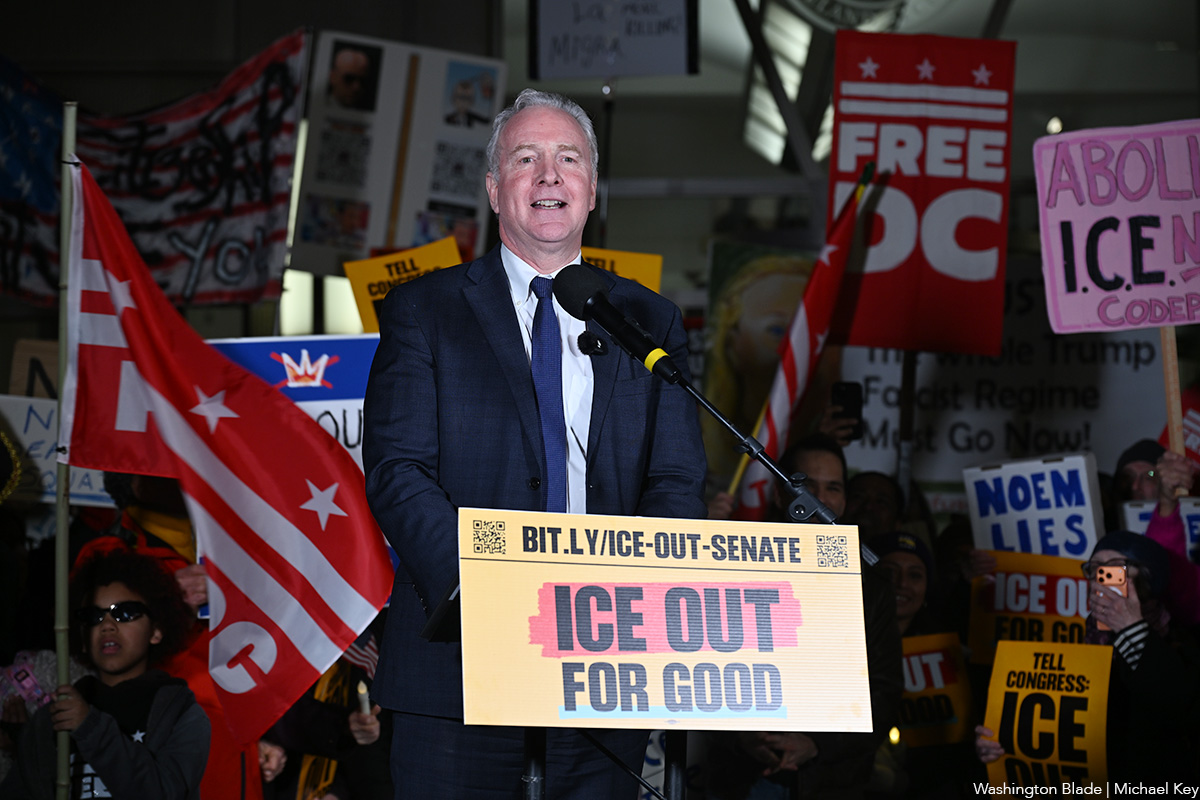
By LEE O. SANDERLIN | The Democratic Party is having something of an identity crisis — losing to President Donald Trump twice in three elections will do that.
Should the party embrace anti-establishment figures who espouse progressive policy ideas like Medicare for all and rhetoric about unrigging the economy for the 1 percent? Or should Democrats try to appeal to moderates who want to return to semi-normalcy in a time of political upheaval?
Although he’s been in Congress since 2002, with key leadership roles throughout his tenure, Maryland Sen. Chris Van Hollen, 67, counts himself firmly in the anti-establishment camp.
The rest of this article can be found on the Baltimore Banner’s website.
Maryland
Anne Arundel schools updates gender identity regulation following Trump administration threats
District facing federal lawsuit, White House threats over guidelines

By JESSICA CALEFATI | Under pressure from the Trump-Vance administration, Anne Arundel County Public Schools Supt. Mark Bedell announced Wednesday the district had updated a regulation intended to protect transgender students’ right to be called by their chosen name.
The revised language makes clear that district rules on gender identity do not block parents’ rights under the Family Educational Rights and Privacy Act as the federal government alleged last month, and that a student’s gender identity will not be treated as confidential medical information.
“No policy, guideline, or practice may limit or otherwise interfere with parental rights under FERPA,” Bedell wrote in a Wednesday letter to the community. “This includes any information maintained in education records that relates to gender identity, transgender status, sexual orientation, preferred name, or preferred pronouns.”
The rest of this article can be read on the Baltimore Banner’s website.

HRC president campaigns for Chris Pappas in NH

We’re getting married but our parents object

Michael Smith could make history as Delaware’s first LGBTQ treasurer

Poland begins to legally recognize same-sex marriages from other countries

Immersive ‘Nation-State’ imagines a society free of authoritarianism

Please join me in supporting the Washington Blade Foundation

American democracy on the brink

Girlfriends charged with Silver Spring murder to go on trial in 2027

Rehoboth mayor calls for commissioner’s resignation after investigation into improper behavior

Trans, nonbinary Americans find refuge in the Netherlands
-

 Commentary4 days ago
Please join me in supporting the Washington Blade Foundation
-
Opinions4 days ago
American democracy on the brink
-
Maryland4 days ago
Girlfriends charged with Silver Spring murder to go on trial in 2027
-
Rehoboth Beach4 days ago
Rehoboth mayor calls for commissioner’s resignation after investigation into improper behavior