a&e features
To fight book banning, it’s time to get loud
Librarians, queer activists, free speech supporters unite to combat frightening trend
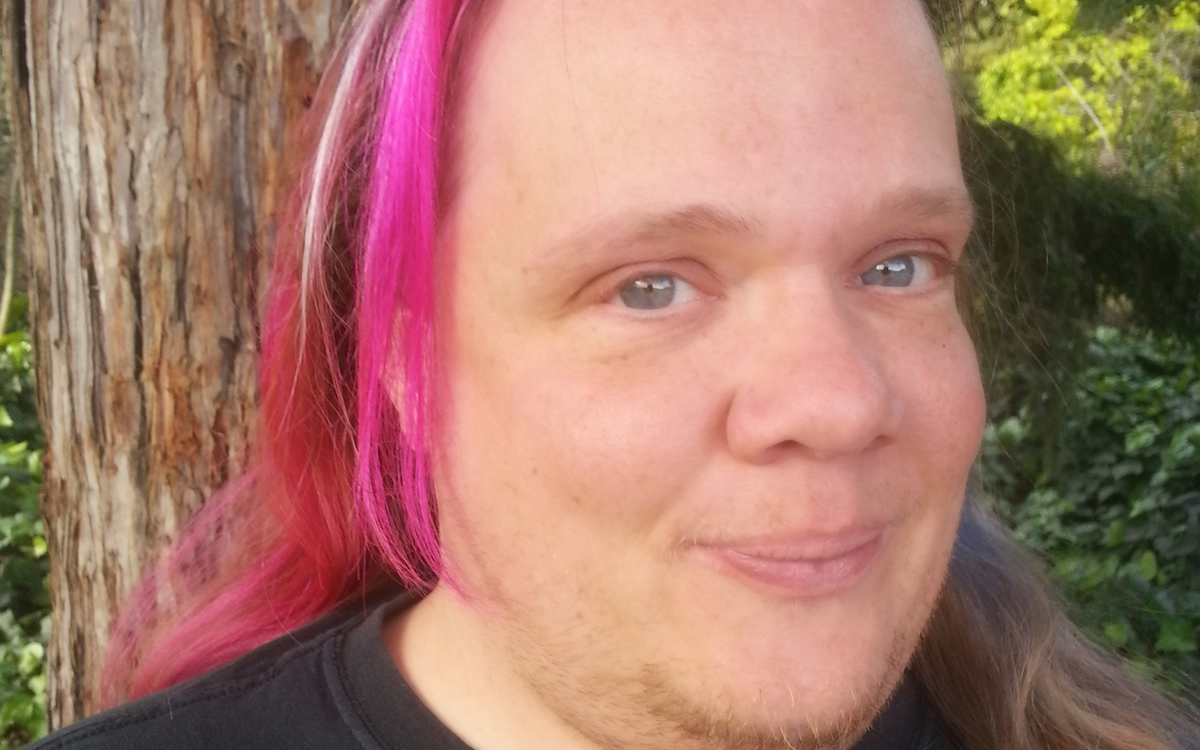
Cynthia Sherman, executive director of the Association of Writers & Writing Programs, recently saw something she never thought she’d see in the United States.
Sherman was online, and suddenly she says, “I saw a book burning, I couldn’t believe it!”
Sherman wasn’t imagining things. Earlier this month, in Mt. Juliet, Tenn., Greg Locke, a pastor, led a book burning, CNN reported. Copies of books in the “Harry Potter” series and “Twilight” series were burned.
There’s been an alarming increase in the number of books nationwide that have been removed from school classrooms and libraries, according to free speech advocates, writers, and LGBTQ activists and allies, interviewed by the Blade by phone and email.
Many of the books being banned, they said, are written by LGBTQ and/or BIPOC (Black, indigenous, people of color) authors, and deal with racism, sexual or gender identity.
Over the last year, calls for the banning of LGBTQ books have frequently taken an ugly turn.
In October, Jen Cousins and Stephana Ferrell attended an Orange County Public Schools school board meeting in Orlando, Fla. Cousins and Ferrell are parents.
Cousins has a 12-year-old daughter named Saffron, who came out as nonbinary a month before the school board meeting.
Ferrell has two children, aged six and eight. “I don’t know what their sexual or gender identity will be,” Ferrell said.
At the school board meeting, a man read a short excerpt from “Gender Queer: A Memoir,” a graphic novel by Maia Kobabe. “He was thrown out,” Ferrell said, “but based just on that brief excerpt the book was removed.”
Sometimes anti-LGBTQ attacks have been aimed at school board members and/or their families.
Rebecca Bender is a parent in Hastings, Minn. Bender and her partner have a son named Reese and a daughter named Reagan. Reese and Reagan, age 5, are twins.
Reese is transgender and out and proud. At two-and-a-half, Reese knew he wasn’t a girl. “I’m a boy, Mom,” he told Bender.
“I’m the brother!” Reese said, referring to his twin sister Reagan.
Reese, who is autistic, attended an early childhood program run by his school district. “We had to advocate for the correct pronouns to be used for him,” Bender said.
People in the community and school district knew Reese. His experience as an out transgender kindergartner has been good, Bender said. But things worked out badly for another mom with a transgender child in Hastings, Bender said.
Kelsey Waits’s youngest child is transgender (and uses they/them pronouns). Waits, who had served on the school board, ran for another term. During the campaign, a group called Concerned Parents outed her daughter as trans (before they were ready to come out).
“I have no issue with people critiquing votes that I have taken or stances I hold that they disagree with,” Waits wrote in a letter to the Paper Boy News. “However, even in this time of political division, a line must exist. Surely, this line was crossed when a group of parents decided not only to attack me, but to attack my children.”
Those concerned about censorship have reason to worry. “Book challenges and removals are significantly up this school year from last year,” said Nora Pelizzari, director of communications, National Coalition Against Censorship. “The most frequently challenged books are by and about people of color and LGBTQ+ people. All of the intersections apply.”
The American Library Association tracks reports of challenged books. From Sept. 1 to Dec. 1, 2021 alone, the ALA tracked 330 book challenges.
In normal times, a book challenge takes the form of a formal request to have the book reviewed, Pelizzari said, “to review if it should be removed or included in a school curriculum or school library.”
The challenge is filed with a school or school district depending on the policy, she added, “this initiates a process by which a school or district reviews the book to determine whether to take action or not.”
These reviews are conducted by committees of librarians, teachers, pedagogical experts, such as curriculum developers, parents, and, ideally, older-grade trained students, Pelizzari said.
But these are not normal times, Pelizzari said. This year, increasingly, people, often parents, are circumventing the review process.
They are demanding, frequently vocally, in school board meetings that books be removed without going through the review process.
Most of the books that have been challenged, such as “Heather Has Two Mommies” by Lealea Newman and “George” by Alex Gino (to be published in April as “Melissa”) have LGBTQ content, said Deborah Caldwell-Stone, director, American Library Association, Office for Intellectual Freedom.
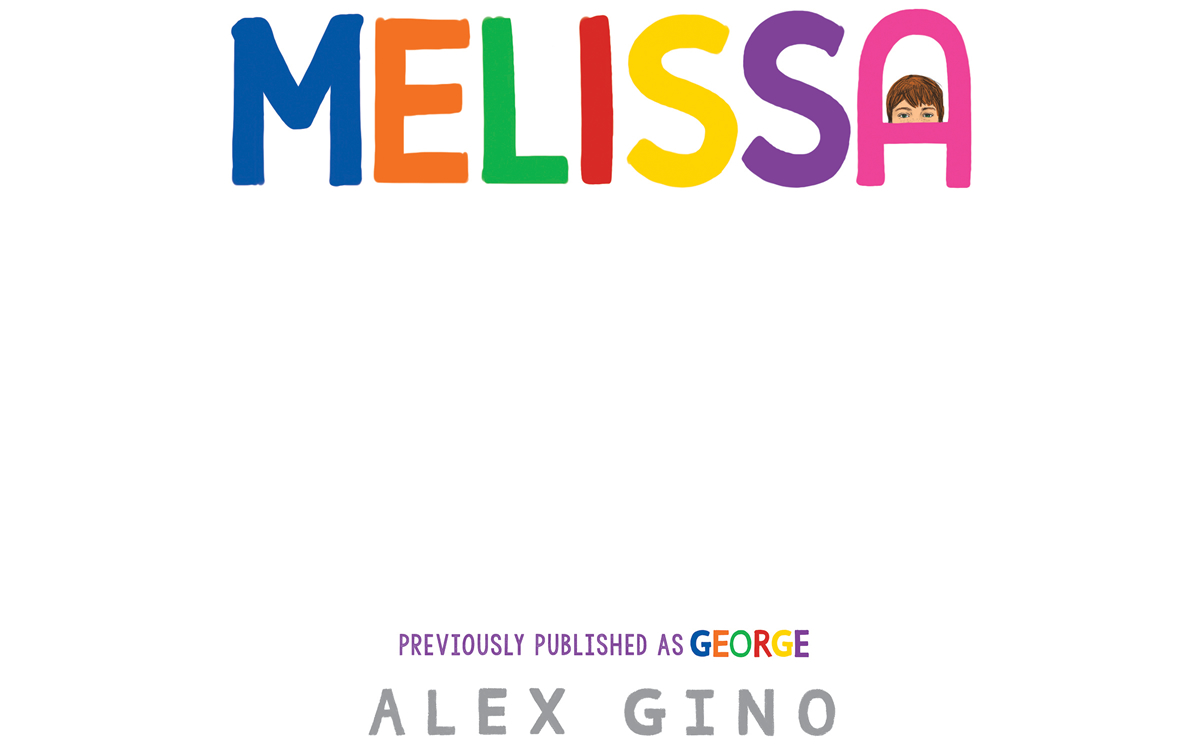
“Heather has Two Mommies” is about a family headed by same-sex parents, and “George” is about a transgender girl named Melissa.
In the aftermath of the murder of George Floyd, people have “challenged books about slavery – the lived experience of Black people,” Caldwell-Stone said, “along with books about LGBTQ+ people.”
The ALA encourages libraries to file reports with “us if they’ve had challenges or encountered censorship,” Caldwell-Stone said, “we promise confidentiality.”
The attempt to censor and ban books by queer writers with LGBTQ+ characters, shouldn’t be viewed as an isolated phenomenon, said Mary O’Hara, a GLAAD rapid response manager. (For info on GLAAD’s #BooksNotBans campaign, go to glaad.org.)
The battle for marriage equality has been won. More than 21 percent of Generation Z adults identify as LGBTQ, according to a Gallup poll released on Feb. 17. “It’s no coincidence that anti-queer groups have made schools their new battlegrounds,” O’Hara said.
The effort to ban LGBTQ books is connected to proposed anti-trans bills that would limit transgender and nonbinary students’ access to health care, rights to participation in sports and use the bathroom, O’Hara said. (In the first week of this year alone, seven states proposed such anti-trans bills.)
“We’re seeing bills [such as the ‘Don’t Say Gay’ bill before the Florida Legislature] advance in state legislatures that would prohibit conversation about sexuality or gender identity in schools,” said Jonathan Friedman, director of free expression and education at Pen America.
People seeking to ban LGBTQ books have an unrealistic view of the world, author Newman said, “they want to show kids a society where all families are white, cisgender, Christian, able-bodied – with one mom and one dad.”
In October, Matt Krause, a Texas state legislator, compiled a list of 850 books that he would like to see removed from schools because they might make students feel “discomfort…because of their race or sex.”
Kalynn Bayron, author of the YA novel “Cinderella Is Dead” and the forthcoming middle-reader novel “The Vanquishers,” lived in San Antonio for many years. She was disheartened to hear that “Cinderella” is on Krause’s list.
“I write about Black, queer protagonists,” Bayron said. “Representation is so important. When books are banned, Black, queer, disabled and other marginalized kids don’t see themselves in stories.”
“And kids who aren’t marginalized won’t see people who are different from themselves,” she added.
LGBTQ activists and allies are fighting back against censorship.
Lily Freeman is a transgender and Jewish activist, and a member of GLSEN’s 2021-2022 National Student Council Cohort. Freeman and her mom run the Instagram and TikTok account @projectuncensored.
“Having representation in books creates acceptance and empathy,” Freeman said. “In online videos, my Mom and I talk about books that have been banned that folks should read.”
Bender and her partner held a fundraiser so that LGBTQ books could be donated to libraries and teachers in her community’s schools.
Early this year, Cousins and Ferrell established the Florida Freedom to Read Project, a group that advocates for the right for students, hetero and LGBTQ, to access ideas and information in schools.
Lisa Keating, director, My Purple Umbrella, and sweet pea Flaherty, owner of King’s bookstore in Tacoma, Wash., co-run the Queerest Book Club Ever. Flaherty, through her bookstore, runs 11 book clubs, including the Banned Book Club.
“We try to select books that tell stories that for so long haven’t been told,” Flaherty said.
It might be time to break through the stereotype of the “quiet librarian,” said Jennisen Lucas, president of the American Association of School Librarians, a division of the ALA.
The effort to ban books could place some librarians’ jobs in jeopardy, said Lucas, who is a librarian for seven schools in Cody, Wyo. “It might be time [for librarians] to get loud,” she said, “about standing against censorship and supporting the First Amendment.”
“It’s what makes the news,” Lucas added.
In December, NCAC issued a statement, “The Attack on Books in Schools,” which was signed by more than 600 organizations.
“It is freedom of expression that ensures that we can meet the challenges of a changing world,” the statement said. “That freedom is critical for the students who will lead America in the years ahead.”


a&e features
Tickets on sale for chef Patrick O’Connell’s book launch event
Sept. 18 kickoff to feature José Andrés, Tom Sietsema

Acclaimed chef Patrick O’Connell is preparing to publish his new memoir, “Main, Middle & Gay” in September and he’s launching the book with an event on Sept. 18 at 6 p.m. at Lisner Auditorium featuring Chef José Andrés and former Washington Post food critic Tom Sietsema.
Tickets for the event go on sale Tuesday, July 21 at Ticketmaster; prices start at $55.
O’Connell, who’s gay, is the pioneering Michelin-starred chef and longtime proprietor of the Inn at Little Washington. He spoke with the Blade about the September event and the launch of his first memoir.
“I’ve known [Andrés and Sietsema] for more than 25 years and I have great respect for them,” O’Connell said. “I felt that it would allow us to add a different dimension rather than just have an interviewer. The chemistry will be fun and lively and unpredictable and exciting. I think we’re all different personalities and we’ll compliment each other.”
O’Connell has published cookbooks but this is his first memoir. The event will feature a short film that will highlight his work and the Inn.
“What I hope to do with the event is bring the book to life visually,” he said. “So we’re producing a short film that will be part of it. Most of the audience will not have read the book so it’ll give them a visual flavor of the book. It parallels the evolution of American cuisine over 50 years. It’s a rare perspective to be in the trenches for that long.”
The book’s title refers to the location of the garage on the corner of Main, Middle, and Gay streets in Washington, Va., where he launched his restaurant that became an international culinary destination.
The Blade will publish the rest of its wide-ranging interview with O’Connell in September in conjunction with the book’s release.
a&e features
The queer Asian comics building collective joy in D.C.
Spotlighting chaotic ways family, romance, identity take shape in their lives
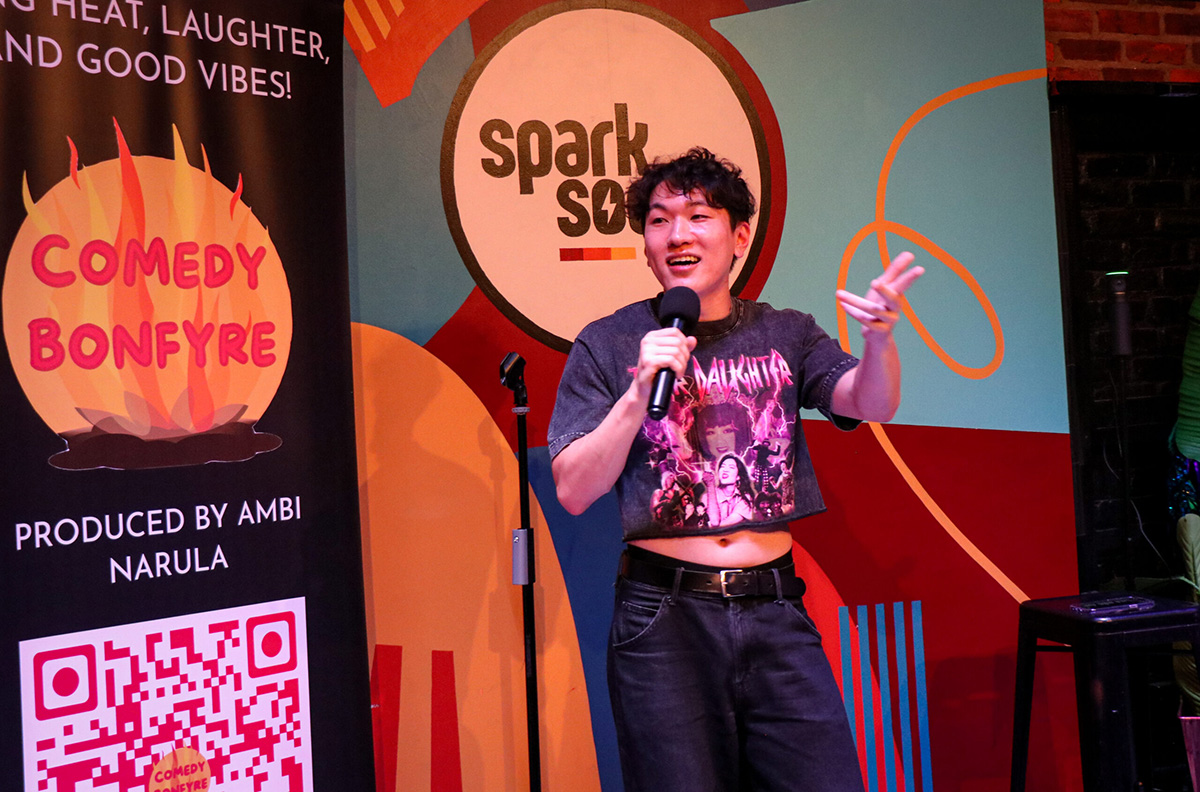
Kevin Chen’s family tombstone has room for four: him, his parents and his boyfriend. The arrangement might prove to be a little awkward.
“My boyfriend is 100% white, and my parents are 100% disappointed,” Chen confessed.
Jokes about family traditions and the untraditional ways they’re practiced earned a burst of laughs at the bar where Chen was opening for the Pride Comedy Special. The D.C. stand-up event, produced by Comedy Bonfyre last month, spotlighted queer Asian comics who shared the chaotic ways family, romance and identity take shape in their lives.
From candid oral sex takes to top surgery hypotheticals like “Where do the boobs go?”, the night highlighted the loud camaraderie of the queer Asian experience — one that sounds like a cacophony of snorts, cackles and belly laughs. While the comics say they are not quite a community, there’s more than enough shared material to bring them together.
“It was such a magical experience. I loved performing in a queer API lineup. It feels so validating,” Chen said after the show. “I’m wondering, ‘Is this how white men feel all the time?’”
Each performance evoked queer Asian joy through a medium that could use more of its presence.
According to Chen, who is based in D.C., it’s hard to say whether there is a true queer Asian comedy presence in his city. There are only a scattered “handful” of Asian comics, and people of color are underrepresented in queer comic circles, he said.
When Tarunika Anand, a nonbinary lesbian comic, first entered the mainstream D.C. comedy scene, they mostly encountered straight white men, describing the experience as “a culture shock.”
“I feel like sometimes a lot of queer spaces are really white, and then a lot of Asian spaces are really straight,” Anand said. “I don’t feel like I fit into either.”
But feeling marginalized didn’t stop these comics from honing their craft and creating spaces for others like them. Alex Kim, who headlined the special and is based in Brooklyn, runs the queer Asian comedy group Boba Gays, which began on WhatsApp and has since made its way to Lincoln Center.
Every Wednesday, Anand co-produces a free comedy show called Funny Side Up. The queer-led group focuses on inclusivity and showcasing new talent.
“It’s really beautiful to speak about your experience and your existence in a way that’s uplifting,” Anand said.
Family is a major throughline of their comedic repertoires.
Chen, for instance, shared that he identifies with jokes about having Asian immigrant parents and the expectations they pass down.
“You see me, you know this part about me, you know this experience intimately, and I can see the truth that you’re trying to wrap a joke around,” he said. “That hits even harder because that’s my truth too. I think that’s what makes good comedy.”
Anand had the audience at the special howling when they explained that their parents’ be-more-like-them comparisons didn’t end when they came out. Instead, the expectations took on a new form.
“Now, my parents want me to be the best gay,” Anand said. “They’re like, ‘Do you know Ellen DeGeneres?’”
Kim said he’s been trying to unlearn things from his Christian Korean mom. Yet he described a moment when he was getting ready for the club and realized he looked just like his mother getting ready for church.
“I’ve been finding it hard to escape her,” Kim said.
Mutual recognition also radiates through the different ways queer love can take shape. From singlehood to death-do-us-part commitments, the comics cover just about every corner.
Anand is holding out hope for settling down with “a nice, pretty, Indian girl.” They recently went through a breakup and said they felt they dodged a bullet.
“As a person of color, I just don’t think I should be with a Swiftie,” they said.
Chen, touching on what it’s like to be in a queer interracial relationship, said that meeting his white boyfriend’s baby nephew for the first time felt like he was forced to participate in a diversity, equity and inclusion training.
“The dad was like, ‘Please welcome Kevin. Be curious about his culture, his history, his foods,’” Chen joked.
Laughter is not the only reward for the comics.
To Anand, comedy is a space where they can say whatever they want. “It gives me a voice,” they said.
Nik Narain, a North Carolina-based trans and nonbinary South Asian comic who performed at the special, said meeting older trans comedians and taking the stage helped him feel reassured in his identity during his transition.
“Stand-up was a really cool way to process that onstage,” he said. “[It] became a way for me to repackage my thoughts.”
Queer Asians are still figuring out their place in the greater D.C. comedy scene. The group is small in numbers and many are still working toward a full-time comedy career. But Narain feels he’s already made it.
Narain is reluctant to pin it all on one moment. He feels that success is already peeking through in milestones — opening for celebrities, traveling to performances and self-producing shows.
“As long as I can keep doing this, I’m super happy,” he said.
This story was produced as part of the AAJA VOICES fellowship program, a student journalism project of the Asian American Journalists Association (AAJA).
a&e features
Mr. Henry’s celebrates 60 years of proud inclusivity
Capitol Hill staple remains ‘a caring community’
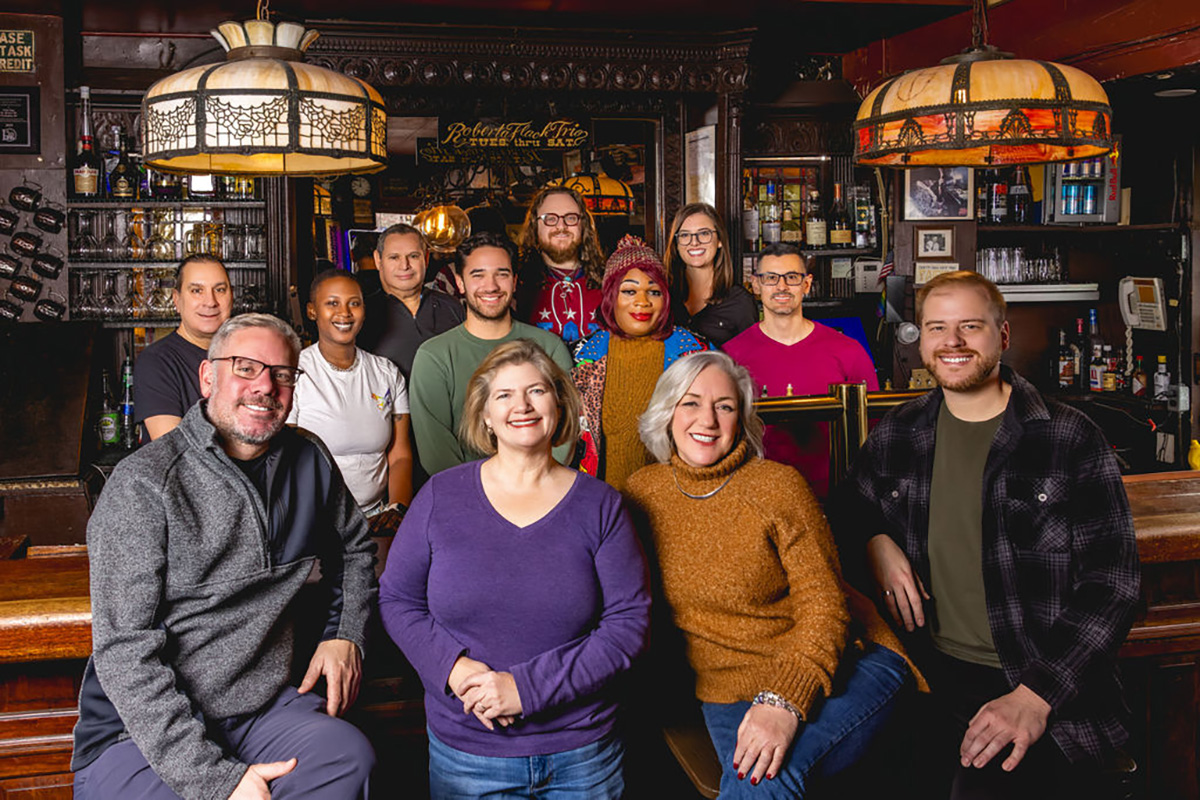
America’s 250th isn’t the only milestone birthday D.C. is celebrating this year.
Beloved D.C. restaurant Mr. Henry’s, that Capitol Hill staple, celebrates its Diamond Jubilee all year long. Named for its original owner Henry Yaffe, the restaurant opened on a warm day 60 years ago in the summer of 1966 and has never looked back.
Yaffe took over what was then a country western restaurant, renovated the interior to his liking, and created an institution. Yet Yaffe had another goal. As a gay man, “he created Mr. Henry’s to be a place where everyone felt welcome — not easy in 1966 — and he succeeded,” says current owner Mary Quillian.
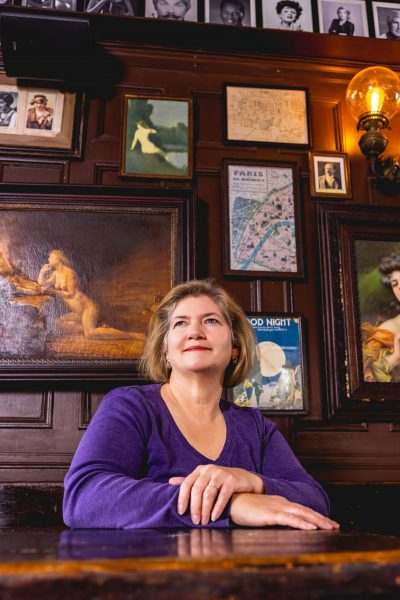
“Mr. Henry’s has long been a place the LGBTQ community has supported because they felt and still feel welcomed,” says Quillian. Even in the current administration, “the gay community and the diversity-minded community continue to come.”
Since then, Mr. Henry’s has changed hands, opened and closed its second floor, welcomed famed musical acts, and played host to politicians, date nights, breakups, and birthdays. But it still feels like home (and has a note in the National Trust for Historic Preservation) at 601 Pennsylvania Ave., S.E.
Its wood-paneled, Victorian-inspired art-filled décor in the downstairs dining room and bar serves American pub fare for lunch and dinner daily, with brunch on weekends (and a dog-friendly patio). Upstairs, Mr. Henry’s hosts live jazz performances and special events most nights, continuing a musical tradition that has defined the venue for decades. That upstairs bar has played host to names like Roberta Flack and Woody Allen.
Musician Kevin Cordt said that, “Mr. Henry’s has been a part of my life for more than 30 years. I started as a customer, then became a bartender and server, and now I have the good fortune to play trumpet at one of the best live music venues in Washington, D.C.”
Aaron Myers, executive director of the D.C. Commission on the Arts and Humanities, is also a supporter. “Not many cities can sport venues that have consistently served the community in the space of culture for more than 50 years, let alone can brag as the birthplace of culture defining talent.”
From the start, Yaffe promoted a rare yet celebrated combination of locals’ bar and soulful nightlife venue. Mr. Henry’s has attracted a diverse crowd at a time when such spaces were – and perhaps still are – uncommon, a diversity that is credited with helping protect the pub during the 1968 D.C. riots.
Longtime customer Evelyn Branic said, “Mr. Henry’s has been my ‘Cheers’ hangout since my wife and I moved to the Hill in 1987. I’ve experienced many iconic moments meeting politicians, reporters, civic activists, and neighbors engaging in spirited conversations. Whether political, LGBTQ, historians, neighbors, or out-of-towners, everyone could find a special place to be greeted as a friend.”
Its welcoming tables come dabbed with a bit of tea: In 1971, in a moment that has since become part of Capitol Hill lore, Yaffe lost the pub in a poker game to Larry Quillian. The Quillian family, recognizing the special role Mr. Henry’s played in the neighborhood, took over ownership, and committed to preserving its spirit. Today, Larry’s daughter Mary owns the bar, having given it a bit of a facelift for the bar’s 50th birthday, bringing in new tables and some fresh menu items.
For example, the menu has some of those dishes that regulars would riot if they disappeared. The Reuben and the hamburgers, the chili and in-house roasted turkey have never departed the menu. Dishes do evolve, says Quillen: they added wings about two decades ago.
In 2026, the restaurant is hosting monthly ticketed “decades” parties, celebrating each of the 10-year periods the restaurant’s been open, plus there were specials in June for Pride. The official 60th anniversary gala takes place Aug. 29, featuring performers, beverages, timeless favorite foods, swag – and the unveiling of a new cocktail.
Inclusive, eccentric, eclectic, Mr. Henry’s is looking forward to maintaining its centrality to diverse crowds in Capitol Hill. Battling inflation, rising menu prices, changing tastes, and thin margins, Quillian says that Mr. Henry’s has — and will always be — “a caring community for so many different folks. And THAT is why I am committed to keeping us going. Society needs places like Mr. Henry’s, now more than ever.”

Polish president vetoes same-sex relationship recognition bills

In the middle of the Bible Belt, a summer camp lets trans kids exhale

Tickets on sale for chef Patrick O’Connell’s book launch event

Remembering Victoria Cruz, Stonewall veteran and beloved trans activist

Wanda Alston Foundation announces passing of founding executive director Brian Watson

Calendar: July 17-23

Whitman-Walker to host legal services workshop

30 years on, ‘The Birdcage’ remains a landmark

Comings & Goings