Books
20th edition of Emily Post’s ‘Etiquette’ offers updated advice on pronouns and much more
A guide for daily life ‘with all its successes and mishaps’
Some families manage bakeries, nurseries, or vineyards.
For Daniel Post Senning, great-great grandson of Emily Post and an Emily Post Institute co-president, and Lizzie Post, great-great granddaughter of Emily Post and an Emily Post Institute co-president, etiquette is the family business.
The Emily Post Institute, based in Waterbury, Vt., conducts seminars and trainings. It partners with businesses and nonprofit groups to “bring etiquette and manners to a wide audience,” according to its website.
When you think of etiquette, you’re likely to be transported to Downton Abbey. Butlers, finger bowls, the dancing school lessons you hated as a kid – stuffy, rich (usually white, hetero) people at formal dinners managing a zillion salad forks – come to mind.
But, for Post and Senning, who co-host the popular, entertaining podcast “Awesome Etiquette,” etiquette is as far from being an ossified, exclusionary code of manners as we are from being the Dowager having tea at Downton.
Emily Post, the acclaimed etiquette maven, published her first book on etiquette, “Etiquette in Society, in Business, in Politics and at Home,” in 1922.
Post’s seminal book, considered by many to be the “holy writ” of etiquette (and stolen from libraries almost as frequently as the Bible), has been revised by Post herself and her descendants during the past century to evolve with changing times.
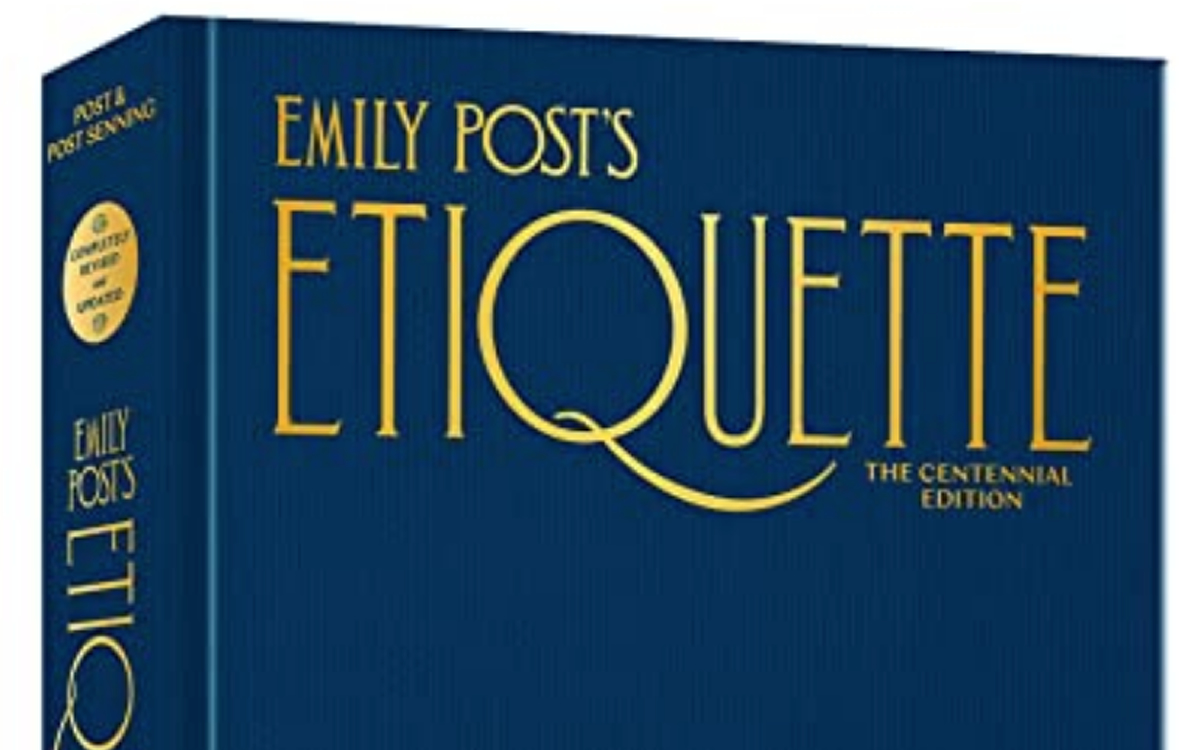
“Emily Post’s Etiquette, The Centennial Edition” by Lizzie Post and Daniel Post Senning, the 20th edition of Emily Post’s “Etiquette,” is just out. (For info on “Emily Post’s Etiquette, the Centennial Edition,” the Awesome Etiquette podcast and the Emily Post Institute, visit emilypost.com.)
The “Centennial Edition” has lively, up-to-date advice and discussion on everything in life in the early 2020s from the use of “mx” as a title to grief to respecting people’s pronouns to how to get company to stop making bigoted “jokes” to how to handle an inebriated guest.
From the get-go, Emily Post, who was born in Baltimore in 1872 during the Gilded Age and died in 1960, didn’t view etiquette as restrictive or exclusionary. “As Emily explained,’” Post and Senning write, “etiquette is not some rigid code of manners; it’s simply how persons’ lives touch one another.”
If you browse some editions of Emily Post’s books (as this reporter has), you won’t find schoolmarmish directives or ethereal descriptions of the etiquette gods’ mannered lives on Mount Olympus.
You’ll find daily life “with all its successes and mishaps,” Post and Senning write, “With tales like ‘How a Dinner Can Be Bungled’ and characters such as Mrs. Worldly, Constance Style, Mrs. Kindhart and the Onceweres.”
Emily Post painted relatable pictures of what to do and not to do, Post and Senning write.
Though Emily Post wouldn’t have known what a smartphone or social media were, her etiquette “still aims to equip you,” write Post and Senning, “with a sense of confidence and preparedness for some of the situations you’ll encounter at home, at work, in your social life, and when you’re out and about.”
Despite claims that etiquette is dead, it is very much alive, say Post and Senning.
Steven Petrow, an award-winning journalist and expert on civility and manners, agrees. “I’m always surprised by how timely Emily Post’s advice continues to be,” Petrow, who is gay, said in an email to the Blade. “Recently, I wrote about ‘monkeypox manners,’ and cited Mrs. Post’s timeless advice about respect, consideration and honesty in our social interactions, which includes those in the bedroom.”
Post and Senning graciously took time out from their busy schedules (the launch of the “Centennial Edition,” hosting their podcast – along with their other work with the Emily Post Institute) to talk with the Blade over the phone in separate interviews.
“Emily Post’s Etiquette, The Centennial Edition” was a Herculean labor of writing and editing for Post and Senning. It took a year to write the book, Post said. And, then there was all of the time spent to ensure that the book was carefully edited.
“I would write,” said Post, 40, who manages the Institute’s publishing efforts, “Dan would come in and help me edit the book.”
It was intense, “day-to-day” labor for her and Senning (along with their other work), Post said. “I’m grateful to all the people who were willing to have their lives disrupted while we worked on it,” she added.
Etiquette has been used for less than gracious purposes, Post said. “It can easily be exclusive.”
The Post family believes that etiquette is based on the principles of consideration, respect and honesty. This may sound abstract. But these principles aren’t empty words. They have a profound impact in the real world.
Before joining the Emily Post Institute in 2008 when he was 30, Senning worked in the performing arts, touring with the Laurie Cameron Company in Los Angeles.
Today, Senning, who lives in Duxbury, Vt., with his wife, Puja and their three children Anisha, Arya, and William, manages the Institute’s training programs. He has co-authored several books on etiquette covering topics from business to digital manners and regularly speaks with media outlets about business, technology, and dining etiquette.
In 2009, same-sex marriage became legal in Vermont. “Then, before the Supreme Court same-sex marriage ruling,” he said, “we were in the vanguard. We got questions about how to respond to same-sex weddings,” Senning added.
The Institute’s response was to note how normal civil unions were, Senning said, and that same-sex weddings weren’t different from hetero weddings.
“If you’re invited to a civil union, reply,” Senning recalled the Institute advising, “let people know if you can or can’t attend.”
Senning loved the “normalization” of the response. “It was really affirming to me,” he said.
Etiquette isn’t only for happy times. It’s called on when things get rough.
“Etiquette has a role in hard times,” Post, who’s been an American Express spokesperson and written columns for publications ranging from “Broccoli Magazine” to “Women’s Running,” said.
Many go through hard times from losing a job to being ill to grieving, she added. Emily Post may have written on etiquette a century ago, but her thoughts on grief ring as true on an iPad screen as they did then in a hardback book.
“At no time does solemnity so possess our souls as when we stand deserted at the brink of darkness into which our loved one has gone,” Emily Post wrote in 1922, “And the last place in the world where we would look for comfort at such a time is in the seeming artificiality of etiquette; yet it is in the moment of deepest sorrow that etiquette performs its most vital and real service.”
“All set rules for social observance have for their object the smoothing of personal contracts,” Emily Post added, “and in nothing is smoothness so necessary as in observing the solemn rites accorded our dead.”
Etiquette can help people grieve together in community through writing a condolence note, attending a funeral or another act of common grief, Lizzie Post said.
If you’ve suffered a loss, it can be incredible to realize the impact a loved one has had when you receive condolence notes or see so many people at a memorial service.
There’s a new trend where you can take part in the grief without going to a funeral, Post, who lives in her native state of Vermont, said. “When someone dies, for example, you raise a glass at five o’clock to honor them.”
Sometimes you have to use etiquette to stand against prejudice. If someone’s telling a racist or anti-queer joke at your dinner table, you’ll need to say, “‘I’m sorry. This is not a joke for this table,’” Post said.
While etiquette counsels against rudeness, safety trumps etiquette, Post and Senning have said on the Awesome Etiquette podcast and in the “Centennial Edition.”
Tolerance doesn’t mean tolerating an unwanted hug, an inappropriate touch or being “othered,” said Post, who has co-authored and authored etiquette books on topics ranging from weddings to legalized cannabis use.
Take hugging. “We talk about how to ask for a hug and how to block a hug,” Post said.
Etiquette experts, like the rest of us, take time off. On vacation, Post, co-author and narrator with Kelly Williams Brown of the Audible Original “Mistakes were Made” (think etiquette meets “Broad City”), doesn’t want to be rude to people. “But, sometimes, I don’t want to analyze behavior,” she said, “I just want to act.”
For info on the fascinating life of Emily Post, go to “Emily Post: Daughter of the Gilded Age, Mistress of American Manners” by Laura Claridge.






Books
Curl up with a good book this fall
New releases include mysteries, biographies, religion, and more

The fall books season offers lots of options so curl up and get ready to read.
FICTION
For the mystery fan who likes a sprinkle of thriller, look for “The Longest Death” by Kevin Jagernauth (Soho Crime, December). Richard Cobson hates his small town, he’s bored and desperate to get away. Stealing from his employer is the only thing that makes life bearable. That all changes when Marlon Montgomery comes to town and the two fall in love because if one guy can steal so easily, what can two do?
If you like graphic novels, try the “Tripping Over You” trilogy by Suzana Harcum and Owena White. Milo and Liam are finally able to be open about their relationship, no more hiding their love. They’re living together now, but can it last? “Tripping Over You Book 3” (First Second Books) is in stores in early November.
Also try “Diana: The Punk Singer Who Ripped Through Time” by Nate Powell (Abrams ComicArts, October). It’s about a young woman who’s trying desperately to escape her past, until a mysterious murder sidetracks her plans.
So you say you’re a romantic at heart? Then look for “Unspeakable Things: A Novel” by Elizabeth Hand (Little, Brown & Company, October). It’s a story set in the 1920s, when two young women arrive in the English Countryside to a dark and ancient manor. But, of course, nothing in a Gothic novel is easy, right? And you’ll love this tale.
NONFICTION
So this upcoming year is going to be one of exploration, right? Then look for “Free Love: Adventures in Marriage and Polyamory” by Michelle Tea (HarperOne, November). It’s a well-researched, personal, and interesting look at the lives of polyamorous couples and what it’s like to live what used to be called an “alternative” lifestyle.
If “fall” says “biography” to you, then look for “Showbiz! My Life as a Middle-Aged Man” by Murray Hill (Gallery Books, October). For decades, Hill has been making audiences laugh with his signature humor, but getting laughs hides his past all too well. He grew up in an abusive family and learning to hone his talents took some ingenuity. If you’re not a Hill fan yet, you will be, once you read this book.
For the reader who’s searching for a spiritual place, “Reading the Bible Through Queer Eyes: Good News for LGBTQ+ People from Genesis to Revelation” by podcasters Brian G. Murphy and Shannon T.L. Kearns (HarperOne, December) might help. Here, the authors look deeply at Scripture to find the queerness that’s there, proving to readers that the Word is not always what it seems.
Young readers may want to check out “Bitter Pill: Randy Shilts and the Dawn of the HIV/AIDS Epidemic” by Clement Xavier, illustrated by Heloise Cochois, foreword by Michael Lee (Abrams ComicArts, November). It’s a highly researched true story of activist Shilts, but also of Harvey Milk, and the earliest days of the AIDS crisis, when gay men needed a loud voice to advocate for them.
And finally, if you want a fun book for your kids or a child you love, look for “Good Night, Break a Leg: Life with Broadway Dads” by Bret Shuford, illustrated by Elena Hager (Penguin Workshop). What do parents do when they go to work? A little boy learns that his dads have very special jobs by day – and by night! It’s a cute book for kids, but a special tale for lovers of Broadway.
Be aware that publication dates change, titles change, books can be canceled, and your librarian or favorite bookseller can help you find what you need. Season’s readings!
Books
Dolly Parton biography puts her hardships into context
‘Ain’t Nobody’s Fool’ a highly researched tome not to be missed

‘Ain’t Nobody’s Fool: The Life and Times of Dolly Parton’
By Martha Ackmann
c.2026, St. Martin’s Press
$30/304 pages
Not too bright.
That’s what people once thought about you. Your language didn’t conform, you had your own sense of style, and you were ignorant about modern things and places and foods. But you were no dummy. You were different, and you had a secret: as in the new biography, “Ain’t Nobody’s Fool: The Life and Times of Dolly Parton” by Martha Ackmann, you knew exactly where you were going.

When Avie Lee Owens and Lee Parton first married, they had the very basics: “two knives, two forks, two spoons, a skillet, a butcher knife, and an old iron kettle.” He was 17; she was 15. Babies came quick. The fourth one was named Dolly, after two great-aunts.
Almost from the time she could walk, Dolly sang. Before she was old enough to attend school, she wrote poetry, and she’d begun to notice rhythms and beats she could make with her fingers. As a schoolchild, she created her own musical instruments out of scraps, and she was eager to perform whenever anyone asked her – and they asked often, because Dolly Parton was a nice girl, and her sense of humor conveyed a warmth that drew people in.
Growing up in the Tennessee mountains, Parton was independent, shunning marriage and child-raising, instead focusing on a dream of being a star. By the time she was in high school, she’d had a regular gig on local television but she recognized that there were few opportunities for fame in the mountains, so she left for Nashville the day after high school graduation, with the snickers of naysayers ringing in her ears.
She stayed with an aunt and uncle there, and she beat the streets, dined on grocery store samples to get by, and missed her family and friends. And they worried about her, but they knew nothing would derail her plans. They knew Dolly would be fine.
As a friend said, “’She had her head on pretty good.’”
Chances are that if you’ve listened to music any time in the last 60 years, you’ve heard Dolly Parton through her words or her music or both. Now you need to learn more about her, and “Ain’t Nobody’s Fool” is where to do it.
Here’s a biography that grabs you on the first page with the tiniest bit of family tree, but not so much that you get bored with it. Author Martha Ackmann writes about Dolly Parton’s early life, putting hardships and experiences in context, both personally and historically. There are name-drops, but not overly so, as Ackmann takes you through Parton’s career, her heartbreaks, her marriage, and her years with Porter Wagoner, in detail but not dramatically embellished or outrageously told. It’s a biography that’s just right, sourced well and written with a fresh take that, like its subject, tells a good story.
Fans, of course, will want this highly researched book but music lovers of any age or type will eat it up. That means you, so use up that Christmas gift certificate. “Ain’t Nobody’s Fool” just shines.
The Blade may receive commissions from qualifying purchases made via this post.
Books
Historiography with heart
Pioneering author John D’Emilio continues to enlighten us in new book ‘Making Gay History’
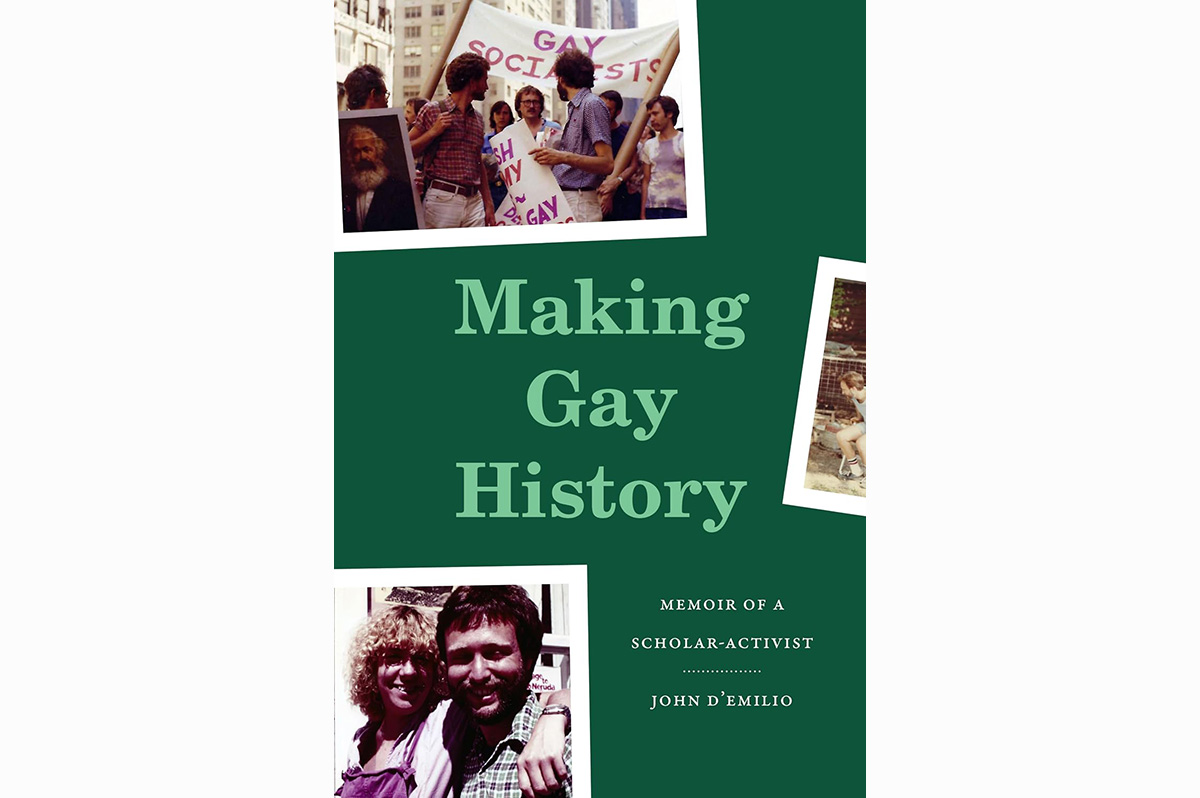
‘Making Gay History, Memoir of a Scholar-Activist’
By John D’Emilio
Dukeupress.edu/making-gay-history
“Dear Dr. Kameny,” wrote the earnest graduate history student almost 50 years ago. “As you know, the academic community only rarely deemed the lives of gay men and women to be worthy of serious scholarly study. To my knowledge, no American history faculty at a major university has yet sponsored a dissertation that deals with gays historically.”
That student was a young man from the Bronx who would change all that. His name is John D’Emilio.
“I must be able to uncover ‘manuscript’ sources, that is unpublished and unique historical materials,” he explained to D.C. gay civil rights pioneer Dr. Franklin E. Kameny who lived in a house stacked to the ceiling with “unique historical materials.” In reality, these were piles of correspondence with government officials and politicians, legal filings, mimeograph copies, gay newspapers, press releases, Mattachine Society brochures and picket signs. Frank Kameny, a self-described “pack rat,” invited D’Emilio into his private world of papers and memorabilia to begin uncovering an erased and forgotten pre-Stonewall history. This was one of many such research forays into “basements, garages and overcrowded living rooms” across America conducted by John D’Emilio. He was a young man on fire to complete a Ph.D. dissertation at the frontier of a distant galaxy — writing a scholarly gay and lesbian history backed by original research where there had been none, only a void.
Reading D’Emilio’s memoir “Making Gay History” (2026, Duke University Press) one has the sense of watching an emerging galaxy spinning around a galactic core of New York scholars and their mentors, young activists, and community historians throbbing with the New York City energy celebrated by Walt Whitman a century before in his epic poem “Mannahatta”. Spinning out of the ‘60s anti-Vietnam War activism; Marxist historical analysis, the Stonewall riots and gay liberation, we can see it coalescing around this one history student’s search for a dissertation topic and himself piecing together a new history that “no one had yet written about … a pioneering work in this newly emerging field.” D’Emilio pitches his idea for a dissertation that “spanned the length of U.S. history, moving from the religious teachings that shaped law and social attitudes … to how the federal government dealt with the increasing visibility of a homosexual world in the twentieth century.” With the blessings of Columbia’s Department of History, he completed his dissertation leading to the publication of his groundbreaking history: “Sexual Politics, Sexual Communities: The Making of a Homosexual Minority in the United States” (1983). When he received his first copy of the bound book in the mail, he “cradled the book in my arm holding it close to my chest….It was as if I had fathered a child.”
More so, D’Emilio fathered a new history. Historiography is the story of how history gets written, conducting original research, uncovering the data and creating the narrative(s) — often a snoozing read of academic process. But not this historiography. “Making Gay History” is a historiography with heart.
“Nothing was going to stop me from giving everything I had to this effort at making change in society and myself,” he declares while connecting with others who share his “boundless excitement for the collection of documents.” There were many others in this spiral with D’Emilio who are mentioned and play important roles. In the spiral were Jonathan Ned Katz (“Gay American History”, 1976); Allan Berube (“Coming Our Under Fire” 1990), Martin Duberman (“Hidden from History”, 1989); Daughters of Bilitis activists Del Martin and Barbara Gittings; Civil War historian Eric Foner and author/activist Larry Kramer. No libertarians among them. Well, maybe the divine Bette Midler who was well known for performing uptown at the Continental Baths who makes an appearance at a Washington Square rally.
He craved his parents’ approval. Among the most riveting scenes in the memoir are a series of family dinners in the Bronx with his old-school parents who go into near shock when he tells them he is gay. How to evade this any longer, especially now that his dissertation is going to be on homosexuality? It is a moving and hilarious sequence. After he says it out loud, “I am gay”: “No. No. No!” his father gasps. “This can’t be true. It can’t be.” D’Emilio thinks, “Oh my God, he’s going to die. I’ve killed my father.”
The D’Emilios — Vincent and Sophie — so resemble the wonderful Castorinis in “Moonstruck,” I am thinking “Oh my God, this is Cher coming out to her parents Cosmo and Rose.” The young graduate student survives the family dramatics even more certain that this was not just his success but “a gay liberation success.” From the family dinner table to the streets, he writes how he marched in the 1973 Pride parade beneath a banner held high: “Gay Socialists.” This man is a born scholar-activist.
D’Emilio does not seem able to pull back. There are passages that veer into autobiographical minutia, detail about the grind to earn a living from the University of North Carolina Greensboro to the University of Illinois Chicago. He writes, ”I would be living on less than half my usual salary for the year, but with the small amount of royalties that I got for my three books, plus some occasional speaking gigs and dipping into savings…”. Much of this is gray matter compared to the galaxy John D’Emilio helped energize that even now brightens our sky.
Charles Francis is president of The Mattachine Society of Washington, D.C. and author of “Archive Activism: Memoir of a ‘Uniquely Nasty’ Journey” (University of North Texas, 2023)

PHOTOS: Walk and 5K to End HIV

PHOTOS: Wanda Alston Foundation Fall Reception

Moving presents a chance to ‘clean house’

EV ecstacy: BMW iX3, Rivian R2

Curl up with a good book this fall

Trump’s Cabinet: Dumb, dumber, dumbest, and evil

More than 150 people detained outside Istanbul courthouse

Virginia Anti-Violence Project struggles to fill federal funding gaps

Gay man sues Delaware AG for not prosecuting partner in domestic violence case

D.C.’s fall theater season is already well underway
-

 Opinions4 days ago
Trump’s Cabinet: Dumb, dumber, dumbest, and evil
-
Turkey5 days ago
More than 150 people detained outside Istanbul courthouse
-
Virginia5 days ago
Virginia Anti-Violence Project struggles to fill federal funding gaps
-
Delaware5 days ago
Gay man sues Delaware AG for not prosecuting partner in domestic violence case