Congress
Sorensen: ‘We’re going to do better today for the next generation’
‘Everyone should be speaking out’ against anti-trans extremism
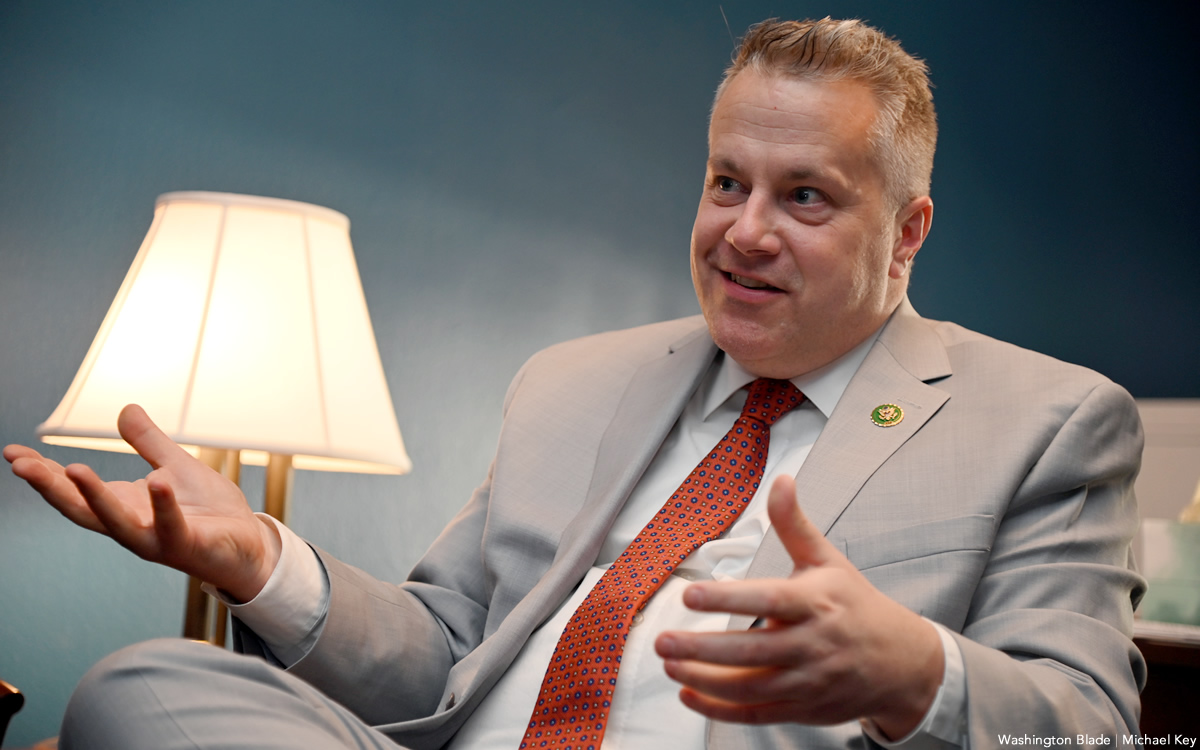
Whether on matters concerning climate change or LGBTQ rights, members of Congress ought to focus on making progress for the benefit of the next generation, U.S. Rep. Eric Sorensen (D-Ill.) told the Washington Blade.
“It’s making that decision today to talk about what’s in our future, not what’s in our past, and to say, ‘let’s just do what’s best for our kids,'” Sorensen said during an exclusive interview with the Blade from his office last week.
The congressman, who became the first openly gay member to represent the state of Illinois in either chamber with his election in 2022, has plenty of experience reaching folks with this message.
A meteorologist by trade, Sorensen began his television career at the ABC affiliate KTRE in Lufkin, Texas in 1999 before becoming chief meteorologist for WREX, Rockford, Illinois’s NBC affiliate, and then senior meteorologist at the ABC affiliate WQAD serving the Quad Cities area.
“You know, I was the one talking about climate change to farmers,” Sorensen said.
“Whenever I talk about climate change, I don’t fault anyone for being in a different place in the past,” he said, which helps to avoid positioning conservatives and climate skeptics in a defensive posture.
“We don’t ever have to agree on who’s causing climate change, or what 1.5 degrees celsius or two degrees celsius means,” Sorensen said. “Let’s just say that we’re going to do better today for the next generation, okay? And the same thing with LGBTQ issues, right?”
As it turned out, discussing climate change “wasn’t this third rail that we thought it was,” he said. Likewise, “it was the same thing as when I had my trans friends on television on Good Morning Quad Cities” for National Coming Out Day.
The move was important, Sorensen said, “so that my community could see these are real people…my friend Paula and my friend Chase are real people.” The congressman added, “we talked about how we came out, and we didn’t get any backlash [from the audience], because, you know what? I don’t live in a hateful community.”
Sorensen said the network looked at audience engagement metrics for segments featuring his trans friends, and for segments in which he addressed climate change, and the data repeatedly indicated that viewers were able to easily countenance both.
Some of this might be attributed to the good will he had built with this audience. After all, “I was the one they were turning to when the tornado was bearing down on their family’s home,” Sorensen said.
Regardless, “how do we expect people to understand if we don’t explain these things?”
‘Everyone should be speaking out’ against anti-trans extremism
Last week, Republicans on the U.S. House Education and Workforce Committee passed legislation that would bar transgender women and girls from competing in school sports per Title IX.
The measure, part of a nationwide wave of anti-trans bills, is likely fated to languish in the Democratic-controlled Senate.
On the heels of a press conference to drum up opposition to the bill that was hosted by the Congressional Equality Caucus and its chair, Rep. Mark Pocan (D-Wis.), Sorensen said, “I’m disappointed because these are real people.”
“We have to understand that, you know, when we talk about the threat that transgender people face today, if you just look at what is being proposed, what the extreme Republicans are saying, is that there’s now a group of kids or a group of people that don’t deserve to learn what athletics is about,” said the congressman, who is also a co-chair of the Equality Caucus.
Sorensen said the message from Republican members backing this legislation is that “this group [of women and girls] doesn’t deserve to learn teamwork as a kid.”
“It’s terrible,” he said. “Everyone should be speaking out against this. What it just shows is that these Republicans, they’re just stoking fear and division and being extreme, instead of actually solving the problems of the people.”
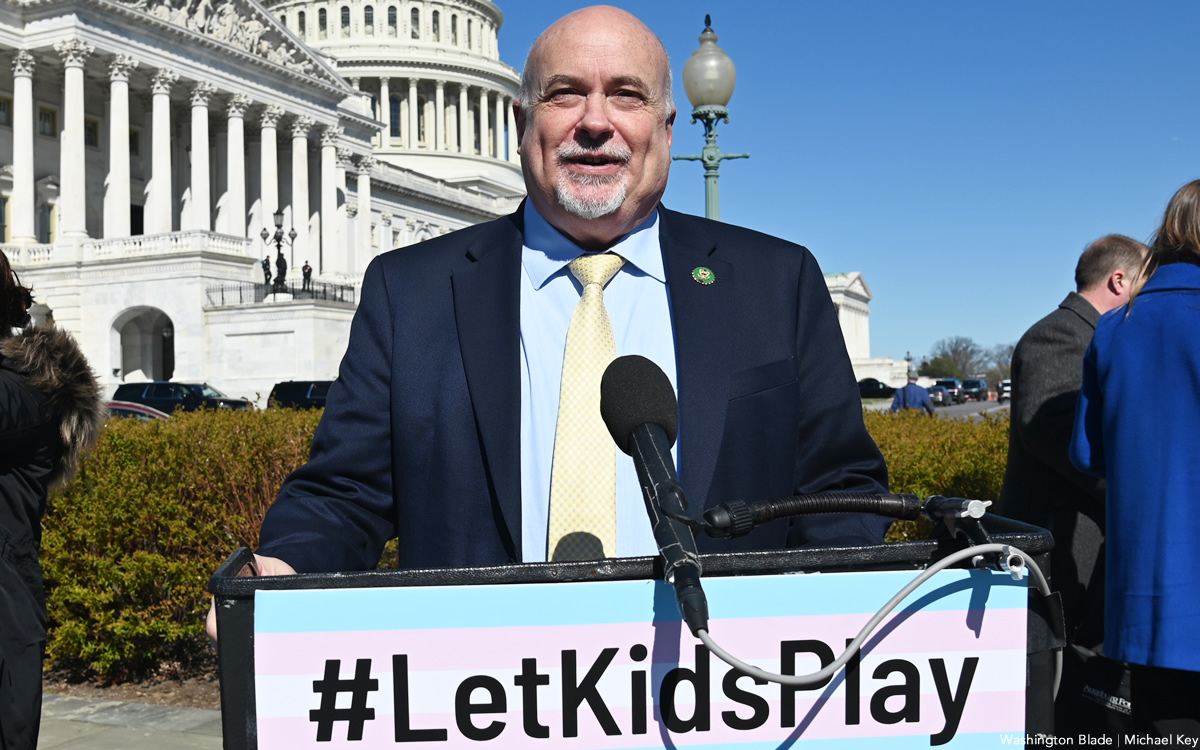
“I think it’s a point of extreme Republicans to run on this platform instead of solving the problems that we do have in front of us,” Sorensen said.
He noted extremism doesn’t seem to have been a winning message for Republican candidates in the 2022 midterm elections, during which time the GOP’s focus was on issues like the economy and healthcare.
It is remarkable “how things have changed in such a short amount of time,” Sorensen said. “And that’s because the Republicans, these extreme Republicans, have decided that they’re going to to roll through this division and hate.”
“It’s insane,” he said, pointing to legislation like the bill proposed in the Iowa Legislature to ban same-sex marriage “when it’s already been set in stone.”
At the same time, the congressman said, there is ample reason for optimism. For example, “in the state of Illinois we rejected that hate because the state of Illinois elected its first LGBTQ member of Congress.”
And back in the Quad Cities, Sorensen had the chance to meet the next generation of out youth when volunteering at the area’s LGBTQ community center, Clock, Inc. “I just stood there in awe at these kids that were able to be themselves.”
Moving forward, Sorensen said Democrats should continue to prioritize issues that Americans actually care about.
“I don’t feel like we need to defend ourselves,” he said. “You know, if they want to put this wedge issue out there, we need to just be able to say, ‘I’m fighting for Americans. I’m fighting to lower the price of goods, connecting people to health care,'” which includes healthcare for trans folks as well as reproductive care including abortions.
Sorensen said his identity as a gay man was not a central feature of his congressional campaign, but still, for many folks, “the only gay person that they knew was Eric Sorensen on channel eight.”
Overcoming homophobia
Growing up in the 1980s during the AIDS crisis, Sorensen said he asked himself, “Why should I even try?” He told the Blade, “I can see in my head the pictures of a hospital room, and I thought, ‘that’s how I’m gonna die,'” he said, so, “why would I even try, when they’re never going to allow me to be on television?”
Having relocated from Lufkin to Tyler, after a couple of years working as a meteorologist in the comparably larger northeast Texas metropolitan area, Sorensen said his sexual orientation became a problem for his employer in 2003.
“My boss told me, ‘Eric, I need you to go to the conference room after your show’s over,'” the congressman remembers.
Laid before Sorensen was his employment contract, a document he had not seen since he had signed it. “All of a sudden,” he said, “the members of management walk in, and I was told to have a seat while nobody across the table sat down – so they were looking down upon me.”
They had been alerted to Sorensen’s profile on Gay.com and offered him the choice to “be that person,” pointing to a printout of his profile, “or have a job.”
From there, he took a pay cut to return to Illinois where “I got to be out,” he said, “I got to be myself,” while every day at work, “I was telling my mom and dad what the weather was like.”
The congressman added, “If I would have given up in that space in Texas, where would I be? I wouldn’t be here today.”




Congress
HRC president campaigns for Chris Pappas in NH
Gay congressman running to succeed retiring U.S. Sen. Jeanne Shaheen

Human Rights Campaign President Kelley Robinson on Sunday campaigned for U.S. Rep. Chris Pappas (D-N.H.) in New Hampshire.
Robinson traveled to Manchester, the state’s largest city, nine days before the Sept. 8 primary that will determine who will vie for retiring U.S. Sen. Jeanne Shaheen (D-N.H.)’s seat.
We’re hitting the pavement across New Hampshire to fight for a freer, fairer future for everyone.
Glad to have Human Rights Campaign President @KelleyJRobinson join us for a canvass launch in Manchester today. pic.twitter.com/XWCEaQxy4o
— Chris Pappas (@ChrisPappasNH) August 30, 2026
Former U.S. Sen. John E. Sununu, who represented New Hampshire in the U.S. Senate from 2003-2009, will face off against former U.S. Sen. Scott Brown, who represented Massachusetts in the U.S. Senate from 2010-2013, in the Republican primary.
Karishma Manzur is among the Democrats challenging Pappas.
A poll the University of New Hampshire Survey Center released on Aug. 26 shows Sununu is ahead of Brown. The same survey shows Pappas ahead of Manzur and his other Democratic challengers.
The UNH Survey Center poll shows Sununu ahead of Pappas by a 45-43 percent margin if they were to face off in the general election. The margin of error is +/-2.1 percent.
Pappas would become the first openly gay man elected to the U.S. Senate if he were to win in November.
Congress
Chris Van Hollen says the Democratic Party needs change. Is he the one to lead it?
Senator is backing anti-establishment Democrats across the country
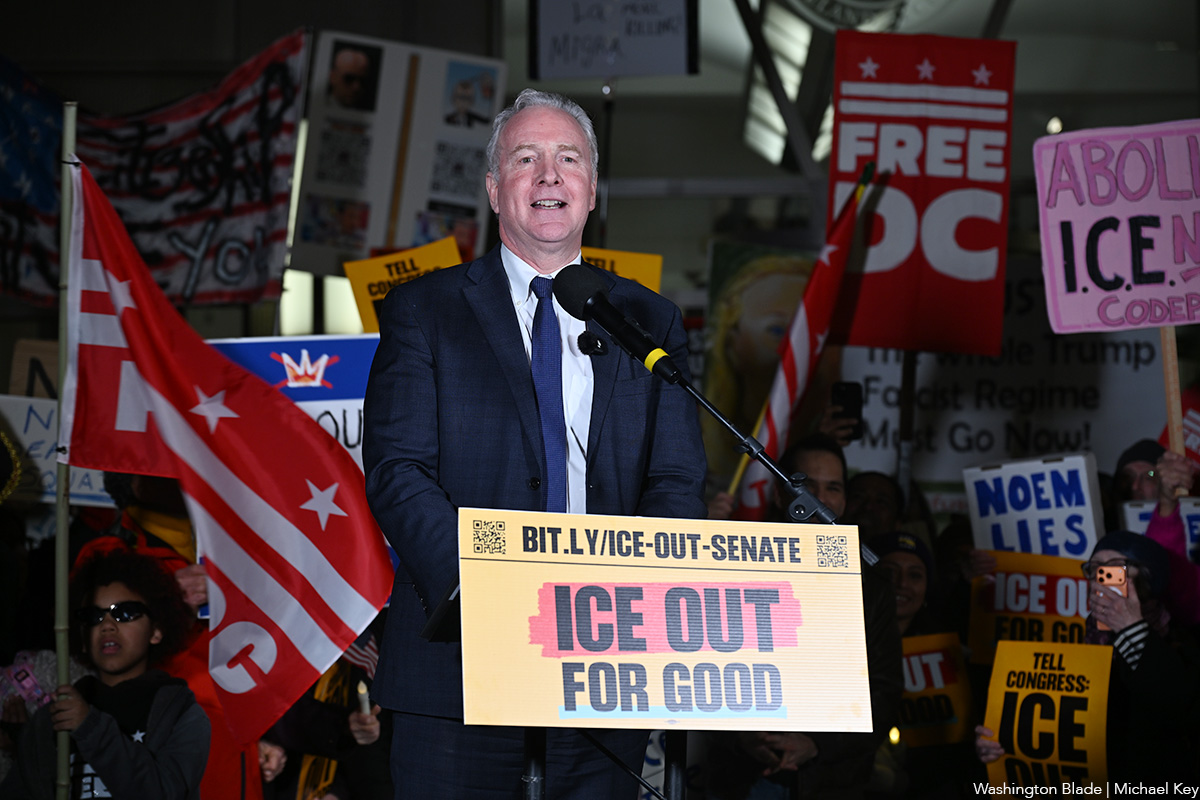
By LEE O. SANDERLIN | The Democratic Party is having something of an identity crisis — losing to President Donald Trump twice in three elections will do that.
Should the party embrace anti-establishment figures who espouse progressive policy ideas like Medicare for all and rhetoric about unrigging the economy for the 1 percent? Or should Democrats try to appeal to moderates who want to return to semi-normalcy in a time of political upheaval?
Although he’s been in Congress since 2002, with key leadership roles throughout his tenure, Maryland Sen. Chris Van Hollen, 67, counts himself firmly in the anti-establishment camp.
The rest of this article can be found on the Baltimore Banner’s website.
Congress
House blocks effort to codify transgender servicemember ban into law
Lawmakers approved two anti-trans NDAA amendments

The U.S. House of Representatives on Tuesday rejected an amendment to the National Defense Authorization Act that would have codified a ban transgender servicemembers in the military.
The bipartisan vote was 212-217.
The NDAA is for the 2027 fiscal year and sets policies for the Defense Department programs and activities and the national security programs of the Department of Energy.
U.S. Rep. Lauren Boebert (R-Colo.) proposed the amendment on July 21. It stated that all personnel are required to serve in accordance with their biological sex, citing military readiness and discipline.
Human Rights Campaign Senior Director of Government Affairs Jennifer Pike Bailey stated that she is grateful for the bipartisan vote that rejected President Donald Trump and Defense Secretary Pete Hegseth’s “dangerous and discriminatory policy that has kicked brave transgender servicemembers out of the military and weakened our national security.”
“Everyone who meets the same rigorous standards should be able to serve their country. We should honor that patriotism, particularly in this moment where we are witnessing brave servicemembers making the ultimate sacrifice for our country, instead of ending their careers and politicizing their existence. We’re grateful that a permanent extension of this ban failed, and we will keep fighting to reverse this senseless policy,” Bailey said.
Mark Takano, chair of the Congressional Equality Caucus, stated that he and his members put in countless hours of work to kill the amendment.
“When Americans know they or their families are going to be targeted by or not supported by the military, that leads them to avoid signing up to serve or staying in the service — making it harder to keep the ranks of the armed services full and our nation safe. My colleagues in the Equality Caucus and I will continue working to prevent these attacks on our servicemembers and their families from becoming law,” Takano said.
According to the Congressional Equality Caucus, two other bills could potentially be passed that would also target the transgender community, both of which were proposed by U.S. Rep. Nancy Mace (R-S.C.).
The first was a bill that would have prohibited gender-related medical care under TRICARE and to prevent TRICARE from covering certain gender-related medical procedures and treatments, which was approved in a vote of 219-208.
The second was a bill that would have prohibited male participation in female sports at DoDEA schools. DoDEA schools are Department of Defense Dependents Schools, which is a network of primary and secondary schools.
The amendment was approved in a vote of 221-203.

Everton Blair makes history as first openly gay congressman from Ga.

Mujer trans salvadoreña es encontrada sin vida

Iceland implements gender-neutral blood donor rules

Blade Foundation to host fundraiser in Rehoboth on Sept. 12

New book examines fashionista Audrey Smaltz’s fabulous life

Gloria Steinem dies at 92

Pentagon expands testosterone screening as trans troops face hormone therapy restrictions

Swiss government backs nationwide conversion therapy ban

Calendar: September 4-10