Politics
HRC, Alphonso David reach settlement agreement
Group’s former president was one-time Andrew Cuomo counsel
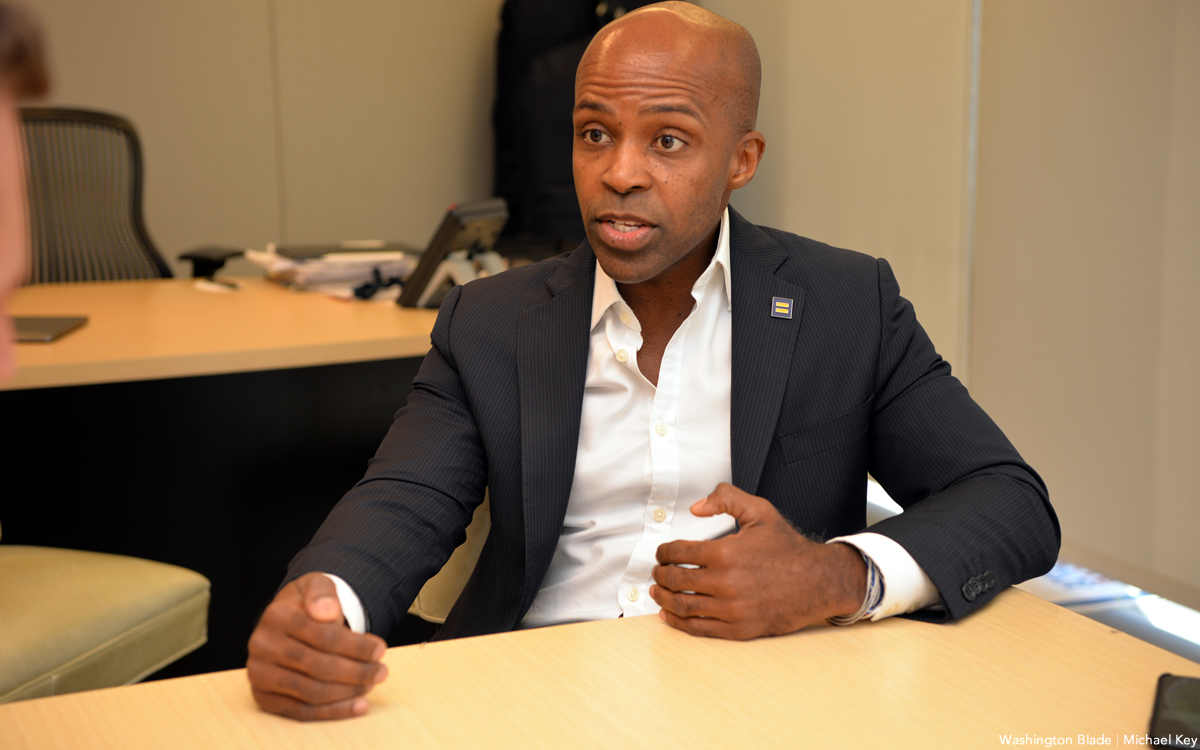
According to a joint statement released on Wednesday, the Human Rights Campaign and its former president, Alphonso David, reached a settlement agreement over David’s racial bias lawsuit against the organization, America’s largest LGBTQ rights group.
The parties’ statement said they “have chosen to amicably resolve” the litigation without specifying the terms of their settlement agreement, which “are confidential.”
Provided that “HRC and Mr. David share the mission of advancing human rights for all LGBTQ+ people and realizing a world that achieves fundamental fairness and equality for all, they agree it is in their mutual best interests, and the interests of the communities that they serve, to put this matter behind them.”
A probe by New York Attorney General Letitia James turned up evidence that David had solicited signatures for a letter that sought to undermine the credibility of a woman who accused Andrew Cuomo of sexual harassment.
David, who at the time served as counsel to Cuomo, then the governor of New York, was subsequently fired from his post leading HRC in September 2021 — and then sued the group, alleging racial discrimination.
According to filings in the case, adjudicated by the U.S. District Court for the Eastern District of New York, HRC argued David was terminated because his work on behalf of Cuomo constituted a “violation of HRC’s Conflict of Interest policy and the mission,” causing damage to the group’s “interests, reputation and prospects” and compromising David’s ability to lead the organization.
David was succeeded by interim HRC President Joni Madison before Kelley Robinson took over in November, becoming the first Black queer woman to lead the organization.




2026 Midterm Elections
LGBTQ issues, attacks on Democrats dominate unusual RNC midterm convention
“Trumpapalooza” emphasized the gains Republicans need to maintain control of the federal government.

The Republican Party held an unusual midterm convention in Dallas last week, where President Donald Trump and other prominent GOP officials spoke in hopes of building enthusiasm and support ahead of the November elections.
The two-day gathering at the American Airlines Center was the first midterm convention of its kind for the Republican Party. Unlike a traditional presidential nominating convention, there was no official party business or nominations. Instead, the event was designed to energize Republican voters and unite the party behind its candidates and broader message heading into the midterm elections.
Trump, who spoke during both nights of the convention, repeatedly emphasized the importance of Republicans turning out to vote in the midterms — elections in which incumbent presidents and the parties in power have historically faced significant challenges.
“I’m asking you to pretend that I’m on the ballot,” the president implored attendees on the first day.
On the second night, Trump delivered another direct appeal to Republican voters.
“You know what happens if you don’t vote? You go to hell,” he said.
Trump also urged attendees at one point to “cheat like hell” to keep Republicans in control of Congress.
The president also used the event to promote Republican candidates, including Texas Attorney General Ken Paxton, the GOP nominee in the state’s closely watched Senate race against outspoken LGBTQ rights supporter James Talarico.
“He may not dress right, he may not talk exactly perfectly, and he may not be the best-looking guy I’ve ever seen, but he’s the greatest attorney general in America and he deserves to be your next senator,” Trump said when talking about Paxton.
Among those in attendance were gay Treasury Secretary Scott Bessent, Rep. Brandon Gill (R-Texas), North Carolina Senate nominee Michael Whatley, and Ohio Republican Sen. Jon Husted.
Both days, there were thousands of empty seats, including almost all of the upper level, despite Trump insisting the arena was “packed” with “thousands” more waiting outside.
The convention’s message frequently emphasized personal and political attacks on Democrats, often over detailed policy discussions. Speakers repeatedly targeted Democratic candidates and progressive figures, with Michigan Democratic Senate nominee Abdul El-Sayed among those mentioned throughout the event.
The first lady was notably absent from the event.
Five RNC officials described the scope of the party’s nationwide “election integrity” effort to Axios. They said strict enforcement of voting laws and preventing noncitizens from registering and voting are top priorities, even as analysts say voter fraud is rare and there is no evidence of any systemic or significant problem.
President Trump also proposed giving American adults $5,000 if Republicans retain control of the House and Senate, a proposal that immediately raised questions about its legality and implementation.
The Republican base has also fractured over several key issues during the last 18 months, including the war in Iran, the handling of the release of the Epstein files, surging gas prices, and rising costs driven by tariffs. The convention was organized as an effort to rally Republicans around the party and motivate turnout despite those divisions and broader concerns heading into the midterms.
A protester carrying a Mexican flag interrupted Vice President JD Vance’s speech on Sept. 10.
“It’s about sending a message to the Democratic Party that if you send your crazies, we’re going to send you packing,” Vance said of the stakes of November’s elections.
More than 100 protesters also marched through downtown Dallas during the RNC Midterm Convention, briefly blocking traffic near the American Airlines Center.
At the convention both nights, an image that can only be described as a thirst trap of Democratic socialist commentator and creator Hassan Piker was shown on the jumbotron, garnering attention on social media.
The social media star posted a video shortly after images of him, abs and all, appeared on the jumbotron, sitting at a desk and completely dumbfounded at the thought that “my meat pic was on the jumbotron at the republican midterm convention.”
Piker has been a frequent target of conservative and Republican figures because of his criticism of the Israel-Palestine war, the war in Iran, and his broader critiques of the establishment and political institutions of both parties. Piker and El-Sayed were two of the most targeted progressive figures during the convention.
Another figure from the other side of the aisle who made an appearance was Democratic Sen. John Fetterman, who in recent months has adopted more conservative positions on some issues and continued to voice strong support for Israel — an issue on which there are divisions within the Democratic Party.
“Yes, I’m a Democrat. Why am I here talking to you today? Because well, I’m a common sense Democrat,” Fetterman said in the prerecorded video that also aired on the American Airlines Center’s jumbotron. “I’m always going to stand with America. I’m always going to reject the extremes and socialism and that anti-American way of life.”
“We’ll work with President Trump to fight and defend the steel way of life right here in the steel valley,” he added.
Fetterman’s prerecorded appearance was a notable moment at an event otherwise dominated by Republican officials and speakers.
Also at the event, accusations began to spread online about alleged Grindr outages in the area of the convention — a juxtaposition with the anti-LGBTQ positions the Republican Party officially reflects and its emphasis on “family values.”
A spokesperson for Grindr told Snopes, “Grindr has not experienced recent outages. Third party sources that often make these claims rely on unreliable data such as self-reporting, while Grindr reports outages directly on its status page.” The status page showed no outages in August or September 2026.
Another person, who goes by the name of Nick Pringle online, garnered over eight million views on an Instagram video in which he claims he was about to start working “undercover as a male escort” at the convention.
In the video, he appears to be in a hotel bathroom and says he will post for the sake of exposing hypocritical Republican lawmakers who have used their power to champion what he described as hateful and divisively anti-LGBTQ legislation.
The Blade reached out to Pringle via Instagram to ask whether he ultimately carried out what he described in the video and whether he had any evidence or additional information to share about his experience at the convention, but did not hear back by the time of publication.
Politics
Ind. prosecutor declines to press charges over false Buttigieg child welfare complaint
Former Biden-Harris Cabinet member declined to comment on decision
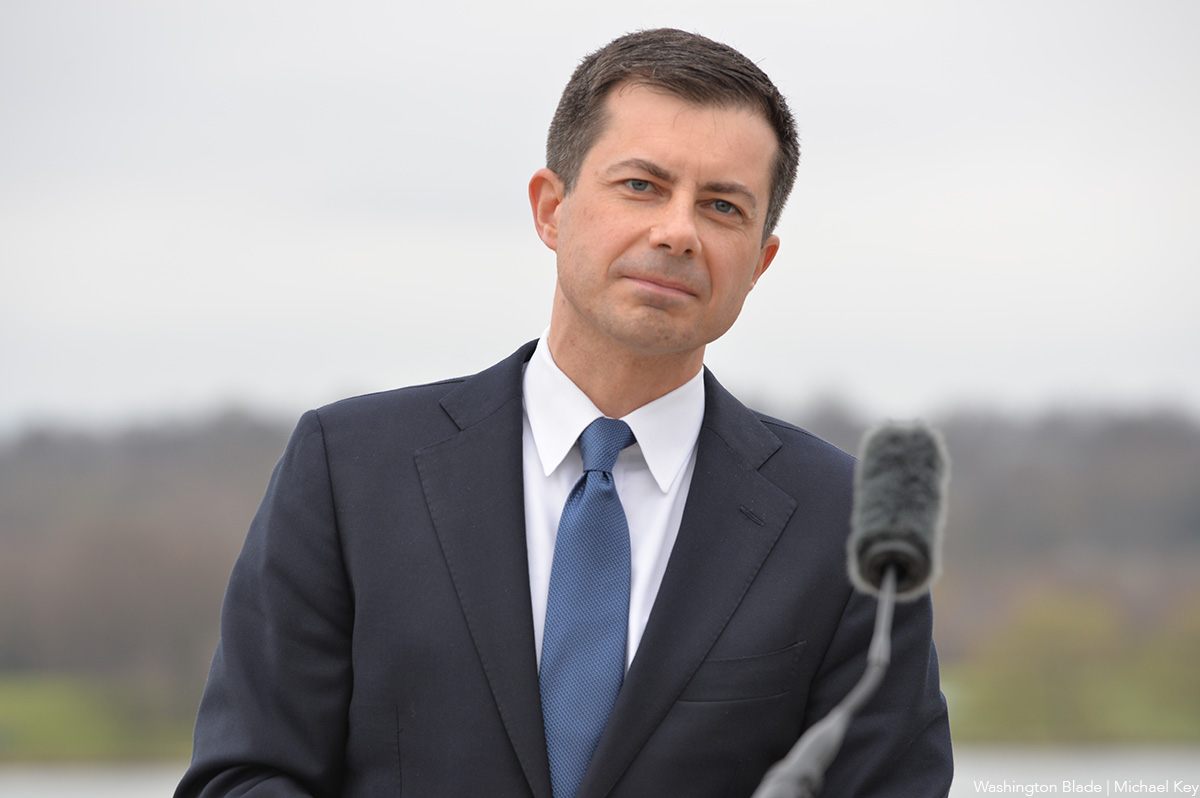
An Indiana prosecutor has declined to file criminal charges against a woman who made a false child welfare complaint against Pete Buttigieg.
Buttigieg, the former transportation secretary in the Biden-Harris administration, was accused in June of posing a threat to his children via an anonymous call to police that resulted in him being temporarily separated from his four-year-old twins.
Marshall County Prosecuting Attorney E. Nelson Chipman Jr. opted not to pursue charges against the Alabama woman who filed the false child welfare claim against the Democratic political figure while she was in Marshall County.
According to ABC 57, the television station in South Bend that published a letter from Michigan State Police to Indiana State Police, the 50-year-old woman, identified only as TJ of Alabama, was responsible for the “brief and intrusive investigation” into Buttigieg and his family.
In the letter to Indiana State Police, Michigan State Police described TJ’s documented alcoholism and other chemical dependencies, as well as hallucinations and delusional thinking. The prosecutor also noted that TJ has self-identified as God and claims to hear voices only she can hear.
The letter from Michigan State Police to Indiana State Police states:
“Your investigation reveals that TJ, 50 years old, has a documented history of alcohol abuse and has experienced numerous treatment facilities and programs for alcoholism and other chemical dependency over the years. Further, TJ has a long history of mental illness, manifested by hallucinations and delusional thinking which includes frequently responding to voices only she hears and grandiose ideation including self-identifying as God. She frequently reports she has enjoyed an evening meal with Barack and Michele Obama.
TJ is from Alabama. During her relatively short stay here, TJ was able to generate three separate police encounters that resulted in reports, one of which resulted in TJ’s arrest for domestic battery. I note her BAC in that case was reported at .323. I also note one of the three early reports was based upon TJ’s claim of herself being a victim of sexual abuse at the age of 3 by her mother some 47 years prior. Her explanation for such a delayed report was incoherent.
As you found out, TJ returned to Alabama and took up residence in a treatment facility only to be soon evicted for a rule violation. She currently resides in a half-way house near Alabama, with very limited mental health treatment options available. I note TJ’s abusive and harassing attitude has resulted in restricting only somewhat her access to a telephone, and that she continues to have access to computers at the facility. Obviously she may still have the ability to file additional complaints. No doubt a regrettable situation.
In light of the totality of circumstances, I am unable to conclude that TJ is capable of forming the requisite intent to support a criminal conviction for this offense. Accordingly, this office will not be filing a criminal case in this matter.
Thank you, as always, for a thorough investigation and cogent report.
Stay safe.
Best regards,
E. Nelson Chipman, Jr.
Marshall County Prosecuting Attorney”
When the situation first arose in June, Buttigieg opened up about the experience via his Substack, where he described the situation as one of the worst things that has ever happened to his family — one that resulted in him being separated from his twins, Joseph August “Gus” and Penelope Rose, for their safety.
“The caller said that he had spoken to a woman who claimed to have met me at a conference several years ago in Alabama, where she said I told her that I had committed unspeakable violent crimes, and the caller believed my children were still at risk,” Buttigieg wrote in a post he titled “A Terrible Thing Happened to My Family.” “I am a reasonable man. I try to keep as calm and low-key as possible. But I cannot describe the mix of rage and sadness that I feel at the idea that someone brought our children into this.”
A Buttigieg spokesman declined to comment on the prosecutor’s decision not to pursue charges, but did tell the Washington Post in a statement: “This has been a painful and infuriating situation for the family. They are in touch with Michigan authorities, seeking answers and accountability for what happened.”
In response to the story Buttigieg shared on his Substack, Kelley Robinson, president of the Human Rights Campaign, released the following statement:
“I know how I would feel if someone tried to come between me and my kids. This is truly bottom-of-the-barrel stuff. It takes an awful, hateful person to question someone’s fitness as a parent just because of who they are, who they love, or in Sec. Buttigieg’s case, perhaps even who he speaks out against politically. We’re thinking of Pete, Chasten, and their whole family in this moment — and we aren’t resting until all LGBTQ+ families have the kind of safety and justice every one of us deserves.”
The Washington Blade reached out to Michigan State Police after the story initially broke to ask if any disciplinary action would be imposed on the woman who made the false report, but was told to file a FOIA request to view the full report. After filing a FOIA request, the Blade was denied access to any additional information.
2026 Midterm Elections
Chris Pappas wins NH Democratic Senate primary
Gay congressman running to succeed retiring U.S. Sen. Jeanne Shaheen

New Hampshire Congressman Chris Pappas on Tuesday won the Democratic primary in the race to succeed retiring U.S. Sen. Jeanne Shaheen (D-N.H.) in the U.S. Senate.
Pappas defeated Karishma Manzur, who was his primary challenger, by a 61.8-36.1 percent margin.
The gay congressman will face off against former U.S. Sen. John E. Sununu, who defeated former U.S. Sen. Scott Brown in the Republican primary.
“Tonight’s victory sends a clear message that voters are looking for leaders who will fight for their rights, their freedoms, and to be treated with dignity and respect,” said Human Rights Campaign President Kelley Robinson in a statement.
She campaigned for Pappas in Manchester, New Hampshire’s largest city, on Aug. 30.
“Chris Pappas has delivered results, stood up for equality, and showed up for the people he serves,” said Robinson in her statement. “HRC was proud to mobilize Equality Voters across New Hampshire to help power this win. We don’t have a second to waste between now and November. We look forward to continuing our work with Rep. Pappas as he drives toward victory in November so he can help return a pro-equality majority to the United States Senate.”
A poll the University of New Hampshire Survey Center released on Aug. 26 showed Sununu ahead of Pappas by a 45-43 percent margin if they were to face off in the general election. The margin of error is +/-2.1 percent.
Pappas would become the first openly gay man elected to the U.S. Senate if he were to win in November.

LGBTQ issues, attacks on Democrats dominate unusual RNC midterm convention

Acclaimed Chef Patrick O’Connell’s memoir reveals the arc of a life well lived

New Hungarian government to scrap anti-LGBTQ adoption law

Fashion icon Bob Mackie dead at 87

Transgender woman killed in Barclay community mourned by friends, advocates

How Dolly became a folk saint for Appalachian queers

Remembering the LGBTQ heroes of 9/11 terrorist attacks

Historiography with heart

Ind. prosecutor declines to press charges over false Buttigieg child welfare complaint

Multi-billion-dollar 9/11 Victim Compensation Fund to continue until 2090
-

 Arts & Entertainment5 days ago
How Dolly became a folk saint for Appalachian queers
-
National5 days ago
Remembering the LGBTQ heroes of 9/11 terrorist attacks
-
Books5 days ago
Historiography with heart
-
Politics5 days ago
Ind. prosecutor declines to press charges over false Buttigieg child welfare complaint