National
Concerns for future emerge at U.S. Conference on HIV/AIDS
‘I’m done being treated like shit in the country I grew up in’
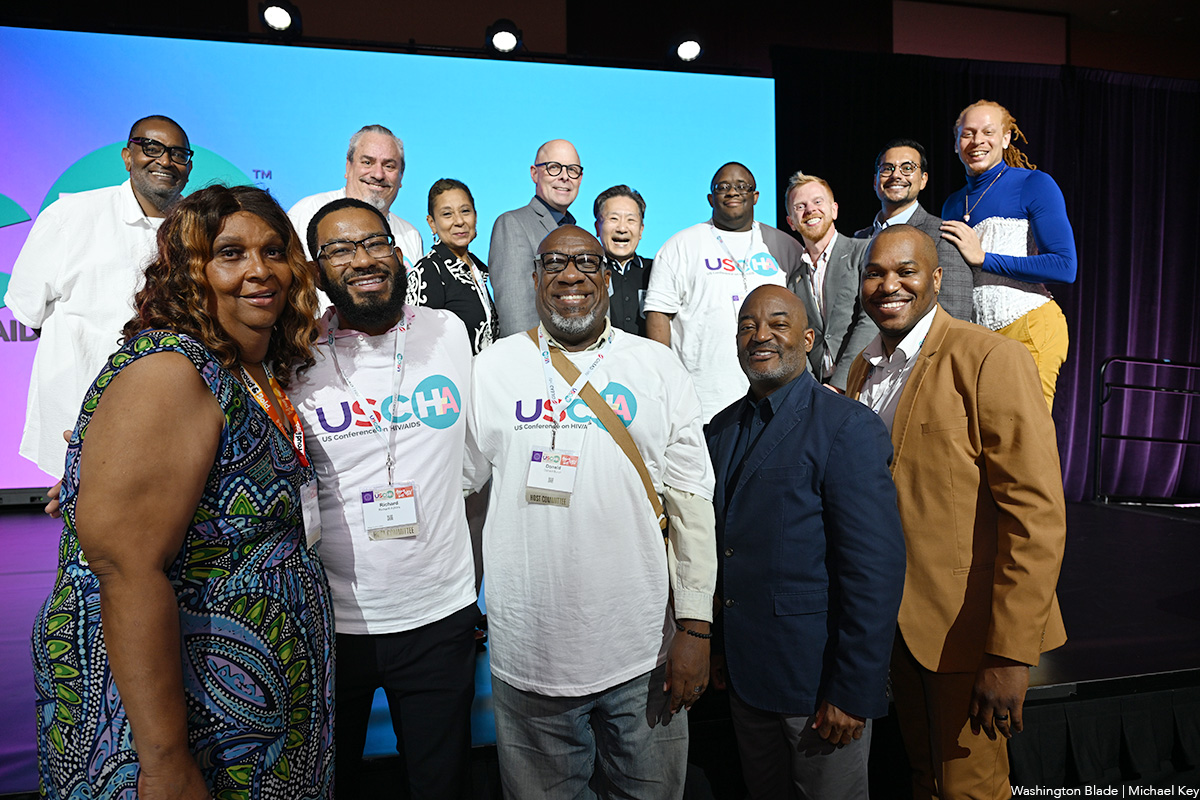
More than 2,400 people, including public health experts, scientists, physicians, local government officials, and community activists, turned out for the 29th annual United States Conference on HIV/AIDS, which took place Sept. 4-7 at the Marriott Marquis Hotel in D.C.
Organized by the D.C.-based group NMAC, formerly known as the National Minority AIDS Council, the conference is considered the nation’s largest and most comprehensive gathering of experts involved in addressing the HIV/AIDS epidemic in the U.S.
NMAC spokesperson Pavni Guharoy said NMAC officials will be completing a final count of the conference participants based on registration numbers later this week, but she said the current estimated attendance was at least 2,500.
The conference included more than 100 workshop sessions that focused on a wide range of issues related to the status of the HIV/AIDS epidemic in the U.S., with a focus on the large and growing number of people living with HIV who are 50 years of age or older.
Information released at the conference shows that as of 2022, of the nearly 1.1 million people living with HIV in the U.S., approximately 54 percent were 50 years of age or older.
Many of the sessions addressed the needs, concerns and sometimes stigma faced by diverse communities of people living with HIV and those at risk for HIV, including African American, Latinx, and LGBTQ communities, both those who are aging as well as young adults.
The conference also included four plenary sessions in which all conference attendees listened to two-dozen prominent keynote speakers. Among them was former U.S. National Institutes of Health official Dr. Anthony Fauci, who pointed out that continuing advances in HIV research have led to effective medical intervention that changed AIDS from a once fatal illness to a condition in which people with HIV can live “a normal life span.”
Other keynote speakers included Earvin ‘Magic’ Johnson, the acclaimed basketball player who became an advocate for people with HIV after testing positive for HIV 33 years ago, and Dr. Rachel Levine, who made history by becoming the first out transgender person to be confirmed by the U.S. Senate in 2021as an appointee by then-President Joe Biden as a U.S. Assistant Secretary of Health.
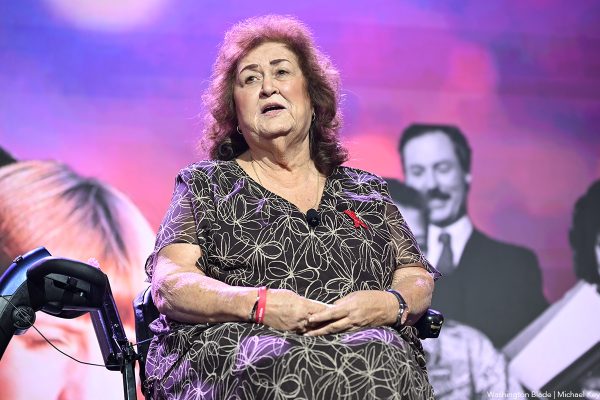
Also speaking was Jeanne White-Ginder, the mother of Ryan White, who was diagnosed with AIDS in 1984 at the age of 13 from a blood transfusion. White-Ginder told conference attendees how Ryan faced discrimination when he was initially barred from going to his school in Indiana out of fear that he could transmit the virus to others at school.
In a moving presentation, she told how Ryan became one of the nation’s early advocates for people with HIV/AIDS up until the time of his death in 1990, one month before his high school graduation. She said then-U.S. Sen. Edward Kennedy (D-Mass.) invited her to come to Washington to help lobby for a bill Kennedy introduced and which Congress passed in her son’s honor called the Ryan White Comprehensive AIDS Resources Emergency (CARE) Act in August 1990.
“Now, today, thanks to your hard work and dedication, Ryan’s bill and your bill, too, provides treatment and support to more than half a million Americans in big cities, small towns and rural communities across the country,” she said. “It has dramatically reduced suffering. It has enabled people to live with HIV, to live long and healthy lives.”
But White-Ginder joined the many conference speakers, including Magic Johnson, in calling on attendees and the public to urge Congress to reject the dramatic cuts in funding for federal AIDS programs, including the Ryan White program, proposed by President Donald Trump and Republican congressional leaders for the Fiscal Year 2026 federal budget.
Among those calling on the AIDS community and allies to speak out against the proposed budget cuts were Paul Kawata, NMAC’s outgoing executive director and CEO, who is retiring Oct. 7, and Harold Phillips, the former director of the White House Office of National AIDS Policy during the Biden administration and current NMAC Deputy Director for Programs who was chosen to succeed Kawata as NMAC CEO.
NMAC officials, led by members of its board of directors, praised Kawata for his 36 years of service as NMAC’s leader and his dedication to the cause of service and support for people with HIV and AIDS.
Kawata reflected on his work at NMAC and his concerns over the current political climate in Washington in a sometimes-emotional farewell address at one of the conference’s plenary sessions on Sept. 5.
“I’ll be honest with you. After 36 years the thought of leaving all of you is much more difficult than I thought it was going to be,” he told the gathering. “You are my family. You are the people that I love,” he said.
“You taught me how to be a better version of me. And I am so extraordinarily grateful for everything that you have given me,” he continued. “And you will always be a part of my heart.”
Pointing to members of the NMAC staff, both current and former members in the audience, Kawata said, “NMAC is NMAC because of what you do every single day with your life. You fight to make a difference in the world. And I am honored and privileged to call you my friends.”
Without mentioning the Trump administration by name, Kawata had harsh words for what he said was happening now in the United States and its impact on people living with HIV.
“I’m not going to lie to you,” he said. “I’m done being treated like shit in the country that I grew up in. I’m done being told that I’m a second-class citizen because of who I love,” he continued. “It’s not my America anymore. And I’m worried for our future.”
He added, “We always talk about the pendulum of justice, about the arc of justice. And I really want you to know in this moment, as difficult and as awful and how hellacious it is, we are on the right side of history. We are the ones who will change the world.”
In his remarks at the conference’s closing Sept. 7 plenary session, Fauci said, “We’re in very difficult times. You don’t need me to tell you that. But we’ve got to continue to put the pressure on what we did in the ‘80s with the activist groups, to make sure we do end the epidemic.”
He noted that he was at his job as director of the U.S. National Institute of Allergies and Infectious Diseases in the early 1980s, when the AIDS epidemic first surfaced and the AIDS patients he and his colleagues cared for, had little chance of survival.
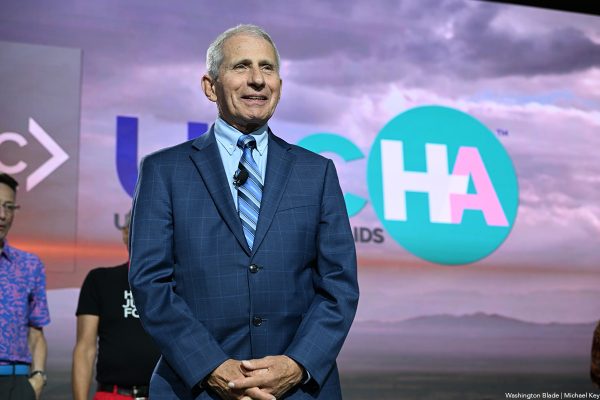
“Fast forward now, 44 years, extraordinary things have happened,” Fauci said. “We now have drugs that you are all very aware of that can have an individual living with HIV live essentially a normal life span in putting under the care and the availability of drugs,” he continued.
“We know what U equals U – something that we didn’t imagine some years ago. That undetectable equals untransmissible,” he said, referring to the current HIV medication that suppresses the HIV virus to an undetectable level that prevents an infected person from transmitting it to someone else.
“And right now, with these drugs that we have for the prevention of HIV we have what we actually hoped for years ago – and that is to end the HIV epidemic,” he said.
Dr. Rachel Levine, who during the Biden administration served in the dual role as Assistant Secretary of Health at the U.S. Department of Health and Human Services and as director of the U.S. Public Health Service Commissioned Corps, also spoke at the closing session of the conference.
She noted that she began her career as a pediatric physician in 1983 in New York City, at the time of the early stages of the AIDS epidemic. From that time through her years as Assistant Secretary of Health, Levine said she observed first-hand the skills and dedication of doctors, nurses, and others who cared for people with HIV/AIDS who she described as the HIV care workforce.
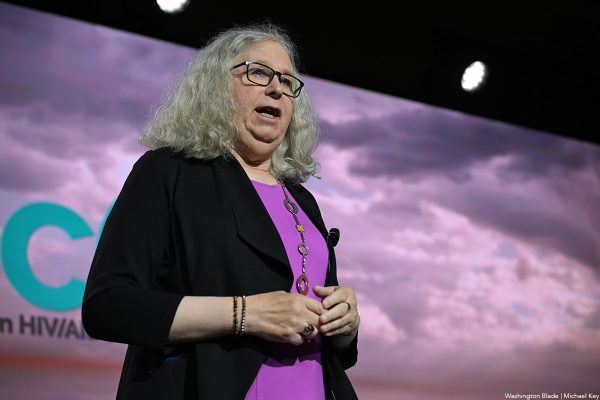
“The HIV care workforce since that time has been incredibly dedicated, with many people working for decades,” she said. “And working to end the HIV epidemic in the United States and around the world. We applaud you. You are in this room. We applaud you arduously for your dedication and for your passion.”
Levine also noted that the cuts in funding and large-scale federal worker layoffs brought about by the Trump administration have had a direct impact on the HIV care workforce.
“Many dedicated public health leaders, including most of the HIV and infectious disease team who I worked with in my office at HHS have had their positions eliminated,” she said. “These hard-working civil servants went to work every single day to support the health and wellbeing of all Americans, including those living with HIV.”
She added, “And we know that there are shortages in HIV care. And it is so critical at this challenging time that we support you, the HIV care workforce.”
Many conference attendees said Magic Johnson played a leading role in boosting morale and spirit at the 2025 U.S. Conference on HIV/AIDS by his inspirational speech at the Sept. 5 plenary session.
Upon receiving a prolonged, standing ovation after being introduced as the next speaker, Johnson said, “When I think about 33 years living with HIV in a moment that changed my life forever. And what a blessing to be here 33 years later to tell that story at a time when there was only one drug.”
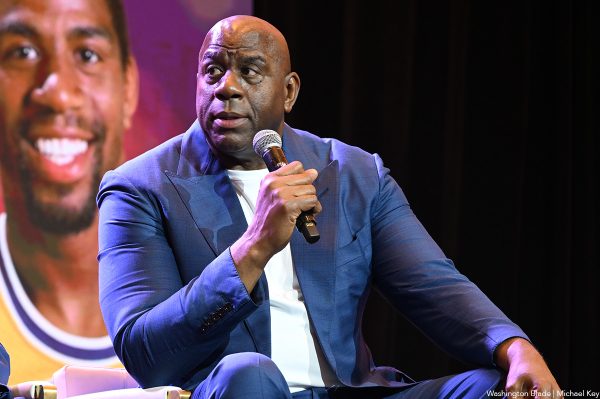
Johnson added, “Wow, and they said it probably is a death sentence for myself, and I had to wrap my arms around making the toughest decision I probably had to make in my life, which was to retire from the NBA.”
Among other things, Johnson said his doctors told him that while he was physically capable of continuing to play basketball, the stress of an 80-game season could impact his immune system and lower his T-cell count.
With the support of family, friends, and his community, Johnson said he miraculously survived the early days without a known fully effective HIV drug. And at the request of community activists, he agreed to speak out as a well-known figure and a person with HIV to inform “my community,” especially people of color, he said, about how to live with HIV and how uninfected people can lower their risk.
“But what I do, I adhere to my doctor. I take my meds. I work out, and then I love life and myself,” he said.
In response to the challenge facing people with HIV under the current political situation, Johnson said, “We got to pull ourselves together and continue this fight, because it’s important and we got to keep this at the forefront. Now, HIV and AIDS kind of slipped back. We got to bring it back up.”
Among other things, he said the nonprofit foundation he helped to form has “given away over $15 million” in grants to HIV/AIDS organizations. “And we will continue to do that because of the work you are doing.”
He received another thunderous applause and standing ovation upon the completion of his speech.
Phillips, who will succeed Kawata as NMAC’s CEO on Oct. 7, told the Washington Blade he believes this year’s U.S. Conference on HIV/AIDS was “extraordinary” under difficult circumstances.
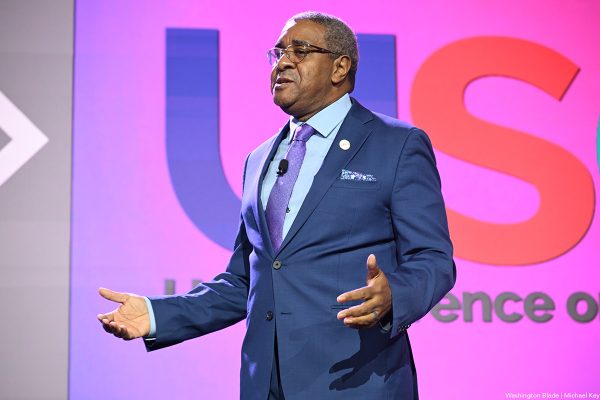
“I think so, because this year we did this without a lot of federal support,” he said. “And many of the attendees – the federal government, HRSA, the Ryan White program told them they couldn’t use their grant funds to attend the conference, which was a shame.”
Phillips added, “But I think with a crowd of over 2,400, some people found a way to be here regardless and thought that it was important, and the topic was important enough. And I think our listening sessions, our workshops, our plenaries hopefully gave them what they needed to continue to be activated to serve people living with HIV. “
“And also gave them a sense of hope, especially in these dark times that we can continue to work to end the HIV epidemic,” he said.





Federal Government
988 restores crisis services for LGBTQ youth

The lifesaving 988 call-in number to help people experiencing mental health crises or suicidal thoughts has once again restored its specialized services for LGBTQ youth.
The lifeline, which used to have the option to “press 3” to be directly sent to specialized services for LGBTQ youth facing mental health crises or suicidal thoughts, was returned on Wednesday following an over-year-long battle with the Trump-Vance administration, which removed the service in May 2025.
The Press 3 option rolled out as a pilot program in 2022 through a government contract with the Trevor Project, a suicide prevention and crisis intervention organization for LGBTQ people.
Then, in June 2025, the federal government announced that the lifeline would be eliminated within a month. By July 2025, 988 Lifeline’s “Press 3” services were terminated.
Openly gay U.S. Sen. Tammy Baldwin (D-Wis.) helped lead Congress in reversing the removal of the lifesaving resource from American phones. As a member of the Senatw Labor-HHS Appropriations Subcommittee, she started the process of securing $535 million for 988 — a $15 million increase — as well as dedicated funding for LGBTQ youth specialized services.
Then, in September 2025, Baldwin, along with U.S. Sen. Lisa Murkowski (R-Alaska), introduced bipartisan legislation in the Senate, the 988 LGBTQ+ Youth Access Act, to codify the 988 Lifeline’s specialized services for LGBTQ young people.
At the same time, U.S. Rep Raja Krishnamoorthi (D-Ill.) introduced the legislation in the House of Representatives alongside U.S. Reps. Michael Lawler (R-N.Y.) Sharice Davids (D-Kan.) Brian Fitzpatrick (R-Pa.) and Seth Moulton (D-Mass.)
The Senate passed Baldwin’s bipartisan funding bill in January 2026, funding the Department of Health and Human Services with explicit language mandating the return of 988’s LGBTQ youth specialized services.
In February 2026, Congress passed legislation mandating that the previously eliminated “Press 3” specialized services be restored and funded with $33,100,000 — but it was unclear if the Press 3 option would still be allowed under current executive orders, namely Executive Order 14168, or “Defending Women From Gender Ideology Extremism and Restoring Biological Truth to the Federal Government.”
Despite the securing of federal funding for the Press 3 resource, the battle to get the 988 LGBTQ+ Youth Access Act through Congress is ongoing — and would provide codafied protection from this removal ever happening again.
According to data on the Trevor Project’s website, LGBTQ young people are more than four times as likely to attempt suicide than their peers.
Baldwin’s office touts the immense help the lifeline provides to LGBTQ people in their moments of greatest need. The press release on the reinstatement of Press 3 highlighted the continued demand for the service:
“The volume of calls, texts, and chats 15 percent higher than a year earlier and nearly 50 percent higher than two years ago. Since the lifeline launched, it has received over 27 million contacts, including over 18 million calls, 4 million texts, and 3 million chats.”
Advocates for LGBTQ rights and mental health awareness have agreed with the increasing numbers and hailed the return as a win for everyone.
“Suicide and mental health struggles touch every community across our state, and that’s why creating the 988 crisis lifeline to make sure help is there for everyone is one of my proudest accomplishments,” said Baldwin said in a statement. “But, last year, the Trump administration decided to make these real struggles a political football and ripped away the specialized line that helped LGBTQ children. This was a deliberate choice. The Trump administration chose to put children’s lives on the line to score some political points.
“I’ve fought tooth and nail to restore this lifesaving resource. When I realized the Trump administration was not going to do it on their own, I wrote it into federal law to require them to restore the Press 3 option,” the Wisconsin senator said. “This lifesaving resource never should have gone away in the first place, but I am glad the lifesaving support Press 3 provides is once again there for people who need it.”
“I’m proud that we secured the funding to restore this lifesaving LGBTQ+ crisis line and successfully pressured the Trump administration to bring the program back,” Krishnamoorthi said. “When an LGBTQ+ young person reaches out for help in a moment of crisis, they deserve to reach a counselor trained to understand and support them. This program should never have been taken away, and now we need to make sure it stays available for every young person who needs it. I’m grateful to the Trevor Project, NAMI Chicago, Equality Illinois, the American Foundation for Suicide Prevention, and all the advocates and young people who worked alongside us to bring these services back.”
Jaymes Black, CEO of The Trevor Project who works with the SAMHSA, in their press three operations celebrated the return of the resource.
“We are grateful to see that the 988 Suicide & Crisis Lifeline’s ‘Press 3’ specialized services for LGBTQ+ youth have been restored. Resuming this national resource will be critical in addressing the public health crisis of suicide among LGBTQ+ young people, and supporting the estimated more than 1.8 million LGBTQ+ youth who seriously consider attempting suicide in the U.S. each year,” Black said via a statement. “We are thankful for the large coalition of bipartisan lawmakers, mental health advocates, allies, and supporters who fought tirelessly for this restoration. We will monitor the launch and usage of these important services to ensure all LGBTQ+ youth are supported with clinically best standards.”
If you or someone you know needs mental health resources and support, please call, text, or chat with the 988 Suicide & Crisis Lifeline or visit 988lifeline.org for 24/7 access to free and confidential services. Trans Lifeline, designed for transgender or gender-nonconforming people, can be reached at (877) 565-8860. The lifeline also provides resources to help with other crises, such as domestic violence situations. The Trevor Project Lifeline, for LGBTQ+ youth (ages 24 and younger), can be reached at (866) 488-7386. Users can also access chat services at TheTrevorProject.org/Help or text START to 678678.
California
Calif. governor signs 6 pro-LGBTQ bills, vetoes 1
Gavin Newsom rejected measure he claimed is legislative overreach

Last week, California Gov. Gavin Newsom signed and vetoed a slew of bills into state law. Among them were seven pertaining to California’s LGBTQ community. Newsom signed six while vetoing one. His actions drew applause and scorn from advocacy groups in the state.
The six signed bills:
Assembly Bill 1775 allows transgender veterans, who were banned from service last year by the Trump-Vance administration, to access housing assistance, use California’s discharge upgrade assistance program, and get support for gaining employment.
Assembly Bill 1930 strengthens privacy protections for healthcare patients and providers by creating clear guidelines for California agencies, individuals, and corporations to respond to out-of-state subpoena requests relating to abortion or gender-affirming care. This includes a requirement to contact the California Attorney General at least seven days prior to responding to the subpoena or providing legal documents. This should add additional protection to those residing in California from investigations in states where abortion or gender-affirming care has more restrictions.
Senate Bill 934 targets conversion therapy in California and increases the amount of time a patient has to bring a medical malpractice lawsuit against a provider for attempting to change the patient’s sexual orientation or gender identity. The bill takes aim at the widely debunked practice that treats queerness as a mental disorder that could be cured through psychotherapeutic methods. Conversion therapy has been illegal in California since 2012; however, a recent Supreme Court decision threw the ban into question, prompting lawmakers to write this new bill that legally defines it as medical malpractice.
Senate Bill 1023 expands access to PrEP, a medication that protects people from contracting HIV. The bill requires insurers to cover the drug through the medical benefit and the pharmacy benefit pathways, allowing for more providers to give patients PrEP.
Senate Bill 1114 strengthens privacy protections for voluntary self-identification data about sexual orientation and gender identity. The bill limits when California government agencies can share this data and bars it from being disclosed outside of the state government, with few exceptions.
Senate Bill 1328 expands support for LGBTQ students and staff in California colleges. The bill requires any institution of higher education to designate an employee at any campus, satellite campus, branch campus, or outreach center to support the needs of LGBTQ individuals.
Equality California, the largest statewide LGBTQ civil rights group in the country, commended the governor for his support of legislation that protects and supports the queer community amid escalating threats, attacks, and rollbacks from the federal government.
Executive Director Tony Hoang said in a written statement, “California is once again demonstrating that when LGBTQ+ people are targeted, our state will respond with action,” adding, “We are grateful to Gov. Newsom for signing these measures.”
The vetoed bill:
Assembly Bill 2164 would have banned California from extraditing anyone residing in California for providing abortions or gender-affirming care in another state. Newsom vetoed this bill despite agreeing with its principles, claiming in a written statement that “extradition is an exclusively executive function” and that he did not want to limit the “executive authority of an incoming governor.”
This bill was created in response to Louisiana’s attempt to extradite a California physician for allegedly sending abortion pills in the mail to a Louisiana woman. Newsom responded forcefully to the extradition request, publicly denying it and stating, “We will not allow extremist politicians from other states to reach into California and try to punish doctors based on allegations that they provided reproductive health care services.”
In a written statement responding to the veto, Lizzy Hinkley, the legal director of the bill’s lead sponsor, Abortion Coalition for Telemedicine, criticized Newsom, stating, “[the] outgoing governor’s principled stance is cold comfort to Californians living and working in the real world post-Dobbs. A high-brow, academic justification for refusing to codify legal protections only reveals an ignorance for the lived reality of patients and providers — and does nothing to help them.”
National
HRC report: LGBTQ students face ‘far greater challenges’ in non-supportive states
Survey finds anti-LGBTQ school harassment, bullying highest in 17 states
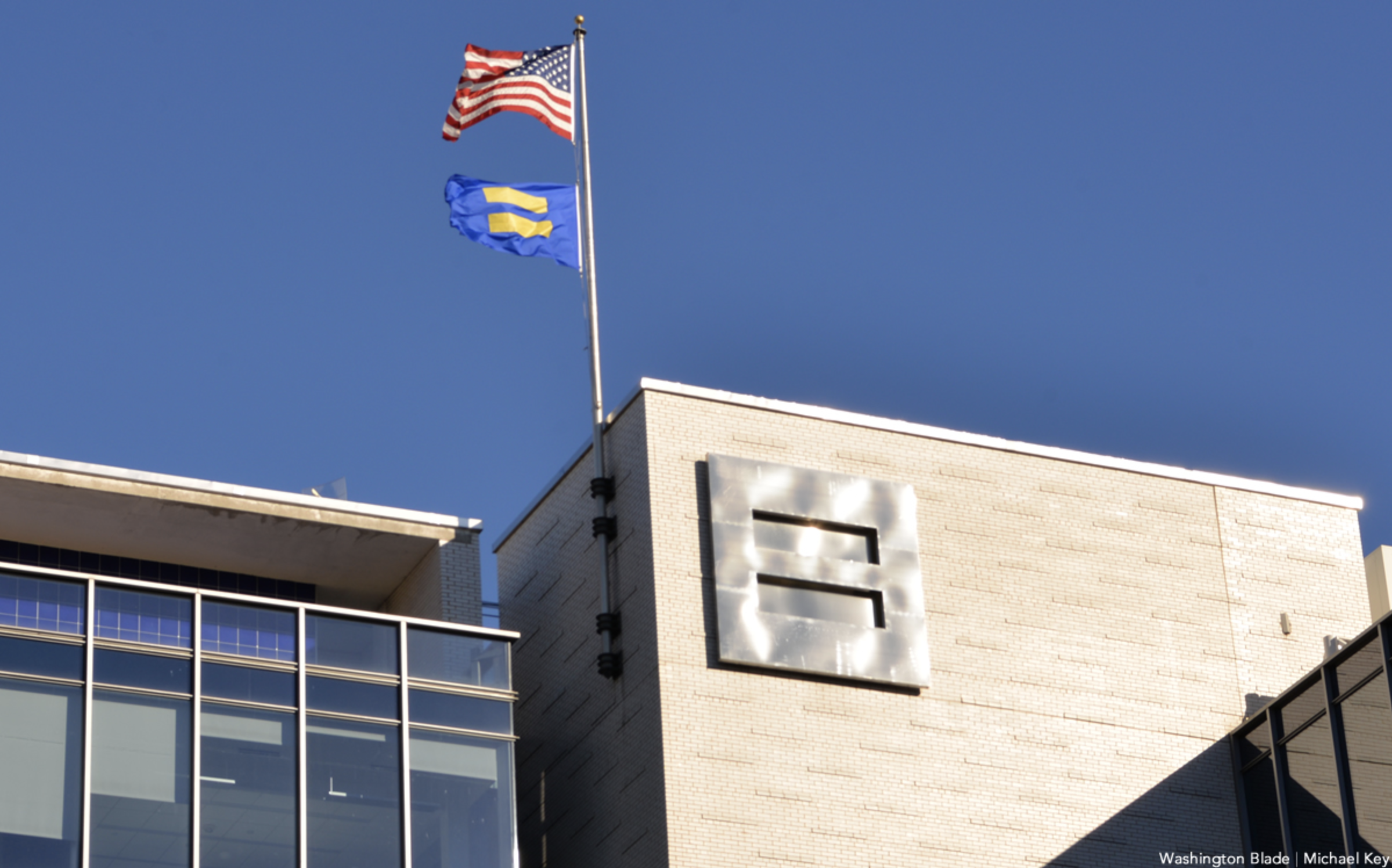
The Human Rights Campaign Foundation, the educational arm of the national LGBTQ advocacy organization Human Rights Campaign, has released a report showing LGBTQ public school students are more likely to face bullying, harassment, and “other barriers” in states that have less overall supportive LGBTQ laws and policies.
The report is based on the HRC Foundation’s National Educator Survey of School Climate and Bullying, which was released on Sept. 17.
“The report finds that harassment, bullying, and other barriers to LGBTQ+ inclusion are more prevalent in states with limiting policies, where educators report widespread restrictions on LGBTQ+ resources, visible expressions of support, and assistance for transgender students,” a statement released by HRC says.
“As just one example,” the statement adds, “while 59 percent of educators in states with limiting policies report restrictions on supporting their transgender students, just 6 percent to 8 percent of educators in states with supportive policies report the same, underscoring the impact of these policies on school climate, student well-being, and the stakes of the upcoming midterm elections for LGBTQ+ youth and inclusive classrooms.”
The report says the survey consisted of responses by 826 educators in 42 states who worked as teachers, principals, counselors, administrators, and others who worked in support services. All worked at schools with students from pre-kindergarten to 12th grade, most being public schools and a smaller number being charter schools, the report says.
It says the survey was conducted between April 15 and May 21, 2026, and included a survey questionnaire with about 55 questions covering a wide range of LGBTQ related school issues.
According to the report, its classification of LGBTQ supportive and non-LGBTQ supportive states is based on a detailed analysis of the LGBTQ related laws and policies of all 50 states, D.C., and U.S. territories conducted by the Movement Advancement Project, or MAP, which describes itself as an “independent, nonprofit thinktank.”
The report includes a chart consisting of 51 boxes representing the 50 states and D.C., with 32 plus D.C. colored as blue and said to have overall LGBTQ supportive policies. The 17 boxes colored in red are said to have overall non-LGBTQ supportive policies and laws, Each of the boxes has the initial of a state or D.C. printed inside it.
In addition to D.C., the chart shows Maryland, Virginia, New York, California, and Massachusetts as among the supportive states. Florida, Texas, West Virginia, and Ohio are among the states shown to be non-LGBTQ supportive.
The HRC statement includes these “key” findings from the survey:
- In states with restrictive LGBTQ+ inclusion policies, 59 percent of educators report restrictions on supporting transgender students, compared to just 6-8 percent of educators in states with supportive LGBTQ+ inclusion policies.
- In states with restrictive policies, nearly 50 percent of educators reported restrictions on LGBTQ+ books or resources, compared to just 7 percent of educators in states with supportive policies.
- Roughly 32 percent of educators in states with restrictive policies reported anti-LGBTQ+ harassment was a moderate or serious problem, compared with 11 percent of educators in states with supportive LGBTQ+ inclusion policies.
- In states with restrictive LGBTQ+ inclusion policies, 29 percent of educators were very worried about anti-LGBTQ+ harassment, compared to 15 percent in states with supportive LGBTQ+ inclusion policies.
- In states with restrictive LGBTQ+ inclusion policies, 36 percent of educators witnessed anti-LGBTQ+ student bullying, compared to 27 percent in states with supportive LGBTQ+ inclusion policies.
- In states with supportive LGBTQ+ inclusion policies, 75 percent of educators reported no restrictions on LGBTQ+-supportive displays, highlighting a substantially more supportive school environment than in states with restrictive policies.
- Educators in states with restrictive LGBTQ+ inclusion policies also reported significant harassment of students based on appearance (57 percent), race or ethnicity (43 percent), sexual orientation (42 percent), and gender identity or expression (39 percent). (No direct comparison figure from supportive-policy states is provided in the data above.)
“Every young person deserves to feel safe and supportive at school, but this report makes clear that for too many LGBTQ+ students, especially transgender youth, are being failed by policies designed to exclude them,” said HRC President Kelley Robinson in the HRC statement.
“We know that when students feel seen, supported, and affirmed, they are more likely to thrive, but when schools become places of exclusion or hostility, young people pay the price through lower engagement, missed opportunities to learn, and poorer mental and physical health,” Robinson said.
The HRC statement notes that the survey findings come at a time when a growing number of states have passed laws targeting LGBTQ students and the school officials and teachers who support them. It says that for the first time, the survey found that “educators themselves are also experiencing anti-LGBTQ+ harassment, highlighting the growing impact of these policies on school staff as well as students.”
The full survey findings and report can be accessed here:

988 restores crisis services for LGBTQ youth

To school to homeschool to school again

Ryan Murphy’s ‘Monster’ vilifies the lesbian

The right to be an ordinary transgender man

LGBTQ community must vote in big numbers

PHOTOS: HRC National Dinner

What’s frightening is also funny in ‘Venus’

I’m 66, he’s 27. Is it love or am I being played?

The LGBTQ real estate map is being redrawn