Opinions
Barney Frank, a hero of mine
There’s never been a stronger, smarter LGBTQ advocate in Congress
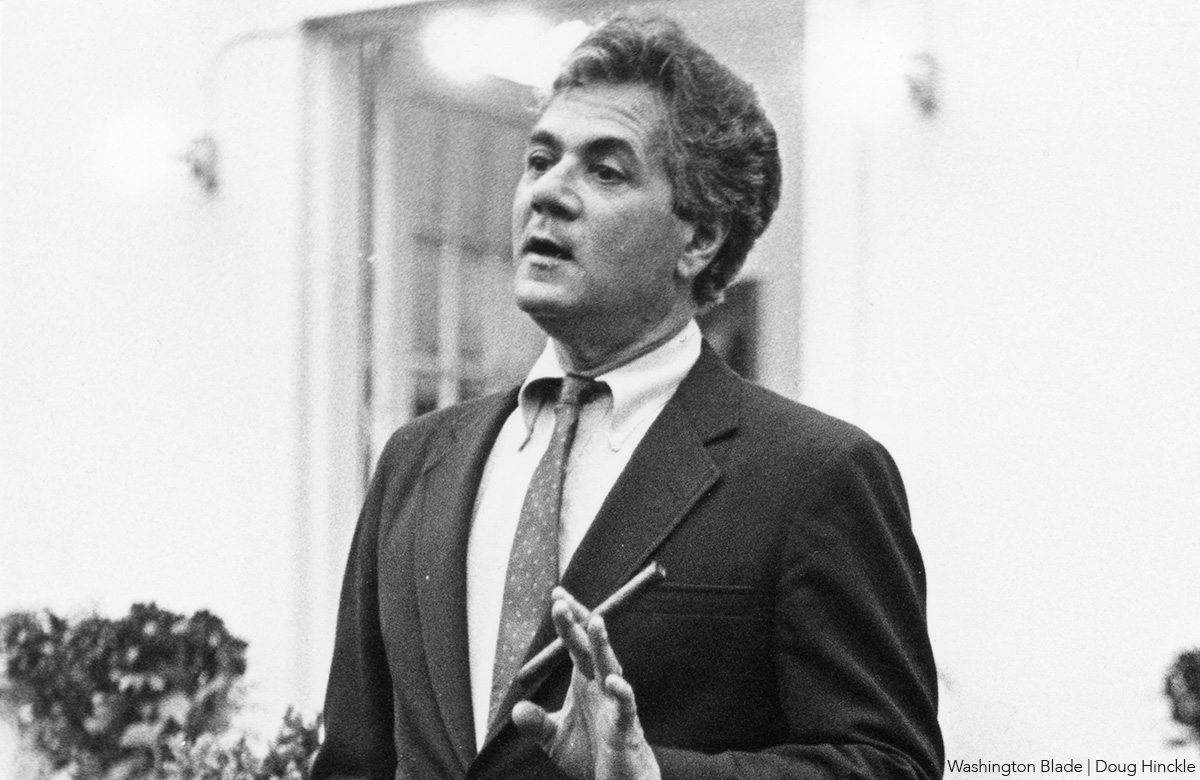
Barney Frank has always been a hero of mine. We grew up in similar circumstances, he in New Jersey, me in upper Manhattan. Both of us knew at a young age we were gay, though that was not a term used when we were young. It was a time when one definitely couldn’t come ‘out’ if you wanted to go into politics.
I met Barney when a mutual friend brought him to brunch at my home in D.C. I had moved to D.C. in 1978 to work for the Carter administration, directing the follow-up to the White House Conference on Handicapped Individuals. That is the term we used back then. I never went back to New York. Barney had been elected to Congress when we met. Neither one of us was publicly out.
Barney Frank is brilliant, and I was honored to meet him. I always enjoy listening to him speak, whether it was at a congressional hearing, or an event we were both attending. Barney was never one for small talk. When we both ended up living in Dupont, he would see me sitting at a coffee shop when he walked by, and simply nod hello, not stopping to chat. If he ever did stop, I always knew it was to suggest something I should be doing, or writing about. Barney has a sparkling wit, when he wants to share it, and knows more about most topics than anyone else. In 2004, 2006, 2008, and 2010, Washingtonian magazine reported that congressional staffers named him the brainiest member of Congress. CBS News reported in 2008 and 2011 that Leslie Stahl and others, referred to him as the smartest guy in Congress. They were right. I had worked for another brilliant member of Congress, Bella S. Abzug (D-N.Y.), but she was out of Congress by the time Barney got there. It would have been fun seeing them work together. I was working for her when she introduced the first Equality Act in 1974. At the time I was deeply closeted.
I ended up coming out in 1984, which was before Barney did. But then I wasn’t running for office. He came out in 1987 and became an even more passionate supporter of the LGBTQ community than he was before. Because now he could make his speeches, and support, more personal. He spoke eloquently trying to pass the Equality Act which didn’t pass the House until after he retired, and then it died in the Senate. I was, and am, a passionate supporter of the Equality Act, and still believe in my lifetime it will pass Congress, and we will have a president who will sign it into law. Hope springs eternal as they say.
Barney is more than just an LGBTQ advocate. He has worked tirelessly on so many issues, in his effort to make life better for all Americans. He recently said the bill he is proudest of, is the Dodd-Frank Wall Street Reform and Consumer Protection Act. It is a sweeping law enacted to overhaul financial regulation following the 2008 financial crisis. Its primary purpose was to end ‘Too big to fail’ bailouts, and protect consumers from abusive financial practices. It was signed into law by President Obama in 2010.
As it has become public that Barney Frank was entering home hospice, and being cared for by his husband Jim, so many of us are looking back at his amazing career. We are recognizing the giant he is, both during his time in Congress, and during his life before, and after. He is the first member of the LGBTQ community who married while in Congress. He is one of the people in our community who really made a difference, and in doing so made so many of our lives better.
Barney has said he is in the process of writing another book on politics, and I already look forward to reading it. I keep visualizing Barney as our community’s Art Buchwald. Those of you who are old enough may remember Buchwald. He was an American humorist, best known for his columns in the Washington Post. He also went into hospice care. But in his case, after five months there, and giving many interviews, he left hospice and wrote another book. It was titled ‘Too Soon to Say Goodbye’ about his five months in hospice. Barney, I am praying I will get to hear you, and see you, on that next book tour.
But if that shouldn’t be, I want to thank you for a life well lived, and all you have done to make my life, the lives of the rest of us in the LGBTQ community, better. We could have never asked for a stronger, or more passionate, advocate.
Peter Rosenstein is a longtime LGBTQ rights and Democratic Party activist.




Opinions
Why we need to protect ‘sacrilegious’ art
Australia sets dangerous precedent for classifying LGBTQ works as offensive

On July 8, Divine Playhouse opened inside a deconsecrated 158-year-old former church on Kent Street in Sydney, Australia. Although the organizers had a permit and received a $100,000 grant from Create NSW to host events in the previously unused space for a whole year, the organizers were forced to shut down after just three days of operations after receiving a tenant breach notice about “offensive trade” under the 1919 Conveyancing Act.
A day after the Divine Playhouse opened, Redevelop, the company leasing out the church (that was deconsecrated almost a century ago) to Heaps Gay Events cited a clause in their contract that prohibits tenants from noisy business. The clause didn’t include any note about political or religious imagery, but even so, Redevelop wrote that Divine Playhouse “insulted and mocked the sincerely held religious beliefs of millions of Christian Australians.”
On opening night, members of conservative Christian and Catholic groups including Fit for the Kingdom and Prodigal Sons protested (without proper authorization) the live music, cabaret shows, and performances they argued mocked the Christian faith. Protesters called drag queens dressed as nuns (the legitimate vestments of the Sisters of Perpetual Indulgence) and events like the Sunday Mess, a brunch party that incorporated religious imagery, “equivalent to hate speech” according to the Redevelop landlords and their lawyers.
But as reports show, the organizers were aware of concerns from the nearby Christian community and made changes in good faith to address those concerns before opening, including changing the name from Unholy Playhouse to Divine Playhouse. Organizers intentionally changed the name in order to make it more inclusive, rejecting the idea that they were mocking religious beliefs in their performances.
But this has not swayed members of conservative Christian groups who, on opening night, shouted at attendees that they “should be ashamed” and were “disgusting.” Redevelop gave the organizers two days to cease operations. As The Guardian reported, volunteers and organizers took down signage and painted over a mural that had all been commissioned for the year-round residency.
While the organizers initially explored whether they could sue for discrimination against LGBTQ+ individuals, the organizers decided to cancel all upcoming events and close the space to protect performers, as protesters filmed people entering and leaving the event without their consent on opening night. Along with facing a breach of contract, Meta also shut down all of Divine Playhouse’s social media accounts, along with personal accounts and LGBTQ+ community accounts. This is an increasingly common problem for queer content creators.
Now, the LGBTQ+ community is in a justified uproar, and conservative Christians in Australia and beyond are furious about what they are calling “offensive art.” The lease violation sets a dangerous precedent for classifying LGBTQ+ art as offensive, which could lead to laws or local restrictions that could be used by developers to discriminate against people who they deem “offensive,” i.e. LGBTQ+ individuals and organizations. This already exists in the United States, where racial covenants enforcing segregation remain on the books.
As theater lecturer Charlotte Farrell wrote, there is a long history of art and performance in church spaces, but Farrell largely cites art in more progressive Christian spaces as opposed to Catholic ones. Queer art in Catholic spaces (including operational and consecrated Catholic churches) do exist, including God is Trans: A Queer Spiritual Journey hosted by the Church of St. Paul the Apostle in New York City in 2023 (although this show also generated controversy).
With the risk of empowering conservatives to lobby for laws or restrictions that would allow them to deny renting to “offensive” people or on the grounds that a person’s art is “offensive,” I argue further that there is an urgent need to call out what this situation was–the explicit attempt to equate queer art that challenges religious institutions, trauma, and abuse as inherently “offensive” and to use this to deny an artist and community’s right to exist in a space.
Art has historically been a vital way not just to evangelize but also to challenge religious institutions that use their power and influence to not just isolate and abuse LGBTQ+ people and other marginalized communities but to systematically oppose their rights. Take for example Sinead O’Connor’s protest performance on the October 3, 1992 episode of Saturday Night Live. O’Connor, who had experienced severe institutional confinement in a Magdalene Laundry run by the church and had experienced intense physical and emotional abuse by her devout mother, tore up a photo of Pope John Paul II.
While she originally planned to hold up a photo of a refugee child, she swapped it with a photo of the pope after singing an a cappella version of Bob’s Marley’s “War” where she changed the lyric to “child abuse.” She looked at the camera and said “fight the real enemy” before throwing the pieces to the ground. At the time, the Irish singer faced intense backlash and a lifetime ban from SNL, but as more information came out about her time in the Laundry, her mother’s emotional abuse, and systemic sexual abuse and people attempting to cover it up in the Catholic Church, people today recognize her protest as the start of a vital conversation.
For some people, O’Connor became a secular saint, a prophet exposing systemic sexual abuse before people were willing to confront the lived experiences that survivors were sharing and religious leaders were covering up. Dr. Margaret Kennedy, founder of Ministry and Clergy Sexual Abuse Survivors and author of “The Courage to Tell,” wrote for Premier Christianity that “when she tore apart a picture of the Pope on Saturday Night Live in 1992, she was preaching.”
Is O’Connor’s religious liberty to preach through this act of protest not equal to that of her critics? Did O’Connor, like anyone at the Divine Playhouse, threaten any religious person?
No, they made a statement about religious institutions and people that continue to abuse people. If that can be targeted so can any other form of protest or acts of resistance that threaten systems of power.
Protest art like O’Connor’s is at the bedrock of human rights in any democratic country. When people stop creating art or move out of spaces out of fear of precipitating anti-LGBTQ+ violence, or are forced out because of claims of lease violations, the whole society loses a vital way to challenge and confront abuse and exploitation. There is a need not just to legally protect people creating protest art but also protest artists themselves so that their work cannot be censored or attacked on the grounds of religious liberty.
To be clear, protecting people’s rights to create protest art is not the same as allowing people to insult or desecrate the imagery of marginalized faiths that face persecution and misrepresentation in the United States today. It’s also not a license for anti-religious bigotry or violence that hurts anyone. Instead, the protection of protest art is a protection of the right to protest itself, the right to challenge and grapple with institutional abuse and religious trauma in ways that cause no one physical harm.
As James Thorpe, co-chair of the Night Time Industries Associates, explained to The Guardian, “Christians have a right to preach, protest and stand outside Divine Playhouse and pray. Queer artists have the right to make art that is confronting, irreverent, and yes, offensive.” Thorpe says that LGBTQ+ artists and communities, and all marginalized groups, have a fundamental right to create art that unsettles people, that challenges social systems that prioritize and sacralize a cisgender, heterosexual norm intrinsically connected to Christian nationalism.
Because in a society where Christian nationalism is fast becoming mainstream, protest art, sacrilegious art is the only language that far right religious groups understand. At the heart of the issue is civility politics, or a strategy used by conservative and far right groups to argue that marginalized communities censor their protests and calls for change to be “respectful.” What respectful is and who deems it respectful is deeply subjective, often the creation of a dominant social group like Christians in the United States.
If far-right forces want to call LGBTQ+ protest art like that at the Divine Playhouse “offensive” or “sacrilegious” so be it. Yes, calling our art, our identities, “offensive” is a form of bigotry, a practice of hate. It reminds many of us raised in high control religious spaces that we are outsiders to the very religious systems that raised us and cultivates the same shame, guilt, and abuse that caused many of us to leave or explore affirming religious or spiritual traditions.
But calling art “offensive” doesn’t change or invalidate the fact that it is a fundamental exercise of our right to free speech, and our fundamental human right to create art that unsettles and upsets people in positions of power. It also doesn’t change the fact that for many of us, creating protest art is a spiritual practice, a form of sacred resistance that helps us challenge systems that have long abused us through purity culture, conversion therapy, and cultures of shame.
Protecting the right to create protest art isn’t just enshrining our right to free speech but for many of us, our right to practice a spiritual act of resistance. And in a time where LGBTQ+ identity, people, and bodies are deemed “offensive. Because at its core, this isn’t just an issue about art anymore, it’s about protecting our right to exist in public spaces and our right to create safe spaces for ourselves.
Emma Cieslik is a D.C.-based museum worker and public historian.
Opinions
Not all trans people are the same
Media, activists need to do more to challenge stereotypes

It’s interesting how the mainstream media, especially the conservative part of it, likes to write about transgender subculture when they should speak up about trans people.
How often do you see mentions of blue or purple hair, Marxism, specific clothing styles and ecology when you see a mention of a trans person?
It happens more often than it should. It looks like the mainstream media, even the ones that don’t demonise us, sincerely believe that being trans means sharing a whole bunch of characteristics that have nothing to do with having a gender identity different from the one that was assigned at birth.
Here are four reasons why it may create problems, and what to do about them.
1. A subculture idea
The assumption that being trans is part of a subculture creates a very specific kind of discrimination, because the mainstream audience who read those stories sincerely believes that being trans is a personal choice or a trend in the same way as being a K-pop fan, a goth, or a metalhead. It basically means that being trans is nothing more than a trend, and trends, as we all know, can change. People who believe in this idea are more likely to speak about “gender ideology” and “propaganda trends” and less likely to listen to scientists and studies around trans issues, or to different experiences of what it means to be trans.
Even if trans people made a choice to be trans, they shouldn’t be discriminated against. In a democratic, free country, no one should be punished for choosing what to do with their body. And hate for subcultures is a real thing that leads to violence. But the problem is that, despite there being a trans subculture, most trans people are statistically not part of it. But where are they in activism?
2. Misleading about goals
Let’s be honest. We are partly to blame for this stereotype. And before you stop reading, let’s just think about the topics most people discuss before the average protest or radical Pride event. Or let’s imagine trans-friendly events. They are mostly leftist, and people at these events share the exact same interests, hobbies, and political positions.
At my last protest about the new draconian Equality and Human Rights Commission guidelines in the U.K. that say trans people can only use public places according to the sex assigned to them at birth, we were speaking about anything else. For example, some speeches were about abolishing “bourgeois democracy,” speaking up for socialist revolution, and saying some other things I definitely couldn’t support.
I’m not against socialism, but I’m against the idea that all trans people are socialists. That is inherently misleading, at best, and harmful, at worst. I support universal basic income and free healthcare, but not revolution or Marxist reform. If I were a cis person who generally supported trans rights but knew too well about the Russian Revolution of 1917 and how it ended for indigenous people and queer people, if I were a bystander, I wouldn’t stop at a protest like that. I probably wouldn’t even believe that the situation is as bad as they are saying.
There is nothing bad about inviting a socialist speaker. The problem begins when all trans events become socialist events. Those protests don’t look like protests for trans rights – they look like protests for socialist revolution or just like a rebel teens gathering.
3. Self-fulfilling prophecy
At the protest I mentioned and at other similar protests, including the ones from the U.S. I saw online, there weren’t a lot of “traditionally” trans people — the ones you may have been able to see in old TV programs about trans experiences, where trans people were presented to be more gender-conforming.
Most activists are young, white, poor but not extremely poor, citizens of the country where they are living, gender-non-conforming, leftist, and non-religious. They like trans horror, drag queen shows, drawing and reading MfM romantasy. And despite the fact that I just finished writing my own trans horror novel, I wonder — where are the other trans people? With different hobbies and lifestyles?
Where are all those “traditional” trans women from old TV shows who like make-up and want to give birth to kids if only it was possible, and trans men who like to spend their time drinking beer in pubs and going to the gym with their bros? I think we need them more than we think. They may give new ideas and perspectives. And they need us.
Why don’t we see them? Why do we see so few trans refugees who came from Middle Eastern, Asian, and African countries? May they be triggered by the world then because the U.S. had the worst dictatorship on the planet, or that the U.K. is a fascist country when they saw something worse than the British government or even MAGA? For some trans person who survived Bashar al-Assad in the Syrian government or fled Eastern Turkestan, such slogans would feel like gaslighting — and I knew because I met many refugees.
Why, finally, do so many trans activists have similar clothing styles, similar interests, and similar experiences?
Because it’s a self-fulfilling prophecy. When trans activists create this kind of culture, they accidentally gatekeep all other trans people who may feel less comfortable within a subculture that has its own rules, style, and ideology, even if none of those things have anything to do with being trans.
4. Media misrepresentation
When the media — conservative and not very conservative — sees the same thing, it doesn’t matter if we are speaking about a trans man who is traditionally masculine and wants a traditional family, or if we are speaking about soft, nice gay boys who happen to promote socialist revolution like many modern stereotypical trans activists. It is equally misleading.
I hate the idea that we need to pretend to be more convenient and normal in order to be accepted by society, because society has never worked that way. But pretending to be accepted by the community is no better.
Trans people are different — and sometimes problematic — and despite the core of activist trans culture, we can have some distinctions when we speak with the media. We should never try to tell people that all trans people are similar.
Now, when trans rights are under attack, it is more important than ever to show that all trans people are just people. We are different, like everyone else. We have our rights, even if we are wrong. Even if we are ugly. Or struggle with inner transphobia. Or some of us internalise traditional roles, or; the opposite, too weird for any culture and subculture. We can make mistakes. But we are not a political party or a monolithic group. Being trans is not a lifestyle, because we have different lifestyles.
Trans kids need to see that they can be whoever they are and still be true, real trans people. And the media should always be questioned when they try to push all trans people into the frame of a subculture.
But to do so, we need to look at our activism and at the representation we are creating.
Opinions
Black Educated Lesbians: A movement rooted in community
Organization’s annual conference is part of a much larger mission
When people hear the word “conference,” they often imagine a weekend event that begins on Friday and ends on Sunday. For Black Educated Lesbians (BEL), our annual conference is only one part of a much larger mission.
BEL was founded because Black lesbians deserve spaces intentionally created with us in mind. Too often, we are overlooked in conversations about health, leadership, philanthropy, education, and community. We exist at the intersection of multiple identities, yet organizations and institutions frequently assume our needs are being met by broader groups. Our lived experiences tell a different story.
BEL is a national nonprofit organization dedicated to creating opportunities for Black lesbians and Black queer women through leadership development, wellness programming, research, education, and community building. While our conference has become one of the few events in the country centered specifically on Black lesbians, our work continues year-round.
Throughout the year, BEL hosts virtual wellness sessions, leadership development opportunities, financial education workshops, community discussions, and mentorship programs designed to help our members thrive personally and professionally. We are also investing in the next generation through our EmpowerHER initiative, connecting Black queer youth with mentors, resources, and leadership opportunities.
Research is another critical part of our work. We are committed to ensuring Black lesbian voices are included in conversations about healthcare, mental health, economic opportunity, and overall well-being. Data drives policy, funding, and services. If our experiences are absent from the research, our needs often remain invisible.
Our annual conference, taking place Sept. 18–20 in Hapeville, Ga., brings this mission to life. Attendees will participate in conversations about physical and mental health, healthy relationships, financial literacy, entrepreneurship, leadership, aging, women’s health, and sexual wellness. The conference also creates opportunities to build meaningful relationships, support Black-owned businesses, and connect with professionals and organizations that understand our community.
Creating spaces like this is not easy. As a small nonprofit, every workshop, meal, scholarship, and resource requires fundraising, partnerships, and countless volunteer hours. Yet we continue because our community deserves spaces where they can simply exist, learn, heal, and grow without explanation.
What makes BEL unique is not simply that we serve Black lesbians. It is that Black lesbians lead every aspect of our organization. We understand the importance of creating programs that reflect our lived experiences rather than asking our community to fit into spaces never designed for them.
Community is not built during moments of crisis. It is built through consistent investment, authentic relationships, and showing up year after year. That is the work BEL is committed to doing.
Whether someone joins us as an attendee, sponsor, volunteer, donor, or community partner, they become part of something much larger than a conference. They become part of a movement dedicated to ensuring Black lesbians are seen, heard, valued, and supported.
As we prepare to welcome attendees from across the country this September, we invite readers to learn more about BEL, support our mission, and help us continue building spaces where Black lesbians don’t just survive, they thrive.
LaJoya Johnson is founder and executive director of Black Educated Lesbians, a national nonprofit dedicated to advancing leadership, wellness, and education for Black lesbians and Black queer women.

Why we need to protect ‘sacrilegious’ art

New GALA show about WWII spy full of conflict, intrigue

Exploring Renée Richards’s life through lens of a trans author

Log Cabin Republicans remove transgender rights from mission

Not all trans people are the same

Man charged with anti-gay assault in D.C. accepts plea offer

Thailand’s first openly gay senator attends World Pride in Amsterdam

Philadelphia gayborhood preservation battle raises questions about displacement

Anne Arundel schools updates gender identity regulation following Trump administration threats

Chicago’s LGBTQ+ youth: Why their zip code still matters
-

 District of Columbia5 days ago
Man charged with anti-gay assault in D.C. accepts plea offer
-
Netherlands5 days ago
Thailand’s first openly gay senator attends World Pride in Amsterdam
-
Pennsylvania5 days ago
Philadelphia gayborhood preservation battle raises questions about displacement
-
Maryland4 days ago
Anne Arundel schools updates gender identity regulation following Trump administration threats