2026 Midterm Elections
Meet the LGBTQ candidates running for U.S. House, Senate
Pappas would become first out gay man elected to upper chamber

The midterm elections are often seen as a report card for the party in power, giving voters an opportunity to weigh in on the direction of the country after two years of unified control of the federal government. With Republicans controlling the White House, Congress and the Supreme Court, the 2026 elections could reshape the balance of power in Washington and determine what the next two years of federal policy will look like.
Among the candidates looking to shape that future are a large number of openly LGBTQ politicians running for federal office. All of the candidates listed below openly identify as members of the LGBTQ community and are running as Democrats, seeking seats in both the U.S. House of Representatives and the U.S. Senate. (See below for a list of LGBTQ incumbents.)
The New Candidates
U.S. Senate:
Chris Pappas — NH
The United States House of Representatives:
Cait Conley — NY-17
Jeremy Moss — MI-11
JoAnna Mendoza — AZ-06
Marni von Wilpert — CA-48
Scott Wiener — CA-11
Chris Gallant — NY-1
JD Ford — IN-5
Janelle Sarauw — U.S. Virgin Islands
If all of these candidates running for federal office win their seats, this would make the federal government the queerest legislative term for Congress ever.
Chris Pappas would become the first openly gay male senator if he wins the race against Republican John E. Sununu. Pappas is currently leading early polls 50% to Sununu’s 42%, and is seen as a fairly centrist Democrat with a slew of accomplishments passed through the House since his election in 2018 that make him a desired candidate for the purple “Granite State.”
Cait Conley is fighting to take two-term incumbent Republican Mike Lawler’s seat for New York’s 17th district, covering parts of Westchester, Rockland, Putnam and Dutchess counties. Conley has a long history of working as a public servant through her extensive military service, which includes six overseas deployments with the Army and work with the National Security Council. Current polling shows she has an advantage over her opponent, 64% to his 36%, making this one a race to watch.
Jeremy Moss is running for election in Michigan, after quickly rising in the ranks within the Great Lake state. Moss, who was elected to his city’s city council, then to the state House, then to state Senate has had a lengthy connection with state politics for someone so young. He also served as the state’s first gay president pro tempore. He is running in the Detroit suburbs, including Oakland County. Nearly all polling puts Moss in the lead with some already giving him 99%.
JoAnna Mendoza is a veteran of the U.S. Navy and U.S. Marine Corps running for a House seat for the Tucson and southeastern Arizona area. She has been outspoken about how the cost of everyday necessities under the current leadership of President Trump and Republicans in Congress has made people in her state less safe. She is currently locked in a tight race with her Republican counterpart, leading Juan Ciscomani 47% to 45%.
Marni von Wilpert is running to represent northern San Diego County. She has experience representing the area as a San Diego City Council member, former prosecutor, and Obama workers’ rights attorney. Von Wilpert holds a narrow lead over Republican Jim Desmond, 45% to 42%.
Scott Wiener is looking for a chance to take former House Speaker Nancy Pelosi’s seat in the San Francisco area. Weiner holds a narrow lead over the Pelosi-endorsed San Francisco supervisor Connie Chan. A New York Times poll has him leading 45% to Chang’s 40%.
Chris Gallant has a slew of federal accomplishments under his belt, from working as an FAA air traffic controller to serving in the U.S. Army and New York Army National Guard, including as a Black Hawk helicopter pilot, and is a volunteer firefighter on Long Island. Despite all of this dedication to public service, he’s running in a solidly red district and trailing his GOP opponent Nick LaLota, 81% to 28% in a recent poll.
JD Ford is fighting to represent the northern Indianapolis suburbs and north-central Indiana against Republican incumbent Victoria Spartz. He was the first and only openly LGBTQ person elected to the Indiana Legislature, running his campaign on making living more affordable. Polling puts him slightly behind Spartz 48% to 46%.
Janelle Sarauw is trying to win the U.S. Virgin Island’s seat in the U.S. Congress. While there is no voting power, the seat can participate in debates. Sarauw is likely to win the seat after sweeping the primary earlier this year, and will face off against Shelley Moorhead, an independent, in November.
The Incumbents
Becca Balint — VT-At Large
Emily Randall — WA-06
Eric Sorensen — IL-17
Mark Pocan — WI-02
Mark Takano — CA-39
Ritchie Torres — NY-15
Robert Garcia — CA-42
Sarah McBride — DE
Sharice Davids — KS-03
Becca Balint is running for reelection to represent all of Vermont, making her one of the few candidates on this list who represents an entire state rather than a congressional district. Balint, a former teacher and Vermont state senator, has made housing affordability, mental health, and protecting democracy central parts of her platform. Recent polling gives Balint a substantial lead over Republican challenger Gerald Malloy, 60% to Gerald’s 30%.
Emily Randall is running for reelection in Washington’s 6th Congressional District, which includes the Olympic Peninsula and parts of the Kitsap Peninsula across Puget Sound from Seattle. Randall, who previously served in the Washington state Senate, has made expanding access to affordable health care a major part of her platform. She appears to be in a relatively strong position for reelection where she won 60% of the vote in Washington’s August top-two primary, while her Republican opponent Teresa Fox received about 25%.
Eric Sorensen is running for another term representing western Illinois. The former television meteorologist has centered his congressional work on lowering costs for working families. There is no public polling in the race, but a current nonpartisan forecast gives Sorensen 59% of the vote compared to Republican Dillan Vancil, with 40%.
Mark Pocan is seeking to continue representing Madison and south-central Wisconsin. Pocan, who has served in Congress since 2013, has focused on issues including health care affordability, workers’ rights and LGBTQ+ equality. There is no public polling of the race, but the current field has no Republican candidate, and a nonpartisan forecast gives Pocan more than a 99% modeled chance of winning.
Mark Takano is running for reelection in California’s 39th congressional district, which includes Riverside and portions of the Inland Empire east of Los Angeles. Takano has made health care and veterans’ issues major parts of his congressional work. There is no public polling of the race, but in his primary he came in first with 61% of the vote compared to Republican Steve Manos’s 39%.
Ritchie Torres is running for another term representing New York’s 15th congressional district in the Bronx. Torres, who previously served on the New York City Council, has made housing, economic development, education, and public safety major parts of his platform. There is no current public polling of the race, but multiple prediction sites have it squarely his to win.
Robert Garcia is seeking another term representing California’s 42nd congressional district, which includes Long Beach and southeastern Los Angeles County. Garcia, the former mayor of Long Beach, has focused on issues including infrastructure, transportation, education, and LGBTQ+ rights while in Congress. There is no public polling of the race, but forecasting has Garcia winning the seat over Republican Brian Burley 99% to 1%.
Sarah McBride, is running for reelection to represent Delaware’s sole congressional district, meaning she represents the entire state. McBride, who made history as the first openly transgender member of Congress, has centered her campaign on lowering health care costs, protecting reproductive health care, and strengthening workers’ rights. There is no public polling of the general election, but a current nonpartisan forecast gives McBride a 99.1% modeled chance of winning against Republican Joseph Arminio.
Sharice Davids is seeking another term representing Kansas’ 3rd Congressional District, which covers the Kansas side of the Kansas City metropolitan area. Davids, a former White House fellow and attorney, has made agriculture, lowering costs, and health care central parts of her platform. There is no current public polling of the race, but prediction polling shows she has a 94% chance of winning her race.




2026 Midterm Elections
LGBTQ issues, attacks on Democrats dominate unusual RNC midterm convention
“Trumpapalooza” emphasized the gains Republicans need to maintain control of the federal government.

The Republican Party held an unusual midterm convention in Dallas last week, where President Donald Trump and other prominent GOP officials spoke in hopes of building enthusiasm and support ahead of the November elections.
The two-day gathering at the American Airlines Center was the first midterm convention of its kind for the Republican Party. Unlike a traditional presidential nominating convention, there was no official party business or nominations. Instead, the event was designed to energize Republican voters and unite the party behind its candidates and broader message heading into the midterm elections.
Trump, who spoke during both nights of the convention, repeatedly emphasized the importance of Republicans turning out to vote in the midterms — elections in which incumbent presidents and the parties in power have historically faced significant challenges.
“I’m asking you to pretend that I’m on the ballot,” the president implored attendees on the first day.
On the second night, Trump delivered another direct appeal to Republican voters.
“You know what happens if you don’t vote? You go to hell,” he said.
Trump also urged attendees at one point to “cheat like hell” to keep Republicans in control of Congress.
The president also used the event to promote Republican candidates, including Texas Attorney General Ken Paxton, the GOP nominee in the state’s closely watched Senate race against outspoken LGBTQ rights supporter James Talarico.
“He may not dress right, he may not talk exactly perfectly, and he may not be the best-looking guy I’ve ever seen, but he’s the greatest attorney general in America and he deserves to be your next senator,” Trump said when talking about Paxton.
Among those in attendance were gay Treasury Secretary Scott Bessent, Rep. Brandon Gill (R-Texas), North Carolina Senate nominee Michael Whatley, and Ohio Republican Sen. Jon Husted.
Both days, there were thousands of empty seats, including almost all of the upper level, despite Trump insisting the arena was “packed” with “thousands” more waiting outside.
The convention’s message frequently emphasized personal and political attacks on Democrats, often over detailed policy discussions. Speakers repeatedly targeted Democratic candidates and progressive figures, with Michigan Democratic Senate nominee Abdul El-Sayed among those mentioned throughout the event.
The first lady was notably absent from the event.
Five RNC officials described the scope of the party’s nationwide “election integrity” effort to Axios. They said strict enforcement of voting laws and preventing noncitizens from registering and voting are top priorities, even as analysts say voter fraud is rare and there is no evidence of any systemic or significant problem.
President Trump also proposed giving American adults $5,000 if Republicans retain control of the House and Senate, a proposal that immediately raised questions about its legality and implementation.
The Republican base has also fractured over several key issues during the last 18 months, including the war in Iran, the handling of the release of the Epstein files, surging gas prices, and rising costs driven by tariffs. The convention was organized as an effort to rally Republicans around the party and motivate turnout despite those divisions and broader concerns heading into the midterms.
A protester carrying a Mexican flag interrupted Vice President JD Vance’s speech on Sept. 10.
“It’s about sending a message to the Democratic Party that if you send your crazies, we’re going to send you packing,” Vance said of the stakes of November’s elections.
More than 100 protesters also marched through downtown Dallas during the RNC Midterm Convention, briefly blocking traffic near the American Airlines Center.
At the convention both nights, an image that can only be described as a thirst trap of Democratic socialist commentator and creator Hassan Piker was shown on the jumbotron, garnering attention on social media.
The social media star posted a video shortly after images of him, abs and all, appeared on the jumbotron, sitting at a desk and completely dumbfounded at the thought that “my meat pic was on the jumbotron at the republican midterm convention.”
Piker has been a frequent target of conservative and Republican figures because of his criticism of the Israel-Palestine war, the war in Iran, and his broader critiques of the establishment and political institutions of both parties. Piker and El-Sayed were two of the most targeted progressive figures during the convention.
Another figure from the other side of the aisle who made an appearance was Democratic Sen. John Fetterman, who in recent months has adopted more conservative positions on some issues and continued to voice strong support for Israel — an issue on which there are divisions within the Democratic Party.
“Yes, I’m a Democrat. Why am I here talking to you today? Because well, I’m a common sense Democrat,” Fetterman said in the prerecorded video that also aired on the American Airlines Center’s jumbotron. “I’m always going to stand with America. I’m always going to reject the extremes and socialism and that anti-American way of life.”
“We’ll work with President Trump to fight and defend the steel way of life right here in the steel valley,” he added.
Fetterman’s prerecorded appearance was a notable moment at an event otherwise dominated by Republican officials and speakers.
Also at the event, accusations began to spread online about alleged Grindr outages in the area of the convention — a juxtaposition with the anti-LGBTQ positions the Republican Party officially reflects and its emphasis on “family values.”
A spokesperson for Grindr told Snopes, “Grindr has not experienced recent outages. Third party sources that often make these claims rely on unreliable data such as self-reporting, while Grindr reports outages directly on its status page.” The status page showed no outages in August or September 2026.
Another person, who goes by the name of Nick Pringle online, garnered over eight million views on an Instagram video in which he claims he was about to start working “undercover as a male escort” at the convention.
In the video, he appears to be in a hotel bathroom and says he will post for the sake of exposing hypocritical Republican lawmakers who have used their power to champion what he described as hateful and divisively anti-LGBTQ legislation.
The Blade reached out to Pringle via Instagram to ask whether he ultimately carried out what he described in the video and whether he had any evidence or additional information to share about his experience at the convention, but did not hear back by the time of publication.
2026 Midterm Elections
Chris Pappas wins NH Democratic Senate primary
Gay congressman running to succeed retiring U.S. Sen. Jeanne Shaheen
New Hampshire Congressman Chris Pappas on Tuesday won the Democratic primary in the race to succeed retiring U.S. Sen. Jeanne Shaheen (D-N.H.) in the U.S. Senate.
Pappas defeated Karishma Manzur, who was his primary challenger, by a 61.8-36.1 percent margin.
The gay congressman will face off against former U.S. Sen. John E. Sununu, who defeated former U.S. Sen. Scott Brown in the Republican primary.
“Tonight’s victory sends a clear message that voters are looking for leaders who will fight for their rights, their freedoms, and to be treated with dignity and respect,” said Human Rights Campaign President Kelley Robinson in a statement.
She campaigned for Pappas in Manchester, New Hampshire’s largest city, on Aug. 30.
“Chris Pappas has delivered results, stood up for equality, and showed up for the people he serves,” said Robinson in her statement. “HRC was proud to mobilize Equality Voters across New Hampshire to help power this win. We don’t have a second to waste between now and November. We look forward to continuing our work with Rep. Pappas as he drives toward victory in November so he can help return a pro-equality majority to the United States Senate.”
A poll the University of New Hampshire Survey Center released on Aug. 26 showed Sununu ahead of Pappas by a 45-43 percent margin if they were to face off in the general election. The margin of error is +/-2.1 percent.
Pappas would become the first openly gay man elected to the U.S. Senate if he were to win in November.
2026 Midterm Elections
Markey’s primary win deemed success for LGBTQ activists
Mass. lawmaker champions transgender rights
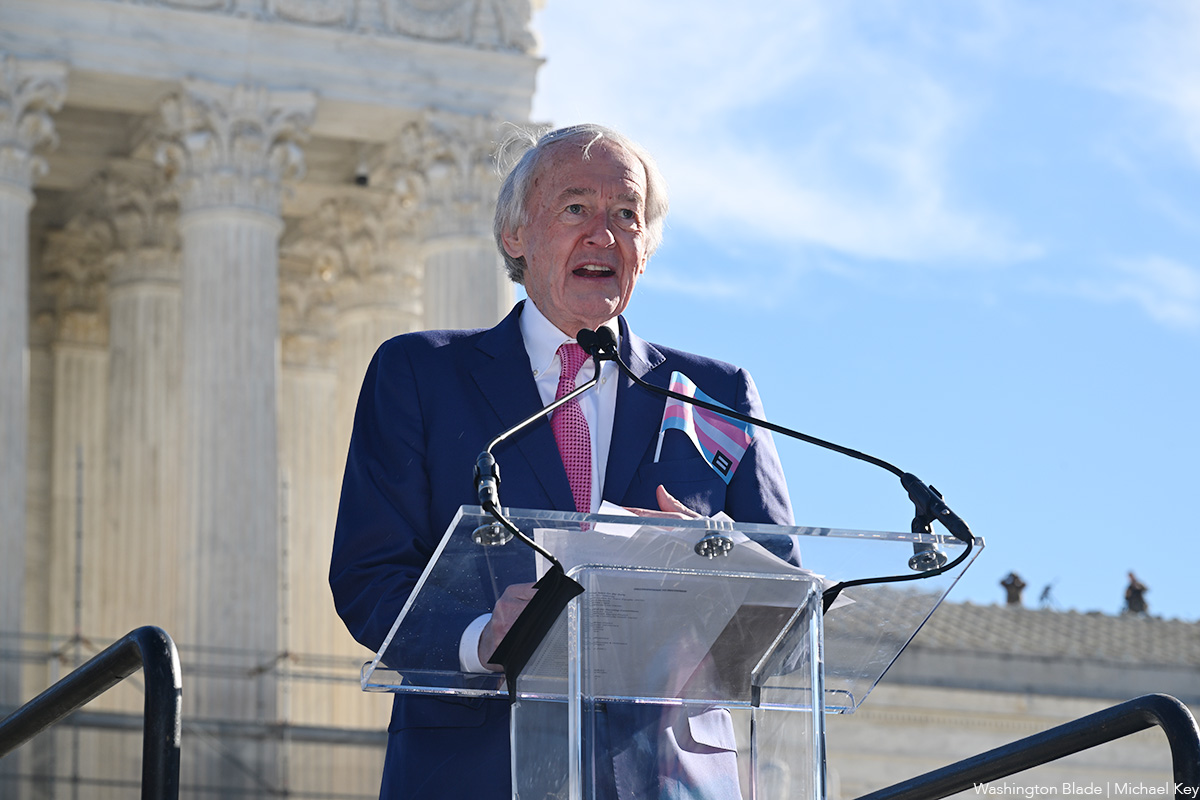
U.S. Sen. Ed Markey (D-Mass.) clinched the Democratic seat for his reelection campaign in Massachusetts’s primary election on Tuesday.
Markey won the deep-blue state with 64.8 percent of the vote, according to NBC News, triumphing over Marine Corps combat veteran and Congressman Seth Moulton, who received 35.2 percent of the vote.
Massachusetts’s primary election, which determined which Democratic candidate will head to the polls to face off against the Republican challenger in November, is being considered a victory for LGBTQ-inclusive policy, as well as for a divisive pro-transgender rights candidate — both things Markey has become an outspoken champion of.
Markey has experience at multiple levels of government, from the state level, where he served three terms in the state House of Representatives, to his federal tenure, including 20 terms in the U.S. House of Representatives and is now serving his second term as a senator. He has become a fixture of a changing Democratic Party in one of the most consistently blue places in the U.S.
This primary — and much of the national discussion surrounding the Senate seat — focused a lot of campaigning power on fighting the growing sentiment, led mostly by Republicans, that the frustration many Americans feel lends itself to an anti-establishment and anti-incumbent attitude.
Markey ran his campaign using his past as a reflection of his commitment to constantly putting his best foot forward for Bay Staters — particularly with apprehension for issues younger and more progressive democrats have been righting for — including Green New Deal and “Medicare for All” while Moulton — who was also elected to federal office prior to this run — campaigned on being younger than Markey, arguing that he was not the same type of established politician.
Moulton also faced backlash for negative comments about trans athletes, sparking criticism for those who did want younger candidate but want for trans rights to be protected.
Markey’s track record of supporting the LGBTQ community is one of the most clear in federal politics, one that has garnered a “100 percent lifetime voting record” on the Human Rights Campaign’s PAC politician review scorecard.
That list of Markey’s actions includes being a cosponsor of the Equality Act, driving landmark legislation to ensure federal protections for LGBTQ Americans, and being one of the most vocal proponents for trans rights in the federal government — specifically in multiple appropriations bills and in the National Defense Authorization Act. He was also the lead sponsor of the Transgender Health Care Access Act and the Transgender Bill of Rights resolution.
Markey first introduced the Transgender Bill of Rights in the Senate in 2023, where it ultimately failed to be brought to law. He reintroduced the legislation this year once again. This was a direct response to the attitude pushed by many conservatives after 2021, when the push to minimize trans rights started to become a key part of their cause and has been constantly propped up by the Trump-Vance administration.
“Massachusetts needs a senator who stands up and fights back, a senator who never forgets who they are fighting for,” Markey said during his victory speech. “That has been the mission of my life, and it always will be.”
Following the calling of the primary, a slew of LGBTQ organizations rallied behind Markey, many pushing his past as an asset that puts his money where his mouth is through advocating for legislation specifically protecting the LGBTQ community.
Tyler Hack, the executive director of the Christopher Street Project, an organization dedicated to pushing for legal protections for trans americans, released a statement following Markey’s win. Hack argued that putting forward such a staunchly pro-trans candidate is a win for the community, especially after endorsing him earlier this year.
“Tonight, anti-trans politics lost. Massachusetts rejected the idea that attacking transgender people is a shortcut to political power. Voters chose a different path: one where equality is not negotiable, cruelty is not courage, and transgender people do not have to disappear for Democrats to succeed.”
The Human Rights Campaign also endorsed him as a candidate earlier this year and issued a statement via its president, Kelley Robinson.
“Ed Markey has spent decades fighting for LGBTQ+ equality, for working people, and for a more livable world,” Robinson said. “He knows why equality matters. He’s stood with us no matter what. We were proud to endorse him this year, and when a pro-equality majority takes back the Senate this fall, we will continue to count on him as a champion for our community.”
Markey is running for reelection against Republican John Deaton in November, where he is expected to win.

Vote now! Best Of LGBTQ DC readers’ choice awards

Meet the LGBTQ candidates running for U.S. House, Senate

Ana Brnabić becomes world’s first openly lesbian head of state

529 openly LGBTQ candidates running in Brazilian election