ASSOCIATE ATTORNEY F/T
Associate Attorney, F/T, Remote Work permitted, J.D. in Law, or Related.
Mail resume: LMD Trade Law PLLC, 1629 K Street NW, Suite 300, Washington, DC 20006

Movies
‘Here the Whole Time’ delivers queer coming-of-age comedy
A feel-good journey toward self-discovery
There are a lot of queer coming-of-age movies about how hard coming of age can be when you’re queer – and that’s because, for far too many queer young people, coming of age is a very difficult experience.
Yet as difficult as it may be, imagine how much more so it is for queer kids who are also struggling with other factors that make them a potential target for bullying and social stigma. When your awakening sexuality is complicated by fears and self-esteem issues that can cause you to feel ostracized even by the other queer kids, it’s pretty hard to find a place where you fit in. Unfortunately, there are far fewer movies that address that kind of “double whammy” scenario, and even fewer whose leading characters don’t look like model-perfect “influencers,” complete with chiseled abs, perfect hair, and flawless skin – which makes it all the more welcome when a movie like that actually does come along.
That’s why the arrival on Netflix of “Here the Whole Time” – a Brazilian teen romcom from director Daniel Lieff – feels a bit like a surprise gift.
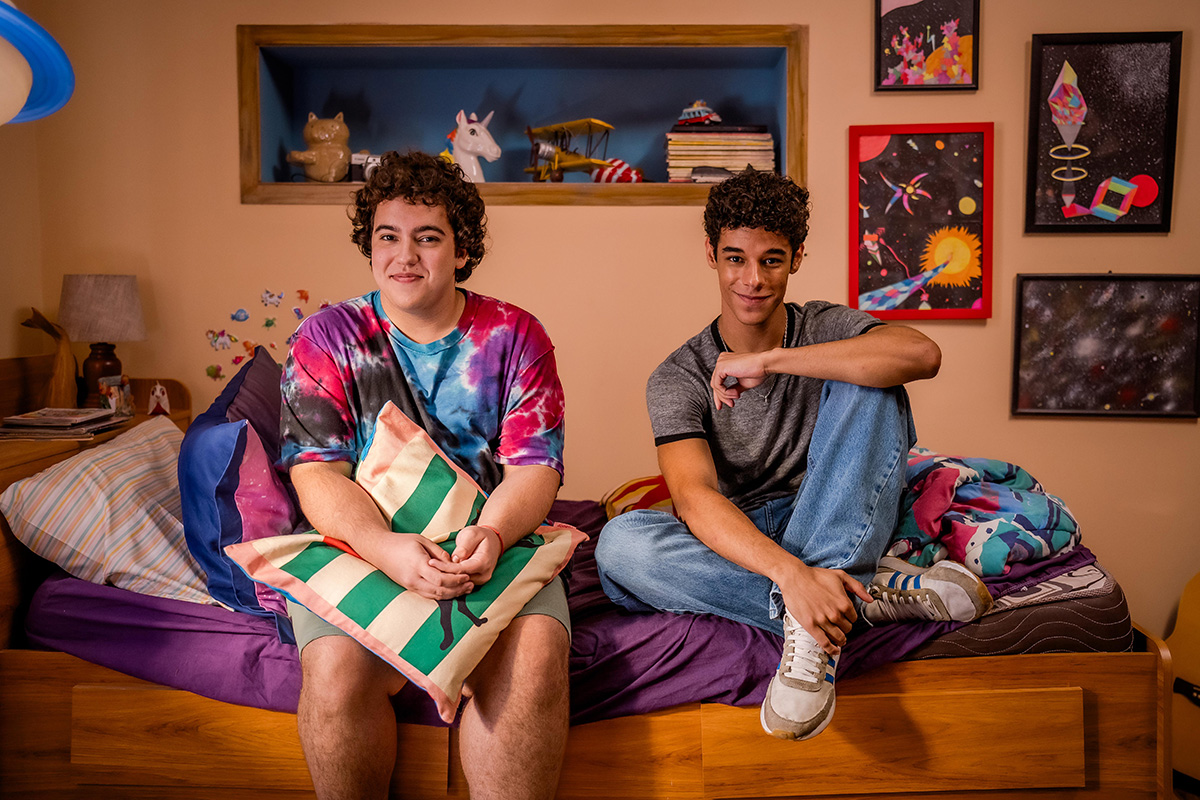
Its central character – Felipe (Miguel Lallo), a teenager who lives with his single mom Rita (Débora Falabella) – is already out as gay, but that’s not the only reason that his life at school is torturous; as he informs us through his own narration, he’s always been the butt of cruel jokes and public bullying because he’s always been (in his own words) “fat.” He’s teased in the classroom, humiliated in the hallways, and victimized at dodgeball in his gym class; so when his eagerly awaited summer break arrives, he’s looking forward to weeks of freedom in which he never has to interact with anyone except his mother.
His blissful dreams of isolating himself in his room are shattered, however, by a rude awakening in the form of Caio (Diego Lira), a neighbor boy and former childhood friend, whose mother and father have left him to stay with Rita while they are away on a trip. Athletic, handsome, and popular, he’s everything Felipe is not, and despite any previous bond of companionship they may have had, Felipe has no intention of playing the gracious host.
Yet as the days go by, the two boys begin to resuscitate their friendship; rather than being the bully Felipe expects, Caio is mostly respectful and exceedingly polite in trying to negotiate their temporary co-habitation. Forced to spend time together, the two gradually warm to each other, opening the door to a renewed friendship; they begin to “hang out” together, expanding the usually isolated Felipe’s social circle to include Caio’s BFF Beca (Mika Soiero) and her girlfriend Melissa (Bel Moreira) — leading to a revelation that turns his newfound friendly feelings for Caio into something more of a crush.
Is the feeling mutual? Can Felipe set aside his insecurities enough to even find out? We did describe the movie as a “romcom, so you can draw your own conclusions from that, but it’s a wild ride of a story, and half the fun is watching it unfold through each new development, so we won’t give any of those surprises away.
It won’t be a spoiler, however, to discuss the way “Here the Whole Time” undercuts the sentiment of its predictably “sweet” formula with its presentation of Felipe as something of an anti-hero, a strident “rebel with a cause” who disdains and distrusts everyone around him except for his mother and sees his therapy (or at least pretends to) as just an extension of school — complete with the unwanted inconvenience of homework.
He’s also, ironically, something of a bully himself, initially responding to the presence of Caio — who is no happier about their temporary living arrangement than he is — with willful and deliberate contempt, and levying his position as host (or as son of the hostess, at least) to assert his circumstantial power and dominance over an unwanted guest. Of course, we can see all along where it comes from, the habitual offense-as-defense tactic that has helped him survive and gain what little self-confidence he has, but that doesn’t make it any less rude.
Still, we don’t dislike him for it; a lifetime of body-shaming can do that to a person. Besides, it makes the transformation that comes in him — after learning to stand up for others like he stands up for himself, and other valuable life lessons he undergoes along the way — feel much more like an uplift. And if his insecurities win out once in a while (as they do, to dramatic effect, in the film’s penultimate chapters), who can blame him?
Caio, too, is portrayed against expectation. His self-assured swagger, like Felipe’s misanthropic hostility, comes from a young lifetime of self-protective compensation, but it’s just as easy for us to see through, and as the tenderness inside is revealed, he’s a far cry from “popular jock” stereotype that Felipe — and the audience — assume him to be,
It’s the dynamic between these two eminently likable characters that makes the film work, granting each of them their own dovetailing journeys toward self-discovery and allowing the feel-good sentiment of the story to emerge as something authentic, rather than just another trope-driven fantasy.
Much of this is thanks to the two young leads, who fully commit to their roles and strike a winning chemistry that makes us want them both to find their way through the amusing — but no less traumatic — growing pains they experience, both together and apart. They succeed in building an onscreen world in which we can believe, with them, in the possibility of rising above the obstacles thrown in their path, and it leaves us feeling not just uplifted, but maybe even a little joyful.
Kudos also go out to Falabella, whose performance as the quintessential “cool mom” makes her stand out as the film’s adult MVP; likewise, director Leiff handles the material with a superb sense of balance between over-the-top absurdity and quietly joyful moments of truth. In the end, though, it’s screenwriters Ray Tavares and Victor Brandt — adapting from a book by Vitor Martins — that’s truly responsible for crafting a charming coming-of-age story that allows itself to reach for the unlikely happy ending instead of sticking with the tried-and-true bittersweetness that usually arrives to provide an extra dash of unrequited yearning.
Of course, more jaded viewers — especially if they’re adults — might find the overall effect of “Here the Whole Time” less of than convincing. But for most of us — and hopefully it’s target audience, especially — it’s a charming reminder that “coming of age” isn’t just about sex or compromising with disillusionment. More than anything else, it’s about learning to let go of our disappointed assumptions to blossom into the life we truly deserve.
As a refreshingly upbeat entry into a genre that somehow holds a key position in our compromised adult lives, it’s definitely a ride worth taking,
U.S. Military/Pentagon
Pentagon expands testosterone screening as trans troops face hormone therapy restrictions
Defense Department says updated guidelines to be issued shortly

The Pentagon has announced that new clinical guidance will be released establishing mandatory testosterone deficiency screening for active-duty and reserve cisgender male service members ages 30 and older, advancing a policy that expands hormone-related care for cisgender troops.
The Defense Department said the existing clinical guidelines, which are not currently available on the Defense Health Agency’s website, are being updated and that the final guidance will be issued shortly.
The announcement comes amid a wave of anti-transgender policies from both the DoD and the Trump-Vance administration, which continue to prohibit trans men from receiving the same treatment.
Under the forthcoming guidance, men ages 30 and older will be forced to undergo testosterone blood tests as part of their medical care. Younger male service members will be tested if they request screening or if clinicians identify warning signs of low testosterone.
The new guidelines formalize a screening program Defense Secretary Pete Hegseth announced in July, when he said the Pentagon would begin testing service members to ensure that “you have the right testosterone levels to operate at your absolute best.”
“Taking care of your long-term health means ensuring you remain strong, resilient, and capable — not just for your next deployment, but for the rest of your life, so you can thrive long after you take off the uniform,” Hegseth said at the time.
The Defense Health Agency’s clinical guidance says the program is intended to address “hormonal and energy-availability issues.” Hegseth said in July that testosterone replacement therapy would remain voluntary for service members if treatment is recommended.
The Food and Drug Administration is also scheduled to hold a meeting later this month with experts to discuss the medical use of testosterone.
The Pentagon’s push to routinely test testosterone levels runs counter to current medical guidance, which generally recommends considering testosterone therapy only for men who have symptoms consistent with low testosterone and have documented low hormone levels on two separate blood tests.
Testosterone is a sex hormone naturally produced by people of all sexes. It plays a role in regulating muscle mass, bone density, and sex drive. Testosterone levels in men naturally decline with age and have been associated with symptoms including erectile dysfunction, low libido, mood changes and weight gain, although experts continue to debate when testosterone therapy is medically appropriate.
The policy has drawn scrutiny from LGBTQ advocates because the Pentagon and Hegseth have simultaneously cited hormone therapy as part of the rationale for removing trans service members from the military.
Under President Donald Trump’s 2025 executive order, “Prioritizing Military Excellence and Readiness,” the military has moved to bar trans people diagnosed with gender dysphoria from serving and has begun formal administrative separation proceedings against trans personnel.
The Pentagon continues to pursue implementation of the trans military ban as litigation over the policy proceeds. As a result, some trans service members have had their gender-affirming hormone therapy halted even as the Pentagon expands testosterone screening and potential treatment for cisgender service members.
SPARTA Pride, a nonpartisan nonprofit organization made up of trans service members, veterans and their allies, criticized the disparity to the Washington Blade when Hegseth first announced the screening program.
“If hormone therapy helps warfighters perform at their best, then it cannot simultaneously be used as evidence that transgender service members are unfit to serve,” said Kara Corcoran, executive director of SPARTA Pride. “The same class of evidence-based medical treatment cannot be characterized as readiness-enhancing for one group and readiness-destroying for another.”
On June 1, the U.S. Court of Appeals for the D.C. Circuit ruled that trans service members already serving in the military could continue to do so while allowing the armed services to continue refusing to enlist new trans recruits.
The Blade reached out to the Pentagon when the testosterone screening program was first announced in July, asking why cisgender service members could receive testosterone therapy while transgender service members could not. The Pentagon did not respond.

Friday, September 4
Go Gay DC will host “LGBTQ+ Community Happy Hour” at 7 p.m. at Freddie’s Beach Bar and Restaurant.This is a chance to relax, make new friends, and enjoy happy hour specials at this classic retro venue. Attendance is free and more details are available on Eventbrite.
Saturday, September 5
Go Gay DC will host “LGBTQ+ Community Brunch” at 11 a.m. at Freddie’s Beach Bar & Restaurant. This fun weekly event brings the DMV area LGBTQ+ community, including allies, together for delicious food and conversation. Attendance is free and more details are available on Eventbrite.
Sunday, September 6
“Nellie’s DC Drag Brunch” will be at 12 p.m. at Nellie’s Sports Bar. Come get served like a queen by a queen. Join Sapphire Blue, Deja Diamond and their team of amazing drag performers for the most fun you’ll have all weekend. Tickets cost $58.51 and are available on Eventbrite.
Monday, September 7
Go Gay DC will host “Out in Rosslyn LGBTQ+ Community Social” at 6 p.m. at Hyatt Centric Arlington. We have been invited to visit Hyatt Centric Arlington, where we will gather in a reserved section of their lounge. Attendees will be greeted by members of the Go Gay DC Leadership Team & receive a name tag upon arrival. This event is ideal for meeting new folks, making new friends, community-building, or just to unwind and enjoy the atmosphere. Casual attire is perfectly fine. More details are available on Eventbrite.
Tuesday, September 8
Coming Out Discussion Group will be at 7 p.m. on Zoom. This is a safe space to share experiences about coming out and discuss topics as it relates to doing so — by sharing struggles and victories the group allows those newly coming out and who have been out for a while to learn from others. For more details, visit the group’s Facebook.
Trans Discussion Group will be at 7 p.m. on Zoom. This event is intended to provide an emotionally and physically safe space for trans people and those who may be questioning their gender identity/expression to join together in community and learn from one another. For more details, email [email protected].
Wednesday, September 9
Job Club will be at 6 p.m. on Zoom upon request. This is a weekly job support program to help job entrants and seekers, including the long-term unemployed, improve self-confidence, motivation, resilience and productivity for effective job searches and networking — allowing participants to move away from being merely “applicants” toward being “candidates.” For more information, email [email protected] or visit thedccenter.org/careers.
Thursday, September 10
The DC LGBTQ+ Community Center’s Fresh Produce Program will be held all day at the DC LGBTQ+ Community Center. People will be informed on Wednesday at 5 p.m. if they are picked to receive a produce box. No proof of residency or income is required. For more information, email [email protected] or call 202-682-2245.
Virtual Yoga Class will be at 7 p.m. on Zoom. This free weekly class is a combination of yoga, breathwork and meditation that allows LGBTQ+ community members to continue their healing journey with somatic and mindfulness practices. For more details, visit the DC LGBTQ+ Community Center’s website.

‘Here the Whole Time’ delivers queer coming-of-age comedy

Pentagon expands testosterone screening as trans troops face hormone therapy restrictions

Calendar: September 4-10

Swiss government backs nationwide conversion therapy ban

Gloria Steinem dies at 92

Beloved D.C. ‘Old Catholic’ Bishop Charles Braun dies at 86

Blade welcomes fall intern

Top Bulgarian court rules government must legally recognize trans people

Markey’s primary win deemed success for LGBTQ activists

Lou Chibbaro Jr. documentary wins award from NLGJA
-

 Obituary5 days ago
Beloved D.C. ‘Old Catholic’ Bishop Charles Braun dies at 86
-
District of Columbia5 days ago
Blade welcomes fall intern
-
Bulgaria5 days ago
Top Bulgarian court rules government must legally recognize trans people
-
2026 Midterm Elections5 days ago
Markey’s primary win deemed success for LGBTQ activists