
Local
D.C. election board rejects marriage referendum
For the third time in less than a year, the D.C. Board of Elections & Ethics has ruled that a ballot measure seeking to ban same-sex marriage cannot be held because it would violate the city’s Human Rights Act.
The board’s ruling Thursday came eight days after opponents and supporters of a gay marriage referendum presented their views on the issue before an expedited public hearing called by the board.
“Based upon the written and oral opinions submitted to the board regarding the propriety of a referendum, as well as its own research and consideration of the matter, the board now concludes that the referendum does not present a proper subject for a referendum because it would authorize discrimination prohibited under the Human Rights Act,” says the ruling.
On two prior occasions, the board and Superior Court judges reached the same conclusion: that a referendum as well as a voter initiative seeking to ban same-sex marriage would violate the city’s human rights law and could not be held.
Similar to the two prior cases, Bishop Harry Jackson, pastor of a Beltsville, Md., church and the lead opponent of same-sex marriage in the District, along with several of his supporters, have vowed to appeal the board’s ruling to the Superior Court.
In an action that could disappoint LGBT activists, the board additionally ruled that the proposed referendum would not violate a separate D.C. election law restriction by interfering with the appropriation of funds or the city budget.
An attorney representing the Gertrude Stein Democratic Club joined the City Council’s attorney in arguing that a ban on same-sex marriage would result in a reduction of as much $1 million in tax revenue generated each year by same-sex weddings. The two attorneys cited a study conducted by the city’s chief financial officer showing that same-sex weddings would be expected to generate significant revenue for D.C. businesses as well as tax revenue for the city.
“[N]otwithstanding the arguments that the [same-sex marriage law] will result in increased revenue for the District, such prospective fiscal impact is insufficient to transform the [law] into an act appropriating funds for the general operation budget,” the board says in its ruling.
It says that various court cases cited by the two attorneys to support the budget argument do not apply in the case of the marriage referendum proposed by Jackson and his backers.
The board’s rejection of the budget argument against a referendum could result in problems for same-sex marriage equality advocates if an appeals court were to side with Jackson and reject the Human Rights Act restriction. Some LGBT activists had hoped the budget argument could be used as a backup plan in the event the human rights law argument runs into trouble at the appeals court level.
The referendum proposal rejected Thursday by the election board calls for overturning the Religious Freedom & Civil Marriage Equality Act of 2009, which the D.C. City Council passed and Mayor Adrian Fenty signed in December. The act would allow same-sex marriages to be performed in the District. It also would authorize churches and religious institutions to refuse to perform such marriages or allow their facilities to be used for such marriages if same-sex unions are contrary to their religious doctrine.
Under the city’s election law, various logistical requirements for a referendum, including the gathering of petition signatures for ballot placement, must be completed before Congress concludes its review of a city law. The congressional review for the marriage bill is expected to be completed March 2, making it unlikely that Jackson and his backers could gather the required petition signatures in time, even if the Superior Court were to rule in their favor.
Last year, Jackson asked the court to extend the deadline for gathering the pettion signature if the court would have ruled to allow a ballot measure to be held. The court rejected that request at the time it rule against the referendum itself.
“I am pleased that the Board of Elections & Ethics has again upheld the Human Rights Act and said that under that a ballot measure to restrict the rights of a minority is not appropriate or allowable under D.C. law,” said Peter Rosenstein, a D.C. gay activist.
Jackson and others calling for the referendum couldn’t immediately be reached for comment.



District of Columbia
Gay ANC member announces candidacy for Ward 1 D.C. Council seat
Community leader Brian Footer seeking seat held by Brianne Nadeau
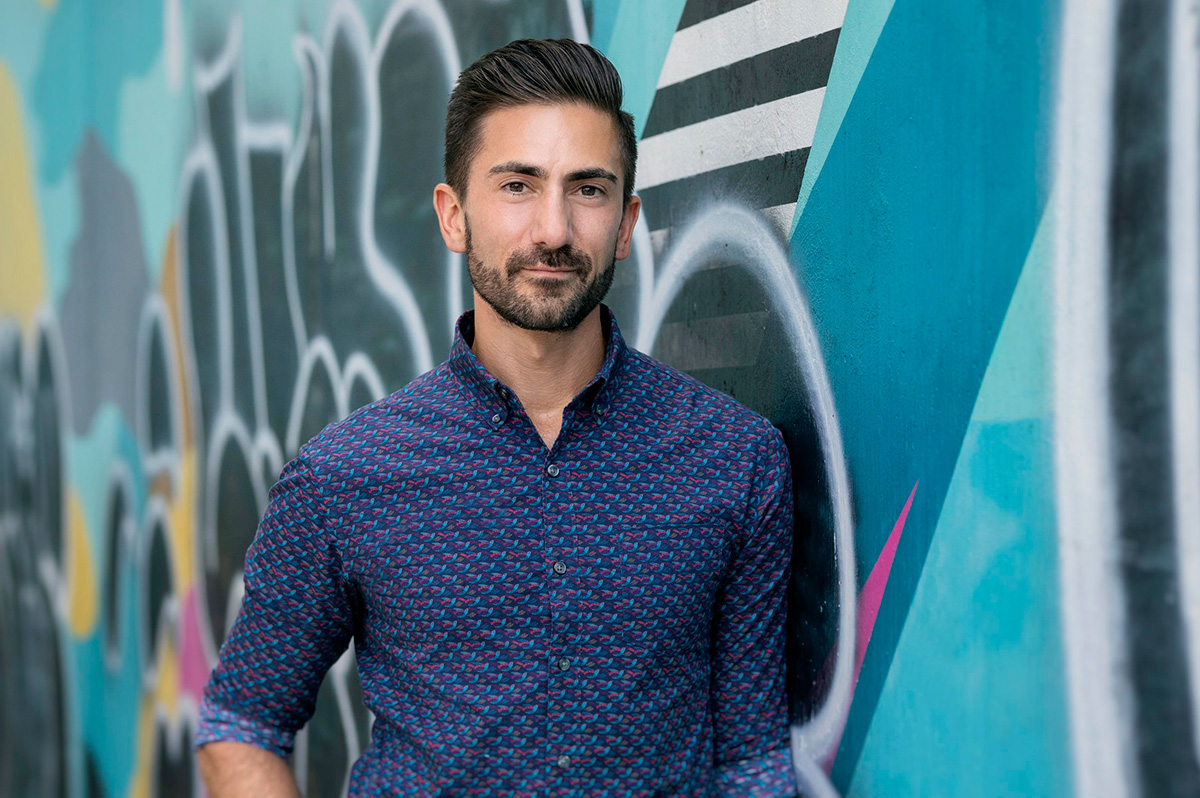
Gay Advisory Neighborhood Commissioner Brian Footer, a community activist who has been involved for many years in local and national government affairs, has announced his candidacy for the Ward 1 D.C. Council seat up for election in 2026.
Footer, a Democrat, will be running in the city’s June 2, 2026, Democratic primary for the Ward 1 Council seat, but it is uncertain whether he will be running against incumbent Ward 1 Council member Brianne Nadeau (D). Nadeau has not yet announced if she plans to run for re-election for a fourth term following her 12 years on the Council.
Nadeau has been a longtime vocal supporter of the LGBTQ community.
If Footer were to win the primary and the November 2026 general election, he would become the Council’s second openly gay member. Ward 5 Council member Zachary Parker (D) is currently the 13-member Council’s only gay member.
Footer is a three-term ANC commissioner who currently serves as Chair of ANC 1E, which represents the city’s Adams Morgan neighborhood.
“Brian has worked at every level of government — federal, state, and local — building a career rooted in public service, aging policy, and inclusive urban planning,” a statement on his campaign website says.
“I’m running for Council because too many people in Ward 1 are doing everything right and still feel ignored by the city they call home,” Footer states on his website.
“I’m running because we can do better,” his statement continues. “That means making housing more affordable, addressing homelessness with real solutions, and keeping our neighborhoods safe with smart, community focused strategies.”
When contacted by the Washington Blade for comment, Nadeau said she was not ready at this time to discuss her plans about running again or about Footer’s candidacy.
“The primary is a ways away, and I’m very focused right now on the budget and the stadium deal and all the work that we’re doing at the Council,” she told the Blade. “So, I really haven’t had time to turn to my plans. So, as a result, I’m also not going to be commenting on anybody else who is determined that they’re running at this time.”
She first won election to the Council in 2014 after she defeated four-term gay Ward 1 Council member Jim Graham in the Democratic primary after Graham became embroiled in an ethics controversy.
In the 2022 Democratic primary Nadeau defeated gay challenger Salah Czapary in a three-candidate race, by a margin of 48.5% of the vote compared to Czapary’s 30.9%.
With the third candidate, Sabel Harris, receiving 20.4%, the outcome showed that the two challengers had a combined total vote count higher than Nadeau.
Further details of Footer’s candidacy can be accessed from his campaign website, brianfooterdc.com.
District of Columbia
Gay GOP group hosts Ernst, 3 House members — all of whom oppose Equality Act
Log Cabin, congressional guest speakers mum on June 25 event
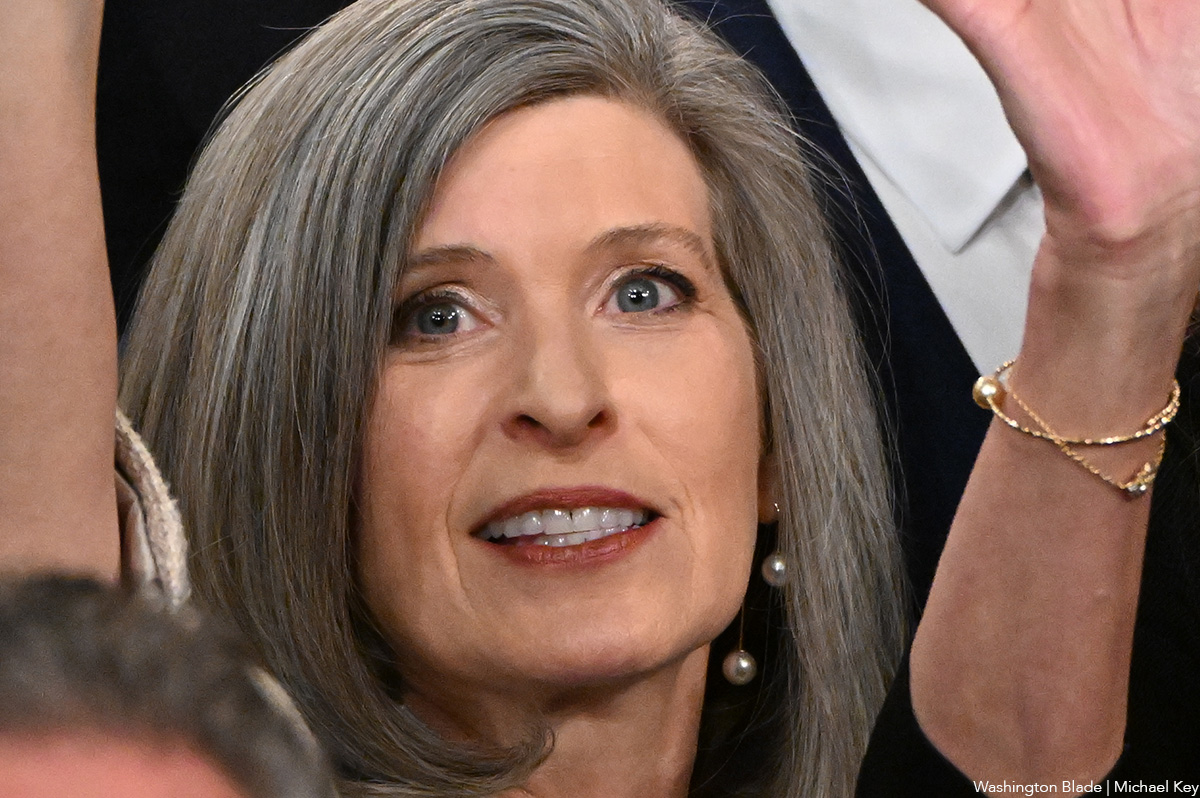
U.S. Sen. Joni Ernst (R-Iowa) and three women Republican members of the U.S. House appeared as guest speakers at the June 25 meeting of Log Cabin Republicans of D.C., the local chapter of the national LGBTQ Republican group with that same name.
The U.S. House members who joined Ernst as guest speakers at the Log Cabin meeting were Celeste Maloy (R-Utah), Kat Cammack (R-Fla.), and Julia Letlow (R-La.).
Neither D.C. Log Cabin Republicans President Andrew Minik nor spokespersons for Ernst or the three congresswomen immediately responded to a request by the Washington Blade for comment on the GOP lawmakers’ appearance at an LGBTQ GOP group’s meeting.
“Please join us for an inspiring evening as we celebrate and recognize the bold leadership and accomplishments of Republican women in Congress,” a D.C Log Cabin announcement sent to its members states.
“This month’s meeting will highlight the efforts of the Republican Women’s Caucus and explore key issues such as the Protection of Women and Girls In Sports Act and the broader fight to preserve women’s spaces in society,” the message says.
It was referring to legislation pending in Congress calling for banning transgender women from participating in women’s sports events.
According to media reports, Ernst and the three congresswomen have expressed opposition to the Equality Act, the longstanding bill pending in Congress calling for prohibiting discrimination based on sexual orientation and gender identity in the areas of employment, housing, and public accommodations.
The Log Cabin announcement says the meeting was scheduled to take place at the Royal Sands Social Club, which is a restaurant and bar at 26 N St., S.E. in the city’s Navy Yard area.
D.C. Log Cabin member Stuart West, who attended the meeting, confirmed that Ernst and the three congresswomen showed up and spoke at the event.
“It was a good turnout,” he said. “I would definitely say probably 30 or 40 people attended.” West added, “Four women came to talk to a group of mostly gay men. That’s something you don’t see very often.”
District of Columbia
D.C. police seek public’s help in July 5 murder of trans woman
Relative disputes initial decision not to list case as hate crime

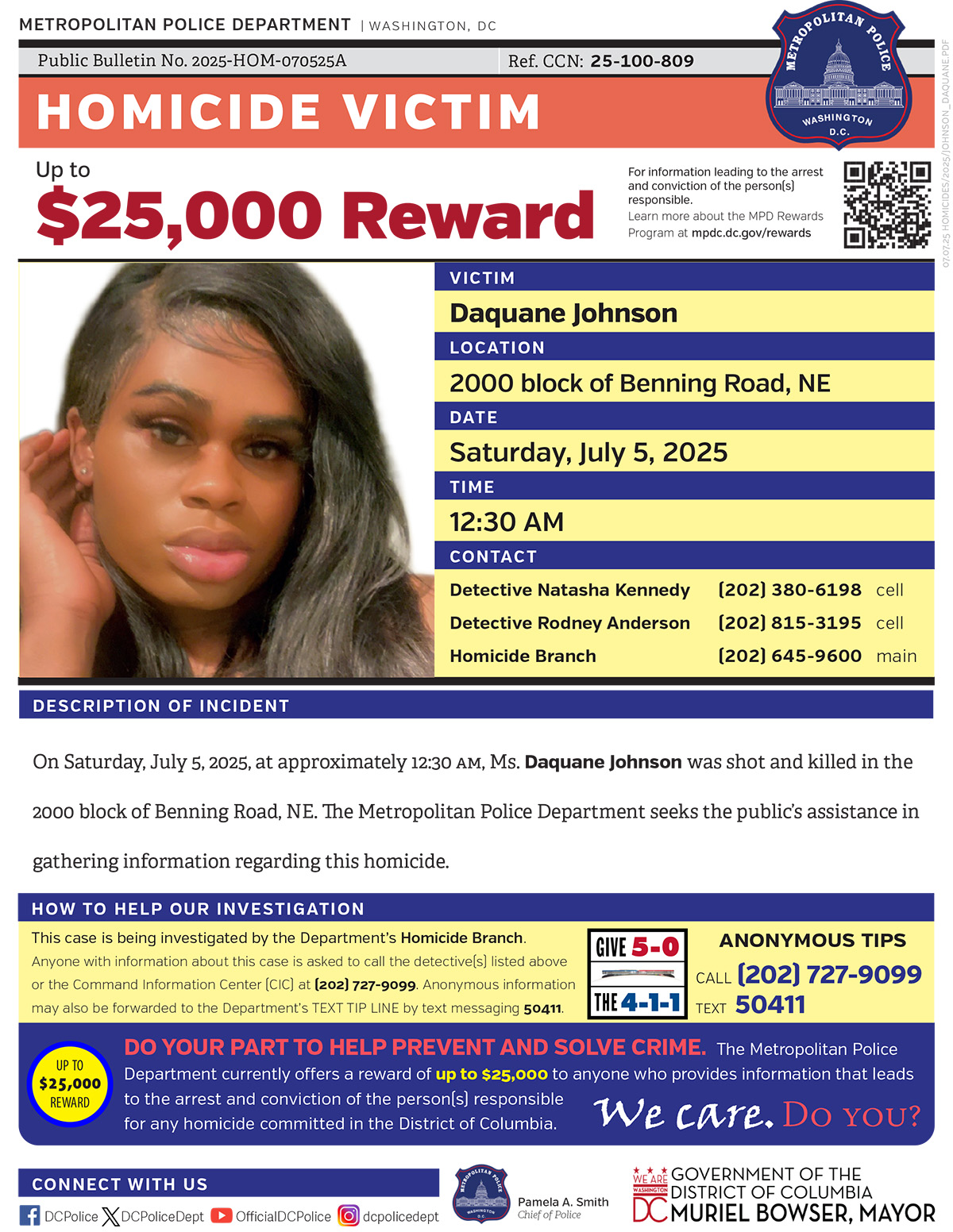
D.C. police are seeking help from the public in their investigation into the murder of a transgender woman who they say was shot to death at about 12:30 a.m. on Saturday, July 5, on the 2000 block of Benning Road, N.E.
But the police announcement of the fatal shooting and a police report obtained by the Washington Blade do not identify the victim, 28-year-old Daquane ‘Dream’ Johnson of Northeast D.C., as transgender. And the police report says the shooting is not currently listed as a suspected hate crime.
It was local transgender activists and one of Johnson’s family members, her aunt, who confirmed she was transgender and said information they obtained indicates the killing could have been a hate crime.
“On Saturday, July 5, at approximately 12:51 a.m., Sixth District officers were flagged down in the 2000 block of Benning Road, Northeast, for an unconscious female,” a July 5 D.C. police statement says. “Upon arrival, officers located an adult female victim suffering from gunshot wounds,” it says.
“D.C. Fire and EMS responded to the scene and transported the victim to a local hospital where after all lifesaving efforts failed and the victim was pronounced dead,” the statement says.
A separate police flyer with a photo of Johnson announces an award of $25,000 was being offered for information leading to the arrest and conviction of the person or persons responsible for the murder.
The flyer identifies D.C. police Homicide Detective Natasha Kennedy as being the lead investigator in the case and says anyone with information about the case should contact her at 202-380-6198.
Longtime D.C. transgender rights advocate Earline Budd told the Blade that one of the police investigators contacted her about the case and that she also spoke to Detective Kennedy. Budd said police confirmed to her that Johnson was a transgender woman.

One of Johnson’s family members, Vanna Terrell, who identified herself as Johnson’s aunt, told the Blade that Johnson used the first name of Dream and had planned to legally adopt that name instead of Daquane but had not gotten around to doing so.
Terrell said she and other family members learned more about the incident when one of two teenage high school students who knew Johnson’s brother contacted a friend and told the friend that they recognized Johnson as they witnessed the shooting. Terrell said the friend then called her to tell her what the friend learned from the two witnesses.
According to Terrell, the witnesses reportedly saw three men approach Johnson as Johnson walked along Benning Road and one of them called Johnson a derogatory name, leading Terrell to believe the men recognized Johnson as a transgender woman.
Terrell said one of the witnesses told the friend, who spoke to Terrell, that the man who shot Johnson kept shooting her until all of the bullets were fired. Budd, who said she spoke to Terrell, who also told her what the witnesses reported, said she believed the multiple shots fired by the shooter was an “overkill” that appears to have been a hate crime. Terrell said she too believes the murder was a hate crime.
In response to an inquiry from the Blade, Officer Ebony Major, a D.C. police spokesperson, stated in an email, “At this point there is nothing in the investigation that indicates the offense was motivated by hate or bias.”
Terrell said a memorial gathering to honor Johnson’s life was scheduled to be held Saturday, July 12, at River Terrace Park, which is located at 500 36th St., N.E. not far from where the shooting occurred.

Gay ANC member announces candidacy for Ward 1 D.C. Council seat

ICYMI: ‘Overcompensating’ a surprisingly sweet queer treat

Democrats need to stop the self-immolation

Spanish women detail abuses suffered in Franco-era institutions

PHOTOS: Independence Day Weekend in Rehoboth

Treasury Department has a gay secretary but LGBTQ staff are under siege

Defying trends, new LGBTQ center opens in rural Winchester, Va.

Gay GOP group hosts Ernst, 3 House members — all of whom oppose Equality Act

USAID’s demise: America’s global betrayal of trust with LGBTQ people

D.C. police seek public’s help in July 5 murder of trans woman
-
 Federal Government2 days ago
Treasury Department has a gay secretary but LGBTQ staff are under siege
-
 Virginia3 days ago
Defying trends, new LGBTQ center opens in rural Winchester, Va.
-
 District of Columbia2 days ago
Gay GOP group hosts Ernst, 3 House members — all of whom oppose Equality Act
-
 Opinions4 days ago
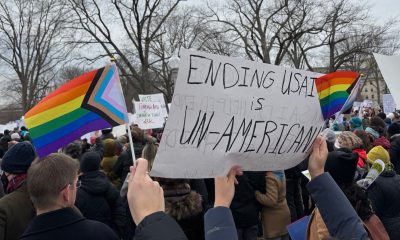
USAID’s demise: America’s global betrayal of trust with LGBTQ people