
National
National news in brief
Marine Corps leader wants separate rooms for gay troops
The uniform leader of the Marine Corps says he would seek separate quarters for Marines should Congress repeal “Don’t Ask, Don’t Tell.”
In an interview with Military.com published March 25, Marine Corps Commandant Gen. James Conway said he wouldn’t require straight Marines to bunk with gay Marines on base, if the situation can be avoided, should Congress repeal the law.
“We want to continue [two-person rooms], but I would not ask our Marines to live with someone who is homosexual if we can possibly avoid it,” Conway said. “And to me that means we have to build [bachelor enlisted quarters] and have single rooms.”
Conway said the Marine Corps is the only service that has two-person rooms because the service thinks it good for unit cohesion, but should the law change allowing open service, the Marine Corps would want to have single rooms.
“If we believe [two-person rooms] is going to be adverse to unit cohesion, then why wouldn’t we join every other services’ standard and say that, you know, under the previous regulations it was conducive, under the current regulations, it’s got the potential to cause friction,” he said.
In the course of engaging Marines on their positions on gays in the military, Conway said an “overwhelming number” have “significant concern” about issues regarding repeal of “Don’t Ask, Don’t Tell,” although he wouldn’t estimate a percentage.
“If perception is reality, we just think our corps would not want to see it changed,” Conway said. “If it is changed, it’s going to require some leadership engaging to make sure that our orders are carried out.”
Pressed further by Military.com on why separate rooms are necessary, Conway said he would “want to preserve the right of a Marine that thinks he or she wouldn’t want to do that, and again, that’s the overwhelming number of people that say they wouldn’t like to do so.”
Media sources during the past several months have cast Conway as one of the leading opponents of repealing “Don’t Ask, Don’t Tell” in discussions among the service chiefs.
In a statement, Nathaniel Frank, senior research fellow at the Palm Center, a think-tank on gays in the military at the University of California, Santa Barbara, said Conway’s proposal doesn’t square with decades of research on gays in the military.
“Decades of research, including all of the conclusions of the 1993 RAND study, shows that separating gays and straights is a bad idea,” he said. “RAND found that creating policies that are applied only to one group of people or to accommodate the prejudices of another group of people only undercut the larger mission of a unified, integrated force.”
Boxer introduces COBRA bill to benefit partners
U.S. Sen. Barbara Boxer (D-Calif.) introduced legislation last week that would allow same-sex domestic partners to have the same access to COBRA benefits as married couples in some circumstances.
The bill, known as the Equal Access to COBRA Act, would allow LGBT people to continue to receive coverage for their same-sex partners under COBRA if they lose their job and their former employer offered health benefits to domestic partners.
In a statement, Boxer called the issue the legislation would address “a question of fairness.”
“Every family deserves access to health insurance, especially in this tough economy,” she said. “This bill ensures that domestic partners and their families will have equal access to health coverage after a job loss.”
According to Boxer’s statement, more than half of Fortune 500 companies cover domestic partners under their health plans.
Under COBRA, or the Consolidated Omnibus Budget Reconciliation Act, employers must continue to offer health care coverage to departing workers and their beneficiaries for up to 36 months.
Joe Solmonese, president of the Human Rights Campaign, said in a statement that Boxer’s bill is important because same-sex couples “are equally affected by economic hardships and should have equal access to important benefits like COBRA continuation coverage.”
“In these troubled economic times, when many Americans are concerned about the security of their jobs and health insurance, LGBT people should not also have to worry whether the COBRA safety net will be there to help protect the health of their families,” he said.


Federal Government
UPenn erases Lia Thomas’s records as part of settlement with White House
University agreed to ban trans women from women’s sports teams

In a settlement with the Trump-Vance administration announced on Tuesday, the University of Pennsylvania will ban transgender athletes from competing and erase swimming records set by transgender former student Lia Thomas.
The U.S. Department of Education’s Office for Civil Rights found the university in violation of Title IX, the federal rights law barring sex based discrimination in educational institutions, by “permitting males to compete in women’s intercollegiate athletics and to occupy women-only intimate facilities.”
The statement issued by University of Pennsylvania President J. Larry Jameson highlighted how the law’s interpretation was changed substantially under President Donald Trump’s second term.
“The Department of Education OCR investigated the participation of one transgender athlete on the women’s swimming team three years ago, during the 2021-2022 swim season,” he wrote. “At that time, Penn was in compliance with NCAA eligibility rules and Title IX as then interpreted.”
Jameson continued, “Penn has always followed — and continues to follow — Title IX and the applicable policy of the NCAA regarding transgender athletes. NCAA eligibility rules changed in February 2025 with Executive Orders 14168 and 14201 and Penn will continue to adhere to these new rules.”
Writing that “we acknowledge that some student-athletes were disadvantaged by these rules” in place while Thomas was allowed to compete, the university president added, “We recognize this and will apologize to those who experienced a competitive disadvantage or experienced anxiety because of the policies in effect at the time.”
“Today’s resolution agreement with UPenn is yet another example of the Trump effect in action,” Education Secretary Linda McMahon said in a statement. “Thanks to the leadership of President Trump, UPenn has agreed both to apologize for its past Title IX violations and to ensure that women’s sports are protected at the university for future generations of female athletes.”
Under former President Joe Biden, the department’s Office of Civil Rights sought to protect against anti-LGBTQ discrimination in education, bringing investigations and enforcement actions in cases where school officials might, for example, require trans students to use restrooms and facilities consistent with their birth sex or fail to respond to peer harassment over their gender identity.
Much of the legal reasoning behind the Biden-Harris administration’s positions extended from the 2020 U.S. Supreme Court case Bostock v. Clayton County, which found that sex-based discrimination includes that which is based on sexual orientation or gender identity under Title VII rules covering employment practices.
The Trump-Vance administration last week put the state of California on notice that its trans athlete policies were, or once were, in violation of Title IX, which comes amid the ongoing battle with Maine over the same issue.
New York
Two teens shot steps from Stonewall Inn after NYC Pride parade
One of the victims remains in critical condition
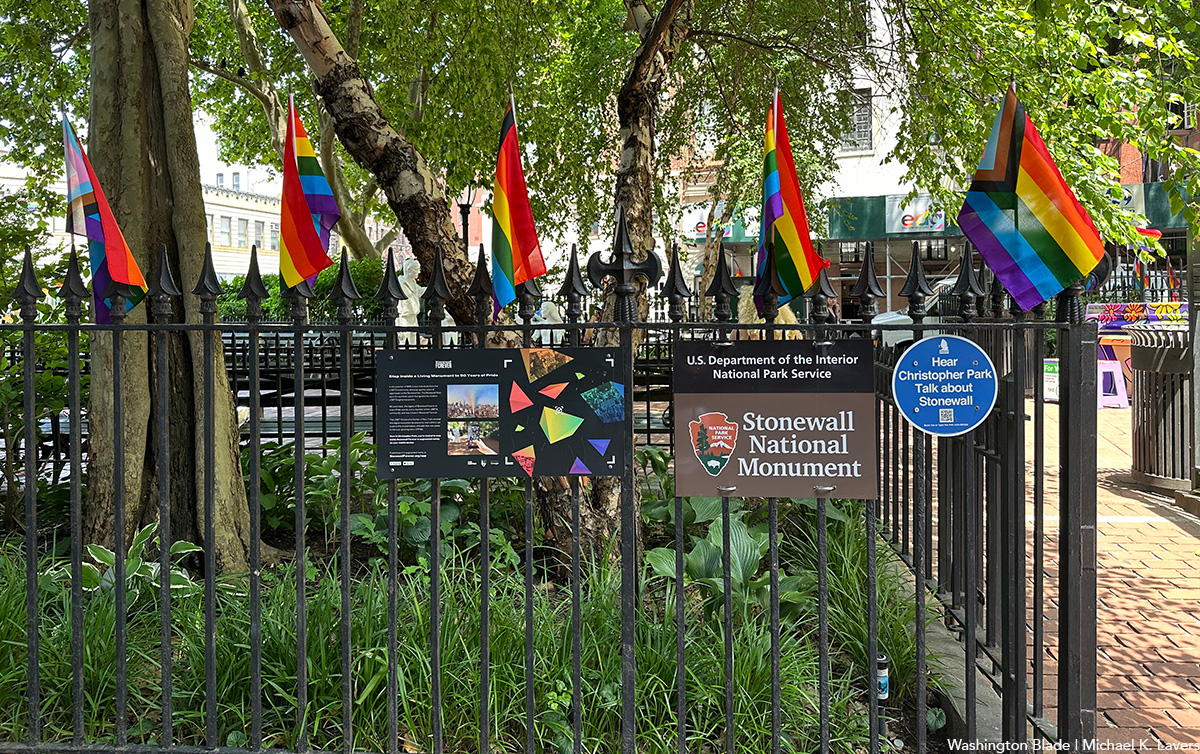
On Sunday night, following the annual NYC Pride March, two girls were shot in Sheridan Square, feet away from the historic Stonewall Inn.
According to an NYPD report, the two girls, aged 16 and 17, were shot around 10:15 p.m. as Pride festivities began to wind down. The 16-year-old was struck in the head and, according to police sources, is said to be in critical condition, while the 17-year-old was said to be in stable condition.
The Washington Blade confirmed with the NYPD the details from the police reports and learned no arrests had been made as of noon Monday.
The shooting took place in the Greenwich Village neighborhood of Manhattan, mere feet away from the most famous gay bar in the city — if not the world — the Stonewall Inn. Earlier that day, hundreds of thousands of people marched down Christopher Street to celebrate 55 years of LGBTQ people standing up for their rights.
In June 1969, after police raided the Stonewall Inn, members of the LGBTQ community pushed back, sparking what became known as the Stonewall riots. Over the course of two days, LGBTQ New Yorkers protested the discriminatory policing of queer spaces across the city and mobilized to speak out — and throw bottles if need be — at officers attempting to suppress their existence.
The following year, LGBTQ people returned to the Stonewall Inn and marched through the same streets where queer New Yorkers had been arrested, marking the first “Gay Pride March” in history and declaring that LGBTQ people were not going anywhere.
New York State Assemblywoman Deborah Glick, whose district includes Greenwich Village, took to social media to comment on the shooting.
“After decades of peaceful Pride celebrations — this year gun fire and two people shot near the Stonewall Inn is a reminder that gun violence is everywhere,” the lesbian lawmaker said on X. “Guns are a problem despite the NRA BS.”
New York
Zohran Mamdani participates in NYC Pride parade
Mayoral candidate has detailed LGBTQ rights platform

Zohran Mamdani, the candidate for mayor of New York City who pulled a surprise victory in the primary contest last week, walked in the city’s Pride parade on Sunday.
The Democratic Socialist and New York State Assembly member published photos on social media with New York Attorney General Letitia James, telling followers it was “a joy to march in NYC Pride with the people’s champ” and to “see so many friends on this gorgeous day.”
“Happy Pride NYC,” he wrote, adding a rainbow emoji.
Mamdani’s platform includes a detailed plan for LGBTQ people who “across the United States are facing an increasingly hostile political environment.”
His campaign website explains: “New York City must be a refuge for LGBTQIA+ people, but private institutions in our own city have already started capitulating to Trump’s assault on trans rights.
“Meanwhile, the cost of living crisis confronting working class people across the city hits the LGBTQIA+ community particularly hard, with higher rates of unemployment and homelessness than the rest of the city.”
“The Mamdani administration will protect LGBTQIA+ New Yorkers by expanding and protecting gender-affirming care citywide, making NYC an LGBTQIA+ sanctuary city, and creating the Office of LGBTQIA+ Affairs.”

UPenn erases Lia Thomas’s records as part of settlement with White House

House Democrats oppose Bessent’s removal of SOGI from discrimination complaint forms

Protests, demands for rights define Pride month in Latin America

PHOTOS: Montgomery County Pride in the Plaza

Walkinshaw wins Democratic primary in Va. 11th Congressional District

Supreme Court upholds ACA rule that makes PrEP, other preventative care free

Supreme Court rules parents must have option to opt children out of LGBTQ-specific lessons

‘White Lotus,’ ‘Severance,’ ‘Andor’ lead Dorian TV Awards noms

Berkshire Choral to commemorate Matthew Shepard’s life

We can’t afford Medicaid cuts in fight against HIV
-
 U.S. Supreme Court4 days ago
Supreme Court upholds ACA rule that makes PrEP, other preventative care free
-
 U.S. Supreme Court4 days ago
Supreme Court rules parents must have option to opt children out of LGBTQ-specific lessons
-
 Television5 days ago
‘White Lotus,’ ‘Severance,’ ‘Andor’ lead Dorian TV Awards noms
-
 Music & Concerts5 days ago
Berkshire Choral to commemorate Matthew Shepard’s life