Theater
Sister act
‘Carpetbagger’s’ gives rare chance for D.C.’s top actresses to shine
‘The Carpetbagger’s Children’
Through Feb. 13
Ford’s Theatre
511 10th St, NW
$15-$55
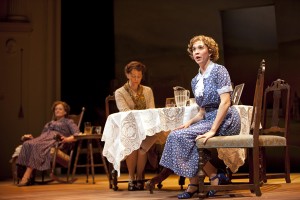
Holly Twyford as Sissie with (background) Kimberly Schraf as Cornelia and Nancy Robinette as Grace Ann in the Ford’s Theatre Society production of Horton Foote’s “The Carpetbagger’s Children,” directed by Mark Ramont. (Photo by T. Charles Erickson, courtesy of Ford’s Theatre)
Few artists evoke memory like the late, great American playwright Horton Foote. His astounding sense of place and ability to gently but truthfully revisit the past through indelibly drawn characters have secured his rank among dramatists.
With his “The Carpetbagger’s Children,” now at Ford’s Theatre, Foote once again takes us back to bygone small town life in coastal Texas. Via revolving monologues delivered by the three surviving Thompson sisters – responsible Cornelia (Kimberly Schraf), defiant Grace Anne (Nancy Robinette), and tractable Sissie played by Holly Twyford who is gay — the splintered family’s well-remembered oral history is revealed.
As the offspring of a union soldier who settled in post-construction Huntington (the usual stand-in for the playwright’s native Wharton, Texas) and made good by buying large tracts of land from the war-impoverished locals, the sisters grew up feeling apart from the surrounding community. And their father’s desire that his heirs not marry for fear they might one day break up his massive estate did little to lessen that sense of separateness.
Looking back, the women recall a life under the thumb of their authoritarian late father. Each in turn talks about property and cotton farming, Grace Anne’s ill-advised elopement to the gold-digging Jackson Le Grand, Sissie’s singing, and strong Cornelia’s moment of weakness when she fell for an insincere suitor. The ladies reverently recollect Beth, their beloved and beautiful older sister who died young, and make frequent reference to their still living (but not seen on stage) brother and senile mother.
While the trio approach the same subjects form different angles, they seem to disagree on very little. Initially, this sisterly consensus among very different women strikes one as an elderly playwright’s (“The Carpetbagger’s Children” is Foote’s penultimate play — written in 2001, eight years before his death at 92) missed storytelling opportunity, but more likely it serves as a testament to the Thompson’s deep-seated family lore.
Gracefully staged by Mark Ramont, the 90-minute show is made up almost solely of engaging monologues — humorous, poignant and real — like most of Foote’s work which includes southern set plays like “Trip to Bountiful” and the Pulitzer Prize-winning “The Young Man From Atlanta” as well as Academy Award-wining screenplays for the films “To Kill a Mockingbird” and “Tender Mercies.” The few instances when the characters briefly interact leave the audience yearning for more.
The cast — comprised of three D.C. favorites – is a treat. With steady gaze and set jaw, Robinette captures Grace Anne’s lifelong rebellion. Twyford’s Sissie, the self-described baby of the family, is blissfully dim and musical (she repeatedly sings “O, the Clanging Bells of Time”). But it’s Schraf as Cornelia, the sensible sister selected by papa to run the estate, who subtly anchors the play and fares most convincingly as one of Foote’s southern women.
Just below the box where Lincoln was shot in the head by that crazy actor John Wilkes Booth, set designer Robin Stapley has placed chairs and a lace-covered dining table crowded with silver-framed family photos. The suggested parlor is backed by endless acres of fertile fields and colorful skies.
One by one, each of the actors fades away, exiting through a cutout in the orange sunset, beautifully expressing the end of a family’s era, lost in time but not forgotten.






Theater
Miss Kitty tackles classical mythology in ‘Metamorphoses’
Folger production seen through the lens of the African diaspora
‘Metamorphoses’
May 7-June 16
Folger Theatre
201 East Capitol St., S.E.
$20-$84
Folger.edu
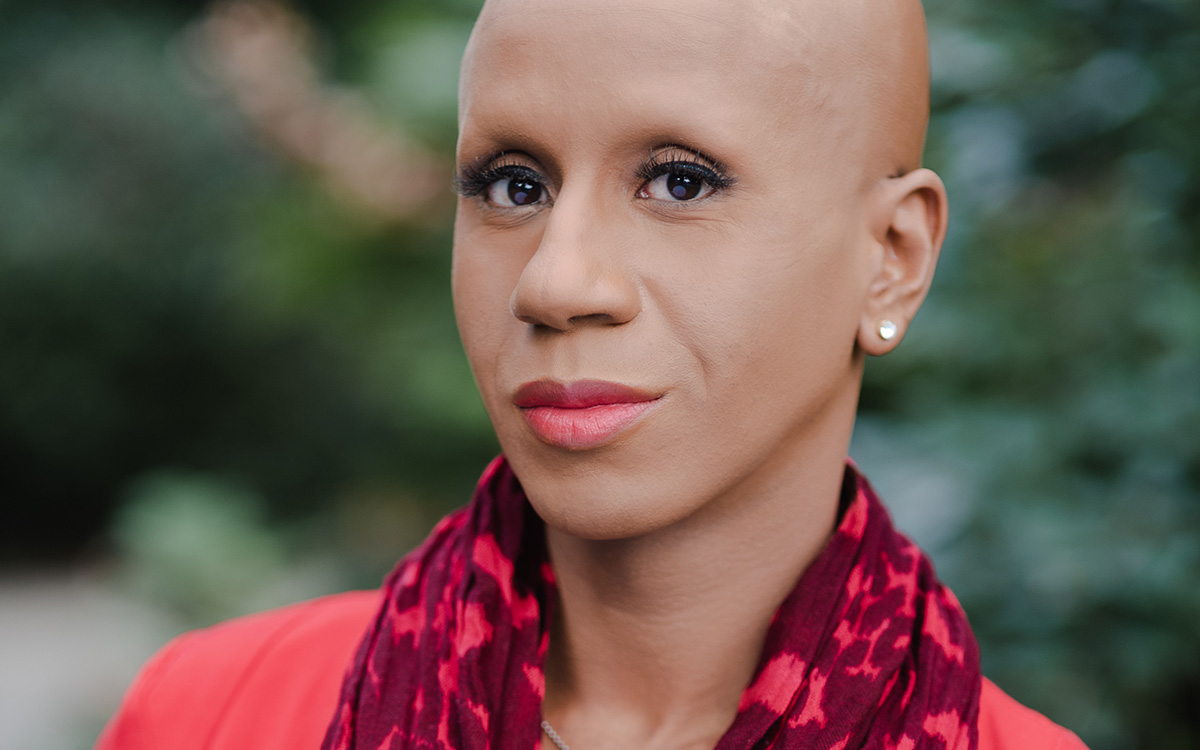
Miss Kitty’s words are thoughtful and measured, occasionally punctuated by flamboyant flourishes and uplifting proclamations. Her tried and tested tagline is “live in fierce not fear.”
She describes herself as “AMAB (assigned male at birth), nonbinary, genderqueer, transfemme” as well as “chanteuse, noble blacktress, and dancer.”
Currently, Miss Kitty is testing her talents in Mary Zimmerman’s “Metamorphoses” at Folger Theatre on Capitol Hill.
At 90 minutes, “Metamorphoses,” is made up of interwoven vignettes from classical mythology including the tales of Midas and his daughter, Alcyone and Ceyx, and Eros and Psyche.
“It’s all stories that relate to the human condition: the follies, the happiness, the love, the loss,” Miss Kitty explains. “And a thorough knowledge of mythology isn’t a requirement for enjoyment.”
The language is contemporary and with its 11-person ensemble cast – comprised exclusively of Black or indigenous people of color – they’re adding their own spin to its present-day feel, she adds.
In Zimmerman’s famously staged premiere production, the actors performed in and around a pool of water. At Folger, director Psalmayene 24 has ditched actual aquatics; instead, he suggests the element by introducing Water Nymph, a new character constructed around Miss Kitty.
Water Nymph doesn’t speak, but she’s very visible from the opening number and throughout the play on stage and popping up in unexpected places around the venue.
“It’s a lot of dancing; I haven’t danced the way Tony Thomas is choreographing me in a very long time. At 40, can she still make theater with just my body as her instrument?
The name “Miss Kitty” was born over a decade ago.
Miss Kitty recalls, “She was still presenting as male and going by her dead name. Someone commented that with the wig she was wearing for a part, she looked like Eartha Kitt whom she deeply admires.”
Her penchant for illeism (referring to oneself in third person) isn’t without good reason. She explains, “It’s to reiterate that however she might look, she’s always there; and if you misgender, she will let you know.”
Initially, the moniker was a drag persona at Capital Pride or the occasional fabulous cabaret performance at a nightclub.
But as time passed, she realized that Miss Kitty was something she couldn’t take off. She had always been a part of her.
“She’s helped me to grow and flourish; she’s given me the strength that I never would have had before. I’m so proud of myself for realizing that before it was too late.”
Bringing Miss Kitty into her theatrical career presented some concerns. Would theater folks be open to the new her, especially those she’d worked with before?
Not always, but she’s found new companies who’ve welcomed Miss Kitty with open arms including Avant Bard, Spooky Action Theater, and now Folger.
Last fall, Miss Kitty appeared in Spooky Action’s Agreste (Drylands), a stunning queer story penned by gay Brazilian playwright Newton Moreno.
After being invited to audition and reading the script, Miss Kitty was determined to be a part of the production.
A work dealing with love and being trans, and transphobia, and how people can turn on a dime once they learn the truth about someone, resonated deeply with the actor.
“The play speaks to the idea that if people just let people be who they are and love who they want to love we’d all be a lot happier,” she says.
For her sublime efforts, Miss Kitty nabbed a Helen Hayes Award nomination in the Outstanding Lead Performer category (winner to be determined on Monday, May 20 during a ceremony at The Anthem).
It’s her first time nominated and first time attending. She’s thrilled.
Miss Kitty grew up in Oxen Hill, Md., and now lives near Washington Harbor. Her entry into performance was through music followed by high school plays. She graduated from Catholic University with a degree in music/concentration in musical theater, and from there dove directly into showbiz.
Looking back, Miss Kitty says, “being a person of color AND queer can be a double whammy of difficulty. You have to live in light and do the things you’re afraid to do. That’s the game changer.”
Presenting “Metamorphoses” through the lens of the African diaspora (the cast also includes Jon Hudson Odom and Billie Krishawn, among others) helps us to realize that every story can be universal, especially for marginalized people — South Asian, Native American, or fully queer perspectives, she says.
“Having an all-Black ensemble opens all new worlds for everyone.”
Theater
Round House explores serious issues related to privilege
‘A Jumping-Off Point’ is absorbing, timely, and funny
‘A Jumping-Off Point’
Through May 5
Round House Theatre
4545 East-West Highway, Bethesda, Md.
$46-$83
Roundhousetheatre.org
In Inda Craig-Galván’s new play “A Jumping-Off Point,” protagonist Leslie Wallace, a rising Black dramatist, believes strongly in writing about what you know. Clearly, Craig-Galván, a real-life successful Black playwright and television writer, adheres to the same maxim. Whether further details from the play are drawn from her life, is up for speculation.
Absorbing, timely, and often funny, the current Round House Theatre offering explores some serious issues surrounding privilege and who gets to write about what. Nimbly staged and acted by a pitch perfect cast, the play moves swiftly across what feels like familiar territory without being the least bit predictable.
After a tense wait, Leslie (Nikkole Salter) learns she’s been hired to be showrunner and head writer for a new HBO MAX prestige series. What ought to be a heady time for the ambitious young woman quickly goes sour when a white man bearing accusations shows up at her door.
The uninvited visitor is Andrew (Danny Gavigan), a fellow student from Leslie’s graduate playwriting program. The pair were never friends. In fact, he pressed all of her buttons without even trying. She views him as a lazy, advantaged guy destined to fail up, and finds his choosing to dramatize the African American Mississippi Delta experience especially annoying.
Since grad school, Leslie has had a play successfully produced in New York and now she’s on the cusp of making it big in Los Angeles while Andrew is bagging groceries at Ralph’s. (In fact, we’ll discover that he’s a held a series of wide-ranging temporary jobs, picking up a lot of information from each, a habit that will serve him later on, but I digress.)
Their conversation is awkward as Andrew’s demeanor shifts back and forth from stiltedly polite to borderline threatening. Eventually, he makes his point: Andrew claims that Leslie’s current success is entirely built on her having plagiarized his script.
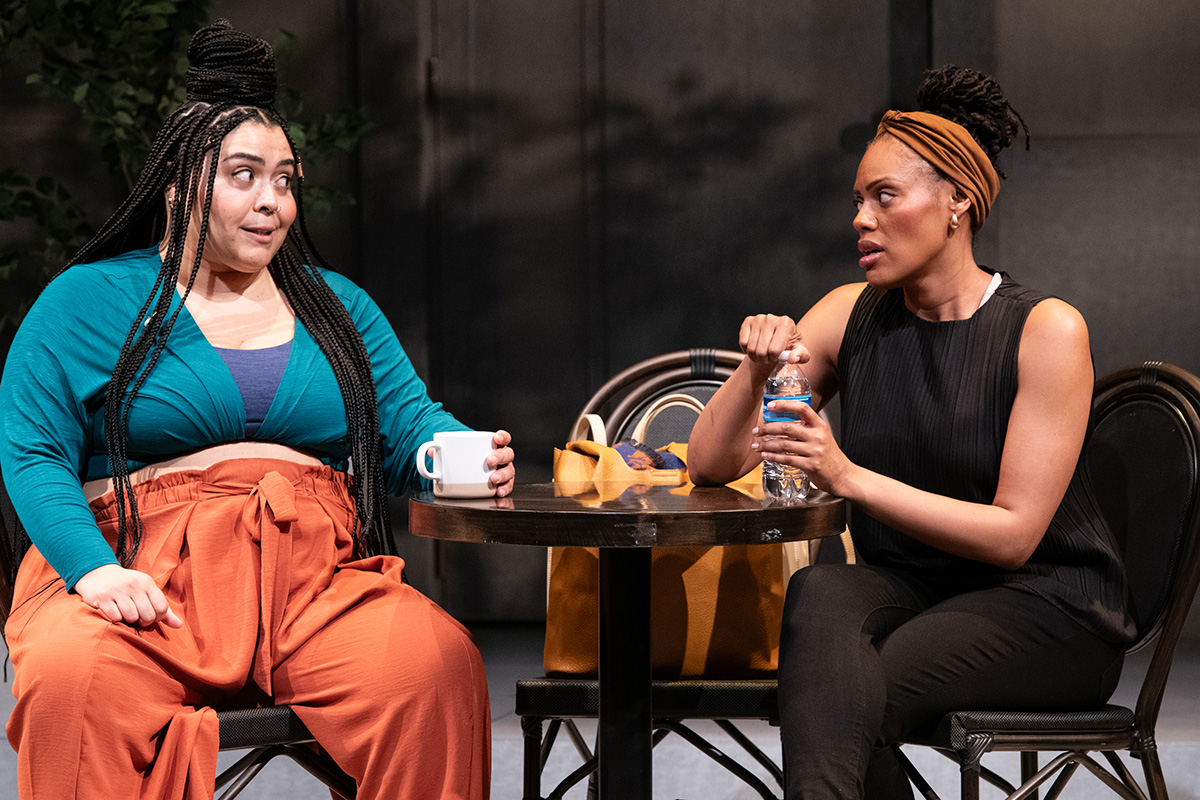
This increasingly uncomfortable set-to is interrupted by Leslie’s wisecracking best friend and roommate Miriam who has a knack for making things worse before making them better. Deliciously played by Cristina Pitter (whose program bio describes them as “a queer multi-spirit Afro-indigenous artist, abolitionist, and alchemist”), Miriam is the perfect third character in Craig-Galván’s deftly balanced three-hander.
Cast members’ performances are layered. Salter’s Leslie is all charm, practicality, and controlled ambition, and Gavigan’s Andrew is an organic amalgam of vulnerable, goofy, and menacing. He’s terrific.
The 90-minute dramedy isn’t without some improbable narrative turns, but fortunately they lead to some interesting places where provoking questions are representation, entitlement, what constitutes plagiarism, etc. It’s all discussion-worthy topics, here pleasingly tempered with humor.
New York-based director Jade King Carroll skillfully helms the production. Scenes transition smoothly in large part due to a top-notch design team. Scenic designer Meghan Raham’s revolving set seamlessly goes from Leslie’s attractive apartment to smart cafes to an HBO writers’ room with the requisite long table and essential white board. Adding to the graceful storytelling are sound and lighting design by Michael Keck and Amith Chandrashaker, respectively.
The passage of time and circumstances are perceptively reflected in costume designer Moyenda Kulemeka’s sartorial choices: heels rise higher, baseball caps are doffed and jackets donned.
“A Jumping-Off Point” is the centerpiece of the third National Capital New Play Festival, an annual event celebrating new work by some of the country’s leading playwrights and newer voices.
Theater
‘Amm(i)gone’ explores family, queerness, and faith
A ‘fully autobiographical’ work from out artist Adil Mansoor

‘Amm(i)gone’
Thorough May 12
Woolly Mammoth Theatre
641 D St., N.W.
$60-$70
Woollymammoth.net
“Fully and utterly autobiographical.” That’s how Adil Mansoor describes “Amm(i)gone,” his one-man work currently playing at Woolly Mammoth Theatre.
Both created and performed by out artist Mansoor, it’s his story about inviting his Pakistani mother to translate Sophocles’s Greek tragedy “Antigone” into Urdu. Throughout the journey, there’s an exploration of family, queerness, and faith,as well as references to teachings from the Quran, and audio conversations with his Muslim mother.
Mansoor, 38, grew up in the suburbs of Chicago and is now based in Pittsburgh where he’s a busy theater maker. He’s also the founding member of Pittsburgh’s Hatch Arts Collective and the former artistic director of Dreams of Hope, an LGBTQ youth arts organization.
WASHINGTON BLADE: What spurred you to create “Amm(i)gone”?
ADIL MANSOOR: I was reading a translation of “Antigone” a few years back and found myself emotionally overwhelmed. A Theban princess buries her brother knowing it will cost her, her own life. It’s about a person for whom all aspirations are in the afterlife. And what does that do to the living when all of your hopes and dreams have to be reserved for the afterlife?
I found grant funding to pay my mom to do the translation. I wanted to engage in learning. I wanted to share theater but especially this ancient tragedy. My mother appreciated the characters were struggling between loving one another and their beliefs.
BLADE: Are you more director than actor?
MANSOOR: I’m primarily a director with an MFA in directing from Carnegie Mellon. I wrote, directed, and performed in this show, and had been working on it for four years. I’ve done different versions including Zoom. Woolly’s is a new production with the same team who’ve been involved since the beginning.
I love solo performance. I’ve produced and now teach solo performance and believe in its power. And I definitely lean toward “performance” and I haven’t “acted” since I was in college. I feel good on stage. I was a tour guide and do a lot of public speaking. I enjoy the attention.
BLADE: Describe your mom.
MANSOOR: My mom is a wonderfully devout Muslim, single mother, social worker who discovered my queerness on Google. And she prays for me.
She and I are similar, the way we look at things, the way we laugh. But different too. And those are among the questions I ask in this show. Our relationship is both beautiful and complicated.
BLADE: So, you weren’t exactly hiding your sexuality?
MANSOOR: In my mid-20s, I took time to talk with friends about our being queer with relation to our careers. My sexuality is essential to the work. As the artistic director at Dreams of Hope, part of the work was to model what it means to be public. If I’m in a room with queer and trans teenagers, part of what I’m doing is modeling queer adulthood. The way they see me in the world is part of what I’m putting out there. And I want that to be expansive and full.
So much of my work involves fundraising and being a face in schools. Being out is about making safe space for queer young folks.
BLADE: Have you encountered much Islamophobia?
MANSOOR: When 9/11 happened, I was a sophomore in high school, so yes. I faced a lot then and now. I’ve been egged on the street in the last four months. I see it in the classroom. It shows up in all sorts of ways.
BLADE: What prompted you to lead your creative life in Pittsburgh?
MANSOOR: I’ve been here for 14 years. I breathe with ease in Pittsburgh. The hills and the valleys and the rust of the city do something to me. It’s beautiful, it’ affordable, and there is support for local artists. There’s a lot of opportunity.
Still, the plan was to move to New York in September of 2020 but that was cancelled. Then the pandemic showed me that I could live in Pittsburgh and still have a nationally viable career.
BLADE: What are you trying to achieve with “Amm(i)gone”?
MANSOOR: What I’m sharing in the show is so very specific but I hear people from other backgrounds say I totally see my mom in that. My partner is Catholic and we share so much in relation to this.
I hope the work is embracing the fullness of queerness and how means so many things. And I hope the show makes audiences want to call their parents or squeeze their partners.

Tel Aviv authorities cancel Pride parade

EXCLUSIVE: White House Press Secretary Karine Jean-Pierre on speaking out and showing up

Vladimir Putin takes office for fifth term as Russia’s president

Billy Porter, Keke Palmer, Ava Max to perform at Capital Pride

Center for Black Equity announces leadership change

PHOTOS: Taste of Point

US Census Bureau testing survey on LGBTQ households

PHOTOS: Gay Day at the Zoo

Trone discusses transgender niece