Local
GOProud head attacked in anti-gay assault
LaSalvia, attacked near Union Station, critical of hate crimes laws; GLLU pager unanswered
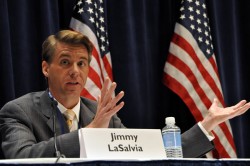
'Why did we spend so much political capital for the federal hate crimes law …still does nothing to prevent hate crimes,’ said GOProud’s Jimmy LaSalvia. (Blade file photo by Michael Key)
The head of the conservative gay Republican group GOProud was attacked on a secluded street behind Union Station while riding home from work on his bicycle on July 15 by a male teenager who called him a “faggot.”
Jimmy LaSalvia, GOProud’s executive director, said the unidentified youth punched him in the chest about 8:30 p.m. as he rode past the youth and six or seven other male teenagers who were with the person that struck him on 2nd Street, N.E. just north of L Street.
“I was on my bike when I approached them,” LaSalvia told the Blade in an e-mail. “Just as I got up to them, the assailant lunged off the sidewalk toward me on the street and delivered a punch across my chest. The momentum of my bicycling driving me into his fist and arm caused a shocking pain like I’ve never felt before,” he said.
“Just as I began to realize what was happening, I heard it. The words are still ringing in my ears as I write this today – ‘F____ faggot!’ LaSalvia said in his e-mail. “It was clear to me in that moment that my sexual orientation had motivated this attack.”
LaSalvia said that after barely catching himself from falling to the ground, he reached into his backpack for his cell phone, with the thought of calling the police. That action prompted one of the teenagers accompanying the attacker to say, “Does he have a gun?” LaSalvia told the Blade.
The attacker and a few of the others with him “puffed up their chests and were clearly ready to continue the attack,” he said. But seconds later, the group fled the scene after he kept his hand inside his backpack, “allowing them to wonder if I was reaching for a gun.”
He said he then rode home and called the police non-emergency number. A receptionist taking the call instructed him to call 911, saying an officer would come to his house to take a report. But LaSalvia said he didn’t feel it necessary to take up police time for what was no longer an emergency. He said he chose instead to wait until morning to file a police report.
According to LaSalvia, on Saturday morning, July 16, he went to the headquarters office of the police Gay & Lesbian Liaison Unit, which is located in the Sun Trust Bank building on Dupont Circle. Upon his arrival, no one answered the doorbell, said LaSalvia, even though he noticed people were inside the office. He said a sign on the door advised visitors to call the GLLU’s pager number, which he did, he said. However, as of Monday morning, no one from the GLLU returned his message.
Sgt. Carlos Mejia, the GLLU’s supervisor, told the Blade on Monday that the unit is phasing out the pager number, which he said is part of an “antiquated” system that sometimes malfunctions. Mejia said the GLLU and the police department have distributed literature and public notices advising citizens to contact the unit on its new 24-hour smart phone number of 202-506-0714.
LaSalia, in a phone interview, said he later reached the GLLU and that one of its members, Sgt. Joe Morquecho, interviewed him about the incident and made a report that lists the incident as a hate crime.
“He gave me the name of the detective handling the case and I was just contacted by a victims’ services representative,” LaSalvia said. “So the police department’s been very good to follow up with me and talk to me about this.”
LaSalvia informed friends about the attack in a message on his Facebook page.
Mejia said the GLLU office is not staffed 24 hours a day. One police source said civilian volunteers sometimes work in the office when the officers are out in the field. The volunteers are instructed not to answer the door since they are not trained to work directly with the public, the source said.
“I realize now that this is something that should be reported,” LaSalvia said.
LaSalvia described his attacker as a black male appearing about 17 or 18 years old, about 5 feet 11 inches tall, and weighing about 145 pounds. He said the attacker was wearing gym shorts and had his shirt off, exposing a slim but “muscular” build. LaSalvia said the attacker had a medium skin complexion and “very short hair – almost like a shaved head.”
GOProud describes itself on its website as an organization representing “gay conservatives and their allies…committed to a traditional conservative agenda that emphasizes limited government, individual liberty, free markets and a confident foreign policy.”
Although D.C. police have listed the assault against him as a hate crime, LaSalvia acknowledged that he and GOProud have emerged as critics of the federal and state hate crimes laws.
“We do not oppose hate crimes laws but I happen to think they’re a waste of time because they don’t do anything to prevent violent crimes from occurring and they have outlasted their usefulness,” he said.
According to LaSalvia, hate crimes laws would have been useful in the past, when state and federal law enforcement officials often did not prosecute crimes targeting gays and other minorities such as blacks. He said those days are all but gone, and authorities now routinely prosecute crimes against gays and other groups, even if they are not officially classified as hate crimes in states that don’t have hate crimes laws.
The Obama administration and a coalition of Democratic and Republican members of Congress that voted to pass the Matthew Shepard Hate Crime Prevention Act in 2009 said the law could act as a deterrent to hate crimes by drawing attention to such crimes and building strong opposition to hate violence in society.
Activists supporting the federal hate crimes law also noted that it includes protections for transgender people. Activists said the transgender community, along with gays and lesbians, could now rely on the federal government to prosecute anti-LGBT hate crimes if a state or local law enforcement agency declines to prosecute such crimes against them.
LaSalvia said he is aware that D.C.’s hate crimes law, as well as similar laws in other states, allow judges to hand down a stricter sentence to criminals convicted of committing a hate crime.
“My argument is I’m fine with that but it didn’t do anything to deter him from doing it,” he said of the youth who attacked him. “And that’s my whole point about why did we spend so much political capital for [the federal hate crimes law] when, OK, it’s retribution, but it still does nothing to prevent hate crimes.”

Virginia
Fellow lawmakers praise Adam Ebbin after Va. Senate farewell address
Gay state senator to take job in Spanberger administration
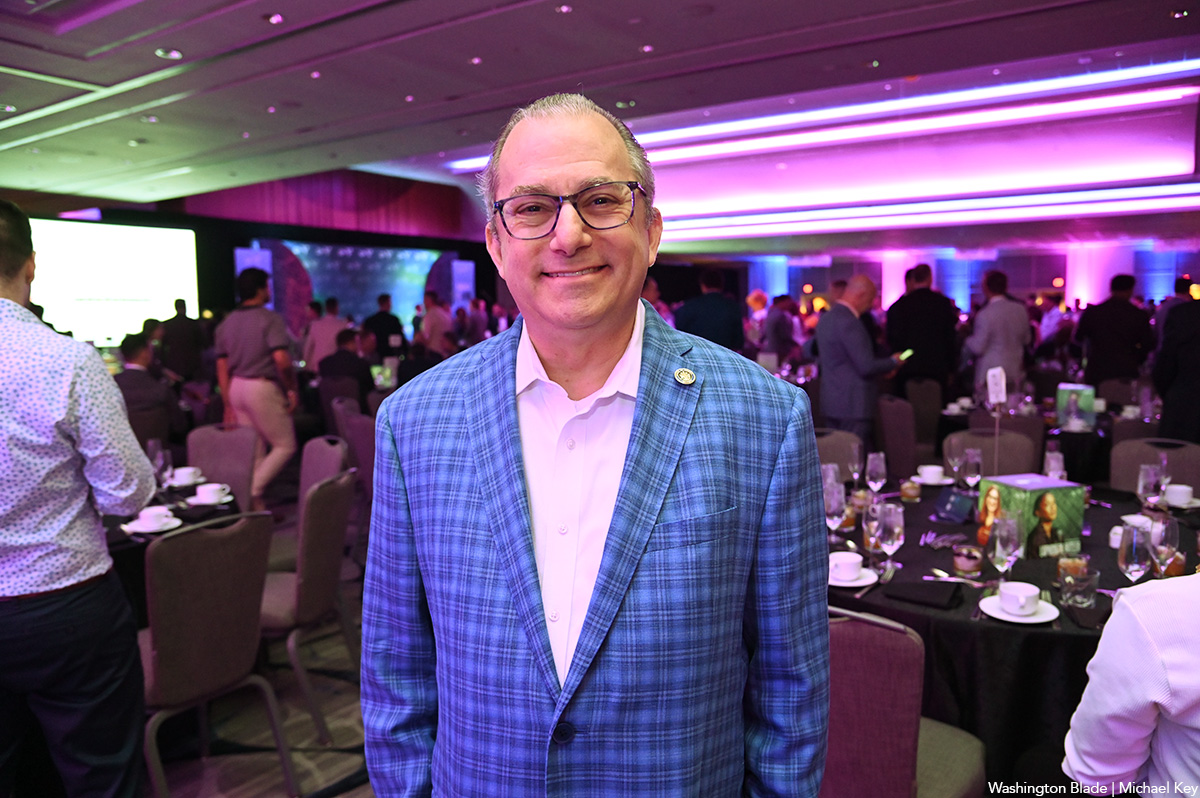
Gay Virginia state Sen. Adam Ebbin (D-Alexandria) delivered his farewell address on Feb. 16 in the Senate chamber in Richmond following his decision to resign from his role as a lawmaker to take a position as senior advisor to Democratic Gov. Abigail Spanberger.
Ebbin, whose resignation was to take effect Feb. 18, received a standing ovation from his fellow senators. Several of them spoke after Ebbin’s address to praise him for his service in the Virginia Senate from 2012 to 2026.
Ebbin first won election to the Virginia House of Delegates in 2003 as the first openly gay member of the General Assembly. He served in the House of Delegates from 2004 to 2012 before winning election to the Senate in 2011.
His Senate district includes Alexandria and parts of Arlington and Fairfax Counties.
“Serving in this body has been the greatest honor of my life,” Ebbin said in his farewell address. “Representing Northern Virginia in the General Assembly — my adopted home since 1989 — has been a responsibility I never took lightly,” he said.
“We are a 406-year-old institution,” he told his fellow lawmakers. “But, when I arrived, I had the distinct honor of being a ‘first’ in the General Assembly,” he said. “Being an openly gay elected official 22 years ago didn’t earn you book deals or talk show appearances — just a seat in a deep minority across the hall.”
Ebbin added, “Still, being out was a fact that felt both deeply personal and unavoidably public. I was proud, but I was also very aware that simply being here carried a responsibility larger than myself.”
Ebbin has been credited with playing a lead role in advocating for LGBTQ rights in the General Assembly as well as speaking out against anti-LGBTQ proposals that have surfaced during his tenure in the legislature.
In his speech he also pointed to other issues he has championed as a lawmaker; including strengthening education programs, expanding access to healthcare, safeguarding the environment, and legislation to help “stand up for working people.”
Among the LGBTQ rights legislation he pushed and mentioned in his speech was the Virginia Values Act of 2020, which bans discrimination based on sexual orientation and gender identity, among other categories.
“I’m particularly proud of our work ensuring Virginia modernized state law to protect LGBT people from discrimination in their daily lives, including in employment, housing, and public accommodations,” he said in his speech. “The Virginia Values Act of 2020 — my proudest achievement — established new protections for all Virginians,” he said.
“This law, the first of its kind in the South, passed with strong bipartisan support,” he stated. “And now — this November — after 20 years, Virginians will finally be able to vote on the Marriage Equality Amendment, which will protect the ability to marry who you love. It’s time for our state constitution to accurately reflect the law of the land.”
He was referring to a proposed state constitutional amendment approved by the General Assembly, but which must now go before voters in a referendum, to repeal a constitutional amendment approved by the legislators and voters in 2006 that bans same-sex marriage.
The U.S. Supreme Court’s Obergefell ruling legalizing same-sex marriage nationwide voided the Virginia same-sex marriage ban. But Ebbin and LGBTQ rights advocates have called on the General Assembly to take action to repeal the amendment in case the Supreme Court changes its ruling on the issue.
In his new job in the Spanberger administration Ebbin will become a senior advisor at the Virginia Cannabis Control Authority, which regulates policies regarding marijuana possession and distribution.
Ebbin was among the lead sponsors of legislation in 2020 to decriminalize possession of marijuana and of current pending legislation calling for legalizing possession.
“When I first entered the General Assembly, I saw too many lives upended by a simple marijuana charge — jobs lost, futures delayed, families hurt,” he said in his speech. “And for far too long, that harm was baked into our laws. That is no longer the case. The times have changed and so have our laws.”
Ebbin said he was also proud to have played some role in the changes in Virginia that now enable LGBTQ Virginians to serve in all levels of the state government “openly, authentically, and unapologetically.”
“I swore to myself that I wouldn’t leave until there was at least one more lesbian or gay General Assembly member,” Ebbin said in his speech. “But when I leave, I’m proud to say we will have an 8-member LGBTQ caucus.”
And he added, “And if anyone on the other side of the aisle wants to come out, you will be more than welcome — we’re still waiting on that first openly gay Republican.”
District of Columbia
Deon Jones speaks about D.C. Department of Corrections bias lawsuit settlement
Gay former corrections officer says harassment, discrimination began in 1993
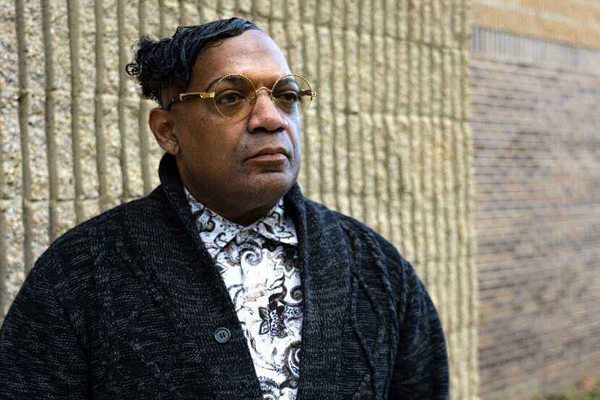
Deon Jones says he is pleased with the outcome of his anti-gay bias lawsuit against the D.C. Department of Corrections that ended after five years on Feb. 5 with the D.C. government paying him $500,000 in a settlement payment.
The lawsuit, filed on his behalf by the American Civil Liberties Union of D.C. and the international law firm WilmerHale, charged that Jones, a Department of Corrections sergeant, had been subjected to years of discrimination, retaliation, and a hostile work environment because of his identity as a gay man in clear violation of the D.C. Human Rights Act.
A statement released by the ACLU at the time the settlement was announced says Jones, “faced years of verbal abuse and harassment, from co-workers and incarcerated people alike, including anti-gay slurs, threats, and degrading treatment.”
The statement adds, “The prolonged mistreatment took a severe toll on Jones’s mental health, and he experienced depression, post-traumatic-stress disorder, and 15 anxiety attacks in 2021 alone.:
Jones said the harassment and mistreatment he encountered began in 1993, one year after he first began work at the Department of Corrections and continued for more than 25 years under six D.C. mayors, including current Mayor Muriel Bowser, who he says did not respond to his repeated pleas for help.
Each of those mayors, including Bowser, have been outspoken supporters of the LGBTQ community, but Jones says they did not intervene to change what he calls the homophobic “culture” at the Department of Corrections.
The Department of Corrections, through the Office of the D.C. Attorney General, which represents city agencies against lawsuits, and the mayor’s office, have so far declined to comment on the lawsuit and the half million-dollar settlement the city offered to Jones, who accepted it.
Among other things, the settlement agreement states that Jones would be required to resign from his job at the Department of Corrections. It also declares that “neither the parties’ agreement nor the District government’s offer to settle the case shall in any way be construed as an admission by the District that it or any of its current or former employees, acted wrongfully with respect to plaintiff or any other person, or that plaintiff has any rights.”
Scott Michelman, the D.C. ACLU’s legal director said that type of disclaimer is typical for parties that agree to settle a lawsuit like this. He said the city’s action to pay Jones a half million-dollar settlement “speaks louder than words.”
With that as a backdrop, Jones reflected on the settlement and what he says was his tumultuous 30-year career as an employee at the D.C. Department of Corrections in a Feb. 9 interview with the Washington Blade.
He and Michelman pointed out that Jones was placed on paid administrative leave in April 2022, one year after his lawsuit was filed. Among his upcoming plans, Jones told the Blade, is to publish a podcast that, among other things, will highlight the hardship he faced at the Department of Corrections and advocate for LGBTQ rights.
BLADE: What are your thoughts on this lawsuit settlement which appears very much in your favor?
JONES: That’s great. I’m happy. I’m glad to resign. It’s been a long time coming. It was the worst time it’s ever been. And I have advocated for the community for many, many years. And not only standing up for my rights but for the rights for others in the LGBTQ community.
And I’m just tired now. And my podcast will start soon. And I will continue to advocate for the community.
BLADE: Can you tell a little about that and when it will begin?
JONES: Once in April, once everything is closed my podcast will be starting. And that’s Deon’s Chronicle and Reveal. Yes, my own podcast.
BLADE: Since we have reported your attorney saying you have been on administrative leave since March of 2022, some in the community might be interested in what you have been doing since that time. Did you get another job or were you just waiting for this case to be resolved?
JONES: I was waiting for this to be resolved. I couldn’t work. That would violate policy and procedures of the D.C. government. So, I could not get another job or anything else.
BLADE: You have said under administrative leave you were still getting paid. You were still able to live off of that?
JONES: Yes, I was able to. Yes, sir. I used to do a lot of overtime. As a zone lieutenant for many years, I have supervised over 250 officers. I’ve also supervised over 25,000 inmates in my 30 years.
BLADE: How many years have you been working for the Department of Corrections?
JONES: It’s 30 years all together. I started down at the Lorton facility. Six facilities — I’ve worked for past directors, deputy directors, internal affairs. I’ve done it all.
BLADE: Do you have any plans now other than doing the podcast?
JONES: Well, to just do my podcast and also to write my book and my memoir inside of the house of pain, the house of shame — what I’ve been through. When I start my podcast off it will be stories — Part 1 through Part 4. And I will go back to the Lorton days all the way up to now. When it first started was sexual harassment and discrimination back down at Lorton. And I mean this has just been the worst time around.
BLADE: So, did you first start your work at the Lorton Prison?
JONES: Yes, I was at the central facility, which was the program institution.
MICHELMAN: Just for context. You may remember this, but the Lorton facility was where D.C. incarcerated people were held. So, that was part of the D.C. Department of Corrections.
BLADE: Yes, and that was located in Lorton, Va., is that right?
JONES: Right.
BLADE: Didn’t that close and is the main incarceration facility is now in D.C. itself?
JONES: Yes. And that closed in 2001.
BLADE: I see. And is the main D.C. jail now at a site near the RFK Stadium site?
JONES: Yes, sir. And next-door is the correctional treatment facility as well.
BLADE: So, are you saying the harassment and other mistreatment against you began back when you were working at the Lorton facility?
JONES: At the Lorton central facility. And they used to flash me too. When I say flash me like the residents, the inmates were flashing. And they [the employees] were flashing.
BLADE: What do you mean by flashing?
JONES: They take their penis out and everything else. I mean the sexual harassment was terrible. And I came out then down there. And I continued to advocate for myself and to advocate for other people who I was told were being picked on as well.
BLADE: As best you can recall, where and what year did that happen?
JONES: That was back in 1993 in April of 1993.
BLADE: The mayor’s office has declined to comment on the settlement and payment the city is giving you. Yet they have always said they have a strong policy of nondiscrimination protections for LGBTQ people in D.C. government agencies. But do you think that was not carried out at the Department of Corrections?
JONES: That’s a blatant reason why — I had 13 anxiety attacks. It was so blatant. Can you imagine? On the airwaves or the walkie-talkies — everybody had a walkie talkie — the captains and the majors and everything. And you transmit it to the command center or something like that. When you finish someone gets on the air and calls you a sissy or a fag.
They received so many complaints, and I also sent the mayor so many emails and begging for help. And they ignored it. They didn’t address any complaints at all. So, that’s bull.
BLADE: But now after you filed your lawsuit and you received this settlement do you think there will be changes there to protect the rights of other LGBTQ employees?
JONES: I hope so, because I have been defending community rights. For many years I have been advocating for different things and different services. And I’ve seen the treatment. There are a lot of mistreatments towards the community over there. And I have taken a stance for a lot of people in the community and protecting their constitutional rights as well as mine.
BLADE: What advice might you have for what the Department of Corrections should do to correct the situation that led to your lawsuit?
JONES: Well, what my advice for the department is they need to go back over their training. And they need to enforce rules against any acts of discrimination, retaliation, or sexual harassment. They need to enforce that. They’re not enforcing that at all. They’re not doing it at all. And this time it was worse than ever, then I’ve ever seen it. That you would get on the walkie talkie and someone would call you a fag or a sissy or whatever else or do evil things and everything. They are not enforcing what they are preaching. They are not enforcing that.
BLADE: Is there any kind of concluding comment you may want to make?
JONES: Well, I hope that this litigation will be a wakeup call for the department. And also, that it will give someone else the motivation to stand up for their rights. I was blessed to have the ACLU and WilmerHale to protect my constitutional rights. So, I am just really happy. So, I’m hoping that others will stand up for their rights. Because a lot of people in the community that worked there, they were actually afraid. And I had some people who actually quit because of the pressure.
Baltimore
‘Heated Rivalry’ fandom exposes LGBTQ divide in Baltimore
Hit show raises questions about identity, cultural representation

By JOHN-JOHN WILLIAMS IV | “Heated Rivalry,” the surprise gay hockey romance that has captivated global audiences and become a cultural phenomenon, has inspired sold-out parties celebrating the characters from the steamy series, including in Baltimore.
For some, love of the show has exposed the loss of a once-vibrant gay nightlife in Charm City and splintered its LGBTQ community. It also brings up layered questions about identity, cultural representation, and the limits of identity politics.
In Baltimore, the majority of the parties also appear to be missing a key ingredient that has been a part of the show’s success: gay men at the helm. Last month, women hosted a dance party at Ottobar, a straight establishment.
The rest of this article can be read on the Baltimore Banner’s website.

4th Circuit rules against discharged service members with HIV

PHOTOS: Clash

Gay Treasury Secretary’s silence on LGBTQ issues shows he is scum

Lawsuit to restore Stonewall Pride flag filed

EXCLUSIVE: Markey says transgender rights fight is ‘next frontier’

Four bisexual women on stereotypes, erasure, representation, and joy

Magic is happening for Round House’s out stage manager

‘Heated Rivalry’ fandom exposes LGBTQ divide in Baltimore

Home is where the heart is