Opinions
Proposed rules a good start, but some could threaten D.C. food trucks
Mobile kitchens should be treated like brick-and-mortar restaurants
By Ché Ruddell-Tabisola
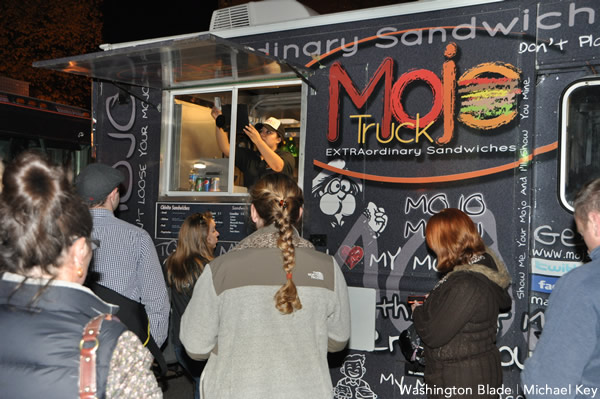
Hungry patrons wait in line outside a popular Washington food truck. (Washington Blade file photo by Michael Key)
Many thanks to Mark Lee for raising the issue and to the Washington Blade for providing a forum to discuss something near to the hearts of many Washington, D.C., residents and workers: Their food trucks.
On Jan. 20, Mayor Vincent Gray proposed new food truck regulations, which were the result of the work of the District’s Department of Consumer and Regulatory Affairs (DCRA). The Washington, D.C. Food Trucks Association is grateful to Mayor Gray for his leadership in proposing new food truck regulations, which are badly outdated. Under current rules food trucks can be fined and/or shut down by police if we do not have a line of waiting customers. It is a policy that every day threatens the sustainability of our small businesses.
The proposed new food truck rules would remedy this problem. Overall, the proposed new rules are a significant improvement over current regulations, which is why the D.C. Food Trucks Association supports Mayor Gray’s proposal and is asking our fans and followers to support them too.
However, the proposed new rules also contain regulations that will continue to threaten our new and innovative small businesses. The proposed regulations would require dessert trucks to go no longer than 10 minutes without a line of waiting customers before risking being fined or closed by police. The D.C. Food Trucks Association believes dessert trucks should be treated the same as savory trucks. The proposed new rules would require food trucks to close at 10 p.m. on weekdays and 1 a.m. on weekends. We believe food trucks should be allowed to operate the same hours as brick-and-mortar restaurants. The new regulations also propose to create Vending Development Zones. We’re concerned that these zones could be manipulated to create “Food Truck-Free Zones.”
Lee raises a number of concerns about food truck regulations in his Feb. 10 op-ed. The D.C. Food Trucks Association believes that food truck rules should be made in the interest of public health and safety, and we currently follow a number of rules with that purpose.
Food trucks must meet the same health and safety requirements as brick-and-mortar restaurants. For example, food truck operators must be certified food protection managers in order to become a licensed vendor, and our mobile kitchens are inspected by the Department of Health twice a year (which is twice as often as brick-and-mortar restaurants). In addition to our mobile kitchens, food trucks must also maintain a brick-and-mortar commercial kitchen where we store and prepare food and that is also regularly inspected by the Department of Health.
Lee raises concerns about taxes paid by food truck operators. To clarify, food truck operators pay the same taxes as other District street vendors as well as payroll taxes, motor vehicle fees and District corporate/unincorporated business franchise taxes. Food truck operators whose brick-and-mortar kitchens are under triple net leases additionally pay the associated property taxes for those kitchens.
Lee also minimizes the threats that D.C. food trucks face. The truth is that D.C. food trucks continue to operate in an uneasy regulatory and political climate. Lee’s own comments are testament to that. One only needs to read comments sent to DCRA in 2010 in response to an earlier version of proposed new food truck rules to see evidence that D.C.’s food trucks are being assailed by draconian proposals not offered in the interest of public health but whose intent is to limit competition. Comments made at that time called for everything from implementing distance rules that effectively banned food trucks downtown, forcing food trucks to move every 30 minutes and asserting that food trucks were altogether illegal.
The heart of the current issue, and what the proposed new food truck regulations address, is that fining and/or closing a food truck because it does not have a line of waiting customers is wrong. A government rule that requires any business to have a sales floor, dining room or waiting queue of customers – or else face the prospect of being shut down by police – makes no sense, limits consumer choice and eliminates fair competition in the market place, which is bad policy for all businesses, not just food trucks. After all, in a free market, isn’t it the customer who decides and who goes?
The District is collecting comments about the new proposed regulations until March 1.
You can read the new proposed regulations at http://dcra.dc.gov/DC/DCRA/News%20Room/DC_Register_Proposed_Vending_Regulations_01.20.12.pdf and submit your comments to [email protected].
Ché Ruddell-Tabisola is executive director of the Washington, D.C. Food Trucks Association and co-owner of the BBQ Bus. Reach him via bbqbusdc.com.
Opinions
USAID’s demise: America’s global betrayal of trust with LGBTQ people
Trump-Vance administration dismantled agency after taking office
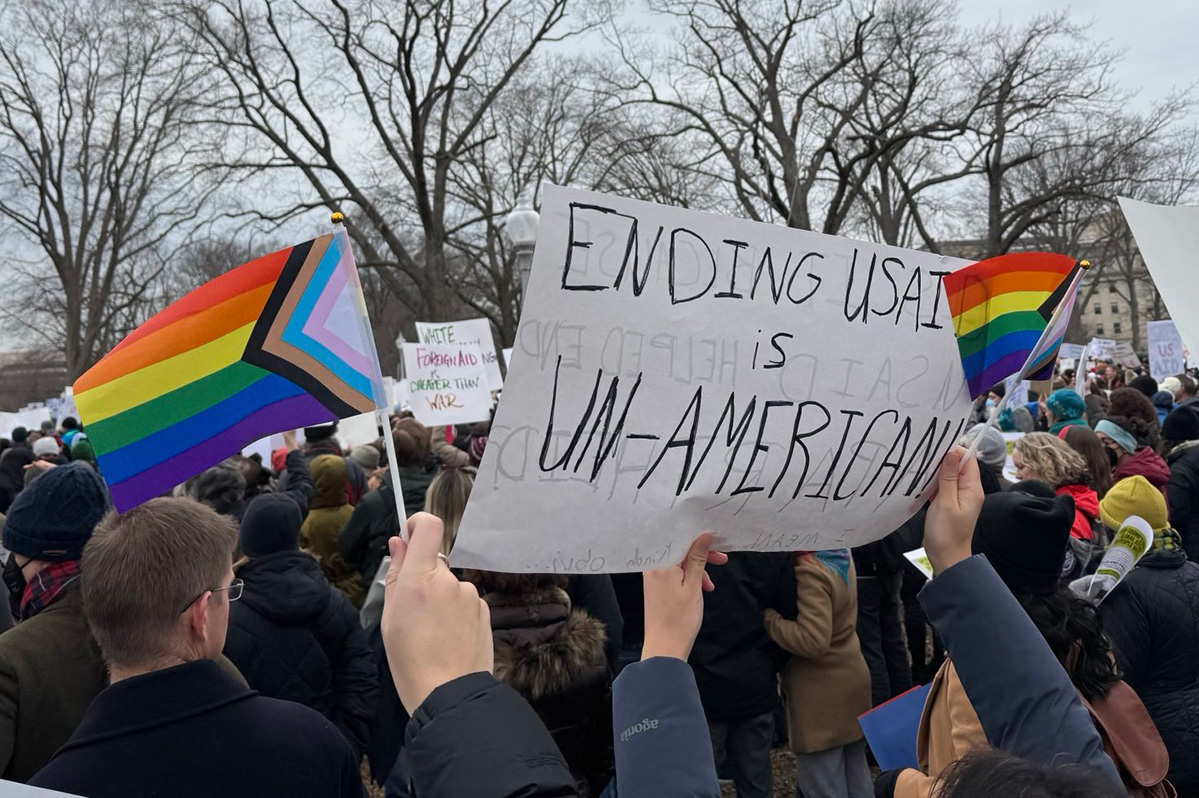
The U.S. Agency for International Development — proudly my institutional home for several years of my international development career and an American institutional global fixture since November 1961 — is no more.
How will USAID’s closure impact LGBTQI+ people around the world, especially in poor, struggling countries (“the Global South”)? Time will tell, but “dire,” “appalling,” and “shameful” are appropriate adjectives, given the massive increase in HIV/AIDS deaths that follow the callous, abrupt, and unspeakably cruel cut-off of funding for USAID’s health and humanitarian programming in HIV/AIDS prevention, treatment, and care.
Regarding LGBTQI+ people and issues, USAID worked in a tough neighborhood. In Africa alone, more than 30 countries in which USAID had programming still criminalize same-sex relationships, often to the point of imposing the death penalty. These fiercely anti-LGBTQI+ countries share harsh anti-LGBTQI+ punishments with most countries in the Middle East and North Africa. Other countries where USAID formerly worked retain colonial-era sodomy laws.
Where did USAID fit into all this turbulence? The agency was not allowed to transgress local laws, so how could it support the human rights of local LGBTQI+ people? USAID did so by building close and trusting relationships with local LGBTQI+ civil society, and by “superpower advocacy” for the universal human rights of all people, including those of us in the queer community.
I served at USAID’s Africa Bureau under the Obama administration, becoming the only openly transgender political appointee in USAID’s history. In that role, I was privileged to have a platform that caught the astounded attention of both queer people and of anti-LGBTQI+ governments around the world. If the president of the United States can elevate a transgender woman to such a senior position within the U.S. government, that open declaration of acceptance, inclusion, worth, and recognition set a precedent that many in the LGBTQI+ community worldwide hoped their countries would emulate.
Serving as an openly queer person at USAID also afforded me the opportunity to meet with many fiercely anti-LGBTQI+ senior politicians and government officials from African countries who sought USAID funding. Uganda’s first woman speaker of the parliament, Rebecca Alitwala Kadaga and her whole delegation came to see me at USAID in Washington about such funding. I had some very frank (and USAID-approved) “talking points” to share with her and her team about President Obama’s strong and secular commitment to equal human rights for all people. My tense meeting with her was also an opportunity to educate her as to the nature of the transgender, nonbinary, and intersex community — we who are simply classified and discriminated against as “gay” people in Uganda and in most countries in the Global South. I also had the chance to represent USAID in the “inter-agency” LGBTQI+ human rights task team led by openly gay U.S. Ambassador David Pressman, whose effective leadership of that Obama-era initiative was inspirational.
Working closely with professional, capable, and caring USAID career employees such as Ajit Joshi and Anthony Cotton, and with the strong and open support of the USAID Deputy Administrator Don Steinberg, I helped to craft and promote USAID’s very first LGBTQI+ policy. Under President Obama, USAID also created the LGBT Global Development Partnership, a public-private partnership supporting LGBTQI+ civil society groups throughout the Global South. USAID funding also increased for programs promoting LGBTQI+ inclusion, anti-violence, and relevant human rights protections. This programming expanded further (albeit never adequately funded) during the Biden administration under the able leadership of USAID Senior LGBTQI+ Coordinator Jay Gilliam and his team.
So what did it all mean? Has USAID left a footprint for the global LGBTQI+ community? Will its absence matter?
In my view, that answer is an emphatic yes. International development and humanitarian response go to the heart of recognizing, respecting, and caring about universal human dignity. USAID converted those ethical commitments into tangible and meaningful action, again and again, and modelled for the world what it means to truly include all persons.
My time serving at USAID was a high point of my career, being surrounded by the best of American civil servants and foreign service officers. For me, “USAID Forever” remains my battle cry. Let’s start thinking of how we will rebuild it, beginning in three years.
Chloe Schwenke is a professor at Georgetown University’s McCourt School of Public Policy.
Opinions
Community comes together to repair WorldPride history exhibition
Vandals damaged pictures, timeline walls on June 22
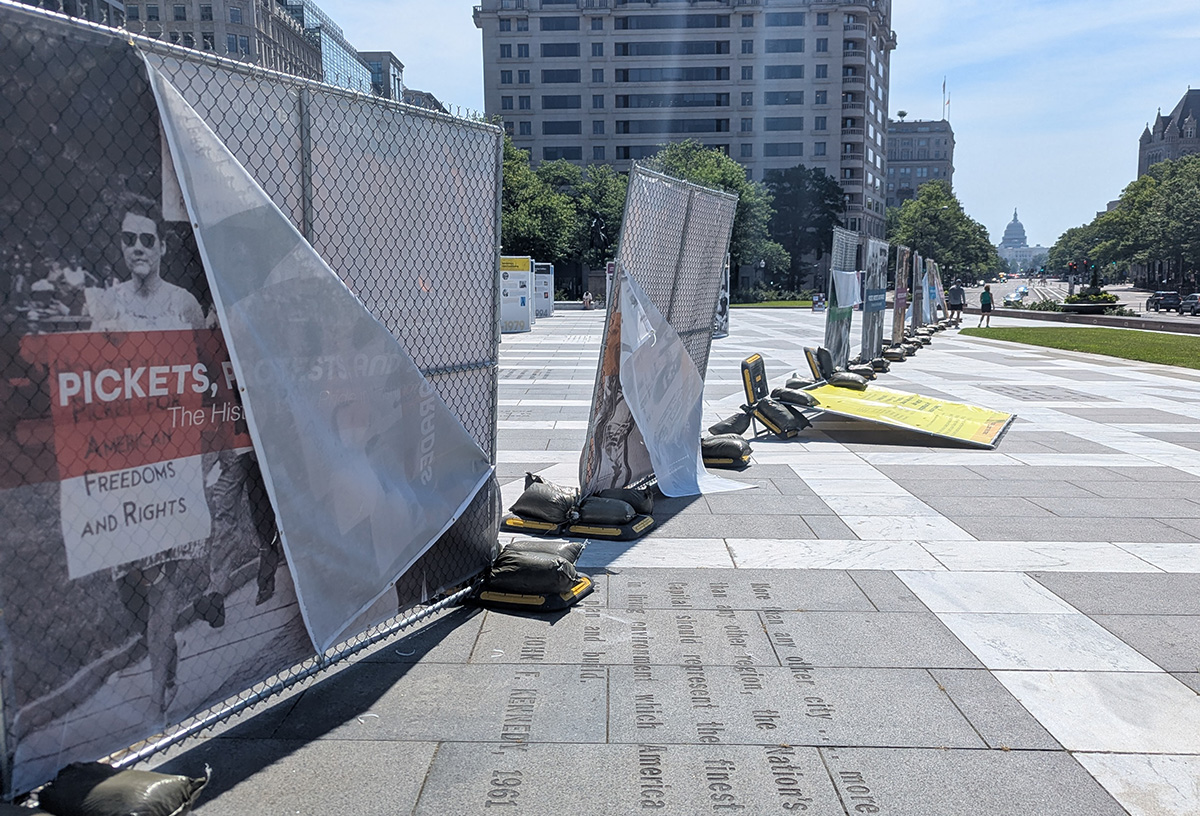
Earlier this month, vandals shouting homophobic slurs damaged the 8-foot hero cubes and timeline walls of the Rainbow History Project’s (RHP) WorldPride exhibition “Pickets, Protests, and Parades: The History of Gay Pride in Washington.” The week’s incident was the fifth homophobic attack on the exhibition chronicling DC’s LGBTQ+ History, the vandalism damage was only made worse by the storms this past week.
In response, RHP posted a call online for volunteers and donations and over a dozen volunteers showed up on Saturday to repair the exhibition in its final stretch.
It took three hours, but the group assembled during a heat advisory to bend the fences back into place, fix the cubes and zip tie all the materials together to keep them safe. Some of those who came out to volunteer, Slatt said, were known RHP volunteers but most were total strangers who had attended an event here or there or just wanted to get involved for the first time, one was even in D.C. as an out-of-town guest and after seeing the Instagram call, decided to spend their day lifting some heavy fencing back into place.
When asked why they showed up, volunteer Abbey said: “especially during Pride month, it’s so important to come together as a community, not just to celebrate, but to support each other. To know that this historic exhibit is even able to exist right now under this administration is really amazing. The fact that we’re just able to help continue it in its last leg of being out here is really important.”
“Rainbow History Project does a lot of work for the community,” another volunteer Ellie said, “they show up in a lot of ways that I think we really need right now, so in terms of being asked to come out and do a couple hours of lifting, that is something that we can easily support and do.”
“We put out a call asking for support from the community, and so we didn’t know what we’d get,” Slatt continued, “but strangers have shown up. We were upset, we were crying. We were trying to come up with a battle plan and more and more people have shown up with open arms and empty hands to do this. It’s 95 degrees, we are melting in the heat. It’s just amazing the number of people who have come here.”
If anything, the anonymous exhibit designer said, the people who vandalized the exhibit made the community stronger and mobilized members passionate about preserving and sharing our histories. Their efforts backfired in a big way — bringing together people who had only attended one or two RHP events or had read about the organization online to actively contribute to the work.
It’s a meaningful representation of the history of D.C.’s LGBTQ+ community, one that often starts with a small group of people who come together to protest but soon mobilize their communities and enact monumental change in the nation’s capital.
“If Pride in D.C. started with 10 people picketing the White House,” Slatt remarked, “you just got 12 more to join the gay history movement.”
This was especially poignant, another volunteer Mattie said, on the week that the Supreme Court issued a decision allowing Tennessee to ban puberty blockers and hormone therapy for minors seeking gender affirming care. It was a devastating moment for the LGBTQ+ community who mobilized once more in front of the Supreme Court this past Friday.
“It’s been actually really important to see this community come together in the face of direct attack on our history in the wake of direct attacks on our rights,” Mattie said, “and we stand up to that. We come together, and we represent. That is so important to maintaining our strength and our community throughout trying times now and ahead.”
When asked about how community members can support RHP’s work and repair the damage long-term to the exhibit, Slatt urged people to donate to RHP, to volunteer as exhibit monitors, and to come visit the exhibit.
“We’ve been doing this for 25 years. This is our 25th anniversary, and if it weren’t for volunteers donating their time and their talents, if it weren’t for small dollar donors, we would never have gotten anything done,” Slatt said. “I’d say to anyone out there that we are on this plaza all through Independence weekend, we are here through the Smithsonian Folklife Festival, people can come on down.”
Slatt and other volunteers will be leading tours each evening at 7 p.m. at Freedom Plaza, and people can pre-order the exhibition catalog right now, which will be delivered in time for LGBTQ+ History Month in October.
Emma Cieslik is a D.C.-based museum worker and public historian.
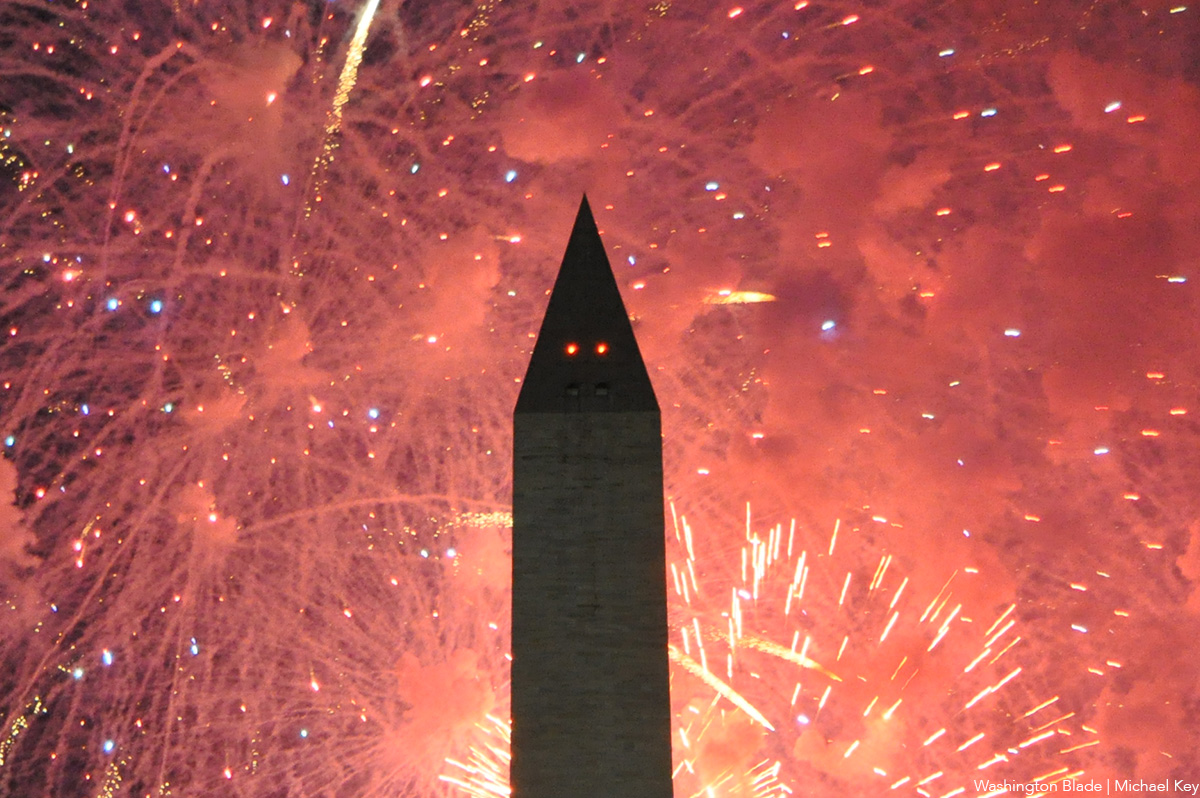
Independence Day, commonly known as the Fourth of July, is a federal holiday commemorating the ratification of the Declaration of Independence by the Second Continental Congress on July 4, 1776, establishing the United States of America. The delegates of the Second Continental Congress declared the 13 colonies are no longer subject (and subordinate) to the monarch of Britain, King George III and were now united, free, and independent states. The Congress voted to approve independence by passing the Lee resolution on July 2, and adopted the Declaration of Independence two days later, on July 4.
Today we have a felon in the White House, who wants to be a king, and doesn’t know what the Declaration of Independence means. Each day we see more erosion of what our country has fought to stand for over the years. We began with a country run by white men, where slavery was accepted, and where women weren’t included in our constitution, or allowed to vote. We have come far, and next year will celebrate 250 years. Slowly, but surely, we have moved forward. That is until Nov. 5, 2024, when the nation elected the felon who now sits in the Oval Office.
There are some who say they didn’t know what he would do when they voted for him. They are the ones who were either fooled, believing his lies, or just weren’t smart enough to read the blueprint which laid out what he would do, Project 2025. It is there for everyone to see. There should be no surprise at what he is doing to the country, and the world. Last Friday his Supreme Court, and yes, it is his, the three people he had confirmed in his first term, gave him permission to be the king he wants to be. The kind of king our Declaration of Independence said we were renouncing. A man who with the stroke of a pen can ruin thousands of lives, and change the course of America’s future. A man who has set back our country by decades, in just a few months.
So, I understand why many are suggesting there is nothing to celebrate this Fourth of July. How do we have parties, and fireworks, celebrating the 249th year of our independence when so many are being sidelined and harmed by the felon and his MAGA sycophants in the Congress, and on the Supreme Court. Yes, there are those celebrating all he is doing. Those who want to pretend transgender people don’t exist, and put their lives in danger; those who think it’s alright to take away a women’s right to control her body, and her healthcare; those who think parents should be able to interfere on a daily basis with their children’s schooling and wipe out the existence of gay people for them. Those who pretend there was a mandate in the last election, when it was only won by about 1 percent. Those who think disparaging veterans, firing them, and taking away their healthcare, is ok. Those in the LGBTQ community like Log Cabin Republicans, who think supporting a racist, sexist, homophobe is the right thing to do.
So, what do we, as decent caring people, do this Fourth of July. What do we say to those who are being harmed as we celebrate. What do we say to those trans people, those women, those immigrants who came here to escape their own dictators, and are now finding they have come to a country with its own would-be dictator. I say to them, please don’t give up on America. Don’t give up on the possibility decent loving people in our country will finally wake up and say, “enough.” That the majority of Americans will remember we fought a revolution to escape a king, and we fought a civil war to end slavery. That we moved forward and gave women the right to vote, and gave the LGBTQ community the right to marry. Don’t give up on the people that did all that, and think they won’t rise up again, and tell the felon, racist, homophobe, misogynist, found liable for sexual assault, now in the White House, and his sycophants in congress, and his cult, that we will take back our country in the 2026 midterm elections. That we will vote in large numbers, and demand our freedom from the tyranny that he is foisting on our country.
So yes, I will celebrate this Fourth of July not for what is happening in our country today, but rather for what our country actually stands for. Not for birthday parades, and abandonment of the heroes in Ukraine in support of dictators like Putin. But for the belief the decent people in our country will rise up and vote. That is what I will celebrate and pray for this Fourth of July. That is what I think the fireworks will mean this July Fourth. I refuse to accept defeat the same way our revolutionary soldiers wouldn’t, and the way our troops in the civil war wouldn’t till the confederacy was defeated.
I will celebrate this Fourth of July because I refuse to accept we will not defeat those who would destroy our beautiful country, and what it really stands for.
Peter Rosenstein is a longtime LGBTQ rights and Democratic Party activist.

UN Human Rights Council extends LGBTQ rights expert’s mandate

Maryland’s oldest rural gay bar — and one of the last — is a log cabin in the woods

USAID’s demise: America’s global betrayal of trust with LGBTQ people

Manchester is vibrant tapestry of culture, history, and Pride

Embracing the chaos can be part of the fun

Supreme Court to consider bans on trans athletes in school sports

Celebrate the Fourth of July the gay way!

Va. court allows conversion therapy despite law banning it

Doug Spearman takes his chance