National
Report: Anti-LGBT murders rose 11 percent in 2011
2011 saw the highest number of anti-LGBT murders since 1996, according to the National Coalition of Anti-Violence Project’s annual report
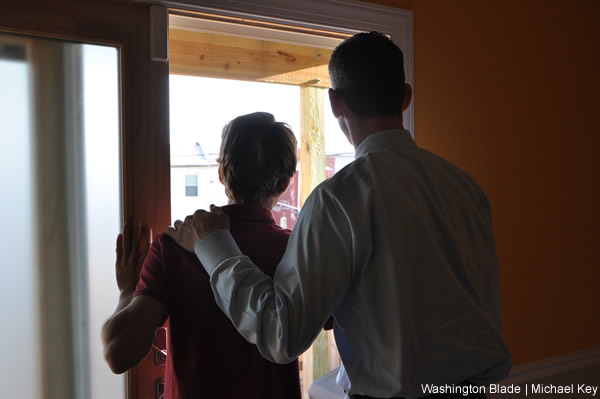
The victim of a brutal anti-gay attack underwent two surgeries in which his badly severed jaw was reattached with two permanent titanium plates. He spoke to the Blade this week on condition of anonymity. (Washington Blade photo by Michael Key)
The National Coalition of Anti-Violence Programs on Thursday reported that the number of anti-LGBT murders in 2011 rose 11 percent from the previous year.
The NCAVP’s annual report documents 30 anti-LGBT homicides across the county. While it showed that incidents of anti-LGBT hate violence decreased 16 percent from 2010, the number of anti-LGBT murders in 2011 is the highest that the agency has documented since it began to issue it began to issue its annual report in 1996.
“It’s definitely shocking to see the increase in the number of murders,” said Hassan Naveed, vice chair of Gays and Lesbians Opposing Violence in the District of Columbia.
NCAVP further noted that 87 percent of the 30 anti-LGBT homicide victims in 2011 were LGBT people of color—trans women comprised 40 percent of those who lost their lives to anti-LGBT bias-motivated crimes.
Anti-violence advocates maintain a lack of housing, employment and legal protections leave trans people particularly vulnerable to bias-motived crimes.
A 2011 National Center for Transgender Equality and National Gay and Lesbian Task Force survey found that nearly a fifth of respondents said they had been homeless at some point in their lives because of their gender identity and expression. The report further indicated that rates of unemployment among trans and gender non-conforming people are twice as high—and four times as high among trans people of color—than the national average. Sixty-three percent of survey respondents said they experienced what NCTE and the Task Force described as “a serious act of discrimination” in employment, education, the health and legal system and in other areas.
DeeDee Pearson was a trans black woman who was killed in Kansas City, Mo, last Christmas Eve. Her friend, Paige Dior, who said she has repeatedly experienced anti-trans violence herself, said Pearson “lived the street life” because she had nowhere else to go.
“Transgender people are normally rejected from their families, so we go out and create our own,” said Dior on an NCAVP conference call with reporters. “When DeeDee was killed on Christmas Eve; it was very, very devastating.”
Metropolitan Police Department statistics note that there were 43 reported bias-related crimes based on sexual orientation in the District of Columbia in 2011, compared to 35 in 2010. The MPD reported 11 anti-trans crimes in the District in 2011, compared to 10 in 2010.
Ejeris Dixon of the New York City Anti-Violence Project noted that the anti-LGBT bias-related crimes documented in the NCAVP report are only “the tip of the iceberg.” She and other anti-violence activists note that many victims remain afraid to report these attacks because of their immigration status or previous experience with law enforcement officials.
The D.C. Trans Coalition, GLOV, the Rainbow Response Coalition and other local anti-violence organizations have begun to lay the foundation for a system that would allow victims of anti-LGBT crimes to report attacks to service providers without going through the MPD. Naveed maintains this initiative would provide what he described as a far more accurate count of the number of anti-LGBT bias attacks in the city.
“The NCAVP report definitely does highlight the need of an inclusive and sensible reporting system for the LGBT community here in D.C.,” he said. “By allowing this system to come into use, we’re really going to see numbers closer to the truth here in D.C.”
Service providers in other cities have also implemented similar independent reporting mechanisms.
The Los Angeles district attorney’s office has recognized the Los Angeles Gay and Lesbian Community Center as a place where victims of anti-LGBT bias crimes can come forward. The agency is then able to bypass the police and directly report these incidents to local prosecutors.
“We have been pretty successful with law enforcement so that option has not been exercised a lot, but it does exist,” noted Jake Finney of the Los Angeles Gay and Lesbian Community Center.
Equality Michigan also offers victims of anti-LGBT crimes the option to report attacks through the Internet or their hotline. Nusrat Ventimiglia, the group’s director of victim services, told the Blade that her organization also works with the Ruth Ellis Center and other service providers in Detroit and across the state to reach those who remain disproportionately vulnerable to bias-related violence.
Back in California, the Los Angeles Police Department in April issued a set of guidelines designed to improve the way its officers treat trans Angelenos. These include the use of names and pronouns that are consistent with a person’s gender identity and expression and the creation of a separate housing unit for trans prisoners in city jails. The new regulations further prohibit officers from searching or frisking a person to determine their sex.
The LAPD has also adopted a policy that bars officers from asking about a person’s immigration status.
“We inform undocumented people that they can report crimes that happen against them,” said Finney. “Knowing your rights is really empowering for people.”




National
Lou Chibbaro Jr. documentary wins award from NLGJA
‘Lou’s Legacy’ produced by D.C.’s Mattachine Society

“Lou’s Legacy: a Reporter’s Life at the Washington Blade,” a documentary produced by The Mattachine Society of Washington, D.C., will receive an Excellence in Journalism Award from NLGJA, the Association of LGBTQ+ Journalists.
The film premiered on WETA PBS in D.C. and Maryland Public Television (MPT) in June of 2025. The documentary’s Emmy-nominated director and producer Patrick Sammon will accept the award for Excellence in Local Television on Sept. 11 at NLGJA’s National Convention in San Francisco.
“Lou’s Legacy” was produced in association with the Mattachine Society of Washington, D.C., a non-profit LGBTQ history society dedicated to conducting original archival research. Aside from Sammon, the NLGJA is recognizing other members of the film’s production team including Producer Julianne Donofrio, Editor Amir Jaffer, Executive Producer Charles Francis, and Executive Producer Pate Felts.
“Lou’s Legacy” tells the story of two D.C. icons — legendary Washington Blade reporter Lou Chibbaro Jr. and beloved drag performer Donnell Robinson, known to generations of Washington audiences as “Ella Fitzgerald.” Through Lou’s nearly five-decade career at the Blade and Ella’s return to the stage after a three-year hiatus following COVID, the 29-minute documentary explores the history of Washington’s LGBTQ community and today’s rising backlash against LGBTQ rights, including laws targeting drag performers.
“All students of journalism can learn a lot from the story of Lou Chibbaro, Jr. Lou has chronicled nearly five decades of LGBTQ+ life and the community’s struggle for equality in Washington, D.C. Lou’s work and the role of the queer press has been essential in covering stories the mainstream media would often ignore or erase,” said Ryan Levi, president of the D.C. chapter of the NLGJA.
“We are thrilled to receive this award from the NLGJA,” said the film’s director Patrick Sammon. “Lou Chibbaro’s nearly five decade career at the Washington Blade demonstrates the essential role LGBTQ journalism plays in telling our community’s stories and documenting its history. This recognition from journalists who follow in Lou’s footsteps is particularly meaningful to me and the rest of our production team.”
Arizona
Shooting outside gay bar in Ariz. leaves three dead
Tucson police investigating double murder-suicide as a hate crime
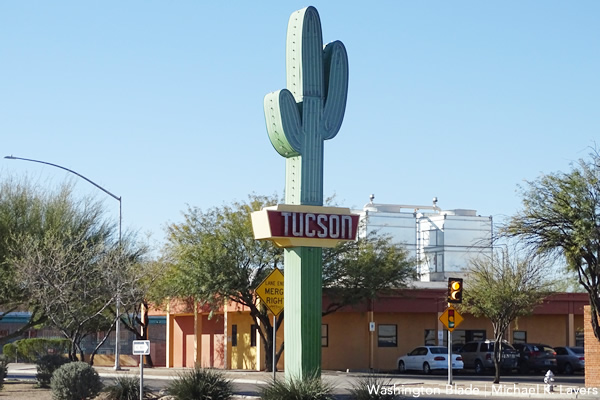
Three people were fatally shot outside a gay bar in Tucson, Ariz., early Monday morning, about a mile from the city’s nightlife district.
Police have said the shooting, which took place in the parking lot of Venture-N bar at 1239 N. 6th Ave., was likely a hate crime and a double murder-suicide following a verbal altercation.
The suspect, Ousman Ceesay, allegedly shot Vincent Anthony Siqueiros and Cameron Davis Capara while they were outside the club around 12:30 a.m. Monday.
Reports show Capara and Siqueiros were pronounced dead at the scene. Ceesay died after being taken to a local hospital with gunshot wounds.
Police have also said that Ceesay was carrying a list of LGBTQ businesses at the time of the shooting.
Arizona Public Media has said police are investigating the case as a hate crime because the suspect was carrying a note containing the names of multiple LGBTQ-associated businesses.
“I am deeply saddened that another senseless loss of life has happened in our community,” Tucson Police Chief Monica Prieto said in a statement. “Bias-based crimes are especially heinous and have no place in our community.”
According to Prieto, there is no imminent threat to the community, and the Tucson Police Department is working to provide extra protection to various LGBTQ businesses across town.
Congresswoman Adelita Grijalva, who represents the area, issued a statement condemning the act of violence, which appears to have been at least in part motivated by homophobia.
“I am disgusted and deeply saddened to learn of a targeted act of hate and the cold-blooded murder of two members of our LGBTQIA+ community, Vincent Siqueiros and Cameron Capara, at the Venture-N bar in Tucson last night. This horrific attack is a painful reminder that even in welcoming communities like Tucson, hate and violence against the LGBTQIA+ community still exist.”
“When that hate is combined with easy access to firearms, the consequences can be deadly. I am sick and tired of Congress refusing to lift a finger to protect our communities while, every day, dozens of people are shot and killed across the country. It does not have to be this way. The House of Representatives is returning to session this week, and our first action should be passing common-sense gun safety reforms that we know can save lives.”
Other federal lawmakers also condemned the shooting.
The Congressional Equality Caucus, which is made up of federal legislators advancing LGBTQ interests, issued a statement after news broke.
“Our hearts are with the friends and loved ones of the victims of this devastating attack outside a Tucson gay bar and with the Tucson LGBTQI+ community,” it said on X. “No one should fear violence because of who they are — and we’re going to continue fighting to build a world where no one does.”
The Human Rights Campaign, the largest LGBTQ organization in the country, released a statement following the shooting.
“We are heartbroken by the loss of Vincent Anthony Siqueiros and Cameron Davis Capara and our hearts are with their families, loved ones, and the entire Tucson LGBTQ+ community. Once again, we are reminded that gun violence robs people of their lives, destroys families, and devastates communities.”
A candlelight vigil honoring the victims is planned for Sept. 2 at 6:30 p.m. at Catalina Park in North Tucson.
Congress
HRC president campaigns for Chris Pappas in NH
Gay congressman running to succeed retiring U.S. Sen. Jeanne Shaheen

Human Rights Campaign President Kelley Robinson on Sunday campaigned for U.S. Rep. Chris Pappas (D-N.H.) in New Hampshire.
Robinson traveled to Manchester, the state’s largest city, nine days before the Sept. 8 primary that will determine who will vie for retiring U.S. Sen. Jeanne Shaheen (D-N.H.)’s seat.
We’re hitting the pavement across New Hampshire to fight for a freer, fairer future for everyone.
Glad to have Human Rights Campaign President @KelleyJRobinson join us for a canvass launch in Manchester today. pic.twitter.com/XWCEaQxy4o
— Chris Pappas (@ChrisPappasNH) August 30, 2026
Former U.S. Sen. John E. Sununu, who represented New Hampshire in the U.S. Senate from 2003-2009, will face off against former U.S. Sen. Scott Brown, who represented Massachusetts in the U.S. Senate from 2010-2013, in the Republican primary.
Karishma Manzur is among the Democrats challenging Pappas.
A poll the University of New Hampshire Survey Center released on Aug. 26 shows Sununu is ahead of Brown. The same survey shows Pappas ahead of Manzur and his other Democratic challengers.
The UNH Survey Center poll shows Sununu ahead of Pappas by a 45-43 percent margin if they were to face off in the general election. The margin of error is +/-2.1 percent.
Pappas would become the first openly gay man elected to the U.S. Senate if he were to win in November.

Markey’s primary win deemed success for LGBTQ activists

Top Bulgarian court rules government must legally recognize trans people

Lou Chibbaro Jr. documentary wins award from NLGJA

Beloved D.C. ‘Old Catholic’ Bishop Charles Braun dies at 86

Blade welcomes fall intern

E-INFOSOL leaders encourage youth to pursue tech careers

Milo Yiannopoulos deported to UK

New book examines Trump cuts to LGBTQ healthcare

Immersive ‘Nation-State’ imagines a society free of authoritarianism