Opinions
Food trucks flail against curbside compromise
D.C. regulatory proposal offers new benefits, streetscape solutions
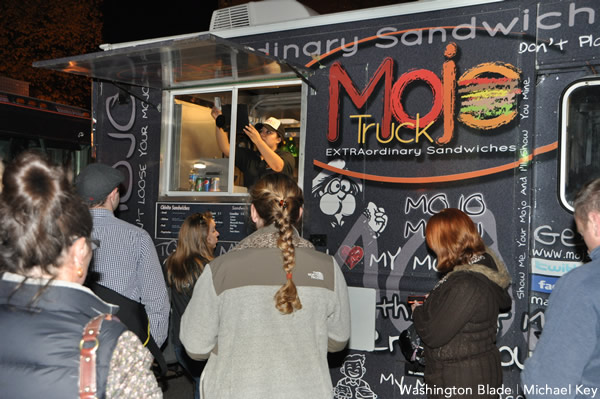
The first-ever Washington Blade Food Truck Rally attracted seven of the city’s best food trucks. (Washington Blade photo by Michael Key)
D.C. Mayor Vincent Gray probably wishes he could be as happy as the scantily clad bodybuilder directing traffic from the middle of a busy urban intersection in a current insurance company TV commercial.
Instead, hopes that special considerations being offered food trucks in newly proposed city regulations released on Oct. 5 governing their operation would be welcomed have suddenly faded. The D.C. Food Truck Association (DCFTA) announced opposition to the new rules last Thursday.
Yep, the familiar food truck tussle with the city is on again.
The revised rules update regulations designed three decades ago for ice cream trucks and hot dog carts. They incorporate changes reflecting review of public comments filed after two previous drafts over the past two years. The city has struggled to devise equitable guidelines for food trucks while balancing multiple public space use needs.
The regulations allow all food trucks to vend from fixed locations and permit use of public space and on-street public parking spots. Trucks need only a single vending license with employees able to manage operations without an owner on-board or purchase of additional licenses.
The modernized rules enable mobile vendors to continue current operations. Food truck owners have long enjoyed special accommodations pending finalization of new regulations. As a result, they now take these beneficial regulatory changes for granted.
Food truck owners oppose a compromise governing their location and concentration on downtown streets, despite being less restrictive than rules adopted by other jurisdictions nationwide. The proposal also poses fewer limitations than an earlier draft issued at the beginning of the year. Overlooked by DCFTA is a significant concession disallowed by D.C. Council legislation approved only three years ago.
That 2009 law requires all vendors to operate from assigned spots and followed an extensive two-year Council review of regulations in other cities. Designed to prevent a repeat of past violent incidents among stationary food cart operators coming to blows over available spots, it will presumably require modification for greater flexibility to be granted.
DCFTA upset centers on encouraging trucks to operate from designated spots in commercial districts for better streetscape management, preventing overconcentration and reducing the pressures on public space. The District Department of Transportation (DDOT) is designated to establish Mobile Roadway Vending (MRV) locations for at least three trucks each, parked one per block on any one side of a street.
Food trucks may currently use any metered parking space for only the allowed two-hour period, provided they pay for parking. Operators commonly disregard this requirement – either exceeding the time limit or not paying the meter fee, or both – and, if caught, consider the $25 ticket a cost of doing business. For that reason, the city is increasing the penalty to $100.
The new MRV alternative would allow use of specially designated parking spaces for four hours, from 11 a.m. to 3 p.m., consolidating meter costs in a quarterly permit fee. This creates certainty of securing space and doubles the service period. Outside MRV zones, use of any parking space would still be allowed.
DCFTA objects to this provision because they organize single-day hyper-concentration by trucks in specific areas, such as “Farragut Fridays” surrounding the downtown green space. Upwards of 30 trucks flock to a single location, often lined up head-to-tail, reducing public parking and negatively affecting pedestrian passage and commercial business activity.
If food truck operators take a fresh look at the opportunities the regulations offer to better serve the public, they would discover the city compromise makes sense.
The plan allows adequate customer choice in MRV zones, but ends the practice of only providing service to locales on particular days. Trucks would be encouraged to spread out equitably to additional areas, expanding service to new markets. It would improve civic management of public streetscapes – urged by businesses, building management firms, Business Improvement Districts, office tenants and residents.
Rather than accusing the mayor of “threatening food trucks” and ignoring the deference to their operation this hybrid approach provides, food trucks should consider their failure to reach out to potential customers and better serve the entire community.
A lack of imagination and disregard for other stakeholders are not legitimate excuses.
Mark Lee is a local small business manager and long-time community business advocate. Reach him at [email protected].



Opinions
USAID’s demise: America’s global betrayal of trust with LGBTQ people
Trump-Vance administration dismantled agency after taking office
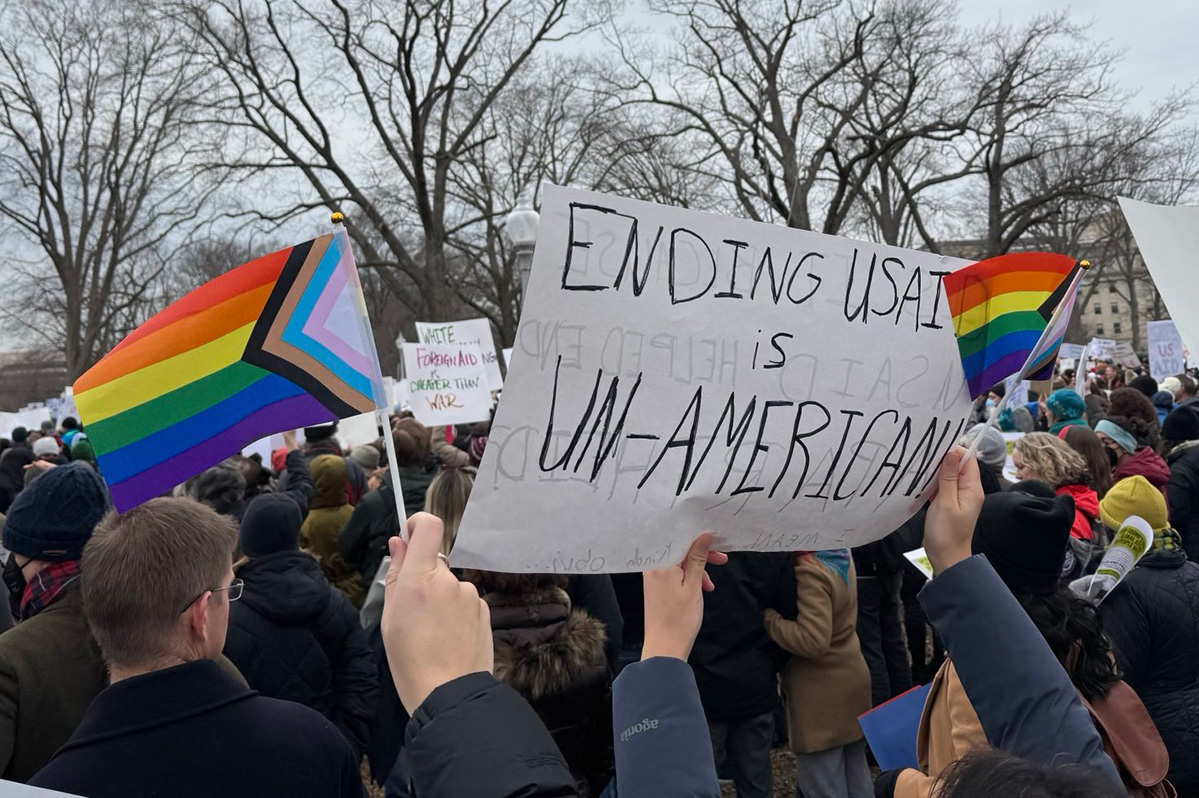
The U.S. Agency for International Development — proudly my institutional home for several years of my international development career and an American institutional global fixture since November 1961 — is no more.
How will USAID’s closure impact LGBTQI+ people around the world, especially in poor, struggling countries (“the Global South”)? Time will tell, but “dire,” “appalling,” and “shameful” are appropriate adjectives, given the massive increase in HIV/AIDS deaths that follow the callous, abrupt, and unspeakably cruel cut-off of funding for USAID’s health and humanitarian programming in HIV/AIDS prevention, treatment, and care.
Regarding LGBTQI+ people and issues, USAID worked in a tough neighborhood. In Africa alone, more than 30 countries in which USAID had programming still criminalize same-sex relationships, often to the point of imposing the death penalty. These fiercely anti-LGBTQI+ countries share harsh anti-LGBTQI+ punishments with most countries in the Middle East and North Africa. Other countries where USAID formerly worked retain colonial-era sodomy laws.
Where did USAID fit into all this turbulence? The agency was not allowed to transgress local laws, so how could it support the human rights of local LGBTQI+ people? USAID did so by building close and trusting relationships with local LGBTQI+ civil society, and by “superpower advocacy” for the universal human rights of all people, including those of us in the queer community.
I served at USAID’s Africa Bureau under the Obama administration, becoming the only openly transgender political appointee in USAID’s history. In that role, I was privileged to have a platform that caught the astounded attention of both queer people and of anti-LGBTQI+ governments around the world. If the president of the United States can elevate a transgender woman to such a senior position within the U.S. government, that open declaration of acceptance, inclusion, worth, and recognition set a precedent that many in the LGBTQI+ community worldwide hoped their countries would emulate.
Serving as an openly queer person at USAID also afforded me the opportunity to meet with many fiercely anti-LGBTQI+ senior politicians and government officials from African countries who sought USAID funding. Uganda’s first woman speaker of the parliament, Rebecca Alitwala Kadaga and her whole delegation came to see me at USAID in Washington about such funding. I had some very frank (and USAID-approved) “talking points” to share with her and her team about President Obama’s strong and secular commitment to equal human rights for all people. My tense meeting with her was also an opportunity to educate her as to the nature of the transgender, nonbinary, and intersex community — we who are simply classified and discriminated against as “gay” people in Uganda and in most countries in the Global South. I also had the chance to represent USAID in the “inter-agency” LGBTQI+ human rights task team led by openly gay U.S. Ambassador David Pressman, whose effective leadership of that Obama-era initiative was inspirational.
Working closely with professional, capable, and caring USAID career employees such as Ajit Joshi and Anthony Cotton, and with the strong and open support of the USAID Deputy Administrator Don Steinberg, I helped to craft and promote USAID’s very first LGBTQI+ policy. Under President Obama, USAID also created the LGBT Global Development Partnership, a public-private partnership supporting LGBTQI+ civil society groups throughout the Global South. USAID funding also increased for programs promoting LGBTQI+ inclusion, anti-violence, and relevant human rights protections. This programming expanded further (albeit never adequately funded) during the Biden administration under the able leadership of USAID Senior LGBTQI+ Coordinator Jay Gilliam and his team.
So what did it all mean? Has USAID left a footprint for the global LGBTQI+ community? Will its absence matter?
In my view, that answer is an emphatic yes. International development and humanitarian response go to the heart of recognizing, respecting, and caring about universal human dignity. USAID converted those ethical commitments into tangible and meaningful action, again and again, and modelled for the world what it means to truly include all persons.
My time serving at USAID was a high point of my career, being surrounded by the best of American civil servants and foreign service officers. For me, “USAID Forever” remains my battle cry. Let’s start thinking of how we will rebuild it, beginning in three years.
Chloe Schwenke is a professor at Georgetown University’s McCourt School of Public Policy.
Opinions
Community comes together to repair WorldPride history exhibition
Vandals damaged pictures, timeline walls on June 22
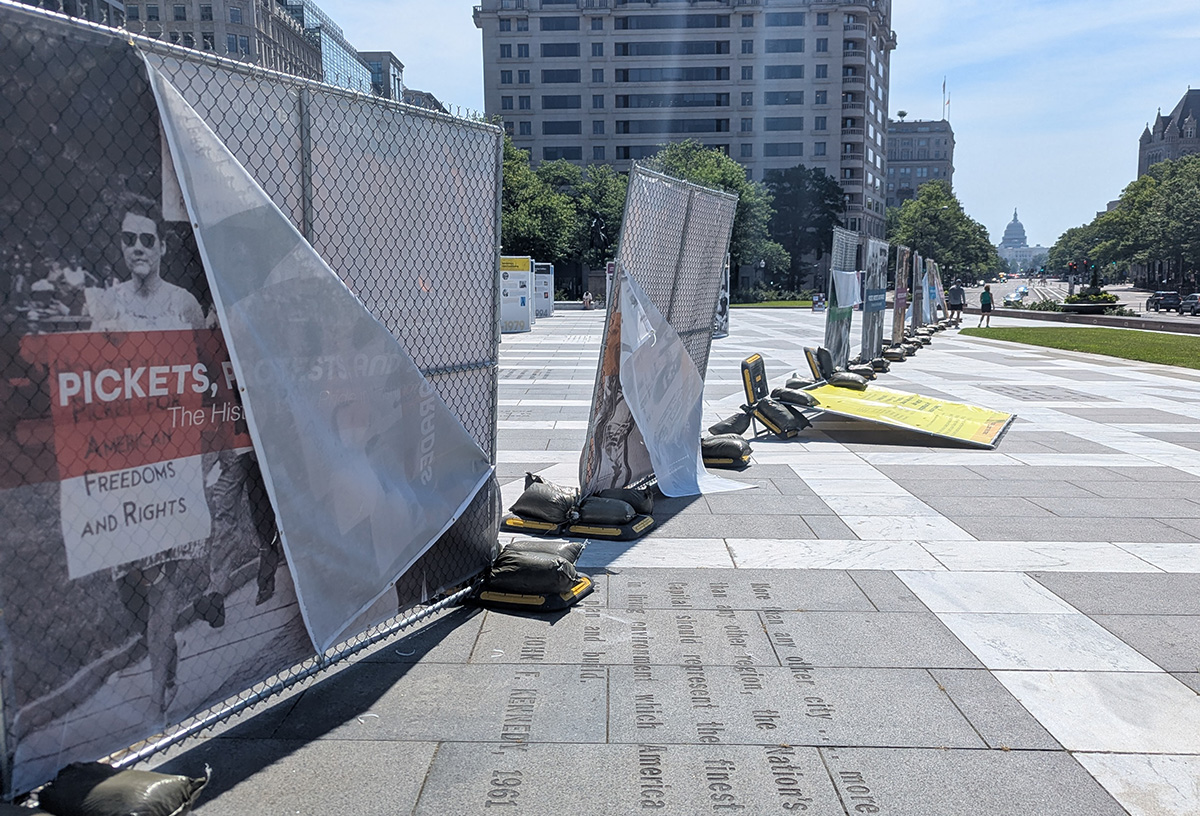
Earlier this month, vandals shouting homophobic slurs damaged the 8-foot hero cubes and timeline walls of the Rainbow History Project’s (RHP) WorldPride exhibition “Pickets, Protests, and Parades: The History of Gay Pride in Washington.” The week’s incident was the fifth homophobic attack on the exhibition chronicling DC’s LGBTQ+ History, the vandalism damage was only made worse by the storms this past week.
In response, RHP posted a call online for volunteers and donations and over a dozen volunteers showed up on Saturday to repair the exhibition in its final stretch.
It took three hours, but the group assembled during a heat advisory to bend the fences back into place, fix the cubes and zip tie all the materials together to keep them safe. Some of those who came out to volunteer, Slatt said, were known RHP volunteers but most were total strangers who had attended an event here or there or just wanted to get involved for the first time, one was even in D.C. as an out-of-town guest and after seeing the Instagram call, decided to spend their day lifting some heavy fencing back into place.
When asked why they showed up, volunteer Abbey said: “especially during Pride month, it’s so important to come together as a community, not just to celebrate, but to support each other. To know that this historic exhibit is even able to exist right now under this administration is really amazing. The fact that we’re just able to help continue it in its last leg of being out here is really important.”
“Rainbow History Project does a lot of work for the community,” another volunteer Ellie said, “they show up in a lot of ways that I think we really need right now, so in terms of being asked to come out and do a couple hours of lifting, that is something that we can easily support and do.”
“We put out a call asking for support from the community, and so we didn’t know what we’d get,” Slatt continued, “but strangers have shown up. We were upset, we were crying. We were trying to come up with a battle plan and more and more people have shown up with open arms and empty hands to do this. It’s 95 degrees, we are melting in the heat. It’s just amazing the number of people who have come here.”
If anything, the anonymous exhibit designer said, the people who vandalized the exhibit made the community stronger and mobilized members passionate about preserving and sharing our histories. Their efforts backfired in a big way — bringing together people who had only attended one or two RHP events or had read about the organization online to actively contribute to the work.
It’s a meaningful representation of the history of D.C.’s LGBTQ+ community, one that often starts with a small group of people who come together to protest but soon mobilize their communities and enact monumental change in the nation’s capital.
“If Pride in D.C. started with 10 people picketing the White House,” Slatt remarked, “you just got 12 more to join the gay history movement.”
This was especially poignant, another volunteer Mattie said, on the week that the Supreme Court issued a decision allowing Tennessee to ban puberty blockers and hormone therapy for minors seeking gender affirming care. It was a devastating moment for the LGBTQ+ community who mobilized once more in front of the Supreme Court this past Friday.
“It’s been actually really important to see this community come together in the face of direct attack on our history in the wake of direct attacks on our rights,” Mattie said, “and we stand up to that. We come together, and we represent. That is so important to maintaining our strength and our community throughout trying times now and ahead.”
When asked about how community members can support RHP’s work and repair the damage long-term to the exhibit, Slatt urged people to donate to RHP, to volunteer as exhibit monitors, and to come visit the exhibit.
“We’ve been doing this for 25 years. This is our 25th anniversary, and if it weren’t for volunteers donating their time and their talents, if it weren’t for small dollar donors, we would never have gotten anything done,” Slatt said. “I’d say to anyone out there that we are on this plaza all through Independence weekend, we are here through the Smithsonian Folklife Festival, people can come on down.”
Slatt and other volunteers will be leading tours each evening at 7 p.m. at Freedom Plaza, and people can pre-order the exhibition catalog right now, which will be delivered in time for LGBTQ+ History Month in October.
Emma Cieslik is a D.C.-based museum worker and public historian.
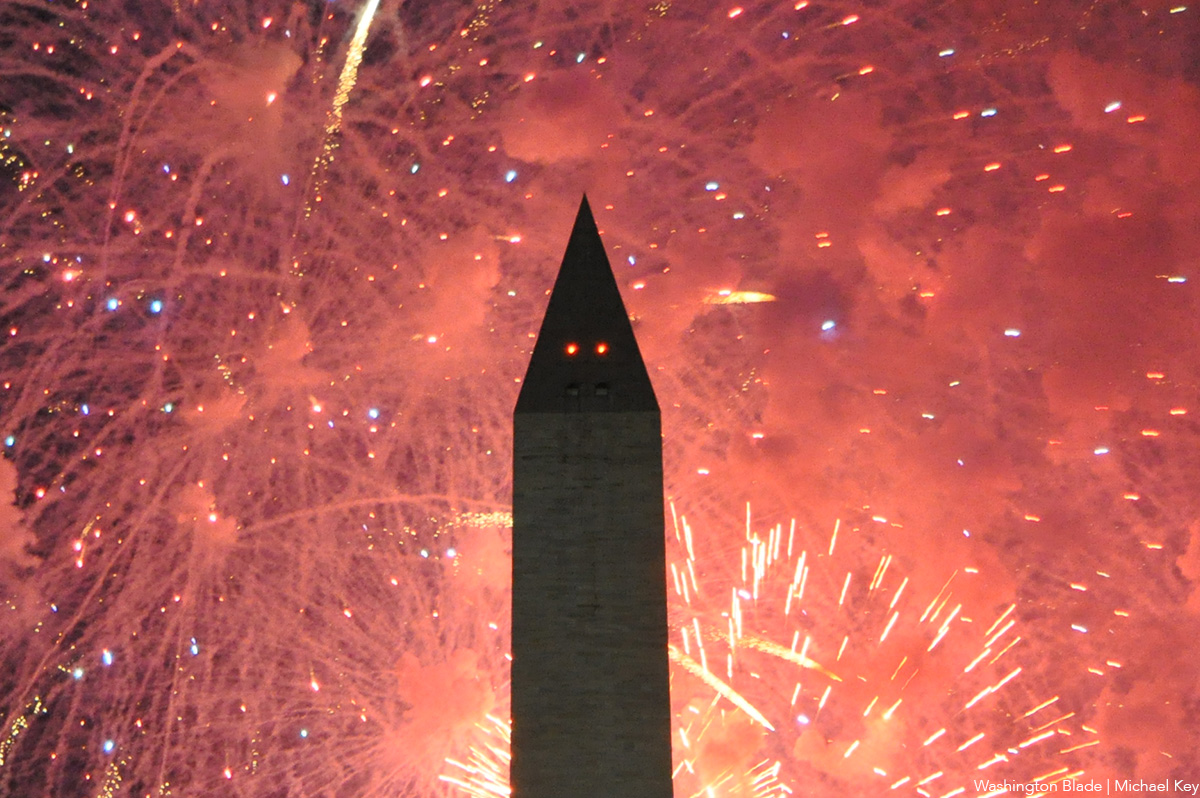
Independence Day, commonly known as the Fourth of July, is a federal holiday commemorating the ratification of the Declaration of Independence by the Second Continental Congress on July 4, 1776, establishing the United States of America. The delegates of the Second Continental Congress declared the 13 colonies are no longer subject (and subordinate) to the monarch of Britain, King George III and were now united, free, and independent states. The Congress voted to approve independence by passing the Lee resolution on July 2, and adopted the Declaration of Independence two days later, on July 4.
Today we have a felon in the White House, who wants to be a king, and doesn’t know what the Declaration of Independence means. Each day we see more erosion of what our country has fought to stand for over the years. We began with a country run by white men, where slavery was accepted, and where women weren’t included in our constitution, or allowed to vote. We have come far, and next year will celebrate 250 years. Slowly, but surely, we have moved forward. That is until Nov. 5, 2024, when the nation elected the felon who now sits in the Oval Office.
There are some who say they didn’t know what he would do when they voted for him. They are the ones who were either fooled, believing his lies, or just weren’t smart enough to read the blueprint which laid out what he would do, Project 2025. It is there for everyone to see. There should be no surprise at what he is doing to the country, and the world. Last Friday his Supreme Court, and yes, it is his, the three people he had confirmed in his first term, gave him permission to be the king he wants to be. The kind of king our Declaration of Independence said we were renouncing. A man who with the stroke of a pen can ruin thousands of lives, and change the course of America’s future. A man who has set back our country by decades, in just a few months.
So, I understand why many are suggesting there is nothing to celebrate this Fourth of July. How do we have parties, and fireworks, celebrating the 249th year of our independence when so many are being sidelined and harmed by the felon and his MAGA sycophants in the Congress, and on the Supreme Court. Yes, there are those celebrating all he is doing. Those who want to pretend transgender people don’t exist, and put their lives in danger; those who think it’s alright to take away a women’s right to control her body, and her healthcare; those who think parents should be able to interfere on a daily basis with their children’s schooling and wipe out the existence of gay people for them. Those who pretend there was a mandate in the last election, when it was only won by about 1 percent. Those who think disparaging veterans, firing them, and taking away their healthcare, is ok. Those in the LGBTQ community like Log Cabin Republicans, who think supporting a racist, sexist, homophobe is the right thing to do.
So, what do we, as decent caring people, do this Fourth of July. What do we say to those who are being harmed as we celebrate. What do we say to those trans people, those women, those immigrants who came here to escape their own dictators, and are now finding they have come to a country with its own would-be dictator. I say to them, please don’t give up on America. Don’t give up on the possibility decent loving people in our country will finally wake up and say, “enough.” That the majority of Americans will remember we fought a revolution to escape a king, and we fought a civil war to end slavery. That we moved forward and gave women the right to vote, and gave the LGBTQ community the right to marry. Don’t give up on the people that did all that, and think they won’t rise up again, and tell the felon, racist, homophobe, misogynist, found liable for sexual assault, now in the White House, and his sycophants in congress, and his cult, that we will take back our country in the 2026 midterm elections. That we will vote in large numbers, and demand our freedom from the tyranny that he is foisting on our country.
So yes, I will celebrate this Fourth of July not for what is happening in our country today, but rather for what our country actually stands for. Not for birthday parades, and abandonment of the heroes in Ukraine in support of dictators like Putin. But for the belief the decent people in our country will rise up and vote. That is what I will celebrate and pray for this Fourth of July. That is what I think the fireworks will mean this July Fourth. I refuse to accept defeat the same way our revolutionary soldiers wouldn’t, and the way our troops in the civil war wouldn’t till the confederacy was defeated.
I will celebrate this Fourth of July because I refuse to accept we will not defeat those who would destroy our beautiful country, and what it really stands for.
Peter Rosenstein is a longtime LGBTQ rights and Democratic Party activist.

ICC issues arrest warrants for Taliban leaders over persecution of LGBTQ people, women

LGBTQ voters divided in Ward 8 special election

#JusticiaParaKarla: una lucha por el derecho a la identidad en El Salvador

Defying trends, new LGBTQ center opens in rural Winchester, Va.

Female writers arrested in Chinese crackdown on gay erotic fiction

Two new documentaries highlight trans history

Celebrate the power of homeownership this Fourth of July

‘A Wrinkle in Time’ comes to Arena Stage

Lesbian feminist becomes South African MP