Local
Activists protest ‘Kill the Gays’ bill outside Ugandan embassy
Ugandan lawmakers are expected to potentially vote on the measure before Dec. 14
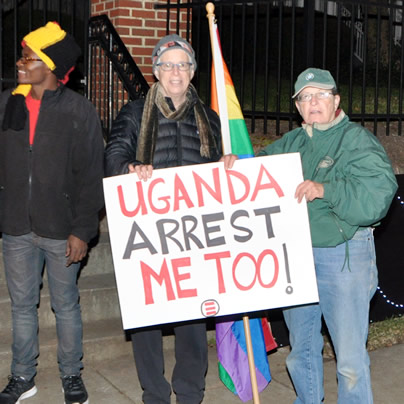
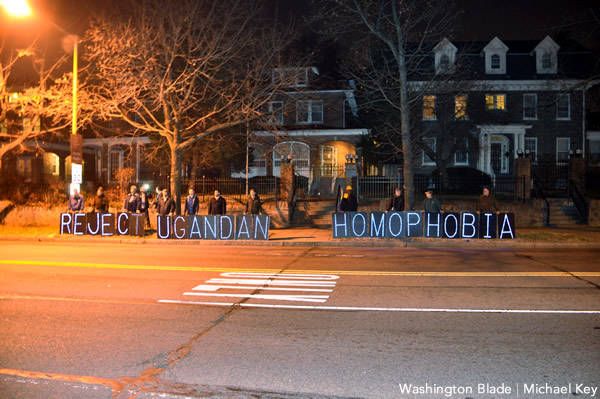
Protesters gather outside the Ugandan embassy in Northwest D.C. on Saturday to protest the country’s “Kill the Gays” bill. (Washington Blade photo by Michael Key)
More than a dozen people gathered outside the Ugandan embassy in Northwest D.C. on Saturday to protest the African country’s so-called “Kill the Gays” bill that would impose the death penalty upon anyone convicted of repeated same-sex sexual acts.
Members of the Maryland Light Brigade, which placed illuminated signs in support of last month’s referendum that upheld the state’s same-sex marriage law on interstate overpasses, organized the protest. They held lighted black panels along the sidewalk in front of the 16th Street, N.W., compound that read “Reject Ugandan Homophobia.”
Several motorists honked their horns in support of the protesters as they drove past the embassy.
“Those lawmakers are better than what they’re doing,” D.C. resident Moses Shaba, who is originally from Uganda, told the Washington Blade. “They are absolutely better than what they’re doing. I am so surprised to see that they are going on with this bill and the kind of articles and provisions that are in that bill because in the long run when this bill if it’s passed they will see their friends, their kids, their daughters, their brothers all going to jail. That’s how bad it is.”
Shaba and other protesters also sought to highlight the role they feel Scott Lively and other American evangelicals have played in exploiting homophobic attitudes in the East African country before Parliamentarian David Bahati introduced the bill in 2009. Sexual Minorities Uganda, an LGBT advocacy group, accused Lively of violating international law when he allegedly conspired with the country’s political and religious leaders to further promote these sentiments in a lawsuit it filed in a Massachusetts federal court in March.
“Normally I might say that I wouldn’t push my way into a foreign country’s internal affairs, but one of the big problems here is there’s a lot of American support for this bill,” Charles Butler said. He specifically referred to the Foundation, the group also known as the Family that organizes the annual National Prayer Breakfast, as one organization to which Bahati and other anti-gay Ugandan lawmakers and religious leaders have ties. “I just feel that it’s our responsibility to fight the Americans who are trying to export homophobia to Africa.”
Advocates expect Ugandan parliamentarians could potentially vote on the “Kill the Gays” bill before the legislative session ends on Dec. 14. The Associated Press and other media outlets have reported Bahati has removed the death penalty provision from his measure, but activists and even the U.S. State Department officials have questioned these reports.
Both President Obama and Secretary of State Hillary Clinton have spoken out against the Anti-Homosexuality Bill — they also condemned Ugandan LGBT activist David Kato’s 2011 murder. Clinton also honored SMUG Executive Director Frank Mugisha and other Ugandan human rights advocates at the U.S. Embassy in Kampala, the country’s capital, in August.
The White House and British Prime Minister David Cameron have also suggested the allocation of international aid should hinge upon a country’s record on LGBT rights.
Back in D.C., Maryland resident Deb Friedman described the “Kill the Gays” bill as “a horrific policy.”
“It’s taking the whole human community a step backwards,” she told the Blade. “I happen to be a lesbian. Even if I wasn’t I would consider it worth of protesting. Whether or not it’s going to do any good in terms of the government of Uganda and who they listen to, but I feel you have to stand out no matter what the outcome or the results are. You can’t just let it happen and not take a stand.”
Rockville resident Steve Brooks, who continues to advocate on behalf of LGBT activists in Zimbabwe in southern Africa, agreed.
“Our brothers and sisters in Africa are facing the prospect of losing their lives and their livelihoods so i’m out here to support them,” he said.






Rehoboth Beach
Rehoboth mayor calls for commissioner’s resignation after investigation into improper behavior
Suzanne Goode ‘has violated her oath of office, disgraced position of commissioner’

Rehoboth Mayor Stan Mills called for the resignation of Commissioner Suzanne Goode, following release of an independent investigation into Goode’s behavior that led Mills to conclude she has violated her oath of office.
Over the past few months, city staff have complained about Commissioner Goode’s extensive and inappropriate communications with them.
In June, Goode went to the house of a fellow commissioner in an attempt to settle a dispute she was having with his neighbor on the online platform NextDoor. Goode also has a history of using anti-LGBTQ language in various emails.
“I believe we’ve come to the point where we can take the most severe action we can take at this time to end Commissioner Goode’s intentional lies and harassment,” said Mills. “This has never been about differences of opinions on issues, but rather about uncivil behavior.”
“Commissioner Goode has violated her oath of office and has disgraced the position of commissioner, and she should resign,” said Mills.
In late June, the city of Rehoboth hired Margaret DiBianca, an attorney who specializes in business and employment conflict resolution, to investigate allegations of harassment and inappropriate behavior by Goode toward city employees and fellow commissioners.
DiBianca submitted the 17-page report on Aug. 12. On Aug. 21, a majority of the commissioners voted to release a redacted version of the report to the public.
Before the vote, Commissioner Susan Stewart, who is set to be sworn in as mayor next month, said that releasing the report is necessary.
“In most workplaces, the documented conduct would warrant her termination,” said Stewart.
“Our laws provide no such path for an elected official. To simply move on would mean keeping this conduct secret, leaving the victims to shoulder the burden themselves without institutional support,” said Stewart.
The investigation reported that Goode had sent nearly 2,000 emails to city employees since 2024 with more emails being sent almost daily. Only 90 emails from June and July were used in the scope of the investigation.
The report found that the emails contained “intentionally degrading and derogatory language, references to individuals’ family members, religion, and disabilities, as well as language hostile to the LGBTQIA+ community.”
The following emails were noted in the report as examples of ‘hostile’ language toward the LGBTQIA+ community:
“On November 7, 2025, Cmr. Goode wrote to a constituent, “PS just curious – how does this alienate the ‘Queens’ in [the City] more than the non-queens in the sense how is it a LGBTQ issue? (Not everything in [the City] revolves around gays, right?).”
“On November 15, 2025, Cmr. Goode said to the Targeted Employees “conservatives now have to remain in the closet (conservatives now have to do what gays had to do in the 20th century – ah, the irony) who object to the woke, drag queen bent of [Clear Space Theatre] at times.”
“On December 29, 2025, Cmr. Goode wrote to a constituent, “straight white males like yourself and my husband might as well just shoot themselves. Pale, stale and male doesn’t cut it in this town, eh?”
The report stated: “The volume of emails and the short intervals between communications sent by Goode reveal a pattern of conduct designed to intimidate, demean and harass rather than to advance legitimate city business.”
The report demonstrated multiple instances of Goode circumventing directives from Mayor Mills requiring her to cease inappropriate communications with city staff.
The conclusion of the report found that Goode’s behavior “falls substantially and demonstrably outside the bounds of acceptable professional behavior expected of an elected official and public servant in violation of the City’s Civility Code and, in turn, constitutes a violation of the Ethics Code.”
“Cmr. Goode’s communications do not foster a “respectful, courteous, and professional work environment” and do not reflect the “dignity and respect” required by the Civility Code.”
The report outlined six recommendations for the city to follow to address Goode’s behavior.
The recommendations included prohibiting Goode from contacting city employees and accessing administrative offices, and requiring Goode to undergo city-approved training on subjects such as respectful workplace behavior.
At the Aug. 21 meeting, the Commissioners voted to adopt all six recommendations.
During the meeting, Goode was given time to respond before the official release of the report.
“When an investigation is an attorney up in Wilmington looking at emails, who never contacts me, obviously it is a one-sided investigation,” said Goode. “The investigative reporter never got my side of anything. I was never given the opportunity to defend myself.”
“In June, Commissioner Goode’s communication became even worse,” City Manager Taylour Tedder told the Blade this week.
Tedder said that the volume of messages jumped to nearly 100 emails just in the month of June.
Tedder identified himself and City Solicitor Lisa Borin Ogden. He said that each of them filed multiple complaints, with one of them being to the Human Resources director.
“With an elected official, there is no way to reprimand or punish them because they’re not an employee,” said Tedder.
Brooke Thaler, communications director for the city of Rehoboth, expressed her frustration with the city’s inability to take serious action against Goode.
“That’s just a bit mind-boggling that something like this can go on, and there’s nothing that can be done about it,” said Thaler.
“The public put their trust in her when they elected her, and I don’t think that their intention was for her to so badly mistreat city staff,” Thaler told the Blade.
“It’s highly doubtful that she will stop, but I think the fact that these protections are in place to at least insulate the employees from receiving it when she’s not in person is a good step,” said Tedder.
Goode responded to the Blade’s request for comment by saying:
“Friday’s session was a kangaroo court and a blatant weaponization of FOIA. The entire report relies on systematic misrepresentation. Time and again, comments I shared from social media or resident outreach were falsely attributed directly to me.
“Without context, these claims are meaningless. As just one example, the city manager accuses me of using a vulgar word on a phone call—a word I do not use (p. 6, line 22). The investigating attorney never even contacted me, proving this process was never meant to be fair,” said Goode.
“I will not validate or accept an investigation built on inaccurate claims.”
Goode has not announced plans to resign.
Maryland
Girlfriends charged with Silver Spring murder to go on trial in 2027
Prosecutors charged both women with killing mother of one of them

Two women identified as a couple who are charged with the May 22, 2026, murder of the mother one of them in her Silver Spring home and who were arrested three weeks later in Ohio are scheduled to go on trial for murder April 19, 2027.
According to online records filed with Montgomery County Circuit Court in Rockville, Vanessa Tjongarero-Henderson, 29, of Clarksburg, Md., and Samantha Raebel, 36, of Phoenix are being held without bond in the Montgomery County Correctional Facility until the time of their trial.
Statements from Montgomery County police show the two women were arrested June 10 in Genoa, Ohio, after fleeing from the scene of the murder in Silver Spring. Police statements and court records show they were extradited back to Maryland in July, where prosecutors with the Montgomery County State’s Attorney’s Office obtained indictments against them for murder.
Earlier statements from Montgomery County police say their investigation into the murder led to their decision to initially charge the two women with first-degree murder for the death of Hilde Henderson, 67, who was Tjongarero-Henderson’s mother.
“Through the course of the investigation, detectives identified Henderson’s daughter, Vanessa Tjongarero-Henderson, and Vanessa’s girlfriend, Raebel, as the suspects,” one of the police statements says. It says police obtained arrest warrants for both women and launched a nationwide search seeking help from the public in in locating them.
One of the police statements says an autopsy determined the cause of Hilde Henderson’s death was blunt-force trauma injuries brought about by a murder. Police and the State’s Attorney’s Office, which is prosecuting the case, have yet to disclose whether they have determined a motive for the murder.
Court records show that prior to the start of the April 19, 2027, trial a “motion” hearing was scheduled for Oct. 30, 2026, a pre-trail conference was scheduled for Feb. 12, 2027, and another motion hearing and a status hearing were scheduled for March 12, 2027.
Court records also show that Tjongarero-Henderson is being represented by attorneys with the Montgomery County court system’s public defender service. The records show that Raebel initially had been represented by a public defender service attorney, but updated records show Aug. 14 is listed as the “removal date” for that attorney.
The docket shows that on Aug. 20, two new attorneys with the prominent D.C. law firm of Covington & Burling made their official appearance as her attorneys in the murder case. One of them, Daniel Solomon, told the Washington Blade in response to an inquiry that the defense has no comment at this time on the case.
He confirmed that Covington & Burling is representing Raebel on a no-cost, pro bono bass.
The office of the Montgomery County public defender service didn’t immediately respond to a phone message from the Blade asking for a comment on the Tjongarero-Henderson case.
Delaware
Delaware fines Rehoboth bar $15,000 for discriminating against trans woman
Hideout told patron she had to use men’s room due to gender marker on driver’s license
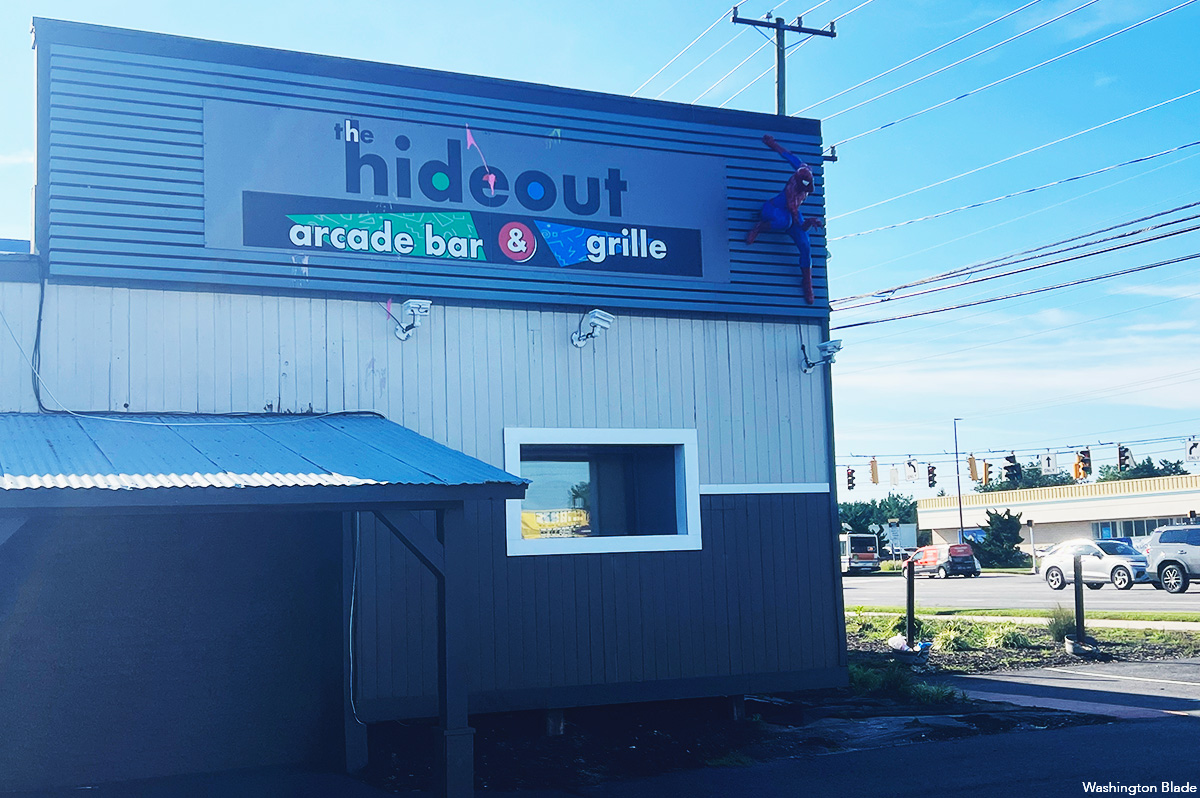
The Delaware Human and Civil Rights Commission voted to fine Hideout Arcade Bar & Grille $15,000 last month due to a discrimination complaint filed by a trans woman over her use of the bathroom.
Katie Sorber, a transgender woman, said that on April 5, 2023, she was stopped by employees and told she could only use the men’s bathroom due to the “male” gender marker on her driver’s license. This occurred after Sorber presented her ID upon entering the bar and ordering a drink.
Sorber took to Facebook to complain about her experience at the bar after she was told to use the men’s bathroom.
On April 12, 2023, Sorber returned to the Hideout but was barred from entering due to her post on social media.
Following Sorber’s post, Bryan Derrickson, the owner of Hideout Arcade Bar & Grille, allegedly began enforcing a policy in which patrons had to use the bathroom that corresponded to the gender marker on their ID.
Derrickson was ordered to pay $10,000 to Sorber, $5,000 to the Special Administration Fund, as well as conduct anti-discrimination training with employees, remove the ban on Sorber from the establishment, and revise the bar’s bathroom policy.
The commission ruled that the bar and Derrickson had wrongfully discriminated against Sorber on the basis of her gender.
Derrickson’s explanations for the denial included safety concerns, a third-party patron complaint, and a reference to the health code. The panel found this to be inconsistent and lacking factual support upon cross-examination.
The case was evaluated under the Delaware Equal Accommodations Law, which explicitly prohibits discrimination and retaliation in places of public accommodation based on gender identity.
This was the second time that the bar has been fined for discriminating against a transgender woman. The bar received a $2,000 penalty in September of last year for denying a transgender woman entry in 2023.
Half of the fine went to Kathy Carpenter Brown, the trans woman who experienced the discrimination. Brown is the founder of TransLiance, an LGBTQ+ advocacy group in Delaware.

Immersive ‘Nation-State’ imagines a society free of authoritarianism

New book examines Trump cuts to LGBTQ healthcare

E-INFOSOL leaders encourage youth to pursue tech careers

Milo Yiannopoulos deported to UK

San Francisco, long a queer safe haven, remains competitive for homebuyers

Music icon and dear LGBTQ friend Dolly Parton remembered

New data shows record-high LGBTQ population amid Trump attacks

Push to elect more LGBTQ ANC members yields results

Please join me in supporting the Washington Blade Foundation

Chris Van Hollen says the Democratic Party needs change. Is he the one to lead it?
-

 Obituary5 days ago
Music icon and dear LGBTQ friend Dolly Parton remembered
-
National5 days ago
New data shows record-high LGBTQ population amid Trump attacks
-
District of Columbia5 days ago
Push to elect more LGBTQ ANC members yields results
-
Commentary4 days ago
Please join me in supporting the Washington Blade Foundation