Politics
Boxer seeks full extension of Social Security benefits
Survivor benefits in question even with court ruling against DOMA
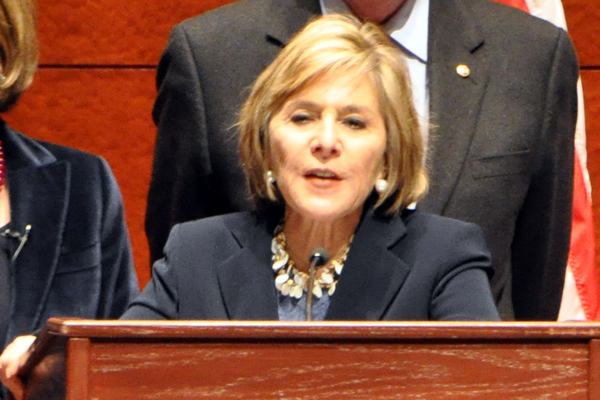
Sen. Barbara Boxer (D-Calif.) is calling on Social Security to implement full benefits for married gay couples. (Blade file photo by Michael Key).
Sen. Barbara Boxer (D-Calif.) is calling on the Social Security Administration to provide survivor benefits for married same-sex couples wherever they move in the country in the wake of the Supreme Court’s decision striking down the Defense of Marriage Act.
In a letter dated July 1, Boxer asks Social Security Administration Acting Commissioner Carolyn Colvin to use “administrative authorities” to extend benefits to the fullest extent possible following the Supreme Court decision striking down Section 3 of DOMA.
“All federal agencies should endeavor to provide swift and equal access to programs and benefits for all same-sex couples, regardless of their state of residence, using existing administrative authorities,” Boxer said.
Social Security survivor benefits are among the benefits that are in question for legally married same-sex couples post-DOMA. Social Security law looks to the state where a couple lives, not where a couple is married. That means a gay couple that marries in New York but moves to Florida may not be eligible if they apply for those benefits there.
In the event that the Social Security Administration believes it can’t offer those benefits administratively, Boxer asks the agency to notify Congress so lawmakers can advance a legislative solution to the issue.
Boxer, one of 14 U.S. senators who voted against DOMA in 1996, said she’s spoken with same-sex couples and heard about the harm caused by withholding Social Security survivor benefits.
“I have met so many surviving spouses and family members of same-sex relationships who struggle needlessly after the passing of their family members,” Boxer writes. “Access to Social Security benefits can often times mean the difference between keeping your home and losing it, or feeding your children and watching them go hungry.”
In her letter, Boxer says she understands the Social Security Administration has already taken some action. The senator says she learned the agency “took immediate steps” to prepare for changes and issued “emergency instructions” to field offices directing them to accept applications from gay couples and hold them until further guidance.
Like Boxer, LGBT advocates have been calling on the Obama administration to interpret the ruling against DOMA broadly so married gay couples will have federal benefits no matter where they move in the country.
During his trip to Africa, President Obama seemed sympathetic to calls when responding to a question about DOMA implementation during a news conference.
“It’s my personal belief — but I’m speaking now as a president as opposed to as a lawyer — that if you’ve been married in Massachusetts and you move someplace else, you’re still married, and that under federal law you should be able to obtain the benefits of any lawfully married couple,” Obama said. “But I’m speaking as a president, not a lawyer.”
After the DOMA ruling, Obama said he directed U.S. Attorney Eric Holder to work with Cabinet officials to prepare for implementing benefits for same-sex couples. Changes are expected to be made on a rolling basis as quickly as practicable.
Mark Hinkle, a Social Security spokesperson, noted the process Obama has set up in response to the Boxer letter.
“The president has directed the Attorney General to work with other members of his Cabinet to review all relevant federal statutes to ensure this decision, and its implications for federal benefits and obligations – including benefits administered by this agency – is implemented swiftly and smoothly,” Hinkle said. “We look forward to working with the Department of Justice to do so.”
Hinkle added the Social Security Administration will respond directly to Boxer with regard to the letter.
In the event that some benefits still aren’t available even in the aftermath of the court ruling, one legislative solution that is available is the Respect for Marriage Act, which was introduced last week by Rep. Jerrold Nadler (D-N.Y.) and Sen. Dianne Feinstein (D-Calif.). The “certainty provision” in the bill would ensure federal benefits continue to flow to married same-sex couples wherever they live in the United States.
The full letter from Boxer follows:
July 1, 2013
The Honorable Carolyn W. Colvin
Acting Commissioner
Social Security Administration
6401 Security Boulevard
Baltimore, MD 21235
Dear Acting Commissioner Colvin:
Until the Supreme Court struck down Section 3 of the Defense of Marriage Act in last week’s historic United States v. Windsor ruling, federal law prevented the recognition of same-sex marriages for purposes of Social Security family and spousal benefits, resulting in the exclusion of millions of Americans from the same critical safety net programs that are made available to the families of heterosexual couples.
I have met so many surviving spouses and family members of same-sex relationships who struggle needlessly after the passing of their family members. Access to Social Security benefits can often times mean the difference between keeping your home and losing it, or feeding your children and watching them go hungry. Surviving spouses and children of same-sex marriages lose thousands of dollars in earned Social Security benefits every year because of the discriminatory policy mandated by the Defense of Marriage Act.
After last week’s Supreme Court ruling, I was pleased to learn that the Social Security Administration (SSA) took immediate steps to prepare for the changes that will be necessary to extend full federal benefits to all same-sex couples and their families. The SSA should be applauded for issuing emergency instructions to all field offices directing them to accept applications from same-sex couples and hold them until specific instructions on how the Court’s decision will be implemented are determined.
I was also encouraged by President Obama’s comments indicating that he believes all legally-married same-sex couples should have access to the same benefits, regardless of where they chose to live.
All federal agencies should endeavor to provide swift and equal access to programs and benefits for all same-sex couples, regardless of their state of residence, using existing administrative authorities. In instances where remedies are not available through executive action and will instead require specific changes to existing law, I urge you to notify Congress immediately so that the legislative process to address these issues can begin.
While I understand the SSA’s review of its legal authorities regarding same-sex couples must be comprehensive and thorough, I encourage you to work as expeditiously as possible for the millions of Americans who await your decisions.
Sincerely,
Barbara Boxer
United States Senator


2026 Midterm Elections
Meet the LGBTQ candidates running for U.S. House, Senate
Pappas would become first out gay man elected to upper chamber

The midterm elections are often seen as a report card for the party in power, giving voters an opportunity to weigh in on the direction of the country after two years of unified control of the federal government. With Republicans controlling the White House, Congress and the Supreme Court, the 2026 elections could reshape the balance of power in Washington and determine what the next two years of federal policy will look like.
Among the candidates looking to shape that future are a large number of openly LGBTQ politicians running for federal office. All of the candidates listed below openly identify as members of the LGBTQ community and are running as Democrats, seeking seats in both the U.S. House of Representatives and the U.S. Senate. (See below for a list of LGBTQ incumbents.)
The New Candidates
U.S. Senate:
Chris Pappas — NH
The United States House of Representatives:
Cait Conley — NY-17
Jeremy Moss — MI-11
JoAnna Mendoza — AZ-06
Marni von Wilpert — CA-48
Scott Wiener — CA-11
Chris Gallant — NY-1
JD Ford — IN-5
Janelle Sarauw — U.S. Virgin Islands
If all of these candidates running for federal office win their seats, this would make the federal government the queerest legislative term for Congress ever.
Chris Pappas would become the first openly gay male senator if he wins the race against Republican John E. Sununu. Pappas is currently leading early polls 50% to Sununu’s 42%, and is seen as a fairly centrist Democrat with a slew of accomplishments passed through the House since his election in 2018 that make him a desired candidate for the purple “Granite State.”
Cait Conley is fighting to take two-term incumbent Republican Mike Lawler’s seat for New York’s 17th district, covering parts of Westchester, Rockland, Putnam and Dutchess counties. Conley has a long history of working as a public servant through her extensive military service, which includes six overseas deployments with the Army and work with the National Security Council. Current polling shows she has an advantage over her opponent, 64% to his 36%, making this one a race to watch.
Jeremy Moss is running for election in Michigan, after quickly rising in the ranks within the Great Lake state. Moss, who was elected to his city’s city council, then to the state House, then to state Senate has had a lengthy connection with state politics for someone so young. He also served as the state’s first gay president pro tempore. He is running in the Detroit suburbs, including Oakland County. Nearly all polling puts Moss in the lead with some already giving him 99%.
JoAnna Mendoza is a veteran of the U.S. Navy and U.S. Marine Corps running for a House seat for the Tucson and southeastern Arizona area. She has been outspoken about how the cost of everyday necessities under the current leadership of President Trump and Republicans in Congress has made people in her state less safe. She is currently locked in a tight race with her Republican counterpart, leading Juan Ciscomani 47% to 45%.
Marni von Wilpert is running to represent northern San Diego County. She has experience representing the area as a San Diego City Council member, former prosecutor, and Obama workers’ rights attorney. Von Wilpert holds a narrow lead over Republican Jim Desmond, 45% to 42%.
Scott Wiener is looking for a chance to take former House Speaker Nancy Pelosi’s seat in the San Francisco area. Weiner holds a narrow lead over the Pelosi-endorsed San Francisco supervisor Connie Chan. A New York Times poll has him leading 45% to Chang’s 40%.
Chris Gallant has a slew of federal accomplishments under his belt, from working as an FAA air traffic controller to serving in the U.S. Army and New York Army National Guard, including as a Black Hawk helicopter pilot, and is a volunteer firefighter on Long Island. Despite all of this dedication to public service, he’s running in a solidly red district with recent predictions favor LaLota 81 to 26.
JD Ford is fighting to represent the northern Indianapolis suburbs and north-central Indiana against Republican incumbent Victoria Spartz. He was the first and only openly LGBTQ person elected to the Indiana Legislature, running his campaign on making living more affordable. Polling puts him slightly behind Spartz 48% to 46%.
Janelle Sarauw is trying to win the U.S. Virgin Island’s seat in the U.S. Congress. While there is no voting power, the seat can participate in debates. Sarauw is likely to win the seat after sweeping the primary earlier this year, and will face off against Shelley Moorhead, an independent, in November.
The Incumbents
Becca Balint — VT-At Large
Emily Randall — WA-06
Eric Sorensen — IL-17
Mark Pocan — WI-02
Mark Takano — CA-39
Ritchie Torres — NY-15
Robert Garcia — CA-42
Sarah McBride — DE
Sharice Davids — KS-03
Becca Balint is running for reelection to represent all of Vermont, making her one of the few candidates on this list who represents an entire state rather than a congressional district. Balint, a former teacher and Vermont state senator, has made housing affordability, mental health, and protecting democracy central parts of her platform. Recent polling gives Balint a substantial lead over Republican challenger Gerald Malloy, 60% to Gerald’s 30%.
Emily Randall is running for reelection in Washington’s 6th Congressional District, which includes the Olympic Peninsula and parts of the Kitsap Peninsula across Puget Sound from Seattle. Randall, who previously served in the Washington state Senate, has made expanding access to affordable health care a major part of her platform. She appears to be in a relatively strong position for reelection where she won 60% of the vote in Washington’s August top-two primary, while her Republican opponent Teresa Fox received about 25%.
Eric Sorensen is running for another term representing western Illinois. The former television meteorologist has centered his congressional work on lowering costs for working families. There is no public polling in the race, but a current nonpartisan forecast gives Sorensen 59% of the vote compared to Republican Dillan Vancil, with 40%.
Mark Pocan is seeking to continue representing Madison and south-central Wisconsin. Pocan, who has served in Congress since 2013, has focused on issues including health care affordability, workers’ rights and LGBTQ+ equality. There is no public polling of the race, but the current field has no Republican candidate, and a nonpartisan forecast gives Pocan more than a 99% modeled chance of winning.
Mark Takano is running for reelection in California’s 39th congressional district, which includes Riverside and portions of the Inland Empire east of Los Angeles. Takano has made health care and veterans’ issues major parts of his congressional work. There is no public polling of the race, but in his primary he came in first with 61% of the vote compared to Republican Steve Manos’s 39%.
Ritchie Torres is running for another term representing New York’s 15th congressional district in the Bronx. Torres, who previously served on the New York City Council, has made housing, economic development, education, and public safety major parts of his platform. There is no current public polling of the race, but multiple prediction sites have it squarely his to win.
Robert Garcia is seeking another term representing California’s 42nd congressional district, which includes Long Beach and southeastern Los Angeles County. Garcia, the former mayor of Long Beach, has focused on issues including infrastructure, transportation, education, and LGBTQ+ rights while in Congress. There is no public polling of the race, but forecasting has Garcia winning the seat over Republican Brian Burley 99% to 1%.
Sarah McBride, is running for reelection to represent Delaware’s sole congressional district, meaning she represents the entire state. McBride, who made history as the first openly transgender member of Congress, has centered her campaign on lowering health care costs, protecting reproductive health care, and strengthening workers’ rights. There is no public polling of the general election, but a current nonpartisan forecast gives McBride a 99.1% modeled chance of winning against Republican Joseph Arminio.
Sharice Davids is seeking another term representing Kansas’ 3rd Congressional District, which covers the Kansas side of the Kansas City metropolitan area. Davids, a former White House fellow and attorney, has made agriculture, lowering costs, and health care central parts of her platform. There is no current public polling of the race, but prediction polling shows she has a 94% chance of winning her race.
White House
Trump-appointed judge restores White House TV pool access
Judge called in to question president’s justification of the ban

A federal judge ordered the White House to restore West Wing press credentials to three news organizations after President Donald Trump attempted to bar their access for unfavorable reporting.
Early Thursday morning, Trump-appointed U.S. District Judge Timothy Kelly granted a temporary restraining order brought by POLITICO, CNN, and MS NOW as part of a joint lawsuit. The lawsuit cites the imperative role of a “free press” and ordered the 78 journalists’ credentials returned to the three outlets for at least the next two weeks as litigation plays out.
In the eight-page ruling, the judge goes over a slew of laws that Trump may have violated in banning the three media groups — from stepping on their First Amendment rights to a free press to the Fifth Amendment right to due process.
The judge also questioned Trump’s justification for removing the outlets, originally saying it was a matter of national security.
“The court is skeptical — at least on this record — that defendants’ interest in safeguarding national security is the actual motivation for, or is even advanced by, the revocation of plaintiffs’ hard passes,” Kelly wrote in an 8-page ruling issued just before 1 a.m. ET.
“Nothing in the record that predates this suit suggests that the revocation of plaintiffs’ hard passes was motivated by national security concerns. Certainly, that is not what President Trump said when he announced that he was ‘banning’ plaintiffs from the White House — instead, he focused on the alleged lack of truthfulness and negativity of plaintiffs’ reporting,” the judge added.
The Washington Blade reached out to the White House press office asking if the administration would file an appeal to keep the journalists out of the West Wing but did not hear back before publication time.
White House
White House press pool pushes back after Trump bars three outlets
As President Trump refuses entry to outlets he deems unreasonable, lawsuits have been filed to regain access to the West Wing
Past the first checkpoint to get into the White House, multiple carts filled with camera equipment sat along a fence. Wagons loaded with tripods, cables, mics, and cameras sat just past where they normally would be working at full power. Today, they were turned off and packed away.
Last week, President Donald Trump decided to bar CNN, MS NOW and POLITICO from the White House following reporting he considers “FAKE NEWS.”
Trump, in a post on Truth Social on Monday morning, described his move as “instituting an assault on the FAKE NEWS,” which he said has “grown like Cancer in our beloved United States of America.”
“It is corrupt, purposeful, pervasive, fully coordinated, and totally out of control,” he wrote on the social media site he owns. “It is a threat to our National Security, and must be stopped, NOW!”
As a result, all of the major television networks that comprise the television press pool — ABC, CBS, NBC, CNN, and Fox News — suspended their White House TV pool coverage. They decided to no longer send camera crews to cover President Donald Trump’s events.
“The public has a vital interest in receiving accurate, independent information about its government,” the five White House TV pool networks said in a joint statement Monday. “No administration should restrict a news organization because it objects to its reporting.”
POLITICO, CNN and MS NOW filed a lawsuit Monday to immediately restore access for their reporters, who had their credentials confiscated by the Secret Service.
In the White House, there was a noticeable shift in the atmosphere. The Washington Blade is the only LGBTQ news outlet that is part of the White House Press Pool, and was acting as the primary print pooler as the situation unfolded on Monday.
Whispers about who might be kicked from the press pool next could be heard both in the press area of the West Wing, as well as outside the part of the White House dedicated to filming the president’s office. The area where TV stations normally film their live shots of the White House while reporting looked less busy than a normal Monday — especially as the president made his way to New York City ahead of the UN General Assembly meeting this week.
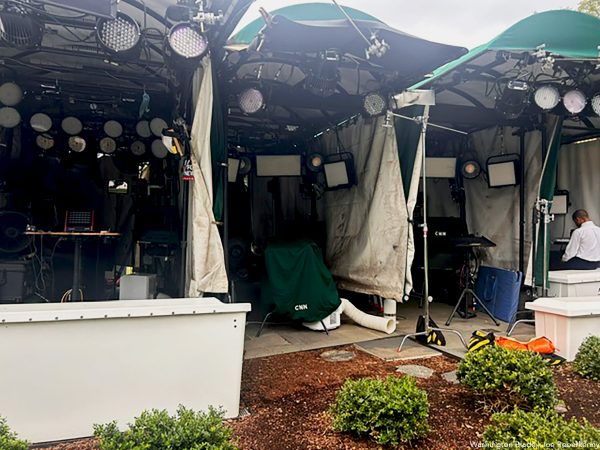
CNN’s outdoor filming area, which is staffed nearly at all times, sat dark with a green cover over the space that normally houses its cameras and political reporters like Kaitlan Collins.
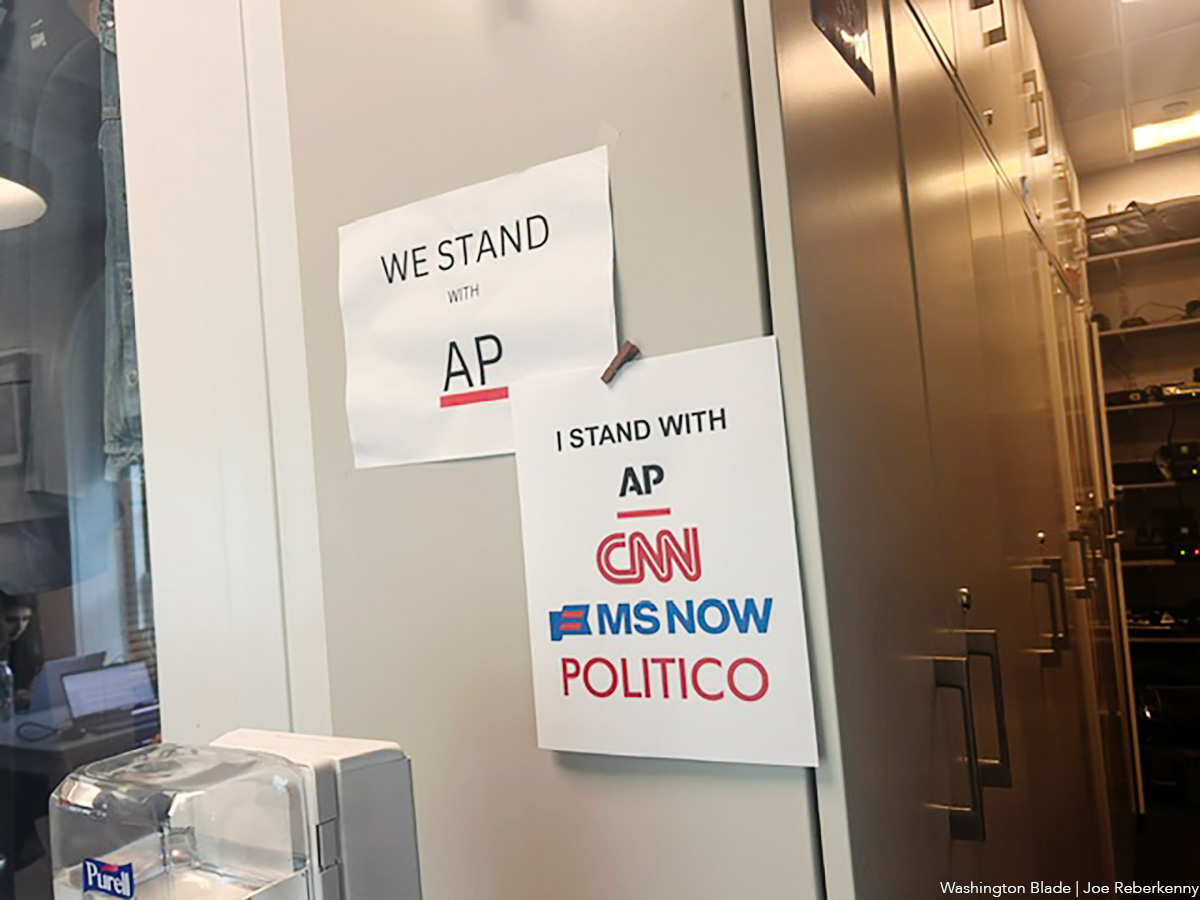
There were small signs of solidarity from other outlets in the press office. A sign that has hung outside one of the news offices in the West Wing was updated. It originally read, “WE STAND WITH AP” following President Trump’s first attempt at removing a news outlet he deemed unfavorable. It now includes “I STAND WITH AP CNN MSNOW POLITICO.”
The change could also be felt as the press pool attempted to cover the president.
There was a ribbon cutting in honor of the $6 million helipad installed at Trump’s behest — which had nearly no audio as a result of fewer microphones in the space following the outlets’ removal on Monday afternoon, and partly because of the loud sound of Marine One.
Vice President JD Vance defended Trump when asked about the changes to TV access at the White House, standing with the president despite this likely being a violation of the First Amendment’s guarantee of a free and fair press.
“He’s not banning media outlets. What he’s doing is saying we’re not going to give you special access to the White House if you engage in what is effectively propaganda,” Vance said, alleging that 92% of the stories from CNN, MS NOW and Politico about Trump are “negative.”
“That’s not representative of the American people. It’s not representative of public opinion,” Vance said.
He pushed back on the notion that this is a hindrance on free speech — claiming access to the president through White House visitation is a privilege — a privilege that in this administration, at least until courts weigh in, could change the landscape of the American media system.
“It’s about basic fairness. They can still report. They still have the access to free speech. They’re just not going to get an office in the White House anymore,” Vance said.
Jacqui Heinrich, the White House Correspondents Association President condemned the president’s actions in restricting media access in a statement sent to WHCA members on Saturday.
“Today’s action revoking access for journalists from CNN, POLITICO, and MSNOW violates the First Amendment. The implications extend beyond these organizations: a standard used to exclude one news outlet because of its coverage could be applied to any outlet in the future.
“The American people, through a free and independent press, must be able to scrutinize those elected to power, regardless of whether government officials view it favorably. That’s why courts have repeatedly held that once the White House provides access to journalists, it cannot deny that access arbitrarily or based on the content of their reporting. The WHCA calls on the administration to immediately restore our colleagues’ access.”

Annapolis Pride arrives this weekend

Calendar: October 2-8

Renee Good’s family files two federal lawsuits

House Democrats urge White House to confront Turkish government over anti-LGBTQ crackdown

988 restores crisis services for LGBTQ youth

HRC National Dinner 2026: A night of music, activism, LGBTQ history

Lesbian Bar Project co-founder: purity politics could destroy our remaining spaces

529 openly LGBTQ candidates running in Brazilian election

HRC report: LGBTQ students face ‘far greater challenges’ in non-supportive states

Meet the LGBTQ candidates running for U.S. House, Senate
-

 LGBTQ Non-Profit Organizations5 days ago
HRC National Dinner 2026: A night of music, activism, LGBTQ history
-
Bars & Parties5 days ago
Lesbian Bar Project co-founder: purity politics could destroy our remaining spaces
-
Brazil4 days ago
529 openly LGBTQ candidates running in Brazilian election
-
National5 days ago
HRC report: LGBTQ students face ‘far greater challenges’ in non-supportive states