Sports
A timeline of progress in U.S. sports
Looking back on influential coming out stories since 1975
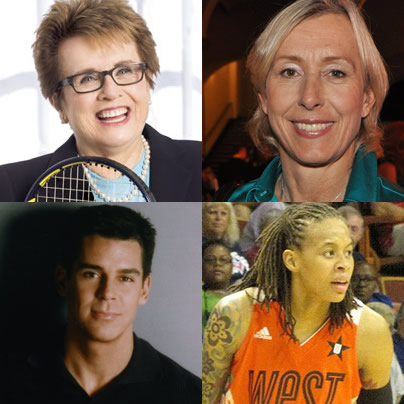
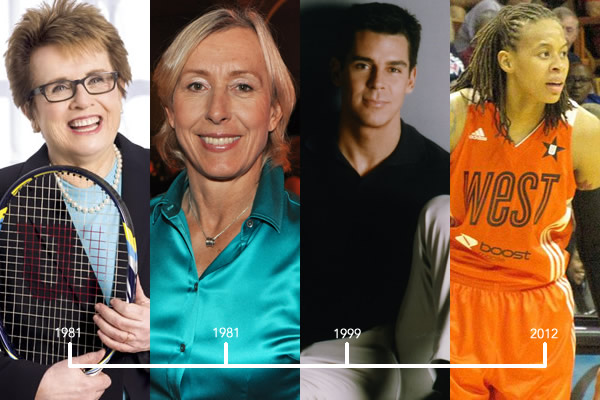
(From left) Billie Jean King, Martina Navratilova, Billy Bean and Seimone Augustus (King photo by Andrew Coppa Photography, Navratilvoa photo by Michael Key, Bean photo by David Vance, Augustus photo by Danny Karwoski)
This timeline reflects the highlights of professional U.S. athletes who have come out in the most popular American sports based on reports in various news media outlets, including OutSports. It is not a definitive list of all athletes that have come out, but experts consider those identified here to have had an important impact in paving the way for more LGBT athletes to come out.
1975: David Kopay, an NFL player with the Washington Redskins, San Francisco 49ers and other teams, comes out as gay shortly after retiring from football. He becomes the first known NFL player, active or retired, to openly discuss his sexual orientation — first with the news media and later in his 1977 bestselling book, “The David Kopay Story: An Extraordinary Self-Revelation.”
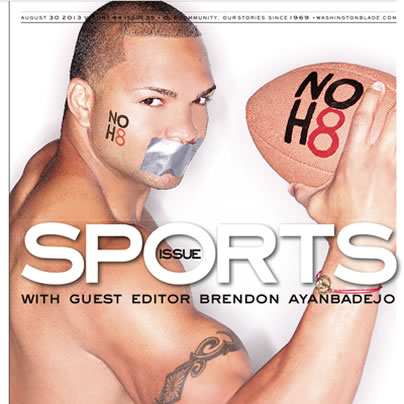
FIND MORE OF THE WASHINGTON BLADE SPORTS ISSUE HERE.
1976: Ophthalmologist and tennis player Dr. Renee Richards is outed as a transgender woman when the U.S. Tennis Association refused to allow her to play in the U.S. Open on grounds that she was born as a male and could not compete against women. She challenged the denial in court and won her case the following year, enabling her to become the first known transgender person to play in a professional sport.
1981: Billie Jean King, the nationally acclaimed tennis star, was outed by her ex-partner Marilyn Barnett in a palimony lawsuit. King said later that the disclosure that she was a lesbian resulted in her losing about $2 million in commercial endorsements from companies that dropped her immediately after learning she was gay.
1981: Martina Navratilova, the internationally acclaimed tennis star, willingly disclosed that she is a lesbian just months after the outing of Billie Jean King. Navratilova became the first big name professional athlete to come out of the closet during the height of her playing career. Although the tennis establishment for the most part supported her she later told the LGBT blog OutSports she lost as much as $10 million in endorsements from companies that spurned her because of her sexual orientation.
1988: Major League Baseball umpire Dave Pallone is fired by then Commissioner of Baseball Bart Giamatti, who cites unsubstantiated allegations that Pallone had sex with a minor. Although authorities in Saratoga Springs, N.Y., dropped an investigation into the allegations and in Pallone’s view exonerated him of any wrongdoing, the umpire said Giamatti and other baseball officials didn’t want him in baseball because he’s gay. In his 1990 book “Behind the Mask: My Double Life in Baseball,” Pallone says his firing reinforced the perception that Major League Baseball would not allow gay players or umpires.
1992: Roy Simmons of the NFL, who played for the New York Giants and Washington Redskins in the 1980s, came out as gay in a TV interview on the “Phil Donahue Show,” several years after his football career ended.
1993: Then former Major League Baseball player Glen Burke came out publicly in 1993 in interviews in Sport magazine and NBC’s “Today” show. According to subsequent reports in the media, Burke came out to his fellow players and manager Tommy Lasorda when he played for the Los Angeles Dodgers in the 1970s. The Dodgers traded him to the Oakland A’s reportedly because top management feared news of Burke’s sexual orientation would become public, leading to negative publicity for the team. He is credited with being the first Major League Baseball player to come out to an entire team. Burke died of AIDS in 1995.
1996: Muffin Spencer-Devlin, a three-time tournament winner on the Ladies Professional Golf Association Tour in the 1980s, came out as a lesbian in a March 1996 article in Sports Illustrated, becoming the first female or male professional golfer to come out while still playing.
1999: Major League Baseball player Billy Bean publicly disclosed he’s gay in 1999, four years after his baseball career ended. He began his Major League Baseball career in 1987 and played for the Detroit Tigers, Los Angeles Dodgers, and San Diego Padres. He wrote about his life as a closeted gay ball player in his 2003 book “Going the Other Way: Lessons from a Life In and Out of Major League Baseball.”
2002: Esera Tuaolo, a defensive lineman for nine years in the NFL before retiring in 1999, came out as gay in a 2002 interview on ESPN. He became the third widely known NFL player to come out shortly after retiring. Like the other two – David Kopay (1975) and Roy Simmons (1992) – Tuaolo’s post-career coming out reinforced the longstanding belief that no NFL player could come out while still playing without facing dire consequences.
2005: Sheryl Swoopes, a seven-time Women’s National Basketball Association (WNBA) All-Star who was chosen three times as the league’s most valuable player, came out as a lesbian in 2005 at the height of her career. After being hailed as a role model for lesbians in sports, Swoopes startled LGBT basketball fans in 2010 when news surfaced that she ended her relationship with her female partner and announced she was engaged to marry a man. She has since retired from basketball and is head coach for the women’s basketball team at Loyola University in Chicago.
2007: John Amaechi, a professional basketball player who retired in 2003, came out as gay four years later, becoming the first player in the National Basketball Association (NBA) to come out, either during or after his playing days. His coming out was timed to coincide with the publication of his autobiography, “Man in the Middle.”
2011: Rick Welts, president of the Golden State Warriors, an NBA team, came out as gay in a New York Times interview in May 2011, becoming the first openly gay executive of the NBA and any of the other top U.S. professional sports. LGBT sports enthusiasts say Welts’ status as an out gay person in a high-level executive post in the professional sports world set a precedent for encouraging more pro sports executives as well as players to come out.
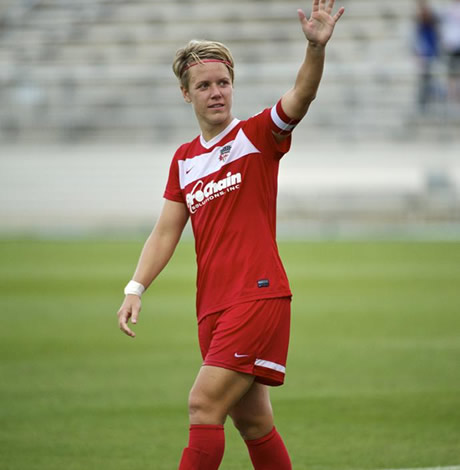
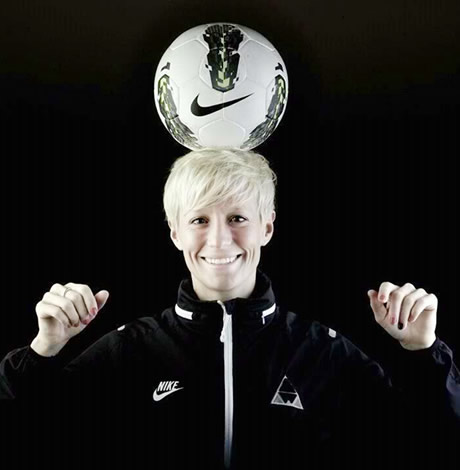
2012: Megan Rapinoe, a women’s U.S. professional soccer player with the Seattle Reign team and who is credited with helping the U.S. women’s national soccer team win a Gold Medal at the 2012 Summer Olympics in England, came out as a lesbian in an interview with “Out” magazine. The sports blog SB Nation reported earlier this month Reign team officials will allow the internationally acclaimed soccer star to play for the French soccer team Lyon for the remainder of this year and next year, with the expectation that she will return to Seattle in June 2014.
2012: Seimone Augustus, considered a WNBA superstar with the Minnesota Lynx team, surfaced as an out lesbian and strong advocate for same-sex marriage when she backed the campaign to oppose a 2012 ballot measure in Minnesota to ban same-sex marriage in the state constitution. After the defeat of the ballot measure, Augustus announced plans to marry her partner Lataya Varner in a Minnesota ceremony.
2013: Robbie Rogers, an American professional soccer player, startled the soccer establishment in February of this year by announcing he is gay and was retiring from soccer at age 25, ending his tenure as a member of England’s championship team Leads United. In May, Rogers changed his mind and was quickly snatched up by the Los Angeles Galaxy, making him the first openly gay professional men’s soccer player in the U.S. having the status of an active player.
2013: Brittney Griner, a star rookie on the WNBA team Phoenix Mercury, publicly disclosed she is gay in April of this year. She became the first woman’s professional basketball player to do so at the start of her professional career.
2013: Jason Collins, a professional basketball player who has played on six NBA teams since 2002, including the Washington Wizards, came out as gay in April of this year, becoming the first active athlete associated with one of the four major male team sports (basketball, football, baseball or hockey) to do so. His decision to come out drew widespread support from fellow athletes and fans, including from President Barack Obama and former President Bill Clinton. However, last month Collins became a free agent and is awaiting a contract with a team to continue playing in the NBA.
Sports
2 former NBA players launch cheap anti-trans stunt to exploit WNBA rules
Enes Kanter Freedom and Royce White are attempting to extend their finished sports careers through vague gender eligibility policy in the WNBA.

As transgender sports policy continues to make headlines, two former NBA players are attempting to use vague WNBA wording on players’ gender identity to extend their finished professional sports careers.
Enes Kanter Freedom and Royce White, two male former professional basketball players who have aligned themselves with the ‘far-right’ political spectrum, have announced that they plan to self-identify as transgender in order to meet the requirements to declare themselves eligible for the WNBA draft.
Freedom last played for the NBA in 2022, while White played his last professional game in 2018.
Both players have explicitly stated that this choice is an attempt to exploit the policy currently in place in the WNBA — one that assumes those who say they identify as transgender women are women — unlike what these two have done.
The WNBA’s collective bargaining agreement states that “only players who are women are eligible to play in the WNBA,” but it does not include more specific language about gender identity or sex assigned at birth, according to The Athletic, The New York Times’s sports publication.
Neither Freedom nor White has previously made any statements about being trans.
“If simply declaring who you are is all that’s required, then I meet every single requirement necessary to compete in the WNBA,” Freedom wrote on X. “Based on the current guidelines, I can and am officially declaring my eligibility for the upcoming WNBA draft in April 2027.”
Hours later, White made a similar statement to Fox News, emphasizing that this was solely an attempt to exploit the policy — an attempt at inclusion — and use it as a loophole to stay relevant in the sport he left in 2018.
“I’m transgender. I’m a woman. I identify as sometimes identifying as a woman for purpose of basketball, professional basketball, so I’ll be declaring for the WNBA draft in 2027 as well,“ White told Fox News. “I think I’d be unstoppable. But I’m a team-first guy. I’m a pass-first kind of player. I do the little things. I led my team in all five major stat categories at Iowa State University, so I do a little bit of everything. I’ll do whatever the coach needs me to do. I’ll do whatever the girls need me to do.”
White also said that he would be open to suing the WNBA if he were not allowed to be a part of the draft, while making transphobic comments about genitalia in the same breath.
“I think the WNBA could come out and make a definitive statement about guys with a pair of balls playing in the Women’s Association,“ White said, saying he doesn’t “want to be discriminated against.”
“I want fair treatment,” White continued while also using the opportunity to promote his run for the U.S. Senate seat in Minnesota. “I’m a young Black, hopefully United States Senator that would like a fair chance to participate as a sometimes-identifying-as-a-transgender-woman athlete.”
“We’re gonna have to have a huge legal battle about discrimination if I can’t play,” he added.
White has made multiple failed attempts to run for office as a Republican since leaving the NBA, with statements surrounding conspiracy theories and his support for Trump coming under fire.
He has faced court actions after falling behind on court-mandated child support payments and has faced family repercussions for his political activities.
White’s grandfather has distanced himself from White, stating: “There’s no way I can support my grandson supporting the GOP, and in essence, Trump.”
In response to Freedom’s X post and White’s announcement, the Women’s National Basketball Players’ Association, the players’ union for the WNBA, released a statement doubling down on its commitment to inclusivity in the sport.
“We embrace justice, equity, diversity, and inclusion. Those are the values that unite this Union and allow it to protect women’s sports while creating transformational change,” the statement said in a post on Instagram.
“Hate, abuse, and demonization of any person or group of people, including transgender people, only fuel fear, division, and harm. We will continue to have hard conversations,” the post continued. “But we will not be used as political pawns.”
The statement comes just days after WNBA Commissioner Cathy Engelbert sent a memo to teams attempting to address ongoing discussions around transgender athletes in women’s basketball.
“I know many of you have received questions in recent weeks regarding transgender athlete participation in women’s basketball, and I expect this topic will continue to receive significant attention,” Engelbert wrote in the memo, which was sent Friday afternoon and published in the Associated Press. “I wanted to reach out to share how we are approaching these conversations at the league office and to thank those of you who have responded to questions from the media with thoughtfulness and professionalism.”
“We recognize that this is a complex and nuanced topic, and we will continue to have important conversations with all of you and the Players Association in the weeks and months ahead,” Engelbert said. “We also plan to convene additional discussions and offer listening sessions for any team leaders who would like to participate. Your perspectives and feedback are invaluable, and I appreciate those who have already reached out to share their thoughts.”
The memo, which does not clarify whether the league’s stance on gender eligibility will change or what the ongoing conversations have looked like, comes as political figures — particularly those on the right — continue to fuel debates over transgender participation in women’s sports across the country and across sports.
Republican Florida Gov. Ron DeSantis also commented on the ongoing eligibility meetings the WNBA is holding, using the issue to criticize transgender participation in women’s sports.
“WNBA meeting to decide whether 2+2=4 or 2+2=5,” Desantis wrote on X on Saturday.
Indiana Fever player Sophie Cunningham voiced support for barring transgender girls and women from girls’ and women’s sports. Cunningham’s comments sparked small rallies and protests in Seattle and Portland when the Fever were on the road last week.
Despite the loudest voices — and those being covered by non-LGBTQ outlets — highlighting negative takes on transgender inclusion on female sports teams, multiple WNBA members have voiced their support for transgender women participating in sports.
Seattle Storm center Stefanie Dolson and Minnesota Lynx coach Cheryl Reeve have used their platforms to continue their vocal support for transgender women participating in sports.
“We need to protect trans kids,” Reeve said on Aug. 1. “To me, it’s a human rights issue. Every kid has a right to sports.”
A source familiar with the league told the Blade that the WNBA is not taking Freedom and White’s announcements seriously and is not entertaining what the source characterized as bad-faith efforts to demonize the transgender community. The source emphasized that there are no serious or immediate eligibility issues involving the two men and said their attempts to enter women’s sports do not represent an effort to protect women’s sports.
“The WNBA will not allow bad-faith publicity stunts designed to mock or demean others to dictate serious conversations about league policy,” the source told the Blade on Tuesday. “There are no immediate eligibility issues affecting the WNBA.”

Iran and Egypt on Friday faced off during the World Cup’s “Pride Match” in Seattle.
Iran is among the handful of countries in which consensual same-sex sexual relations remain punishable by death. Discrimination and persecution based on sexual orientation and gender identity is commonplace in Egypt.
Friday’s match coincided with Pride weekend in Seattle. The Egyptian Football Association and the Football Federation Islamic Republic of Iran both objected to playing in the “Pride Match.”
Egypt and Iran tied 1-1.
FIFA, for its part, allowed Pride flags inside the stadium during the match.
“The FIFA World Cup 2026 is an inclusive event that welcomes people from all backgrounds,” a FIFA spokesperson told the Washington Blade in a statement. “Fans of all sexual orientations and gender identities are welcome at matches and events. General statements of human rights, including rainbow flags and other flags representing sexual orientation and gender identity, are permitted under the FIFA World Cup 2026™ Stadium Code of Conduct and may be displayed inside stadiums provided they are used in a manner consistent with the code.”
Human Rights Watch welcomed FIFA’s decision to allow Pride flags inside the stadium. Outright International, a global LGBTQ and intersex rights group, distributed Pride flags in Seattle on Friday, which was Pride Match Day.
“Visibility matters,” said Outright International Executive Director Maria Sjödin. “Pride is now being celebrated in more than 100 countries, including this weekend in Seattle. For many LGBTIQ people, seeing a Pride flag in public is a reminder that they are not alone, and that their rights and dignity are recognized.”
FIFA President Gianni Infantino earlier this year told Die Weltwoche, a Swiss magazine, that “there will be no ‘Pride Match’ at the (FIFA) World Cup.”
“There will be a FIFA World Cup match in Seattle, and on the same day, events organized by external organizations will be taking place in the city,” said Infantino. “But that has nothing to do with the match itself.”
Peter Tatchell, a long-time LGBTQ activist from the U.K. who is director of the Peter Tatchell Foundation, was among those who traveled to Seattle for Friday’s match. Tatchell accused FIFA of not vetting World Cup teams — specifically Iran, Egypt, Saudi Arabia, Ghana, Senegal, Qatar, Tunisia, Morocco, Iraq, Uzbekistan, and Algeria — over whether they would allow gay players.
“FIFA is protecting LGBT+ visibility in the stands while failing to protect LGBT+ players on the pitch,” said Tatchell.
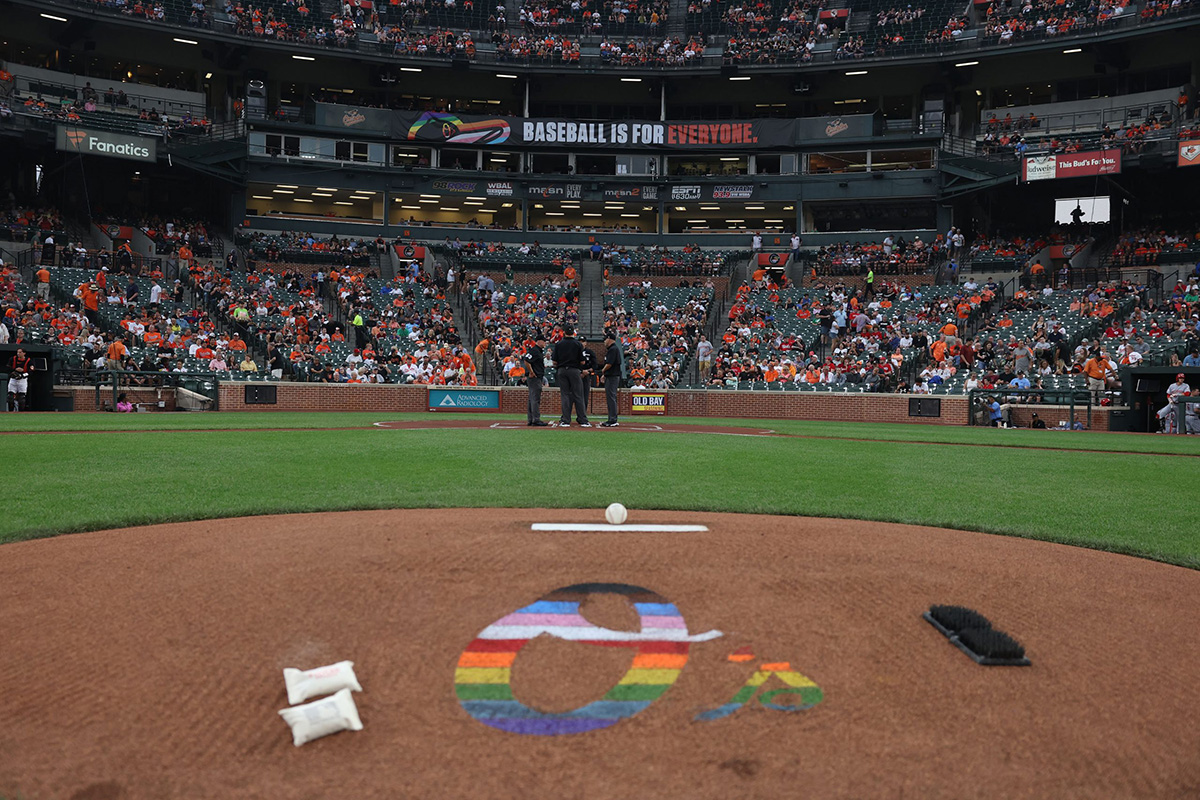
The Baltimore Orioles will take on the Washington Nationals on Friday, June 26 at 7 p.m. for Pride Night at Oriole Park.
The first 15,000 fans will receive an exclusive Pride Night Orioles jersey. The Washington Blade is a media sponsor of this event.
To purchase tickets, visit Orioles.com/Tickets.

Flanagan beats Craig in Minn. Senate primary after winning key LGBTQ endorsements

Gay ANC commissioner sues D.C. over police ‘failure’ to pay reward money

New LGBTQ visitor center slated for Wilmington, Del.

Jason DePuy on coping with homophobia in ‘Big Brother’ house