News
Dutch LGBT advocacy spans more than a century
Formal gay activism in the Netherlands began in 1911 over consent law
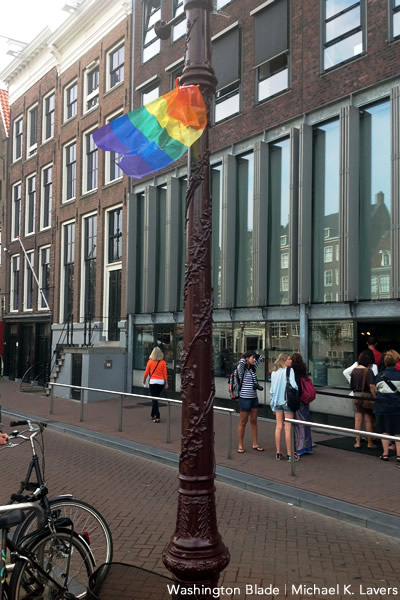
A rainbow flag outside the Anne Frank House in Amsterdam (Washington Blade photo by Michael K. Lavers)
AMSTERDAM — Formal Dutch LGBT advocacy began in 1911 when the Netherlands raised the age of consent for same-sex sexual relations from 16 to 21.
Koen van Dijk, executive director of COC Nederland, a Dutch LGBT advocacy group, told the Washington Blade during an interview in his Amsterdam office earlier this month the measure prompted gay men to respond against it.
“That spurred gay men that were insulted by this legislation, but were also offended by it to become more organized and start working on change,” he said.
COC Nederland can trace its origins back to the late 1930s when a group of gay men who primarily lived in Amsterdam begin to publish a magazine called “The Right to Live.”
Gay organizing in the Netherlands came to an abrupt halt in 1940 when Germany invaded the Netherlands. Those who published the magazine burned their archives and went underground because van Dijk said they “heard stories of what happened to gay people in Germany” under the Nazi regime.
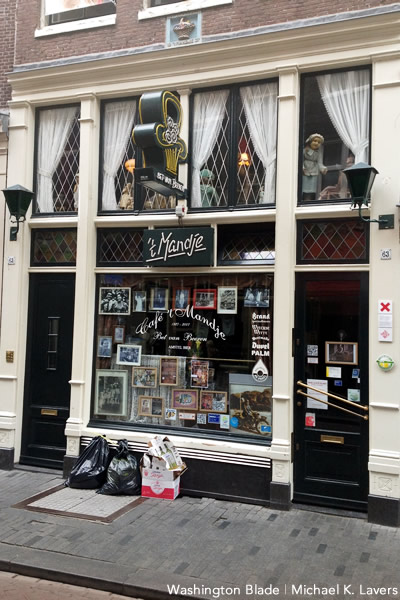
Amsterdam’s oldest gay bar, Café t’Mandje, opened in 1927. (Washington Blade photo by Michael K. Lavers)
Café t’Mandje, the country’s first gay bar that lesbian Bet van Beeren opened in what is now Amsterdam’s Chinatown in 1927, remained open during the war. Van Beeren hid Jews and smuggled weapons to the Dutch resistance in her establishment throughout the occupation. She even bribed German soldiers with alcohol.
“The Right to Live” began to publish after the war ended in 1945, and COC Nederland formally came into existence on Dec. 7, 1946. It began as a social club under the acronym Center for Relaxation and Culture or Cultuur-en Ontspanningscentrum (COC) in Dutch, and had two offices in Amsterdam and The Hague.
“It was a social club where people could meet behind closed doors,” van Dijk said. “Discrimination was still very high in the Netherlands at that time. People would actually lose their jobs if they were out at work and could lose their homes.”
LGBT equality and acceptance remain group’s objectives
COC Nederland has two broad goals: Personal emancipation of LGBT people and the promotion of greater acceptance of gay men and lesbians in the country through legislation and social acceptance.
Lawmakers in 1971 equalized the age of consent for same-sex and opposite-sex sexual relations. The Dutch government in 1973 formally recognized COC Nederland, which at that time was known as the Dutch Association for Integration of Homosexuality COC.
The Netherlands in 2001 became the first country in the world to extend marriage rights to gays and lesbians.
Van Dijk was quick to point out COC Nederland continues to work on a host of issues in spite of the country’s liberal and pro-gay reputation.
A 2009 report the Dutch Ministry of Justice commissioned found 70 percent of LGBT people in the Netherlands have experienced harassment because of their sexual orientation and/or gender identity and expression. A third of respondents said they experienced physical violence.
One-third of Dutch LGBT employees are not out in the workplace, while more than 30 percent of people in the Netherlands said they find gay people kissing in public shocking.

COC Nederland’s GSA program is now in two-thirds of the Netherlands’ public high schools. (Washington Blade photo by Michael K. Lavers)
Van Dijk said anti-LGBT bullying in Dutch schools remains a problem — COC Nederland in 2008 launched a program based on Gay-Straight Alliances in the U.S. to combat homophobia and transphobia. The initiative is now in two-thirds of the country’s public high schools.
“The layer of tolerance is thinner than it looks at first glance,” van Dijk told the Blade, noting anti-LGBT attitudes remain among specific religious and ethnic groups in the Netherlands. “There’s a whole spectrum of intolerance that is still really worrying.”
COC Nederland: Dutch government is an ally
Van Dijk said lawmakers have been responsive to concerns his organization and other LGBT advocacy groups have had over specific issues.
Dutch lawmakers last September passed a law that said a resident of the Netherlands could only sponsor their partner for immigration purposes if the couple had already legally married in the foreign-born spouse’s country of origin. The Netherlands is one of only 14 countries in which gays and lesbians can legally marry.
Lawmakers quickly repealed the statute after COC Nederland and other LGBT advocates expressed concern.
“We had to go to Parliament, go to our government to say you probably don’t mean this happening, but this will make our lives more difficult,” van Dijk said. “They’ve been very responsible.”
Van Dijk said LGBT asylum seekers in the Netherlands remain particularly vulnerable because the government places them in housing with their countrymen who may subject them to anti-gay harassment and violence. He noted officials are sometimes unaware of this treatment, while others may blame the victim who experiences mistreatment because of their sexual orientation or gender identity and expression.
“For them a gay man is 40, wearing a pink boa standing on a boat at gay Pride,” van Dijk told the Blade. “They don’t recognize LGBT people and that they have a different view of how good they should be or take care of themselves in that situation. So we need to really work with organizations like them, or care organizations for the elderly.”
State Secretary for Security and Justice Fred Teeven in 2011 introduced a bill for which COC Nederland and the Transgender Network Netherlands had lobbied for years that would allow trans people to change their gender on their birth certificates, passports and other official documents without undergoing sterilization and sex-reassignment surgery before petitioning a judge to grant the request.
Argentina President Cristina Fernández de Kirchner last year signed a law that allows trans Argentinians to legally change their gender on official documents without surgery and an affidavit from a doctor or another medical provider. The Dutch measure is similar to the Argentine law, but it would still require a trans person to obtain a statement from an “expert” to legally change their gender.
The proposal would also eliminate the need to petition a judge to approve a person’s request to legally change gender.
“It’s an invasion of rights,” van Dijk said in reference to current Dutch law. “It’s the integrity of the body; it’s privacy.”
The main chamber of the Dutch Parliament earlier this year approved the bill, but the country’s Senate has yet to act upon it. Van Dijk said he remains hopeful senators will vote on the measure in the fall once they debate a bill that would allow a married lesbian to petition municipal officials – and not go before a judge as current Dutch law mandates — to receive full parental rights of her spouse’s child she conceived through artificial insemination.
“The Senate is not working very fast at the moment, but we have good hopes that within a year it will all be fixed,” van Dijk said.
COC Nederland also works with LGBT rights advocates in Eastern Europe, Africa and other areas throughout the world.
The organization in April staged a protest outside the meeting between Russian President Vladimir Putin and Dutch Prime Minister Mark Rutte over Russia’s LGBT rights record. More than 3,000 people last month protested a Russian law that bans gay propaganda to minors and other anti-LGBT measures in the country during a Kremlin-sponsored concern in Amsterdam’s Museumplein that van Dijk said was designed to “acquaint the Dutch audience with the beauty and diversity of Russian culture.”
Authorities in the Russian city of Murmansk in July arrested four Dutch LGBT rights advocates who are not affiliated with COC Nederland for violating the country’s gay propaganda law while filming a documentary about LGBT life in Russia.
Van Dijk described Russia’s LGBT rights record as a “disgrace,” but said COC Nederland does not support calls to boycott the 2014 Winter Olympics over the issue.
“What we’re doing is listening to our counterparts in Russia and [they’ve asked] us to come over instead of to boycott,” van Dijk said. “We’re not going to explain to them what’s best for them. They should explain to us what is best for them.”



Maryland
Md. Commission on LGBTQIA+ Affairs released updated student recommendations
LGBTQ students report higher rates of bullying, suicide

The Maryland Commission on LGBTQIA+ Affairs has released updated recommendations on how the state’s schools can support LGBTQ students.
The updated 16-page document outlines eight “actionable recommendations” for Maryland schools, supplemented with data and links to additional resources. The recommendations are:
- Developing and passing a uniform statewide and comprehensive policy aimed at protecting “transgender, nonbinary, and gender expansive students” against discrimination. The recommendation lists minimum requirements for the policy to address: name, pronoun usage, and restroom access.
- Requiring all educators to receive training about the specific needs of LGBTQ students, by trained facilitators. The training’s “core competencies” include instruction on terminology, data, and support for students.
- Implementing LGBTQ-inclusive curricula and preventing book bans. The report highlights a “comprehensive sexual education curriculum” as specifically important in the overall education curriculum. It also states the curriculum will “provide all students with life-saving information about how to protect themselves and others in sexual and romantic situations.”
- Establishing Gender Sexuality Alliances “at all schools and in all grade levels.” This recommendation includes measures on how to adequately establish effective GSAs, such as campaign advertising, and official state resources that outline how to establish and maintain a GSA.
- Providing resources to students’ family members and supporters. This recommendation proposes partnering with local education agencies to provide “culturally responsive, LGBTQIA+ affirming family engagement initiatives.”
- Collecting statewide data on LGBTQ youth. The data on Maryland’s LGBTQ youth population is sparse and non-exhaustive, and this recommendation seeks to collect information to inform policy and programming across the state for LGBTQ youth.
- Hiring a full-time team at the Maryland Department of Education that focuses on LGBTQ student achievement. These employees would have specific duties that include “advising on local and state, and federal policy” as well as developing the LGBTQ curriculum, and organizing the data and family resources.
- Promoting and ensuring awareness of the 2024 guidelines to support LGBTQ students.
The commission has 21 members, with elections every year, and open volunteer positions. It was created in 2021 and amended in 2023 to add more members.
The Governor’s Office of Communication says the commission’s goal is “to serve LGBTQIA+ Marylanders by galvanizing community voices, researching and addressing challenges, and advocating for policies to advance equity and inclusion.”
The commission is tasked with coming up with yearly recommendations. This year’s aim “to ensure that every child can learn in a safe, inclusive, and supportive environment.”
The Human Rights Campaign’s most recent report on LGBTQ youth revealed that 46.1 percent of LGBTQ youth felt unsafe in some school settings. Those numbers are higher for transgender students, with 54.9 percent of them saying they feel unsafe in school.
Maryland’s High School Youth Risk Behavior Survey reveals a disparity in mental health issues and concerns among students who identify as LGBTQ, compared to those who are heterosexual. LGBTQ students report higher rates of bullying, feelings of hopelessness, and suicidal thoughts. Nearly 36 percent of LGBTQ students report they have a suicide plan, and 26.7 percent of respondents say they have attempted to die by suicide.
The commission’s recommendations seek to combat the mental health crisis among the state’s LGBTQ students. They are also a call for local and state governments to work towards implementing them.
Virginia
Va. lawmakers consider partial restoration of Ryan White funds
State Department of Health in 2025 cut $20 million from Part B program
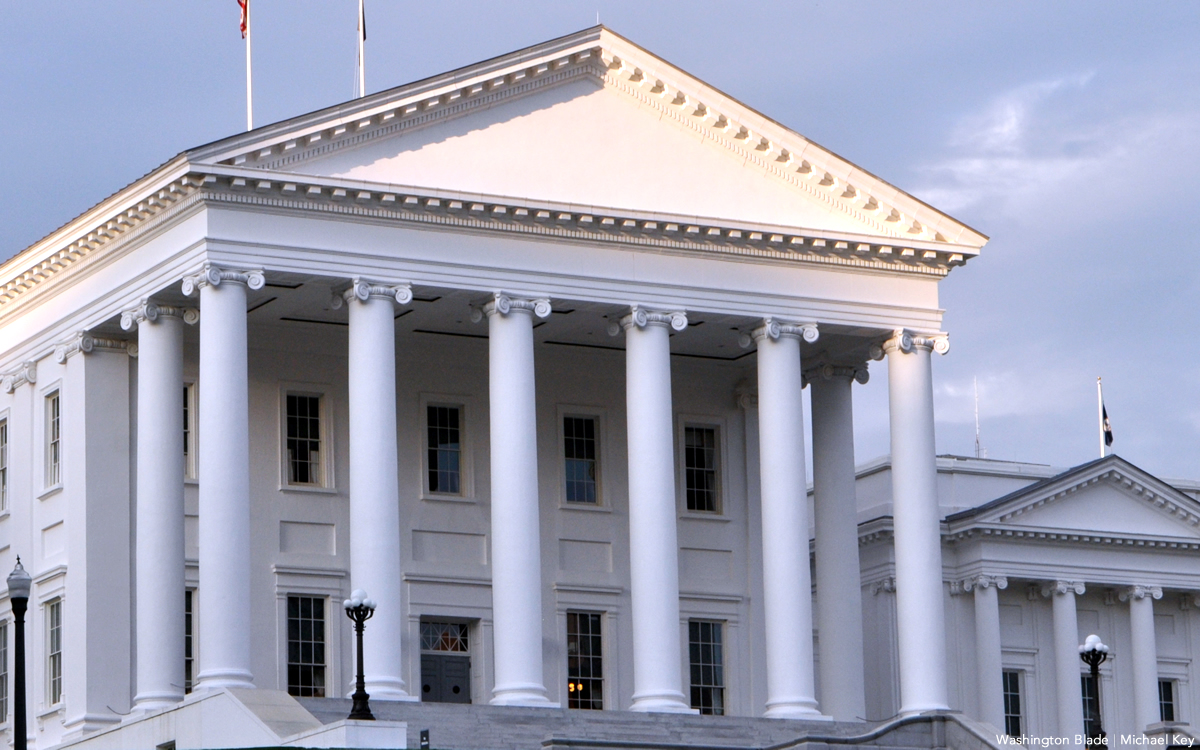
The Virginia General Assembly is considering the partial restoration of HIV funding that the state’s Department of Health cut last year.
The Department of Health in 2025 cut $20 million — or 67 percent of total funding — from the Ryan White Part B program.
The funding cuts started with the Trump-Vance administration passing budget cuts to federal HIV screening and protection programs. Rebate issues between the Virginia Department of Health and the company that provides HIV medications began.
Advocates say the funding cuts have disproportionately impacted lower-income people.
The Ryan White HIV/AIDS Program, a federal program started in 1990, provides medical services, public education, and essential services. Part B offers 21 services, seven of which remained funded after the budget cuts.
Equality Virginia notes “in 2025, a 67 percent reduction severely destabilized HIV services across the commonwealth.”
Virginia lawmakers have approved two bills — House Bill 30 and Senate Bill 30 — that would partially restore the funding. The Ryan White cuts remain a concern among community members.
Both chambers of the General Assembly must review their proposed changes before lawmakers can adopt the bills.
“While these amendments aren’t a full restoration of what community-based organizations lost, this marks a critical step toward stabilizing care for thousands of Virginians living with HIV,” said Equality Virginia Executive Director Narissa Rahaman. “Equality Virginia plans to continue their contact with lawmakers and delegates through the conference and up until the passing of the budget.”
“We appreciate lawmakers from both sides of the aisle who recognized the urgency of this moment and will work to ensure funding remains in the final version signed by the governor,” added Rahaman.
National
Peter Thiel’s expanding power — and his overlap with Jeffrey Epstein
Gay billionaire’s name appears 2,200 times in files, but no criminality alleged
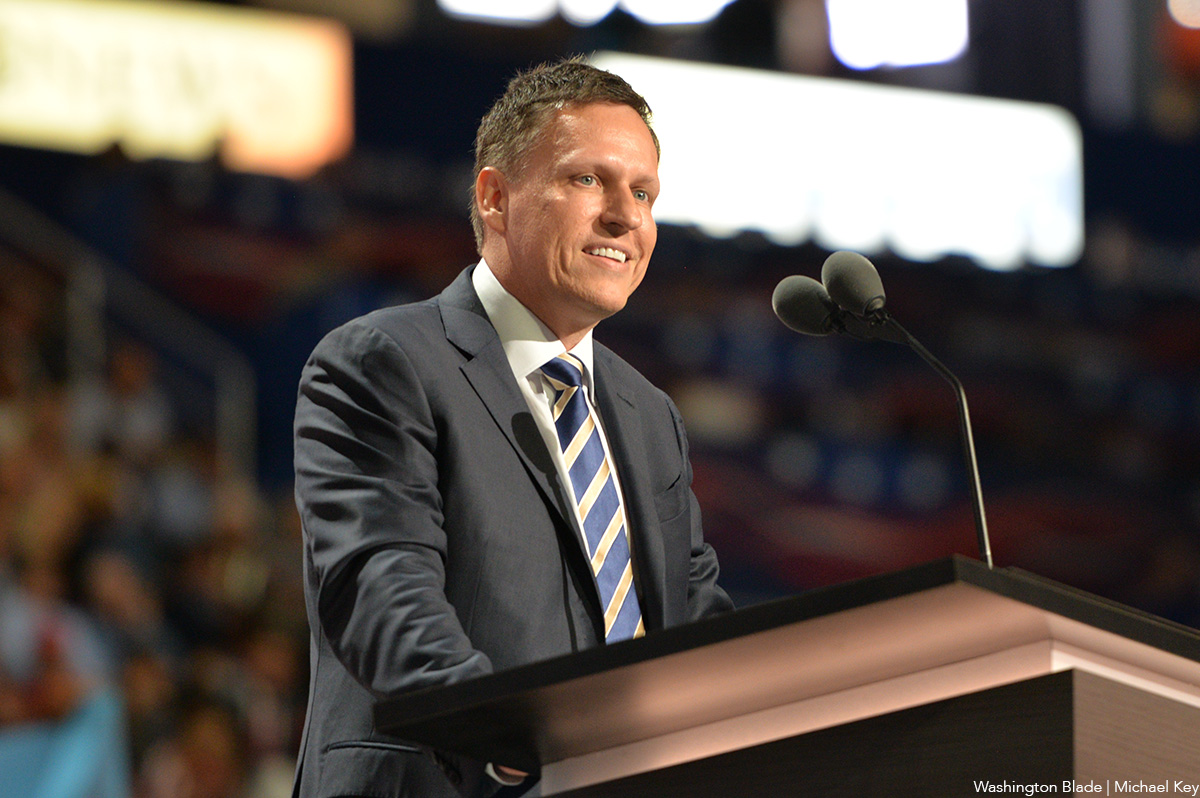
There are few figures in modern politics whose reach extends across Silicon Valley, Wall Street, and Washington, D.C., as Peter Thiel’s.
A billionaire venture capitalist, Thiel built his fortune at the dawn of the internet age and has since positioned himself at the highest levels of U.S. technology, finance, and national defense infrastructure. He is best known as a co-founder of PayPal, an early investor in Facebook, and the co-founder of Palantir Technologies — a data analytics firm that maintains significant contracts with U.S., U.K., and Israeli defense and intelligence agencies.
Over the last two decades, Thiel has also built an interconnected network of investment vehicles — Clarium Capital, Founders Fund, Thiel Capital, Valar Ventures, and Mithril Capital — giving him influence over emerging technologies, political candidates, and ideological movements aligned with his worldview. Through these firms, Thiel has backed companies in artificial intelligence, defense technology, biotech, cryptocurrency, and financial services, often positioning himself early in sectors that later became central to public policy debates.
Born in Frankfurt, West Germany, in 1967, Thiel immigrated to the United States as an infant. He later attended Stanford University, earning a degree in philosophy before graduating from Stanford Law School in 1992. As an undergraduate, he founded The Stanford Review, a conservative student publication that opposed what it described as campus “political correctness.” The paper became a platform for combative and contrarian arguments that previewed themes Thiel would revisit in later essays and speeches about elite institutions, democracy, and technological stagnation.
Thiel’s professional ascent coincided with the explosive growth of the dot-com era. In 1998, he co-founded PayPal, helping pioneer digital payment systems that would become foundational to online commerce. When the company was sold to eBay in 2002 for $1.5 billion, Thiel emerged a multimillionaire and part of what would later be known as the “PayPal Mafia” — a loose but influential network of founders and early employees who went on to launch or invest in some of Silicon Valley’s most dominant firms.
In 2004, Thiel made one of the most consequential investments of his career, providing $500,000 in seed funding to Facebook, then a fledgling social network founded by Mark Zuckerberg. He became the company’s first outside investor and later served on its board. That early bet proved extraordinarily lucrative and cemented Thiel’s status as a major venture capitalist with a reputation for identifying transformative platforms before they reached scale.
The same year, he co-founded Palantir Technologies. Initially backed in part by In-Q-Tel, the CIA’s venture capital arm, Palantir developed software — including its Gotham platform — designed to help defense, intelligence, and law enforcement agencies integrate and analyze massive datasets. The company’s tools allow users to map relationships, identify patterns, and visualize complex networks across financial records, communications data, and other digital trails.
Over time, Palantir secured billions of dollars in public-sector contracts. It has worked with the U.S. Department of Defense, Immigration and Customs Enforcement, the Centers for Disease Control and Prevention, and allied governments abroad. Public reporting has documented that its global government contracts exceed $1.9 billion, including agreements with Israeli defense entities — relationships that reportedly expanded following the Oct. 7 attacks in Israel. Critics have raised concerns about civil liberties and surveillance, while supporters argue the company provides essential national security tools.
By the mid-2000s, Thiel was no longer simply a wealthy entrepreneur. He was a financier operating at the intersection of capital, advanced technology, and government — with investments embedded in some of the country’s most sensitive security systems. His political giving would later extend that influence further, including support for candidates aligned with his populist and nationalist leanings– notably Donald Trump in 2016.
As his wealth and influence expanded, so too did his proximity to other powerful — and, in some cases, controversial — figures in global finance.
Among them was Jeffrey Epstein.
Thiel’s name appears more than 2,200 times in documents released so far by the U.S. Department of Justice related to Epstein. A name appearing in legal filings does not, by itself, indicate wrongdoing. However, the extensive references illustrate that Epstein’s social and financial network intersected with elite figures in technology, academia, politics, and finance — including individuals connected to Thiel’s business and philanthropic circles.
Epstein’s legal troubles became public in 2005, when police in Palm Beach, Fla., investigated allegations that he had sexually abused a minor. In 2008, he pleaded guilty in state court to soliciting prostitution from a minor under a plea agreement that was widely criticized as unusually lenient. He served 13 months in county jail with work-release privileges and was required to register as a sex offender. Comparable federal charges can carry significantly longer sentences.
Despite that conviction, Epstein continued to maintain relationships with prominent business and political figures for years. The extent to which members of elite networks remained in contact with him after his guilty plea has been the subject of extensive scrutiny.
Documents released by the Justice Department indicate that individuals connected to Thiel’s philanthropic and investment circles communicated with Epstein after his conviction. One document shows an invitation, sent on behalf of the Thiel Foundation, for Epstein to attend a technology event in San Francisco. Additional financial records and reporting indicate that between 2015 and 2016, Epstein invested approximately $40 million in funds managed by Valar Ventures, one of Thiel’s firms. Other records reflect meetings and correspondence, at times arranged through intermediaries. Epstein also extended invitations to his Caribbean residence.
There is no evidence that Thiel was involved in Epstein’s criminal conduct. The documented interactions do, however, show numerous planned meetings between the two both in the Caribbean (where Epstein’s infamous island is located) and across the world, while also raising questions about why business relationships continued after Epstein had pleaded guilty to a sex offense involving a minor and was a registered sex offender. For critics, that continued engagement speaks to the insular nature of elite finance, where access to capital and networks can override reputational risk.
Palantir represents another overlap. In emails made public through Justice Department releases, Epstein referenced Palantir in correspondence with Ehud Barak, the former Israeli prime minister who also maintained ties to Epstein. The emails do not indicate that Epstein had operational involvement in Palantir or access to its systems, however, they show that he discussed one of Thiel’s most strategically significant companies — a firm deeply integrated into Western defense and intelligence systems — with senior political figures abroad.
Separately, Thiel’s long-running dispute with Gawker Media offers additional insight into how he has exercised power outside traditional political channels.
After Gawker published an article in 2007 that publicly identified Thiel as gay, he later secretly funded litigation brought by professional wrestler Hulk Hogan over the outlet’s publication of a sex tape. The lawsuit resulted in a $140 million judgment against Gawker, which ultimately filed for bankruptcy. Thiel later confirmed his financial backing of the case, framing it as a defense of privacy and a response to what he considered reckless media behavior.
The episode demonstrated Thiel’s willingness to deploy substantial financial resources strategically and, at times, discreetly. It also illustrated how wealth can be used to influence institutions — whether through venture capital, political donations, or litigation.
Taken together, the record does not establish criminal liability for Thiel in connection with Epstein. It does, however, situate him within a dense web of elite finance, national security contracting, political influence, and reputation management. As additional documents related to Epstein continue to emerge, that web — and the decisions made within it — remains a subject of public interest and ongoing scrutiny.

Madonna’s dancer Slam prepping new book

Md. Commission on LGBTQIA+ Affairs released updated student recommendations

Va. lawmakers consider partial restoration of Ryan White funds

Finding community through tragedy

Peter Thiel’s expanding power — and his overlap with Jeffrey Epstein

After layoffs at Advocate, parent company acquires ‘Them’ from Conde Nast
ACLU sues Kansas over law invalidating trans residents’ IDs

Calendar: February 27-March 5

Plan your wedding the LGBTQ way