Local
‘I want to really remember what happened’
Mayor, officials honor World AIDS Day, promise continued fight
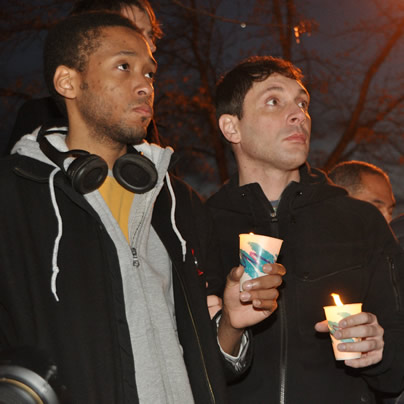
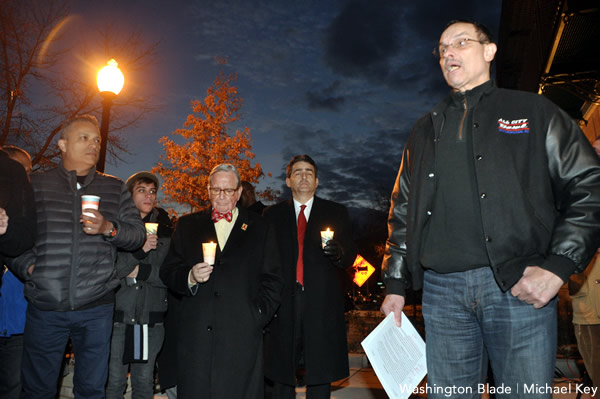
D.C. Mayor Vincent Gray and three members of the City Council participated in a candlelight vigil to honor World AIDS Day on Sunday. (Washington Blade photo by Michael Key)
About 75 people, including D.C. Mayor Vincent Gray and three members of the City Council, raised candles outside a former Whitman-Walker Clinic building at 14th and S streets, N.W., on Sunday night as part of the city’s 26th Annual World AIDS Day commemoration.
“This day has been a day to remember all those who have been affected by the epidemic and to rededicate ourselves not only to continue the fight against HIV but actually finding a cure,” said Whitman-Walker Health Executive Director Don Blanchon, who served as host of the event.
“On this World AIDS Day we have great hope and optimism that we may see the end of this epidemic in the not too distant future,” Blanchon said. “In this year we have seen tremendous advances in the fight. We’ve seen dramatic improved statistics on HIV/AIDS in our city.”
Gray, who pointed to a significant drop in the HIV infection rate in D.C. over the past several years, said he too is optimistic that a cure for AIDS could come sooner rather than later.
“It’s hard to believe that it wasn’t many years ago that we talked about AIDS being a death sentence,” Gray said. “It is not a death sentence anymore. With the advancement of pharmacology, even those who have full-blown AIDS can live a rich life. As long as the people take their medicine and stay on their regimen they can live a full and rich life,” he said.
Blanchon said Whitman-Walker chose to hold this year’s World AIDS Day vigil at the 14th and S Street site because the building at 1407 S St., N.W., was the home of the then Whitman-Walker Clinic during the peak of the AIDS epidemic during the 1980s and early 1990s.
He noted that Whitman-Walker Clinic, which has since been renamed Whitman-Walker Health, moved most of its patient care programs out of the 1407 S St. building in 1993, when it opened its Elizabeth Taylor Building one block away at 14th and U streets, N.W. Whitman-Walker continued to operate other programs in the S Street building until 2007, according to Whitman-Walker spokesperson Chip Lewis.
The JBC Companies real estate development firm, which purchased the 1407 S St. building along with adjacent properties, last month, installed a sculptured vertical column called the Pillar of Fire on the sidewalk outside the building. A plaque at the base of the sculpture says it’s dedicated to the “Whitman-Walker Clinic and the many health care workers who served the LGBT community in this building from 1987 to 2008, the early years of the pandemic.”
D.C. Council member Jim Graham (D-Ward 1), who served as executive director of Whitman-Walker during its years at the 1407 S St. building, called on those attending the World AIDS Day gathering to remember the dedicated people who worked on AIDS-related causes in the early years of the epidemic.
“Like everybody else who is here, I want to remember. I don’t want to forget. I want to really remember what happened,” Graham said. “And when I was committing to think of the people that I wanted to mention, there became too many names. People who ought to have been with us today are not.”
Among the names Graham mentioned were Gene Frey, a Whitman-Walker official who died in the mid-1980s of AIDS and for whom Whitman-Walker’s Gene Frey Award has been named. Others named were longtime Whitman-Walker supporters and local AIDS advocates Hank Card and Dusty Cunningham, both of whom also died of AIDS.
Others attending the vigil were D.C. Council members David Grosso (I-At-Large) and Tommy Wells (D-Ward 6). Also attending the event was Dr. Joxel Garcia, director of the D.C. Department of Health; and Michael Kharfen, acting director of the DOH’s HIV/AIDS, Hepatitis, STD, and Tuberculosis Administration (HAHSTA).
Rev. Courtenay Miller, pastor of Norbeck Community Church of Silver Spring, Md.; and Rabbi Laurie Green of Bet Mishpachah, the D.C.-based synagogue that caters to the LGBT community, led prayers at the vigil.
Blanchon praised Graham for taking the lead in guiding Whitman-Walker through some of the most difficult times when not many other clinics and health facilities were focusing on AIDS
“In this building a small group of dedicated men and women provided care and compassion when many others would not in our community,” Blanchon told the gathering. “In the epidemic’s darkest hours these individuals gave without question what is the best of humanity – compassion, respect and love in one’s hour of needed.”
He added, “So many of those individuals are no longer with us and yet they live on in our hearts and minds. They were our partners, our family members, our friends, and our work colleagues. And today they are the light and hope that we carry forward in the quest to find a cure for AIDS.”
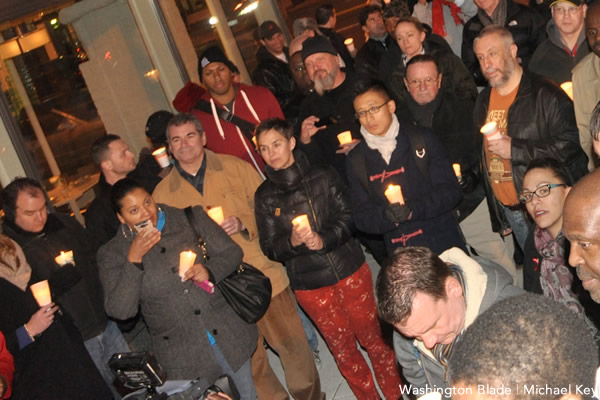
The 2013 D.C. World AIDS Day vigil drew about 75 participants. (Washington Blade photo by Michael Key)


Virginia
Fellow lawmakers praise Adam Ebbin after Va. Senate farewell address
Gay state senator to take job in Spanberger administration
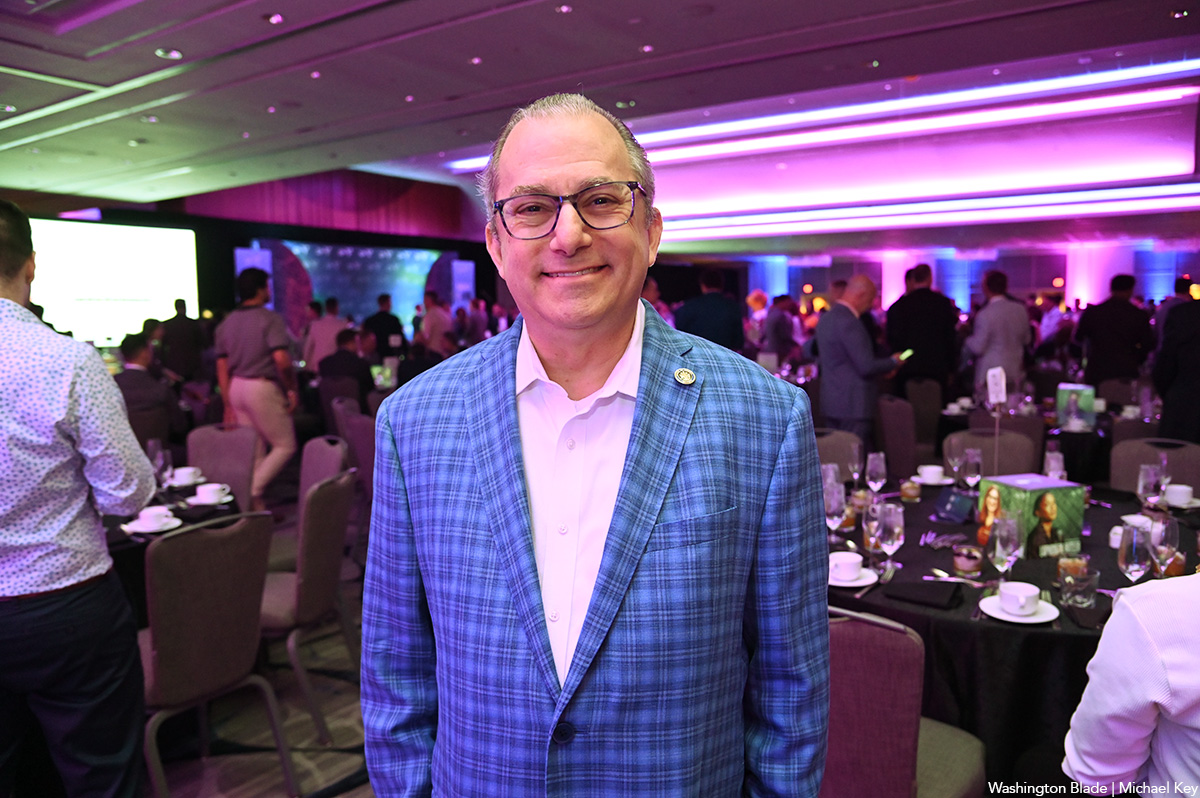
Gay Virginia state Sen. Adam Ebbin (D-Alexandria) delivered his farewell address on Feb. 16 in the Senate chamber in Richmond following his decision to resign from his role as a lawmaker to take a position as senior advisor to Democratic Gov. Abigail Spanberger.
Ebbin, whose resignation was to take effect Feb. 18, received a standing ovation from his fellow senators. Several of them spoke after Ebbin’s address to praise him for his service in the Virginia Senate from 2012 to 2026.
Ebbin first won election to the Virginia House of Delegates in 2003 as the first openly gay member of the General Assembly. He served in the House of Delegates from 2004 to 2012 before winning election to the Senate in 2011.
His Senate district includes Alexandria and parts of Arlington and Fairfax Counties.
“Serving in this body has been the greatest honor of my life,” Ebbin said in his farewell address. “Representing Northern Virginia in the General Assembly — my adopted home since 1989 — has been a responsibility I never took lightly,” he said.
“We are a 406-year-old institution,” he told his fellow lawmakers. “But, when I arrived, I had the distinct honor of being a ‘first’ in the General Assembly,” he said. “Being an openly gay elected official 22 years ago didn’t earn you book deals or talk show appearances — just a seat in a deep minority across the hall.”
Ebbin added, “Still, being out was a fact that felt both deeply personal and unavoidably public. I was proud, but I was also very aware that simply being here carried a responsibility larger than myself.”
Ebbin has been credited with playing a lead role in advocating for LGBTQ rights in the General Assembly as well as speaking out against anti-LGBTQ proposals that have surfaced during his tenure in the legislature.
In his speech he also pointed to other issues he has championed as a lawmaker; including strengthening education programs, expanding access to healthcare, safeguarding the environment, and legislation to help “stand up for working people.”
Among the LGBTQ rights legislation he pushed and mentioned in his speech was the Virginia Values Act of 2020, which bans discrimination based on sexual orientation and gender identity, among other categories.
“I’m particularly proud of our work ensuring Virginia modernized state law to protect LGBT people from discrimination in their daily lives, including in employment, housing, and public accommodations,” he said in his speech. “The Virginia Values Act of 2020 — my proudest achievement — established new protections for all Virginians,” he said.
“This law, the first of its kind in the South, passed with strong bipartisan support,” he stated. “And now — this November — after 20 years, Virginians will finally be able to vote on the Marriage Equality Amendment, which will protect the ability to marry who you love. It’s time for our state constitution to accurately reflect the law of the land.”
He was referring to a proposed state constitutional amendment approved by the General Assembly, but which must now go before voters in a referendum, to repeal a constitutional amendment approved by the legislators and voters in 2006 that bans same-sex marriage.
The U.S. Supreme Court’s Obergefell ruling legalizing same-sex marriage nationwide voided the Virginia same-sex marriage ban. But Ebbin and LGBTQ rights advocates have called on the General Assembly to take action to repeal the amendment in case the Supreme Court changes its ruling on the issue.
In his new job in the Spanberger administration Ebbin will become a senior advisor at the Virginia Cannabis Control Authority, which regulates policies regarding marijuana possession and distribution.
Ebbin was among the lead sponsors of legislation in 2020 to decriminalize possession of marijuana and of current pending legislation calling for legalizing possession.
“When I first entered the General Assembly, I saw too many lives upended by a simple marijuana charge — jobs lost, futures delayed, families hurt,” he said in his speech. “And for far too long, that harm was baked into our laws. That is no longer the case. The times have changed and so have our laws.”
Ebbin said he was also proud to have played some role in the changes in Virginia that now enable LGBTQ Virginians to serve in all levels of the state government “openly, authentically, and unapologetically.”
“I swore to myself that I wouldn’t leave until there was at least one more lesbian or gay General Assembly member,” Ebbin said in his speech. “But when I leave, I’m proud to say we will have an 8-member LGBTQ caucus.”
And he added, “And if anyone on the other side of the aisle wants to come out, you will be more than welcome — we’re still waiting on that first openly gay Republican.”
District of Columbia
Deon Jones speaks about D.C. Department of Corrections bias lawsuit settlement
Gay former corrections officer says harassment, discrimination began in 1993
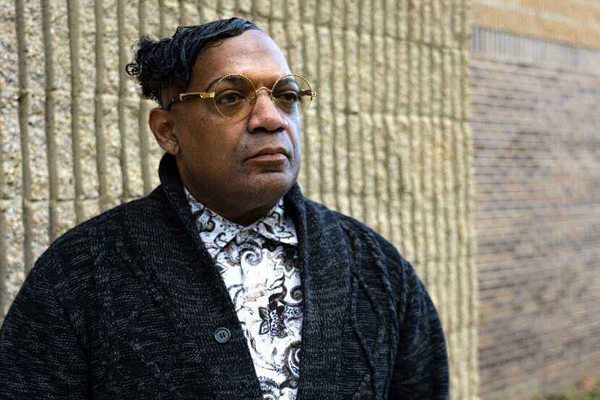
Deon Jones says he is pleased with the outcome of his anti-gay bias lawsuit against the D.C. Department of Corrections that ended after five years on Feb. 5 with the D.C. government paying him $500,000 in a settlement payment.
The lawsuit, filed on his behalf by the American Civil Liberties Union of D.C. and the international law firm WilmerHale, charged that Jones, a Department of Corrections sergeant, had been subjected to years of discrimination, retaliation, and a hostile work environment because of his identity as a gay man in clear violation of the D.C. Human Rights Act.
A statement released by the ACLU at the time the settlement was announced says Jones, “faced years of verbal abuse and harassment, from co-workers and incarcerated people alike, including anti-gay slurs, threats, and degrading treatment.”
The statement adds, “The prolonged mistreatment took a severe toll on Jones’s mental health, and he experienced depression, post-traumatic-stress disorder, and 15 anxiety attacks in 2021 alone.:
Jones said the harassment and mistreatment he encountered began in 1993, one year after he first began work at the Department of Corrections and continued for more than 25 years under six D.C. mayors, including current Mayor Muriel Bowser, who he says did not respond to his repeated pleas for help.
Each of those mayors, including Bowser, have been outspoken supporters of the LGBTQ community, but Jones says they did not intervene to change what he calls the homophobic “culture” at the Department of Corrections.
The Department of Corrections, through the Office of the D.C. Attorney General, which represents city agencies against lawsuits, and the mayor’s office, have so far declined to comment on the lawsuit and the half million-dollar settlement the city offered to Jones, who accepted it.
Among other things, the settlement agreement states that Jones would be required to resign from his job at the Department of Corrections. It also declares that “neither the parties’ agreement nor the District government’s offer to settle the case shall in any way be construed as an admission by the District that it or any of its current or former employees, acted wrongfully with respect to plaintiff or any other person, or that plaintiff has any rights.”
Scott Michelman, the D.C. ACLU’s legal director said that type of disclaimer is typical for parties that agree to settle a lawsuit like this. He said the city’s action to pay Jones a half million-dollar settlement “speaks louder than words.”
With that as a backdrop, Jones reflected on the settlement and what he says was his tumultuous 30-year career as an employee at the D.C. Department of Corrections in a Feb. 9 interview with the Washington Blade.
He and Michelman pointed out that Jones was placed on paid administrative leave in April 2022, one year after his lawsuit was filed. Among his upcoming plans, Jones told the Blade, is to publish a podcast that, among other things, will highlight the hardship he faced at the Department of Corrections and advocate for LGBTQ rights.
BLADE: What are your thoughts on this lawsuit settlement which appears very much in your favor?
JONES: That’s great. I’m happy. I’m glad to resign. It’s been a long time coming. It was the worst time it’s ever been. And I have advocated for the community for many, many years. And not only standing up for my rights but for the rights for others in the LGBTQ community.
And I’m just tired now. And my podcast will start soon. And I will continue to advocate for the community.
BLADE: Can you tell a little about that and when it will begin?
JONES: Once in April, once everything is closed my podcast will be starting. And that’s Deon’s Chronicle and Reveal. Yes, my own podcast.
BLADE: Since we have reported your attorney saying you have been on administrative leave since March of 2022, some in the community might be interested in what you have been doing since that time. Did you get another job or were you just waiting for this case to be resolved?
JONES: I was waiting for this to be resolved. I couldn’t work. That would violate policy and procedures of the D.C. government. So, I could not get another job or anything else.
BLADE: You have said under administrative leave you were still getting paid. You were still able to live off of that?
JONES: Yes, I was able to. Yes, sir. I used to do a lot of overtime. As a zone lieutenant for many years, I have supervised over 250 officers. I’ve also supervised over 25,000 inmates in my 30 years.
BLADE: How many years have you been working for the Department of Corrections?
JONES: It’s 30 years all together. I started down at the Lorton facility. Six facilities — I’ve worked for past directors, deputy directors, internal affairs. I’ve done it all.
BLADE: Do you have any plans now other than doing the podcast?
JONES: Well, to just do my podcast and also to write my book and my memoir inside of the house of pain, the house of shame — what I’ve been through. When I start my podcast off it will be stories — Part 1 through Part 4. And I will go back to the Lorton days all the way up to now. When it first started was sexual harassment and discrimination back down at Lorton. And I mean this has just been the worst time around.
BLADE: So, did you first start your work at the Lorton Prison?
JONES: Yes, I was at the central facility, which was the program institution.
MICHELMAN: Just for context. You may remember this, but the Lorton facility was where D.C. incarcerated people were held. So, that was part of the D.C. Department of Corrections.
BLADE: Yes, and that was located in Lorton, Va., is that right?
JONES: Right.
BLADE: Didn’t that close and is the main incarceration facility is now in D.C. itself?
JONES: Yes. And that closed in 2001.
BLADE: I see. And is the main D.C. jail now at a site near the RFK Stadium site?
JONES: Yes, sir. And next-door is the correctional treatment facility as well.
BLADE: So, are you saying the harassment and other mistreatment against you began back when you were working at the Lorton facility?
JONES: At the Lorton central facility. And they used to flash me too. When I say flash me like the residents, the inmates were flashing. And they [the employees] were flashing.
BLADE: What do you mean by flashing?
JONES: They take their penis out and everything else. I mean the sexual harassment was terrible. And I came out then down there. And I continued to advocate for myself and to advocate for other people who I was told were being picked on as well.
BLADE: As best you can recall, where and what year did that happen?
JONES: That was back in 1993 in April of 1993.
BLADE: The mayor’s office has declined to comment on the settlement and payment the city is giving you. Yet they have always said they have a strong policy of nondiscrimination protections for LGBTQ people in D.C. government agencies. But do you think that was not carried out at the Department of Corrections?
JONES: That’s a blatant reason why — I had 13 anxiety attacks. It was so blatant. Can you imagine? On the airwaves or the walkie-talkies — everybody had a walkie talkie — the captains and the majors and everything. And you transmit it to the command center or something like that. When you finish someone gets on the air and calls you a sissy or a fag.
They received so many complaints, and I also sent the mayor so many emails and begging for help. And they ignored it. They didn’t address any complaints at all. So, that’s bull.
BLADE: But now after you filed your lawsuit and you received this settlement do you think there will be changes there to protect the rights of other LGBTQ employees?
JONES: I hope so, because I have been defending community rights. For many years I have been advocating for different things and different services. And I’ve seen the treatment. There are a lot of mistreatments towards the community over there. And I have taken a stance for a lot of people in the community and protecting their constitutional rights as well as mine.
BLADE: What advice might you have for what the Department of Corrections should do to correct the situation that led to your lawsuit?
JONES: Well, what my advice for the department is they need to go back over their training. And they need to enforce rules against any acts of discrimination, retaliation, or sexual harassment. They need to enforce that. They’re not enforcing that at all. They’re not doing it at all. And this time it was worse than ever, then I’ve ever seen it. That you would get on the walkie talkie and someone would call you a fag or a sissy or whatever else or do evil things and everything. They are not enforcing what they are preaching. They are not enforcing that.
BLADE: Is there any kind of concluding comment you may want to make?
JONES: Well, I hope that this litigation will be a wakeup call for the department. And also, that it will give someone else the motivation to stand up for their rights. I was blessed to have the ACLU and WilmerHale to protect my constitutional rights. So, I am just really happy. So, I’m hoping that others will stand up for their rights. Because a lot of people in the community that worked there, they were actually afraid. And I had some people who actually quit because of the pressure.
Baltimore
‘Heated Rivalry’ fandom exposes LGBTQ divide in Baltimore
Hit show raises questions about identity, cultural representation

By JOHN-JOHN WILLIAMS IV | “Heated Rivalry,” the surprise gay hockey romance that has captivated global audiences and become a cultural phenomenon, has inspired sold-out parties celebrating the characters from the steamy series, including in Baltimore.
For some, love of the show has exposed the loss of a once-vibrant gay nightlife in Charm City and splintered its LGBTQ community. It also brings up layered questions about identity, cultural representation, and the limits of identity politics.
In Baltimore, the majority of the parties also appear to be missing a key ingredient that has been a part of the show’s success: gay men at the helm. Last month, women hosted a dance party at Ottobar, a straight establishment.
The rest of this article can be read on the Baltimore Banner’s website.

Fellow lawmakers praise Adam Ebbin after Va. Senate farewell address

LGBTQ groups question US health agreements with African countries

European Parliament resolution backs ‘full recognition of trans women as women’

Deon Jones speaks about D.C. Department of Corrections bias lawsuit settlement

Home is where the heart is

CMS moves to expand HIV-positive organ transplants

FOIA lawsuit filed against State Department for PEPFAR records

Trans sports bans rooted in eugenics

Trans students not included in new India University Grants Commission equity rules

Pride flag raised at Stonewall after National Park Service took it down
-

 Health5 days ago
CMS moves to expand HIV-positive organ transplants
-
State Department4 days ago
FOIA lawsuit filed against State Department for PEPFAR records
-
Opinions4 days ago
Trans sports bans rooted in eugenics
-
India4 days ago
Trans students not included in new India University Grants Commission equity rules