News
Brewer’s ‘turn away the gay’ veto not universally popular at CPAC
Some young conservatives say measure misunderstood
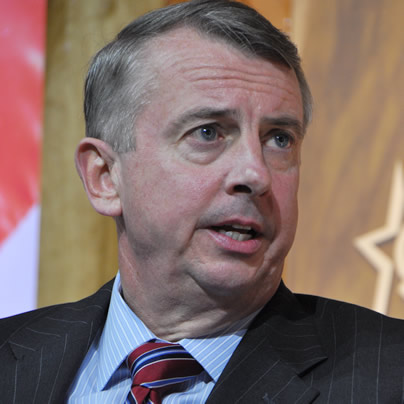
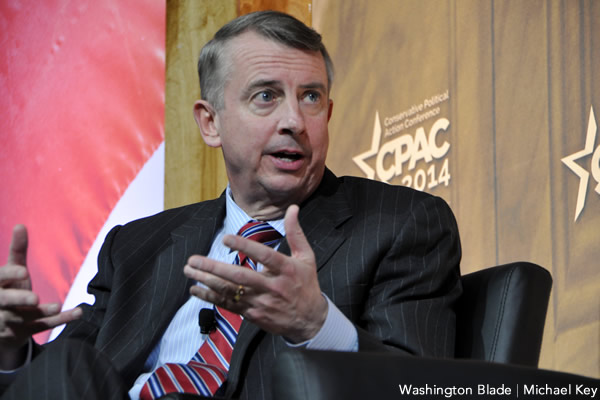
Ed Gillespie said he’s unaware of the bill vetoed by Gov. Jan Brewer. (Washington Blade photo by Michael Key)
NATIONAL HARBOR, Md. — Following a national outcry, Arizona Gov. Jan Brewer recently vetoed a bill that would have enabled businesses to refuse services to gay people for religious reasons. But some attendees at the 2014 Conservative Political Action Conference didn’t share her opposition to the measure.
A handful of the estimated 8,500 attendees over the weekend at the annual gathering for conservatives who spoke the Washington Blade either professed to have no knowledge of the legislation, SB 1062, or thought the religious liberties expansion under the legislation was misunderstood.
Ed Gillespie, a Republican political analyst who’s seeking to unseat U.S. Sen. Mark Warner (D-Va.) in the upcoming mid-term election, was among those who said he had no knowledge of the bill when asked by the Blade whether Brewer should have vetoed it.
“I haven’t looked at that bill,” Gillespie said. “I’ve been very focused on the Senate race. I’m running for the United States Senate in Virginia, So, very focused on federal issues there, and I just don’t know enough about what was in that bill. I’m sorry.”
Despite opposition to the bill from Arizona businesses, both GOP U.S. senators from the state and even former Republican presidential nominee Mitt Romney, some younger attendees at the conference who were familiar with the legislation said the bill was unfairly criticized and that outrage against the legislation was a product of the LGBT movement.
Matteo Moran, 20, a junior at Hillsdale College in Michigan, said he thinks Brewer “gave into” pressure of groups that said SB 1062 was an anti-gay bill, insisting the measure wasn’t directed at anybody.
“I think the reasoning behind her vetoing it was wrong,” Moran said. “I don’t think her veto was the wrong thing to do; I just think her rationale behind it was because it could be interpreted as being she gave into gay activist groups on that.”
Asked about gay non-discrimination laws, Moran said each business should “have a right to refuse service to anybody they deem is against whatever they believe.”
“Personally, I don’t think there should any discrimination laws, period,” Moran said. “I think people should have an equal choice, equal opportunity. That’s what I believe is everyone should have an equal opportunity to fight for the same jobs. Having legislation against or for one group or another is discriminatory in and of itself.”
Andrew Homer, 21, a graduate student at George Mason University, also said Brewer shouldn’t have vetoed the bill because he said it was only “a statement of religious right.”
“Just as people who are gay who own a business were turning away people who were against being gay, the same exact rights was what that bill was trying to instill,” Homer said. “You can try to turn away whomever you want to turn away, as long as it’s not discrimination on, you know, ‘I just don’t like you, go away.’ It’s their religious right.”
But Homer drew a distinction between discrimination against LGBT people that the legislation would have enabled and discrimination against categories of people protected under existing law.
“That’s not on a religious basis,” Homer said. “Gay people can claim that they have a religious basis, that they do not want to serve people who don’t support what they believe in. That’s fine. The same thing is for people who are not gay, who do not believe in gay rights, they should be allowed to have that exact same power.”
It’s true the legislation never explicitly mentions LGBT people, but most observers agreed its intent was clear — to enable businesses to refuse services to LGBT people, such as baking a cake or photographing a same-sex wedding.
These CPAC attendees are in the extreme minority in their views. According to a recent Washington Post-ABC News poll, 81 percent of Americans reject the idea of allowing businesses to discriminate against or to refuse services to LGBT people.
But they’re in line with the views of former Republican presidential candidate Rick Santorum, who told The National Review during an interview at CPAC he “absolutely” would have voted for the legislation and opposition to the bill was the result of “hysteria” created by the media.
“You talk about a complete mischaracterization of a bill,” Santorum said. “Actually, you could make the case this bill actually limited religious liberties because it actually added a section to the Religious Freedom Restoration Act that actually required you to have legitimate religious objection. Before, you just said, ‘Well, it’s against my religion, or I have a religious objection. Here they actually put a standard here.”
Prior to his interview with the Review, the Blade attempted to ask Santorum in the halls of the Gaylord Convention Hall if Brewer should have vetoed the bill. He declined to answer and left quickly before this reporter could finish asking the question.
Ross Hemminger, co-director of GOProud and among the guests at CPAC, told the Blade he doesn’t think those expressing views supporting the Arizona bill were representative of conference attendees, saying observers shouldn’t assume they’re all bigoted.
“It’s a little bit disingenuous to paint CPAC as bigoted because a handful of attendees you spoke to said they supported the Arizona bill and thought it was mischaracterized,” Hemminger said. “We had multiple conversations with multiple people there who didn’t like the bill and were glad that it was vetoed, people who, quite frankly, didn’t support gay marriage, but don’t believe in being bigoted toward gay people.”
Sen. Rand Paul (R-Ky.), known for his libertarian mindset, won the CPAC presidential straw poll by a whopping 31 percent, beating Sen. Ted Cruz (R-Texas), who finished in second place, by double digits.
George Doll, 20, a sophomore at the University of South Dakota, offered a nuanced position on the bill, saying he had misgivings about requiring businesses to do things, but ultimately said Brewer “should have vetoed” the bill.
“I think it’s wrong that they’re doing it,” Doll said. “I don’t think it’s right to refuse service to people based on any sort of creed or religion or sexuality, but I guess if you own the place, you can do what you want.”
CORRECTION: An earlier version of this story incorrectly attributed a comment to Matteo Moran about the 1964 Civil Rights Act. The question asked was specifically about non-discrimination laws aimed at protecting gay people, not the 1964 Act. The Blade regrets the error.




District of Columbia
Blade editor to be inducted into D.C. Society of Professional Journalists Hall of Fame
Kevin Naff marks 24 years with publication this year
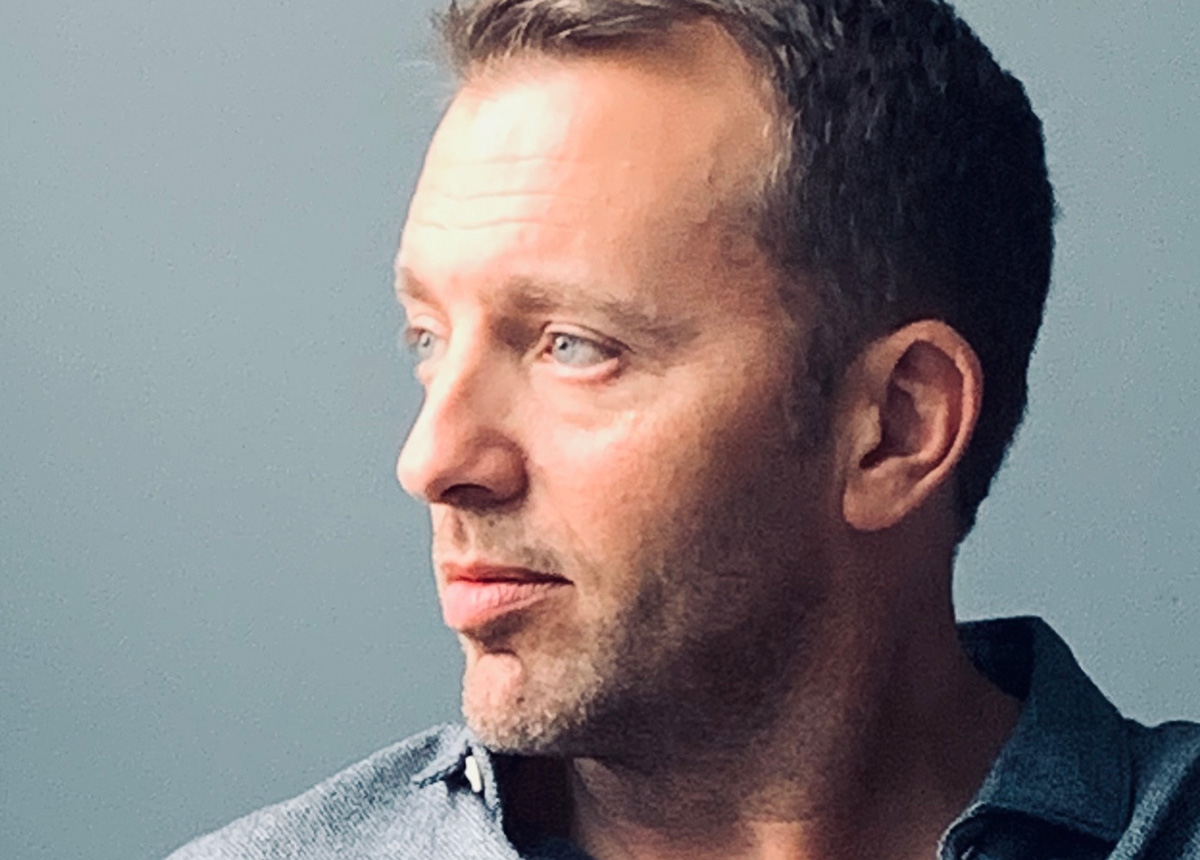
Longtime Washington Blade Editor Kevin Naff will be inducted into D.C.’s Society of Professional Journalists Hall of Fame in June, the group announced this week.
Hall of Fame honorees are chosen by the Society of Professional Journalists’ Washington, D.C., Pro Chapter. Naff and two other inductees — Seth Borenstein, a Washington-based national science writer for the AP and Cheryl W. Thompson, an award-winning correspondent for National Public Radio — will be celebrated at the chapter’s Dateline Awards dinner on Tuesday, June 9, at the National Press Club. The dinner’s emcee will be Kojo Nnamdi, host of WAMU radio’s weekly “Politics Hour.”
“I am tremendously honored by this recognition,” Naff said. “I have spent a lifetime in the D.C. area learning from so many talented journalists and am humbled to be considered in their company. Thank you to SPJ and to all the LGBTQ pioneers who came before me who made this possible.”
Naff joined the Blade in 2002 after years in print and digital journalism. He worked as a financial reporter for Reuters in New York before moving to Baltimore in 1996 to launch the Baltimore Sun’s website. He spent four years at the Sun before leaving for an internet startup and later joining the mobile data group at Verizon Wireless working on the first generation of mobile apps.
He then moved to the Blade and has served as the publication’s longest-tenured editor. In 2023, Naff published his first book, “How We Won the War for LGBTQ Equality — And How Our Enemies Could Take It All Away.”
Previous Hall of Fame inductees include luminaries in journalism like Wolf Blitzer, Benjamin Bradlee, Bob Woodward, Andrea Mitchell, and Edgar Allen Poe. The Blade’s senior news reporter Lou Chibbaro Jr. was inducted in 2015.

It was never meant to become something big.
When I say that I created the first pro-neurodiversity self-advocacy group in Russia and Ukraine, made by autistic people for autistic people, everyone imagines something grand. But it wasn’t. We had three blogs. One of them was updated every day at first, then every two days, with original translations of blog posts, personal stories, and studies about autism and neurodiversity, as well as articles written by our autistic followers.
We held a peer support group meeting once every two weeks, provided one-to-one peer support online, and sometimes offered legal and psychological advice. We also organized workshops for solicitors, psychologists, and social workers, took part in public protests, and distributed free materials.
But all of it was just me and volunteers that were coming and leaving. We had some donations, but we never had any grants while I was living in Russia, nor any sponsors. We have never had an office. The biggest support we received came from our subscribers, most of whom were queer, and from LGBTQ groups.
And here is the important part of the story: from the very beginning, we were LGBTQ-friendly, and queer people played a key role in the existence of my Autistic Initiative for Civil Rights.
Today, on World Autism Acceptance Day, I want to tell a story about how the autistic self-advocacy community in Russia, Ukraine, the U.S, Australia and the UK worked side by side with the LGBTQ movement — and how LGBTQ autistic people changed the pro-neurodiversity movement, using my personal journey and the story of one group as an example.
When I was 17, I started to realize that I might be autistic. There wasn’t much information about autism in my home city, Donetsk, in Ukraine — most post-Soviet psychiatrists believed that autism was a form of childhood schizophrenia, and my parents believed that my autistic behavior was the devil’s work. It wouldn’t be surprising to say they thought the same about my queerness.
So I started digging online, and from the very beginning, the work of three amazing queer autistic authors stood out to me.
Jim Sinclair, a pioneer of the modern pro-neurodiversity movement and the leader of one of the first autistic self-advocacy groups Autistic Network International, is an openly intersex person.
Ly Xīnzhèn Zhǎngsūn Brown is a queer, nonbinary transgender activist who developed an educational program about autism for police in the U.S. Like me, they grew up among intensely conservative and religious people and were interested in the Middle East and politics.
And finally, Julia Bascom, a lesbian woman, wrote the essay “Quiet Hands” about stimming, which deeply resonated with teenage me after my parents’ constant attempts to make my body language more “normal.”
These were people whose writing saved me from suicidal thoughts created by toxic ideas promoted in the Russian- and Ukrainian-language internet at the time — the idea that autistic people are a burden and would never be accepted as they are.
These amazing American queer autistics also made me question my own queerphobic thoughts. At the time, I was an extremely religious Christian, with severe OCD around prayer and a constant fear of going to hell. For the first time, I read statistics showing that autistic people are more likely to be queer. Actually, now we know that they are up to six times more likely to be trans and nearly three times more likely to be LGB.
As a young person who had decided to make autism acceptance the work of my life, I began to think that maybe it wasn’t so frightening to be openly queer. After all, if I believed that God never made mistakes and that I was destined to be autistic, then perhaps some people were destined to be queer as well.
When Donetsk was occupied by pro-Russian forces in 2014, and my family moved to Russia (political consistency had never been their strong point), I moved in with my autistic best friend in St. Petersburg, who later became my wife.
And so, away from my abusive parents, my work in autism advocacy began. But it was autistic activists who helped me to realise that I’m queer and accept it.
LGBTQ activists were our first real supporters. My first public speech about autistic acceptance was at a Rainbow Tea meeting, a space for LGBTQ teenagers. Our autistic peer support group took place in LGBT community center, such as the Coming Out group in St. Petersburg (now recognized as an extremist organization), and the Deystvie community center.
The Alliance of Heterosexuals and LGBT for Equality was our main partner in organising autistic public actions and protests, contacting Russian liberal media, and, finally, I became one of the leaders of the first Russian LGBTQ-disability group, Queer Peace. It worked side by side with my autistic informational projects, organizing workshops and masterclasses for solicitors, psychologists, and LGBTQ group leaders to bring inclusion into LGBTQ services.
Meanwhile, autism initiatives led by non-autistic people and supporters of social Darwinism were often strongly homophobic or considered work with the LGBTQ community — or support for LGBTQ autistic people — to be “unbeneficial.”
Of course, even within Russian LGBTQ organizations, it wasn’t all inclusive. Many high-ranking LGBTQ leaders in Russia are still ableist, at least on an everyday level. But when LGBTQ community in the West began moving towards disability inclusion, post-Soviet countries followed that trend.
More importantly, my LGBTQ-autistic projects were supported by other autistic queer people, including folks from Indigenous nations under Russian control, people from villages, and those from unsupportive families.
Autistic queer people in Ukraine soon started their own — often stronger — work in promoting neurodiversity and LGBTQ rights, both within LGBTQ communities and in wider society. In part, this was because they knew Ukrainian much better than I did. Although I understand Ukrainian and can use it, it has never been my mother tongue.
Also, a Russian vlogger and autism support group leader, Jarry, a trans autistic person, began creating the first accessible video materials about autism, sharing many stories from the perspective of autistic AFAB people.
More and more autistic people in post-Soviet countries began to argue that autism is wrongly framed as a disorder, even if it can be a disability due to the misunderstanding and discrimination autistic people face — and queer people were ahead of this shift.
Finally, Bascom, the same American autistic lesbian who inspired me as a teenager and later the executive director of the Autistic Self-Advocacy Network, began mentoring our translation projects, including brochures and free books from English into Russian. The Autistic Women and Nonbinary Network, one of the most trans-inclusive and intersectional groups in the U.S., also showed us full support.
In Australia, Beinannon Lee, an autistic lesbian raising children with her wife, helped us share parenting advice for post-Soviet autistic parents and parents of autistic children. As part of the Autistic Family Collective, she opened new perspectives on homeschooling for neurodivergent families worldwide, while also showing that same-sex couples can be deeply supportive and respectful parents.
When I was stuck in Israel for four months while trying to obtain an American visa, the first organisation that supported my autistic initiative was an LGBTQ group in Tel Aviv that also supported Palestinian refugees and refugees from African countries. In the UK, Lesbian Asylum Support Sheffield was the first LGBTQ group I connected with — and the first to ask me to help with inclusion. Autistic UK, an autistic-led organization, was the first autistic group I worked with here and showed strong queer inclusivity.
And if you go to Trans Day of Remembrance events or trans protests in Sheffield, you will see just how many autistic activists are there.
In my 11 years of LGBTQ and autism activism, I have seen how much autistic and LGBTQ people have done for each other — and how those who are both queer and autistic continue to fight for their rights. It is something stronger than borders, stronger than any one country’s direction. Now, when politicians around the world are arguing against the rights of trans people to be themselves, attacking LGBTQ rights, and trying to dehumanize autistic people and take away our agency, we need to remember this — and stay together.
The White House
Kristi Noem ‘devastated’ as husband’s alleged fetish spending surfaces
Former DHS head ‘blindsided’ by allegations
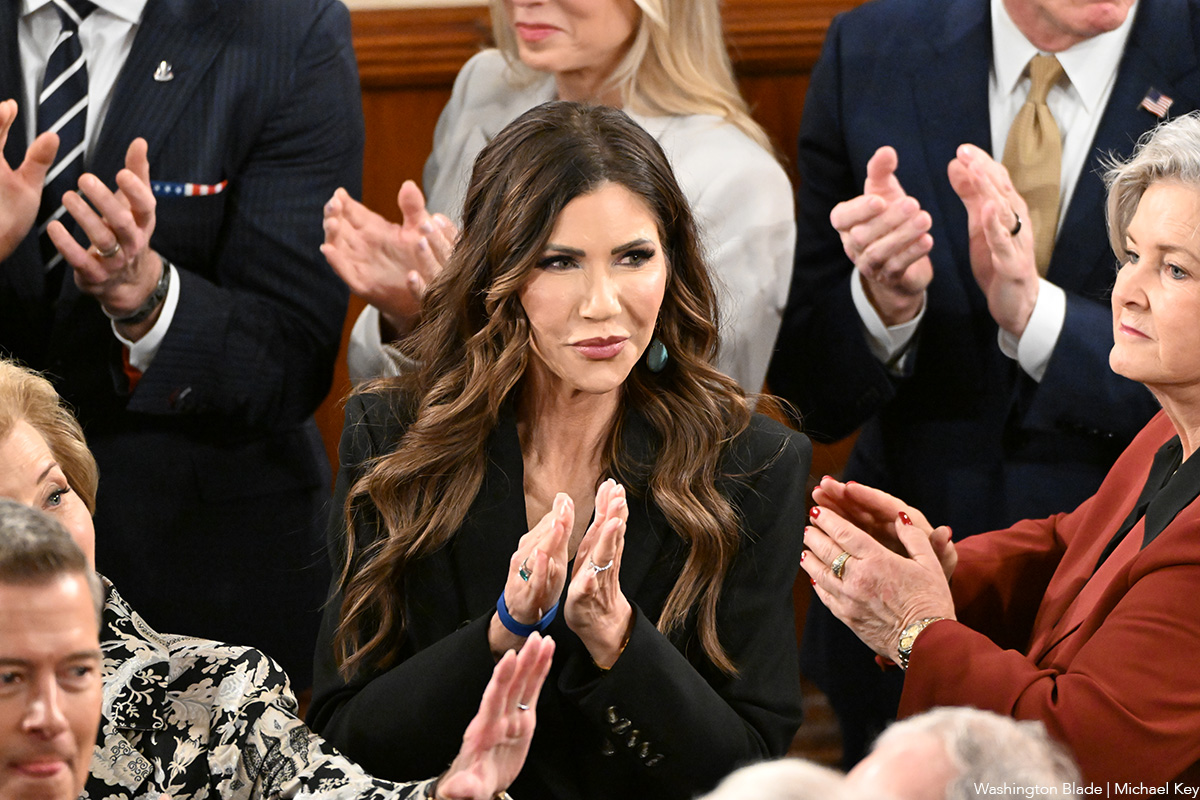
Former Department of Homeland Security Secretary Kristi Noem said she is “devastated” after reports alleged her husband paid large sums to fetish models and shared cross-dressing photos while married to her.
The Daily Mail first reported the story on March 31, accusing 56-year-old Bryon Noem — the former second gentleman of South Dakota and husband to the former DHS secretary — of exchanging hundreds of messages with three women in the “bimbofication” fetish scene. According to the report, he praised their surgically enhanced bodies and was asked to send them money though various online accounts during the 14 months his wife led the nation’s largest federal law enforcement agency.
He sent them at least $25,000 via Cash App and PayPal, according to the story, that also included photos reportedly show him wearing pink shorts and a flesh-colored top with balloons simulating breasts.
When the payments were delayed or failed to be sent, the women would get mad and ignore him, the story reads. At least one woman who didn’t receive money after texting Noem was so disgruntled she posted about his behavior on social media before later deleting it.
The allegations quickly went viral across social media and major news outlets. Representatives for Kristi Noem told the New York Post she was “devastated” and that her family was “blindsided” by the claims, while requesting privacy and prayers.
President Donald Trump, when asked by the Daily Mail, expressed surprise that the Noem family had confirmed the photos’ authenticity.
“They confirmed it? Wow, well, I feel badly for the family if that’s the case, that’s too bad,” Trump told the outlet that broke the story. “I haven’t seen anything. I don’t know anything about it. That’s too bad, but I just know nothing about it.”
Kristi and Bryon Noem met in high school and married in 1992, according to the Daily Mail. They have two daughters, Kassidy, 31, and Kennedy, 29, and a son, Booker, 23.
The controversy comes after Noem’s recent removal from one of the highest-ranking positions in Trump’s Cabinet. Markwayne Mullin was sworn in as Homeland Security Secretary last week, though Noem remains part of the president’s team as special envoy to the Shield of the Americas, a U.S.-led regional security organization focused on coordinating efforts to combat organized crime, drug trafficking, and illegal migration throughout the Western Hemisphere.
Noem’s political career spans more than a decade across state and federal government jobs. She served in the South Dakota House of Representatives from 2007 to 2011, in the U.S. House of Representatives from 2011 to 2019, and as Governor of South Dakota from 2019 to 2025.
She was confirmed as Secretary of Homeland Security during Trump’s second term, serving from 2025 until her removal following widespread backlash over escalating U.S. Immigration and Customs Enforcement operations, which included separating children from their families and two separate fatal shootings of U.S. citizens by ICE officers during protests. Trump reportedly decided to fire Noem from DHS after her congressional hearing related to the deaths, in which she stated that the president had approved a $200 million-plus government-funded DHS advertising campaign that prominently featured her.
The reports about her husband have also reignited speculation about Noem’s personal life, including rumors involving Trump supporting political operative Corey Lewandowski, described by some as the “worst-kept secret in D.C.”
Some accounts suggest Bryon Noem was aware of the alleged relationship — and benefited from it. Political commentator Ryan James Girdusky fueled that speculation during an August 2025 episode of the It’s a Numbers Game podcast, citing what he described as “D.C. gossip” that a top Cabinet official — rumored to be Noem — had privately claimed her husband was gay.
“A reporter walked up to her and said, ‘Why are you having this affair? Why haven’t you met up with your husband? Why aren’t you divorcing your husband?’” Girdusky said on the podcast. “And she blurted out to this reporter, who I know, and said, ‘Oh, my husband’s gay.’”
Unlike the unverified claims surrounding her husband, Noem’s political record on LGBTQ issues is well documented.
In 2024, while serving as governor, her administration canceled a contract with a community health worker organization, resulting in a $300,000 settlement with a transgender advocacy group. The contract had included a roughly $136,000 state-administered federal grant, of which about $39,000 had already been distributed, according to the group’s attorneys.
Noem also championed a series of policies restricting trans rights. She signed executive orders in 2021 barring transgender girls and women from competing on women’s sports teams at public schools and colleges in the state. In addition to using executive authority to enact these policies, she signed legislation into law. She enacted House Bill 1080, which bans age-appropriate, medically necessary health care for trans youth — despite widespread support for such care from major medical associations and global health authorities.
Noem also supported legislation aimed at restricting trans athletes, though she ultimately vetoed one bill, citing potential legal challenges from the NCAA while maintaining support for its intent. Additionally, she signed a Religious Freedom Restoration Act that LGBTQ advocates say enables discrimination under the guise of protecting religious liberty.

Award-winning D.C. chef reaching new culinary heights

Trans-driven ‘Serpent’s Skin’ delivers campy sapphic horror

Now more than ever: the importance of LGBTQ activism

D.C. not the place for antisemitic Democratic Socialists of America

Blade editor to be inducted into D.C. Society of Professional Journalists Hall of Fame

‘Out for McDuffie’ event held at D.C. gay bar

The Oscar-losing performance that’s too good to miss

‘Jonah’ an undeniably compelling but unusual memory play

Thousands attend ‘No Kings’ protests in D.C.