News
Rep. Hartzler wants another shot at anti-trans military amendment
Missouri Republican wants inclusion of measure in spending package
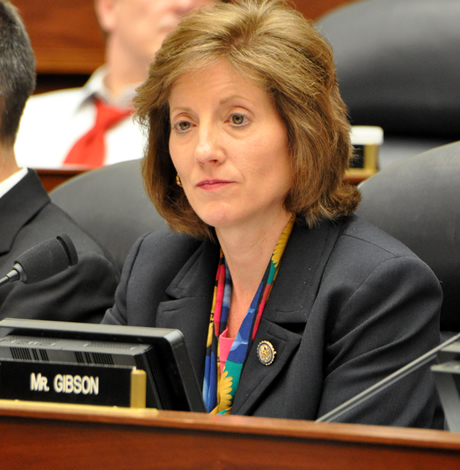
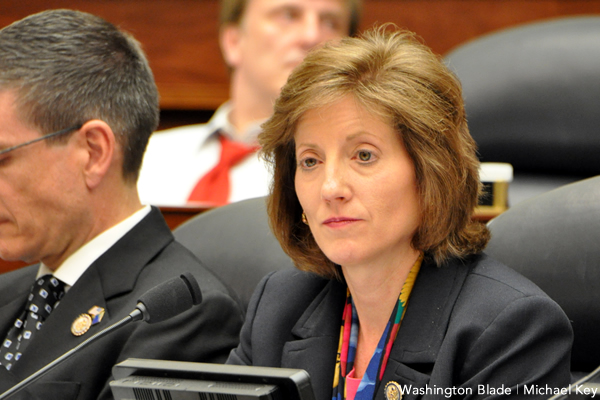
Rep. Vicky Hartzler (R-Mo.) is seeking another shot at barring funds for transition-related case in the U.S. military
(Washington Blade file photo by Michael Key)
Rep. Vicky Hartzler (R-Mo.) is looking for another shot at her amendment that would have barred the Pentagon from paying for transition-related health care for transgender service members, according to Politico.
In the aftermath of the U.S. House narrowly rejecting the amendment as part of the fiscal year 2008 defense authorization bill, Hartzler is reportedly leading “a mix of GOP defense hawks and conservatives” to include the measure in a different spending bill that will soon arrive on the floor.
“Steps must be taken to address this misuse of our precious defense dollars,” Hartzler said in a statement to Politico. “This policy hurts our military’s readiness and will take over a billion dollars from the Department of Defense’s budget. This is still an important issue that needs to be addressed.”
As introduced by Hartzler the last time around, the amendment would prohibit the Pentagon from made expenditures in its health system for transition-related care, including hormone therapy and gender reassignment surgery, for both service members and their dependents.
According Politico, supporters of the amendment are urging House Speaker Paul Ryan (R-Wis.) to use a procedural trick to include the amendment automatically as part of the spending bill. Failing that, they’re requesting another floor vote on the amendment as part of consideration for the base bill.
The House last week voted down the Hartler amendment by a 214-209. Twenty-four Republicans and all 190 Democrats present voted against the measure.
According to Politico, most Republicans expected the Hartzler amendment to pass overwhelmingly and were surprised when it failed. (Ryan told the Washington Blade during his news conference he supported the measure and predicted it would pass.) The morning after the defeat of the amendment, Republicans spent a good chuck of a closed-door GOP conference meeting harping about what happened, the Politico reported.
Conceivably, the measure could pass the second time around. Six Republican last time didn’t vote or were absent (including House Majority Whip Steve Scalise, who’s recovering from a gun shot wound). Rep Brian Mast (R-Fla.), who voted against the provision, has since said his vote was in error and he meant to vote for it.
Caroline Boothe, a House Rules Committee spokesperson, said Hartzler hasn’t yet submitted an amendment for potential consideration as part of the defense appropriations bill.
“We have yet to receive the Hartzler amendment again for the bills next week,” Boothe said. “But when we do, the Committee will consider it like we do any other amendments.”
According to Politico, senior Republican sources predicted leadership would deny the request to add Hartzler amendment’s to a House rule because it would circumvent regular order. Whether a separate floor amendment on the proposal would be allowed is unclear.
Openly transgender service has been the rule for the U.S. military for about a year in the aftermath of an Obama-era policy change that lifted the regulatory ban on their service. Transgender people can come out in the military without fear of discharge, but openly transgender people still can’t enlist. Defense Secretary James Mattis pushed back the target date for that change until Jan. 1 pending a review of transgender service.
Media outlets reported when Hartzler offered her around last week, Mattis privately contacted her to urge her to withdraw the measure. White House Director of Legislative Affairs Marc Short denied the White House whipped a “no” vote on the measure, although he said there was a question about whether it should be include in the defense authorization bill.
Aaron Belkin, director of the San Francisco-based Palm Center, blasted Hartzler in a statement for not giving up on her amendment, accusing of inventing false data to bolster her case against transgender military service.
“Thousands of transgender troops have been serving for an entire year, and they have been widely praised by Commanders,” Belkin said, “and 18 foreign militaries allow transgender personnel to serve. Transgender military service works, and pretending that it does not requires inventing data. This is the same, discredited strategy that opponents used to prop up the failed ‘don’t ask, don’t tell’ policy the first time around.”
Read more at Politico.






National
HRC condemns DoE removal of LGBTQ bullying data from federal survey
Organization cites rise in homophobic, transphobic policies, worse mental health outcomes

The Human Rights Campaign is slamming the White House — and the Department of Education — following their removal of some LGBTQ bullying data from federal data collection.
The Civil Rights Data Collection is a mandated survey of all public school districts that collects figures on a wide variety of statistics about students — including demographics that include race, ethnicity, sex, disability status, and English learner status; course-level enrollment data, such as how many students are enrolled in advanced placement or honors classes; and school climate information, such as rates of bullying, harassment, suspensions, and expulsions.
That data collection has been ongoing since 1968 — nearly six decades — but now has a major change in what questions are being asked, or not asked, that advocates are largely attributing to the Trump-Vance administration’s culture war fight on LGBTQ children in the country.
Changes to the 2025-2026 survey questions — approved by the Office of Budget and Management in July — eliminated a space for schools to report how many students identify as nonbinary, how often those students are victims of harassment and bullying, and whether school districts have policies prohibiting gender identity-based incidents.
K-12 Dive, a publication that focuses its reporting on news related to K-12 education, first published a list of these data collection changes from 2024-2025 to 2025-2026.
These questions, as well as others that included LGBTQ student topics on treatment in schools, were added to the CRDC under the Biden-Harris administration. By including these questions, policymakers hoped this would lead to increased investigations into discrimination complaints, initiate compliance reviews, and provide policy guidance to districts, according to Education Department documents.
The CRDC also eliminated the mention of “gender identity” from the definition of rape and sexual assault. The prior collection of data (before the Trump-Vance administration changed it) defined rape as something that could be done to “all students, regardless of sex, or sexual orientation, or gender identity.” Now, the new data collection questions say, “All students, regardless of sex, or sexual orientation can be victims of rape,” removing “gender identity” from the new definition.
By removing and changing definitions, this could have a real-world impact on some of the school’s most vulnerable students. According to CRDC data from 2021-2022, more than 1,800 school districts reported enrolling one or more nonbinary students.
Additional data also shows that the changes to data collection is harming public school students. U.S. Sen. Bernie Sanders (I-Vt.), the ranking member of the Senate Health, Education, Labor, and Pensions Committee released a report in April finding that the Trump-Vance administration’s efforts to all but close the Department of Education Office for Civil Rights has left students facing discrimination and harassment throughout the country without the federal recourse they are entitled to under federal law.
The Williams Institute, a think tank that collects data and conducts research on issues related to sexual orientation and gender identity, has data indicating the true number of nonbinary and transgender children is much higher — they estimate that for children ages 13 to 17, nearly 724,000 identify as nonbinary or trans.
This is in line with a slew of policies pushed by the Trump-Vance administration since their federal takeover. Within his first day in office, President Donald Trump signed Executive Order 14168, titled “Defending Women from Gender Ideology Extremism and Restoring Biological Truth to the Federal Government.” This directive attempts to make the federal definition of gender unchangeable, determined by sex assigned at birth alone.
Within his first month of his second term, Trump issued Executive Order 14187, titled “Protecting Children from Chemical and Surgical Mutilation.” The order directs federal agencies to restrict gender-affirming medical care — including puberty blockers, hormone therapy, and surgeries — for individuals under the age of 19.
He also pushed multiple anti-trans executive orders, including Executive Order 14201, “Keeping Men Out of Women’s Sports,” and Executive Order 14183, “Prioritizing Military Excellence and Readiness,” targeting trans athletes and military members, respectively.
These policies have a real-world impact on trans people.
The Trevor Project, a nonprofit dedicated to crisis and suicide prevention for LGBTQ people under 25, reported that, for the seventh year in a row, LGBTQ youth are at higher risk for suicide as a result of mistreatment and stigmatization.
Trevor Project data showed that nearly 60 percent of LGBTQ young people ages 13-17 said they were bullied in the past year, and that 36 percent of LGBTQ youth seriously considered suicide in the last year. The data shows a bigger discrepancy for trans youth, with that number hovering around 40 percent considering suicide.
HRC President Kelley Robinson issued a statement following the approval of the new data collection questions that leaves LGBTQ students’ bullying statistics under — if not completely unreported.
“If there was even a shadow of a doubt, this latest move by the Trump administration makes it abundantly clear they do not care about the safety of LGBTQ+ students, and trans students in particular,” Robinson said. “These are adults who should be protecting our kids. And instead, they are making sure bullying and harassment are not tracked. If they are not tracked, bullying and harassment cannot be prevented or stopped — which is exactly what the Trump administration wants. Parents deserve to know their kids are safe at school, and every single young person deserves dignity and safety at school. Anything less is plain evil.”
HRC has a “Welcoming Schools” initiative that they say is the “most comprehensive” bias-based bullying prevention program in the nation. The program includes LGBTQ and gender-inclusive resources for schools, help navigating special education and disability resources for LGBTQ-identifying students, and other tools to help schools become more inclusive.
This program has been in effect for nearly two decades and, according to HRC, reaches nearly 750,000 students.
The Washington Blade reached out to both the Department of Education and Office of Management and Budget for comment but did not receive a response by publication time.
Netherlands
Dutch PM: More needs to be done to defend trans rights
Rob Jetten on Friday was on World Pride Human Rights Conference panel

Editor’s note: International News Editor Michael K. Lavers and Photo Editor Michael Key will be on assignment in Amsterdam until Aug. 10.
AMSTERDAM — Dutch Prime Minister Rob Jetten on Friday said more needs to be done to defend transgender people and their rights.
“Everywhere in the Western world, it’s definitely the group that’s the most vulnerable in the moment and it’s rather well-picked also by our advisories,” he said during a panel at the World Pride Human Rights Conference in Amsterdam that Ying Xin and Diego García Blum of Global LGBTQI+ Human Rights Program at the Harvard Kennedy School’s Ryan-Carr Center for Human Rights Policy moderated. “They’ve chosen the smallest group within our broader community (trans people) to attack them, to ensure that we can strip their rights and if they’ve done with that, they’ll go after the next group within our community, so we shouldn’t be naïve about what’s behind it.”
“It’s very well-funded. It’s very well-organized and we have to organize as well to fight back and to win this fight,” added Jetten. “We also need to be more open in conversations that we are having within the community and also dive into it much deeper and maybe even have more difficult and annoying conversations.”
Jetten in February became the Netherlands’ first openly gay prime minister.
He appeared on the panel alongside former Irish Prime Minister Leo Varadkar, who in 2017 became his country’s first openly gay head of government, and former San Marino Captain Regent Paolo Rondelli, who was his country’s ambassador to the U.S. from 2007-2016.
Several other current former heads of government who are gay or lesbian also participated in the panel. They include former Icelandic Prime Minister Jóhanna Sigurðardóttir, former Luxembourgish Prime Minister Xavier Bettel, and Andorran Prime Minister Xavier Espot Zamora. California Congressman Mark Takano, who chairs the Congressional Equality Caucus, and LGBTQ+ Victory Fund CEO Evan Low were among those who attended.
Jetten in his remarks said he was “very surprised” to learn that “not only in the U.S. but also in some European countries that we’ve let them decide what the gay group looked like.” The Dutch prime minister further pointed out that conservatives began “to attack the debate on toilets or starting this debate about trans people in Olympic games.”
“That is, of course, a ridiculous debate to start, but we’ve got distracted because we were so busy having this debate on Olympians, and then we actually forgot the real fight was about access to healthcare, just being yourself, being able to enlist in the army, or being able to be a young trans boy or girl in school,” said Jetten. “We got distracted by some fresh meat that was thrown into the area by some very conservative people.”
“We have to open our eyes and have very in-depth conservations within our community, and come up with a much better strategy to win this fight and to protect all our trans brothers and sisters, dolls, whatever,” he added. “Because if we don’t win this fight for trans people, we’re going to lose the bigger fight for all LGBTQ people in the world.”
Varadkar noted Ireland in 2015 passed a law that allows people to legally change their gender without surgery or other medical interventions.
He conceded there was “a liberal wind blowing across the world at the time, and it was largely uncontested.”
“It would be harder now, quite frankly, to do that legislation,” said Varadkar.

Scottish lawmakers in 2022 passed the Gender Recognition Reform Bill, which lowered the age for anyone to legally change their gender without medical intervention from 18 to 16. Then-British Prime Minister Rishi Sunak’s government later blocked the measure from taking effect.
The U.K. Supreme Court in 2025 ruled the legal definition of a woman under the country’s Equality Act is limited to “biological women.” Author J.K. Rowling is among those who praised the decision that stemmed from a case that challenged the Scottish government’s decision to include trans women in its definition of women when it sought to increase the number of women on government boards.
The Trump-Vance administration on Jan. 20, 2025, the first day it was in office, issued a sweeping executive order that, among other things, declared the federal government would only recognize two genders: male and female. The White House earlier this year in its counterterrorism strategy said it “will also prioritize the rapid identification and neutralization of violent secular political groups whose ideology is anti-American, radically pro-transgender, and anarchist.”
“We have to stay united,” said Rondelli. “The strategy was, since the beginning, was a Nazi strategy to create groups, target groups, and to create maximum distractions to avoid discussion about some sort of policies.”
“Trans people are the target at the moment,” he added. “But after them it will probably be some others, so we have to stay united.”

The White House
HRC files class action over federal ban on gender-affirming care coverage
Lawsuit filed Monday challenges White House effort to restrict care

The Human Rights Campaign Foundation, the nonprofit sister organization to the largest LGBTQ human rights lobbying and advocacy organization in the U.S., along with law firms Correia & Puth and Cohen Milstein Sellers & Toll, filed a class action lawsuit against the government as it attempts to restrict gender-affirming healthcare for federal employees.
The suit, filed on Monday, alleges that the Office of Personnel Management, run by Trump appointee Scott Kupor, is discriminating against LGBTQ federal employees (and their families and retired employees) by prohibiting health insurance coverage for gender-affirming care under the Federal Employees Health Benefits and Postal Service Health Benefits plans. There are five plaintiffs named in the complaint, but it extends to others who have those healthcare plans.
The document asserts that OPM’s prohibition on coverage for “gender transition” care in the FEHB and PSHB programs violates Title VII, the federal law that prohibits discrimination based on sex, race, color, religion, or national origin.
The policy, which was implemented on Jan. 1 following the 2025 issuing of Program Carrier Letter, mandated that insurance providers in these programs deny any coverage for gender-affirming care. In February, HRC filed a federal complaint with OPM over the change in healthcare policy, which was ultimately passed to the Equal Employment Opportunity Commission for review. That complaint is now an officially filed class action lawsuit in the U.S. District Court for the District of Columbia.
Research from the Williams Institute at UCLA Law, a think tank that collects data and conducts research on issues related to sexual orientation and gender identity, indicates that this policy denying gender-affirming care will impact healthcare access for at least 39,400 current and former federal employees and their dependents.
Human Rights Campaign President Kelley Robinson released a statement following the lawsuit’s filing.
“Our message to the Trump administration is simple: we’ll see you in court,” said Robinson. “Healthcare access should never be weaponized to advance discrimination — and the denial of coverage for critical healthcare based simply on who you are blatantly violates the rights of all of us.”
Gender-affirming care has been under constant attack by the Trump-Vance administration since its return to the White House, despite the practice being considered as extensively evidence-based but also supported by nearly every major medical organization. This type of care is provided to all people—not just transgender people—and includes things such as social affirmation, including using correct names and pronouns and wearing clothing that matches a person’s gender identity; mental health support, such as counseling to reduce depression and anxiety; and, in some cases, medical interventions such as reversible puberty blockers or hormone therapy when deemed medically appropriate.
“Federal employees have been through the wringer with the Trump administration,” said Cathy Harris, partner at Correia & Puth. “We draw the line at blatant discrimination to deny healthcare to our nation’s dedicated civil servants.”
“This odious policy is the latest example of the Trump administration’s obsession with targeting transgender people, using shameful and cruel tactics to threaten their employment, their health, and the well-being of themselves and their families,” Robinson added. “OPM’s actions will not go unchallenged, and we’ll continue to fight so that federal employees and their families receive the dignity they deserve.”
This is not the first time the White House has directly attacked gender-affirming care.
In January 2025, the administration issued Executive Order 14187, titled “Protecting Children from Chemical and Surgical Mutilation.” The order directs federal agencies to restrict gender-affirming medical care — including puberty blockers, hormone therapy, and surgeries — for individuals under the age of 19.
For more information on how to get involved with the lawsuit, visit hrc.org.

HRC condemns DoE removal of LGBTQ bullying data from federal survey

Dutch PM: More needs to be done to defend trans rights

HRC files class action over federal ban on gender-affirming care coverage

Perez Hilton’s live breakdown reveals social media mental health crisis

Mr. Henry’s to host 60th anniversary party

PHOTOS: Petal Release Party

My evening with Madonna

Remembering Elliot Leonard, generous visionary who helped LGBTQ communities thrive

Buttigieg indicates he may run for president in 2028