News
99 Dems urge State Dept. to recognize citizenship of LGBT couple’s child
Merkley, Harris lead call on Trump administration to drop appeal
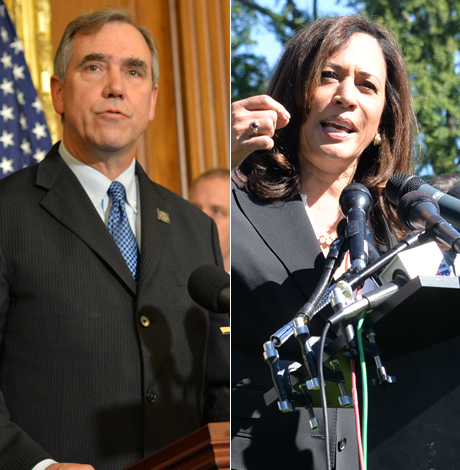
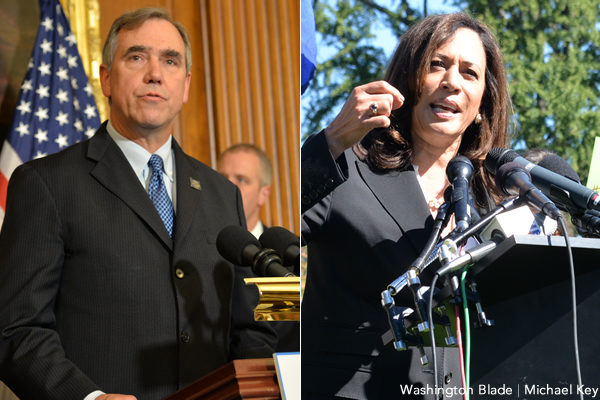
A group of 99 congressional Democrats — 80 in the U.S. House, 19 in the U.S. Senate — are calling on the Trump administration to reverse its policy of refusing to recognize the birthright citizenship of children to LGBT families born overseas via surrogacy methods.
The call come in the form of a pair of letters. Leading the letter in the House is Rep. Deb Haaland (D-N.M.) and the co-chairs of the LGBT Equality Caucus, each of an openly LGB member of Congress, including Rep. David Cicilline (D-R.I.), the most senior openly gay member of the U.S. House. In the Senate, Sen. Jeff Merkley (D-Ore.) and Sen. Kamala Harris (D-Calif.) are leading the charge.
Both letters are dated June 6 and addressed to a Secretary of State Mike Pompeo. The House says the Trump administration policy is “discriminatory and cruel”; the Senate calls it “extraordinary and deeply disturbing.”
“Even in the face of the mounting hardship the policy has created for loving families, your department has gone to great lengths to continue to defend a policy in federal court that separates American families before they reach the U.S. border edge,” the Senate letter says.
The Senate letter refers to the case of Andrew and Elad Dvash-Banks, a married same-sex couple — one an American citizen, and one an Israeli national — who had twin sons through a gestational surrogate in Canada.
The State Department, however, required a DNA test to prove the children were related to the couple to provide them U.S. passports. One child, Aiden, was deemed a citizen because he’s the biological son of Andrew, but the other, Ethan, wasn’t because he’s the biological son of Elad.
The Trump administration continues to refuse to recognize the citizenship of Elad despite the U.S. Supreme Court’s decision 2015 decision in favor marriage equality nationwide, which guarantees all the “constellation of benefits” of marriage to same-sex couples.
In a case against the Trump administration filed by Immigration Equality on the basis that the policy violates the Immigration & Nationality. A federal court ruled against the State Department, but the Trump administration has appealed the decision to the U.S. Ninth Circuit Court of Appeals.
According to the Senate letter, the policy against the couple “is not an isolated case” and addition couples have come forward with similar stories.
“Stories after stories have recently been chronicled of same-sex couples being told by your department that their marriages are, by definition, invalid, and that any children they may have abroad risk becoming stateless,” the letter says. “Every new American parent should focus on celebrating the birth of a child, not be consumed with fear that all members of their family may not be welcomed back home to the United States.”
Both letters call on the Trump administration to change the policy. The Senate letter specifically calls on the Trump administration to “immediately drop” the appeal of the Dvash-Banks case and “make it clear that every U.S. married couple is entitled to the same rights under the U.S. Constitution, no matter whom they love.”
A State Department spokesperson declined to comment in response to the senators’ letter.
“We generally do not comment on our communications with Congress,” the spokesperson said. “Due to ongoing litigation, we have no further comment at this time.”
Joining Merkley and Harris in signing the letter was Sens. Edward Markey (D-Mass.), Chris Murphy (D-Conn.), Patrick Leahy (D-Vt.), Bernie Sanders (I-Vt.), Catherine Cortez Masto (D-Nev.), Dianne Feinstein (D-Calif.), Tom Udall (D-N.M.), Jacky Rosen (D-Nev.), Dick Durbin (D-Ill.), Amy Klobuchar (D-Minn.), Tammy Duckworth (D-Ill.), Chris Coons (D-Del.), Cory Booker (D-N.J.), Maggie Hassan (D-N.H.), Ron Wyden (D-Ore.), Bob Casey (D-Pa.), and Tim Kaine (D-Va.).
California
Calif. GOP gubernatorial candidate ad ‘disgusting attempt to exploit lesbian intimacy’
Activists, anti-LGBTQ religious leaders criticized Steve Hilton spot

Two women sit on a bed, a Pride flag hanging behind them. One is nervous; the other tells her to be calm and that she’ll do “all the work.” The music swells. The two hold hands and — fill out a ballot voting for Steve Hilton?
This is the new advertisement from the Hilton gubernatorial campaign that is drawing rebuke from both sides of the aisle, but for very different reasons.
Jorge Reyes Salinas, the communications director at Equality California, said the ad was an insult to the queer community.
“This ad is a disgusting attempt to exploit lesbian intimacy for political attention,” he said. The advertisement plays on media tropes that Salinas says “reduce lesbian and bisexual women … to sexual entertainment,” rather than showing them as well-rounded characters. “Any group of the LGBTQ+ community deserves the same dignity and respect as everyone else,” he said.
The ad is truly hyper-sexualized. It ends with one woman telling the other, “Now lick it.” The two pause and stare before she reveals an envelope to send the ballot, and large text pops up saying, “Just try it!”
Salinas characterized the ad as a desperate attempt to get attention from a candidate who is trailing far behind in the polls in heavily Democratic California. The Democratic candidate Xavier Becerra, who is endorsed by Equality California, holds a 25-point lead over Hilton according to recent polling by the UC Berkeley Institute of Governmental Studies.
Conservatives have also criticized the ad.
Influential evangelical Pastor Jack Hibbs thought the ad was distasteful and said, “lesbianism among college girls and some high school girls that right now is an actual pandemic of social ill.” Republican attorney general candidate Michael Gates said it undermines “the sanctity of the relationship between parents and their children.” This criticism is rather confusing because although the ad features two relatively young women, they both appear to be adults, not minors.
“The comments from Pastor Jack Hibbs should be criticized because there is nothing wrong with two women being attracted to each other,” Salinas said. “We’re calling out the ad’s stereotypes, while also rejecting the homophobia in the response to it … by other Republicans.”
The backlash from Hilton’s own party and supporters shows that an advertisement full of queer innuendo was ill-considered, considering the national GOP’s attacks on LGBTQ people in recent years. Hilton himself has been campaigning against transgender girls and women competing in school sports and using locker rooms that correspond with their gender identity. This context might be why Hilton’s political base responded to the ad just as poorly as the liberal voters he was attempting to court.
Hilton says the ad is part of a new series rolling out before Election Day, showing stereotypical California liberal archetypes voting for Hilton. He claims these ads are authentically filmed with real actors, as opposed to being A.I. generated, like many of his previous ads. One other advertisement has been released so far by the campaign showing a man at a spiritual retreat also being swayed to vote for Hilton, although it is notably absent of sexual innuendo.
Caleb Kaufman is a California Local News Fellow placed with the Los Angeles Blade. The California Local News Fellowship is a state-funded initiative to support and strengthen local news reporting. Learn more about it at fellowships.journalism.berkeley.edu/cafellows.
2026 Midterm Elections
Trump uses anti-trans slur against Democratic Senate candidate
President mocked Annie Andrews

President Donald Trump used an anti-trans slur against Democratic South Carolina Senate candidate Annie Andrews on Monday as he sought to rally support for Republicans in the state’s Senate race.
In a post on Truth Social, Trump attacked Andrews three times, referring to her as “trannie” while promoting U.S. Sen. Darline Graham (R-S.C.)’s campaign.
Andrews is running against Graham for a Senate seat in the solidly Republican state.
Earlier this year, Graham was specially appointed to the seat following the death of her brother, Lindsey Graham, who represented South Carolina in the Senate from 2003 to 2026.
Andrews, the Democratic nominee from the state, is a pediatrician that lives in Charleston with her three children. She told NBC News that she will “work with anyone to put South Carolina first.”
“As a mom and a pediatrician, I’m in this race to fight for my patients, my three kids, and South Carolina,” Andrews said, adding that “lowering costs and making life better for families across our state is going to take all of us working together.”
Andrews used the attention from the president’s attack to emphasize what she described as a focus on policy issues rather than the culture wars that have dominated much of the political debate.
“If you care more about your bills than the politics in Washington, this campaign is for you,” she added.
Trump’s remarks have drawn criticism from leaders on both sides of the aisle.
Senate Minority Leader Chuck Schumer (D-N.Y.) condemned Trump’s words Monday night on social media, calling his attacks on Andrews “despicable.”
“Annie Andrews is a mom and pediatrician who’s always put her community first — and she’s exactly who South Carolina needs representing them in the Senate,” Schumer said on X.
Former South Carolina Gov. David Beasley, a Republican, also criticized the president’s attack on Andrews, urging voters to “reject politics based on division and hate.”
“This is abhorrent. Elections don’t have to be about cruelty and lies. South Carolina deserves better,” Beasley wrote Monday night on X.
South Carolina has not elected a Democratic senator in nearly three decades.
Andrews’s campaign website does not mention her positions on LGBTQ issues.
The Washington Blade reached out to Andrews’s campaign for comment on Trump’s attack and her positions on transgender rights but did not hear back by time of publication.
District of Columbia
D.C.’s LGBTQ homeless facilities face possible hit from Trump funding cuts
38 percent of homeless youth identify as LGBTQ, up from 2025
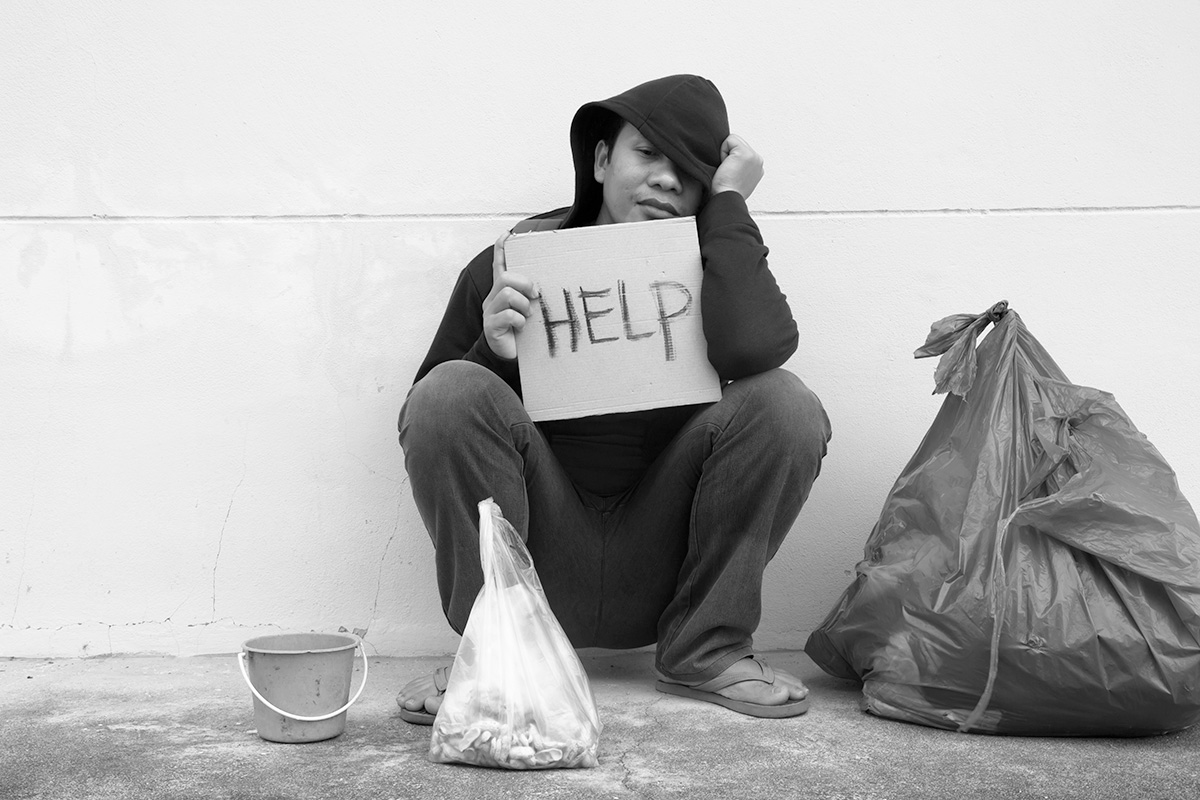
(Editor’s note: This article is part of our 2026 contribution to the D.C. Homeless Crisis Reporting Project in collaboration with other local newsrooms. The collective works will be published throughout the week at bit.ly/DCHCRP.)
A decision by President Trump’s administration to eliminate most federal funding for community-based programs to place homeless people in permanent subsidized housing could have a severe adverse impact on LGBTQ people facing homelessness in D.C., according to local advocates.
Officials with organizations that provide services for homeless people in the D.C. area and nationally have pointed to an executive order issued by Trump last year that calls for ending federal support for so-called “Housing First” programs that arrange for permanent subsidized housing for homeless people. The officials note that Trump’s proposed fiscal year 2027 budget calls for eliminating funding for the Housing First programs.
Advocates for programs providing support for homeless people note that ending federal funding for permanent housing for homeless people will — and in some cases already has — resulted in occupants of homeless shelters and short-term transitional housing facilities remaining in those facilities far longer than in the past, preventing openings for others who need housing.
A lawsuit filed by several states and homeless advocacy organizations, including the D.C.-based National Alliance To End Homelessness, to block the Trump efforts to cut off those funds has temporarily delayed some of the funding cuts. A decision in August by a federal judge in Rhode Island declared the Trump action a violation of a federal law for failing to open the proposal for the funding cuts to public comment before putting it in place.
Court records show the U.S. Department of Housing and Urban Development (HUD), which provides the federal funding for homeless related programs, appealed the lower court ruling and an appeals court reversed the ruling pending further appeal by the parties that filed the lawsuit.
At least two of the five D.C. organizations that provide housing for homeless LGBTQ youth have said their funding so far has not been cut due to the Trump actions.
Cesar Toledo, executive director of the Wanda Alston Foundation, which currently provides transitional housing for 20 LGBTQ homeless youth, said his organization receives local D.C. government funding but no federal funding so his group has so far not been impacted by the Trump action.
Debby Shore, executive director of the Sasha Bruce Youthwork organization that provides housing for young people ages 18-24, including some LGBTQ youth, said her organization also had not yet been impacted but it could be impacted soon.
“We have not had that funding cut,” she told the Washington Blade. “What we understand is if HUD is allowed to go through with those changes, then we will,” she said. “Because we have one of our programs that’s funded directly by HUD,” which she said could be considered the type of “long term” housing that HUD wants to cut.
A spokesperson for the local LGBTQ youth advocacy organization SMYAL, which currently provides housing for 55 homeless LGBTQ youth according to its website, didn’t immediately respond to a Blade inquiry into whether they have been impacted by the Trump actions. Toledo of the Alston Foundation said he understood that SMYAL has received federal funding for its homeless program.
At least two other D.C. organizations that provide housing for homeless youth, including some LGBTQ youth – Covenant House and the Latin American Youth Center – also couldn’t immediately be reached for comment on whether they have been impacted by the Trump funding cuts.
The city’s only shelter for homeless LGBTQ adults, which is operated by the D.C. Department of Human Services and is D.C. funded, has not been immediately impacted by the Trump funding cuts, according to a DHS statement sent to the Washington Blade in response to a Blade inquiry. Called Living Life Alternative, the low-barrier shelter accommodates 40 individuals, the statement says.
It says DHS receives federal funding for its homeless services programs, and it was awaiting HUD approval for its annual federal funding grant for the city’s Permanent Supportive Housing program for homeless residents. It says the current funding for that program expires Jan. 31, 2027.
According to the statement, a separate federal grant DHS receives from HUD for homeless assistance services was approved for next year but included “a slight reduction in funding of $22,808.”
The annual 2026 Point-In-Time (PIT) count of homeless people in D.C., conducted in January, recorded a total of 5,363 people who were homeless, a 4 percent increase over the previous year.
The PIT count report shows 424 adults, or 12 percent of the adults counted, identified as members of the LGBTQ community, a slight increase over the 11.7 percent of homeless LGBTQ people counted in 2025. It shows that 38 percent of “Transition Age Youth” ages 18-24 identified as LGBTQ, an increase of one percent over the 37 percent of LGBTQ youth counted in 2025.
The Trump administration through HUD has said it supports housing for homeless people that lasts no more than two years and participants should be required to get treatment for the mental illness and substance use disorders such as drug addiction and alcoholism that many homeless people suffer from.
The Washington Post has cited studies showing that up to two-thirds of homeless people have a mental illness and two in five have a substance use disorder.
“Housing First has failed our most vulnerable and enabled addiction,” the Post quoted HUD saying in an email message. “HUD’s proposed reforms seek to address the root cause of homelessness and advance recovery, self-sufficiency, and competition that drives accountability,” the Post quoted the HUD statement as saying.
Shore, director of Sasha Bruce Youthwork, disputes that assessment, saying treatment for disorders should not be a replacement for longer term housing programs, which she said improves the outcome of treatments for disorders.
“I think the idea of putting more services in place – I don’t have any problem with that,” she said. “But suggesting that you do that in exchange for longer term supports for people does not seem to be the right way to go.”

Calif. GOP gubernatorial candidate ad ‘disgusting attempt to exploit lesbian intimacy’

Trump uses anti-trans slur against Democratic Senate candidate

D.C.’s LGBTQ homeless facilities face possible hit from Trump funding cuts

10 years later, we still can’t shake Barry Jenkins’s ‘Moonlight’

‘Some Like It Hot’ a wild ride at renovated Bernard Family Theatre

Eliot Glazer’s new book an engaging collection of essays

Equality Chamber hosts Pride in Business Expo and Profits & Pours

Learn more about Virginia’s queer history

Lula, Flávio Bolsonaro to face off in second round of Brazilian presidential election

‘Merrily’ is for Sondheim super fans, the uninitiated, and anyone in between
-

 Books4 days ago
Eliot Glazer’s new book an engaging collection of essays
-
Out & About4 days ago
Equality Chamber hosts Pride in Business Expo and Profits & Pours
-
Out & About4 days ago
Learn more about Virginia’s queer history
-
Brazil3 days ago
Lula, Flávio Bolsonaro to face off in second round of Brazilian presidential election