Local
An early holiday gift for city’s gay couples

Mayor Adrian Fenty (DC Agenda photo by Michael Key)
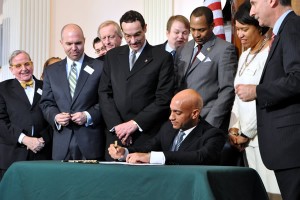
With about 200 spectators cheering from the pews, D.C. Mayor Adrian Fenty signed a bill last week to legalize same-sex marriage in Washington during a ceremony at a church that played a leading role in pushing for black civil rights in the 1950s and 1960s.
“To the world, today an era of struggle ends for thousands of residents of Washington, D.C., who have been denied the fundamental right to marry the person of their choosing,” Fenty told the gathering at All Souls Unitarian Church in Northwest D.C.
“I say to all those residents who watch the nation’s capital today that our city is taking a leap forward in ensuring freedom and equality to all residents.”
Fenty signed the Religious Freedom & Civil Marriage Equality Amendment Act of 2009 four days after the D.C. Council gave its final approval of the measure, 11-2.
The signing also came five months after a separate bill passed by the Council and signed by Fenty, which recognizes same-sex marriages performed in other jurisdictions, became law after clearing its required congressional review.
The measure that Fenty signed Friday was expected to be sent to Capitol Hill this week, where it, too, must undergo a congressional review of 30 legislative days. Most congressional observers expect the Democratic controlled Congress will allow the bill to become law by taking no legislative action to overturn it.
“The signing of this bill marks a watershed moment for human rights in the District of Columbia,” said Rev. Robert Hardies, pastor of All Souls Unitarian Church and one of the leaders of a coalition of D.C. clergy members who support same-sex marriage equality.
“I and the nearly 200 D.C. clergy who supported this bill look forward to celebrating the marriages of loving lesbian and gay couples in sanctuaries like this one all over our city,” he said.
Among those standing behind Fenty as he signed the bill at a table set up in front of the church alter were D.C. Council Chair Vincent Gray (D-At Large); gay Council member David Catania (I-At Large), author and lead sponsor of the bill; and Council member Phil Mendelson (D-At Large), chair of the committee that shepherded the bill through the Council.
Also standing at the table for the signing were gay Council member Jim Graham (D-Ward 1), in whose ward the church is located; Council members Jack Evans (D-Ward 1); Muriel Bowser (D-Ward 4), and Harry Thomas Jr. (D-Ward 5); and Fenty’s LGBT Affairs Office director, Christopher Dyer.
(DC Agenda photo by Michael Key)
Fenty and Catania, among others participating in the bill signing ceremony, said the decision to hold the event in a church was symbolic of the message they sought to project during the campaign to legalize same-sex marriage in the city: that the legislation would not infringe on the rights of people of faith and would, in fact, give ministers supportive of marriage equality the right to legally perform same-sex marriages.
Most of the opposition to the legislation was led by clergy who oppose same-sex marriage on religious grounds. Bishop Harry Jackson, pastor of Hope Christian Church in Beltsville, Md., and the lead spokesperson for the bill’s opponents, has vowed to continue efforts to urge Congress to overturn the legislation.
Jackson and his supporters also are appealing in D.C. Superior Court a ruling by the city’s election board denying a proposed voter initiative that sought to ban same-sex marriage in the District of Columbia.
Catania told people gathered for the bill’s signing that six generations of his family, including his grandfather, have been Baptist ministers. He noted that leaders of the churches in which his ancestors were a part were outspoken abolitionists in the fight against slavery prior to the Civil War.
“I was raised in a household that loved this country,” he said. “And at times, even in our struggles, we wonder whether our best days are behind us. I have to be completely honest with you. I’ve never been more certain in my life that our best days are before us.”
Catania said the passage and signing of a same-sex marriage bill was the culmination of years of work from committed LGBT activists and their allies, beginning with veteran D.C. gay activist Frank Kameny, who is credited with founding the local LGBT rights movement in the early 1960s.
“I was fortunate enough to simply guide the process and draft [the bill], but it would not have taken place without the extraordinary leadership of Phil Mendelson on the Judiciary Committee and our non-stop support from our [Council] chairman. And enough cannot be said about the rank and file members of this Council, who stood with us.”
Sources familiar with the mayor’s office said Fenty also considered holding the signing ceremony at Covenant Baptist church in
Southeast D.C., which is headed by pro-same-sex marriage pastors Dennis and Christine Wiley. The Wileys, along with Hardies of All Souls, were co-chairs of the coalition of clergy backing same-sex marriage. One source, speaking on condition of anonymity, said Fenty is thought to have chosen All Souls in part because it’s located in the neighborhood where he grew up.
In his remarks, Fenty introduced his parents, who were in the audience, and noted that their status as an interracial couple made them a part of the marriage equality movement.
“My parents know a little something about marriage equality,” he said. “They married almost 40 years ago and in a country at the time where every jurisdiction didn’t agree that an interracial couple should be married. Had they not been able to, I would not be standing here as mayor of the District of Columbia right now.”
Graham, who, along with Catania, has been a longtime LGBT rights advocate, appeared to express the emotion that many LGBT activists and same-sex couples present at the bill signing event shared.
“Thank God for this day,” he said. “Thank God that I was able to live to see this day.”
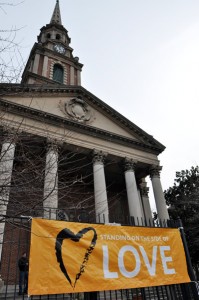
All Souls Unitarian Church (DC Agenda photo by Michael Key)
Graham praised Fenty for standing out as a “certainty” that the bill would be signed whenever the Council felt the time was right to pass it.
He also pointed to the historic support All Souls Unitarian Church provided for the African American civil rights movement in the 1950s, when the church founded one of the city’s first integrated youth clubs. It was at a time when D.C.’s youth recreation facilities were segregated among black and whites.
“We can’t overlook how fitting it is that we are in this church,” he said, “because this church has a great tradition of fighting for civil rights and human rights.”
Fenty, Catania and Graham were beseeched after the ceremony by activists and same-sex couples attending the event who asked them to pose for pictures with them and to sign copies of a mayoral press statement announcing the bill signing.
“It’s an exciting day for many of us,” said gay Democratic activist Peter Rosenstein, one of the organizers of the same-sex marriage advocacy group Campaign for All D.C. Families. “It’s a day that many of us thought wouldn’t come in our lifetimes. It’s for us and for future generations.”
Michael Crawford, co-chair of D.C. for Marriage, said he doesn’t believe Fenty and the 11 Council members who voted for the bill would face serious opposition in their upcoming elections over this specific issue.
“The folks who are claiming they will enact political retribution against Council members that voted for marriage equality, by and large, don’t live in the District,” he said. “So it’s going to be pretty difficult for them to have an impact on District elections.”
Rev. Abena McCray, pastor of D.C.’s LGBT welcoming Unity Fellowship Church, and Bishop Rainey Cheeks, pastor of the city’s Inner Light Ministries, which also has a largely LGBT congregation, each said the mayor’s signing of the marriage bill would boost the faith and morale of LGBT people of faith.
“I don’t anticipate a backlash,” McCray said, when asked about clergy who have opposed the bill.
“God is in control,” she said. “God spoke today. History was made. And we’re going to move forward in only one thing, and that’s love.”
Cheeks said he expects efforts by people of faith to fight the legislation will be diminished once they understand it.
“When they really understand that this law does not take away anything from anybody, it adds to,” they will be far less likely to try to reverse the law, he said.
“Every church and every denomination already has the right to say no to whomever they want to say no to,” Cheeks said, on the question of performing same-sex marriages. “It simply expands the right for us to be able to do what we need to do.”




District of Columbia
Bet Mishpachah participates in D.C. Oct. 7 commemoration ceremony
Wednesday marked three years since Hamas attacked Israel
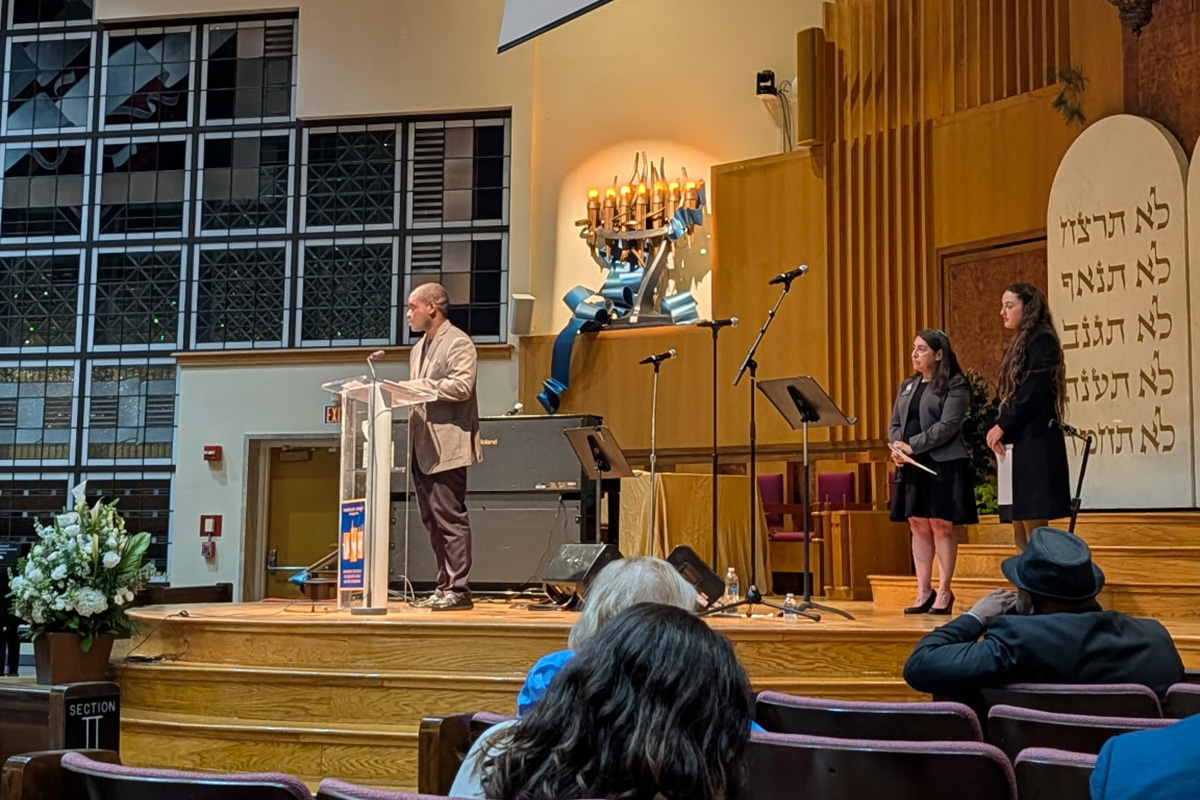
Bet Mishpachah Executive Director Joshua Maxey on Wednesday was among those who spoke at a ceremony in D.C. that marked the third anniversary of the Oct. 7 attack in Israel.
The Jewish Federation of Greater Washington hosted the ceremony that took place at the Washington Hebrew Congregation in Northwest D.C. Bet Mishpachah is the city’s LGBTQ synagogue.
“It was a deeply moving evening, especially hearing the stories of people who knew those who were murdered and those who survived and experiencing music that gave a voice to grief and hope,” Maxey told the Washington Blade.
Hamas militants on Oct. 7, 2023, killed roughly 1,200 people, including upwards of 360 partygoers at the Nova Music Festival near Re’im, a kibbutz that is a couple miles from the Gaza Strip, when it launched its surprise attack on Israel. The militants also kidnapped more than 200 people.
The Hamas-controlled Gaza Health Ministry says Israeli forces have killed more than 74,000 people in the enclave since Oct. 7.
The International Criminal Court in 2024 issued arrest warrants for Israeli Prime Minister Benjamin Netanyahu; former Israeli Defense Minister Yoav Gallant; former Hamas leader Yahya Sinwar; Mohamed Diab Ibrahim al-Masri, the head of Hamas’s military wing known as the Qassam Brigades; and Ismail Haniyeh, chair of the Hamas Political Bureau, after it accused them of committing war crimes and crimes against humanity in Gaza and Israel.
The Israeli government has strongly denied it has committed genocide in Gaza.
An Israeli airstrike on a compound in Khan Younis, a city in southern Gaza, on July 13, 2024, killed killed Deif, one of the alleged Oct. 7 masterminds. Israel less than three weeks later assassinated Haniyah in Tehran, the Iranian capital. Israel Defense Forces soldiers on Oct. 16, 2024, killed Sinwar in Rafah, a city in southern Gaza.
Hamas last October released the remaining hostages in Gaza as part of a ceasefire agreement that President Donald Trump helped broker. Israel has continued to conduct airstrikes and other military operations in Gaza since the official suspension of hostilities took effect.
“For Bet Mishpachah, it was especially meaningful to lift up the names of LGBTQ+ people, those whose identities we know and those whose stories may never be fully known, who were murdered, and to honor the LGBTQ+ survivors whose resilience continues to inspire us,” said Maxey, referring to his participation in Wednesday’s ceremony. “Emily Damari’s story is particularly poignant: while held hostage, she had to hide the fact that she was gay because she feared that revealing her identity to her captors could put her life at even more risk. Yet, she survived.”
“Her story, like so many others, reminds us of the extraordinary courage it takes simply to remain human in the face of hatred,” he added. “May we continue to remember and to mourn, to honor, and to work toward a future rooted in peace and hope.”
Virginia
Campaign urges Virginia High School League to reverse stance on trans athletes
Equality Arlington and other advocacy groups behind ‘Right 2 Play’ VA’ initiative

Virginia advocacy groups have launched a campaign that urges the Virginia High School League to once again allow student athletes to compete on sports teams that correspond with their gender identity.
Equality Arlington on Sept. 16 published an article about the “Right 2 Play VA” campaign. Amy, a group representative, spoke about the initiative with the Washington Blade.
“The primary goal is to reverse the Virginia High School League’s discriminatory ban on allowing transgender girls to play on girls’ sports and replace it with a policy that is fair for all students.” they said.
The Virginia High School League in 2025 announced the policy, which reversed a previous position in support of transgender and nonbinary athletes. The 2025 policy coincided with President Donald Trump’s executive order — “Keeping Men Out of Women’s Sports” — that threatened to “rescind all funds from educational programs that deprive women and girls of fair athletic opportunities, which results in the endangerment, humiliation, and silencing of women and girls.”
The Arlington Gender Identity Alliance, Equality Virginia, and the American Civil Liberties Union of Virginia have also joined the “Right 2 Play VA” campaign.
“We had a policy in Virginia for 12 years that allowed transgender girls to play on girls’ sports teams, and we had not one instance — not one instance — that was brought forward demonstrating an unfair advantage or any type of safety concern,” said Amy.
Amy then discussed what they described are the benefits of trans youth playing sports.
“There are physical benefits. There are mental health benefits. There are community and social development benefits, and those are all well documented,” they said. “All kids should have the right to benefit from playing youth sports. We are talking about kids. We are talking about youth. We are not talking about Olympians. We are not talking about Division One college athletes. We are talking about kids in Virginia, and because the benefits of sports are so well documented, we think that every kid should have the ability to play sports.”
District of Columbia
D.C.’s LGBTQ homeless facilities face possible hit from Trump funding cuts
38 percent of homeless youth identify as LGBTQ, up from 2025
(Editor’s note: This article is part of our 2026 contribution to the D.C. Homeless Crisis Reporting Project in collaboration with other local newsrooms. The collective works will be published throughout the week at bit.ly/DCHCRP.)
A decision by President Trump’s administration to eliminate most federal funding for community-based programs to place homeless people in permanent subsidized housing could have a severe adverse impact on LGBTQ people facing homelessness in D.C., according to local advocates.
Officials with organizations that provide services for homeless people in the D.C. area and nationally have pointed to an executive order issued by Trump last year that calls for ending federal support for so-called “Housing First” programs that arrange for permanent subsidized housing for homeless people. The officials note that Trump’s proposed fiscal year 2027 budget calls for eliminating funding for the Housing First programs.
Advocates for programs providing support for homeless people note that ending federal funding for permanent housing for homeless people will — and in some cases already has — resulted in occupants of homeless shelters and short-term transitional housing facilities remaining in those facilities far longer than in the past, preventing openings for others who need housing.
A lawsuit filed by several states and homeless advocacy organizations, including the D.C.-based National Alliance To End Homelessness, to block the Trump efforts to cut off those funds has temporarily delayed some of the funding cuts. A decision in August by a federal judge in Rhode Island declared the Trump action a violation of a federal law for failing to open the proposal for the funding cuts to public comment before putting it in place.
Court records show the U.S. Department of Housing and Urban Development (HUD), which provides the federal funding for homeless related programs, appealed the lower court ruling and an appeals court reversed the ruling pending further appeal by the parties that filed the lawsuit.
At least two of the five D.C. organizations that provide housing for homeless LGBTQ youth have said their funding so far has not been cut due to the Trump actions.
Cesar Toledo, executive director of the Wanda Alston Foundation, which currently provides transitional housing for 20 LGBTQ homeless youth, said his organization receives local D.C. government funding but no federal funding so his group has so far not been impacted by the Trump action.
Debby Shore, executive director of the Sasha Bruce Youthwork organization that provides housing for young people ages 18-24, including some LGBTQ youth, said her organization also had not yet been impacted but it could be impacted soon.
“We have not had that funding cut,” she told the Washington Blade. “What we understand is if HUD is allowed to go through with those changes, then we will,” she said. “Because we have one of our programs that’s funded directly by HUD,” which she said could be considered the type of “long term” housing that HUD wants to cut.
A spokesperson for the local LGBTQ youth advocacy organization SMYAL, which currently provides housing for 55 homeless LGBTQ youth according to its website, didn’t immediately respond to a Blade inquiry into whether they have been impacted by the Trump actions. Toledo of the Alston Foundation said he understood that SMYAL has received federal funding for its homeless program.
At least two other D.C. organizations that provide housing for homeless youth, including some LGBTQ youth – Covenant House and the Latin American Youth Center – also couldn’t immediately be reached for comment on whether they have been impacted by the Trump funding cuts.
The city’s only shelter for homeless LGBTQ adults, which is operated by the D.C. Department of Human Services and is D.C. funded, has not been immediately impacted by the Trump funding cuts, according to a DHS statement sent to the Washington Blade in response to a Blade inquiry. Called Living Life Alternative, the low-barrier shelter accommodates 40 individuals, the statement says.
It says DHS receives federal funding for its homeless services programs, and it was awaiting HUD approval for its annual federal funding grant for the city’s Permanent Supportive Housing program for homeless residents. It says the current funding for that program expires Jan. 31, 2027.
According to the statement, a separate federal grant DHS receives from HUD for homeless assistance services was approved for next year but included “a slight reduction in funding of $22,808.”
The annual 2026 Point-In-Time (PIT) count of homeless people in D.C., conducted in January, recorded a total of 5,363 people who were homeless, a 4 percent increase over the previous year.
The PIT count report shows 424 adults, or 12 percent of the adults counted, identified as members of the LGBTQ community, a slight increase over the 11.7 percent of homeless LGBTQ people counted in 2025. It shows that 38 percent of “Transition Age Youth” ages 18-24 identified as LGBTQ, an increase of one percent over the 37 percent of LGBTQ youth counted in 2025.
The Trump administration through HUD has said it supports housing for homeless people that lasts no more than two years and participants should be required to get treatment for the mental illness and substance use disorders such as drug addiction and alcoholism that many homeless people suffer from.
The Washington Post has cited studies showing that up to two-thirds of homeless people have a mental illness and two in five have a substance use disorder.
“Housing First has failed our most vulnerable and enabled addiction,” the Post quoted HUD saying in an email message. “HUD’s proposed reforms seek to address the root cause of homelessness and advance recovery, self-sufficiency, and competition that drives accountability,” the Post quoted the HUD statement as saying.
Shore, director of Sasha Bruce Youthwork, disputes that assessment, saying treatment for disorders should not be a replacement for longer term housing programs, which she said improves the outcome of treatments for disorders.
“I think the idea of putting more services in place – I don’t have any problem with that,” she said. “But suggesting that you do that in exchange for longer term supports for people does not seem to be the right way to go.”

Bet Mishpachah participates in D.C. Oct. 7 commemoration ceremony

Man charged in Mall of America shooting plot inspired by Pulse massacre: report

Bar Betsie, inviting and intimate, marks one-year anniversary

Trump, Netanyahu, and Putin are all war criminals

Center Arts Gallery celebrates 10 years with reception, auction

Eliot Glazer’s new book an engaging collection of essays

Equality Chamber hosts Pride in Business Expo and Profits & Pours

Learn more about Virginia’s queer history

Lula, Flávio Bolsonaro to face off in second round of Brazilian presidential election

‘Merrily’ is for Sondheim super fans, the uninitiated, and anyone in between
-

 Books4 days ago
Eliot Glazer’s new book an engaging collection of essays
-
Out & About4 days ago
Equality Chamber hosts Pride in Business Expo and Profits & Pours
-
Out & About4 days ago
Learn more about Virginia’s queer history
-
Brazil4 days ago
Lula, Flávio Bolsonaro to face off in second round of Brazilian presidential election