National
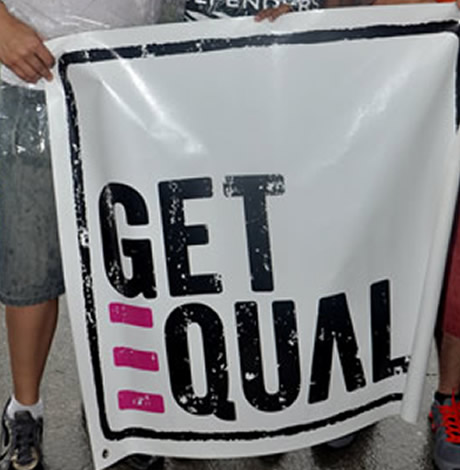
GetEqual names board members
10 people comprise new, provisional board

The group responsible for many recent protests throughout the country over LGBT issues announced Tuesday its new board of directors were set this week to meet to discuss future actions.
The 10 members who comprise the new, provisional board for GetEqual have a history of activism. They are:
• Jillian Weiss, the board chair, a transgender blogger and law professor at Ranapo College in New Jersey;
• Richard Aviles, a 19-year-old Los Angeles native who founded a gay-straight alliance at his home school before going to college at St. Olaf College in Northfield, Minn;
• John Blake, who co-founded Montana Equality Now in 2009 and is studying at the University of Montana;
• Geoff Farrow, a former priest and activist on the 2008 “No on 8” campaign in California;
• B. Loewe, who served as planning director for the Latino Union of Chicago from 2003 to 2009;
• Cathy Marino-Thomas, a former executive director of Marriage Equality New York and current board president of the organization;
• Kelsey Phipps, a law student at Georgetown University and former staffer for the late Sen. Edward Kennedy;
• Mark Reed, a member of the executive steering committee for the National Equality March in 2009;
• Autumn Sandeen, a transgender blogger and former fire controlman for the U.S. Navy;
• and Evelyn Thomas, executive director of the Sanctuary Project, an organization geared toward ending “Don’t Ask, Don’t Tell.”
At the end of six months, each board member will be given the option to assess whether they want to remain on the board for a full term or step down and let someone else join, according to GetEqual.
Robin McGehee, co-founder for GetEqual, said the board members will be attending a staff retreat over the next few days in Los Angeles to discuss the future of the organization.
McGehee said GetEqual has already spoken to local organizers throughout the country about actions against members of Congress as they return home for recess, particularly targeting Democrats who have an unknown status on a whip count on the Employment Non-Discrimination Act or Republicans representing LGBT-friendly districts.
“It doesn’t mean that all of them are talking about office events or direct action,” she said. “It may be that they want to organize or protest or rally outside that legislator’s office, or they may be wanting to organize their own team.”
California
Gay Calif. lawmaker confronted during San Francisco Trans Pride over Gaza stance
State Sen. Scott Wiener running for Nancy Pelosi’s seat
A video posted on X by user Dimitry Yakoushkin of the incident went viral, showing gay California state Sen. Wiener (D-San Francisco) being chased out of Dolores Park, while the group screamed at him. Multiple people in the protest group were wearing black ski masks that concealed their identities.
Wiener is contending to take over Nancy Pelosi’s seat in Congress in the upcoming November general election.
The video started off with Yakoushkin, a local activist, highlighting how great Wiener’s LGBTQ policies and lawmaking work are. As Yakoushkin started to criticize Wiener about his housing policies, others started to gather around the politician.
Yakoushkin and the group quickly transitioned to yelling at him about his stance on the genocide in Gaza.
“You’ve been wonderful for trans people, and … you’ve been terrible on Gaza,” Yakoushkin is heard saying in the video. “You do not belong here (at Trans Pride) anymore, Scott.”
“I want to support someone who’s so positive on trans rights, but you’re a piece of sh*t on Gaza,” he says later in the video. “How could you do that?”
Other protestors shouted obscenities that were hard to distinguish from, but some that jumped out included cries of “f*ck you” and “You’re a piece of sh*t.”
When it was clear this would not be a one-and-done criticism, Wiener is seen on video pivoting to exit Dolores Park, with the group following behind until Wiener was out of the park.
The video garnered over 12 million views as of Monday.
Scott Wiener showed up to the trans march and for the first time we kicked his ass out. It's sad because while he's written some good legislation for queers, hes ultimately a genocidal-supporting center right shill. Trigger warning: broken man walking away defeated. Vote Connie! pic.twitter.com/TXIB7omxde
— Dimitry Yakoushkin (@decadimitry) June 27, 2026
In early January of this year, Wiener declined to call Israel’s actions in Gaza a genocide during a congressional debate forum, as many other politicians have.
A week later, on Jan. 11, Wiener reversed that decision.
“For years, I’ve condemned (Israeli Prime Minister Benjamin) Netanyahu and his extremist government and the devastation they’ve inflicted on Gaza,” Wiener posted on X. “It’s why I’ve been clear I won’t support U.S. funding for the destruction of Palestinian communities. I’ve stopped short of calling it genocide, but I can’t anymore.”
This was after two years of Israeli bombing that led to thousands of Palestinian deaths in the Gaza Strip, following the Oct. 7 attack by Hamas.
After Friday’s incident, Wiener posted a statement, calling it “physical intimidation and harassment” by “people who had previously targeted” him with “aggressive behavior in the past.”
“Last night I attended the Trans March, as I’ve done each year for the past 22 years since the first march in 2004,” the statement said. “I attend each year in solidarity with our trans siblings, who are facing existential threats from right-wing extremists, including the President.”
“I have no objection whatsoever to anyone disagreeing with me, opposing me, or protesting me.
“All of that is core to democracy,” the statement continued. “I also have no issue when people talk to me on the street and ask questions or express opposition. That’s democracy, even when the people engaging in this conduct misrepresent my views. But when opposition and disagreement transition to harassment, including cornering me, touching me, or trying to physically bully me out of a public event, that crosses a line.”
Wiener’s congressional opponent, Supervisor Connie Chan, appeared to march without any incident.
Many critics of Wiener took to social media to point out that Wiener posted this statement and used it as a fundraising opportunity, while not posting about the heavy police presence and arrests during San Francisco’s Pride weekend.
Independent journalist Jersey Noah made an Instagram post to Wiener saying, “What do you have to say about (San Francisco Police Department) assaulting and arresting trans people on the public streets of San Francisco for two consecutive nights? Because you haven’t said a… word.”
This is not the first time a politician has been ousted from San Francisco’s Trans Pride festivities, according to San Francisco-based outlet Mission Local.
Past politicians forced to leave over the last decade include Mayor Daniel Lurie, then-Mayor Ed Lee, City Attorney David Chiu, and then-state Sen Mark Leno, according to Mission Local.
Yakoushkin said the protest was spontaneous, saying, “It was not planned, I was walking home, and I saw him from a distance and I got my camera out to start filming,” according to Mission Local.
The California Senate Democratic Caucus and California LGBTQ+ Caucus made a joint statement of support for Wiener, denouncing the verbal harassment toward Wiener as “unacceptable.”
“Senator Wiener has spent the last 16 years in service to San Francisco,” their statement said. “In that time, he has been a fearless champion for the LGBTQ+ community even when it was not politically popular, leading on landmark legislation advancing the rights and protections for transgender, gender Expansive, and intersex people. He is a steadfast advocate for his communities.
“In California, we believe everyone deserves dignity and respect, regardless of political differences,” the statement continued.
U.S. Military/Pentagon
Court to weigh class action status in trans military ban challenge
Thousands of transgender servicemembers await pivotal decision
While many eyes are on the U.S. Supreme Court awaiting the verdicts in West Virginia v. B.P.J. and Little v. Hecox, another court case involving transgender rights is unfolding less than a mile away at the U.S. District Court for the District of Columbia — one that could have lasting implications for transgender military personnel.
In January 2025, President Donald Trump signed Executive Order 14183, titled “Prioritizing Military Excellence and Readiness,” directing the Pentagon to prohibit transgender, nonbinary, and gender-nonconforming people from serving in the military.
The Trump-Vance administration and Defense Department argued that trans people are inherently incapable of meeting the military’s “high standards of readiness, lethality, cohesion, honesty, humility, uniformity, and integrity,” citing a history or signs of gender dysphoria. According to the Pentagon this creates “medical, surgical, and mental health constraints on [an] individual.” Regardless of their physical or intellectual capabilities, transgender applicants are now considered less qualified than their cisgender peers.
Almost immediately after the executive order was signed, LGBTQ Legal Advocates & Defenders (GLAD Law) and the National Center for LGBTQ Rights filed a federal lawsuit in the U.S. District Court for the District of Columbia challenging the order. The plaintiffs argue the Trump administration acted with discriminatory animus and violated the Equal Protection guarantee of the Fifth Amendment.
The case — originally filed as Talbott v. Trump and now restyled as Talbott v. USA — includes six active-duty service members and two individuals seeking to enlist. Since the initial filing, 12 additional plaintiffs have joined the lawsuit.
On June 1 the U.S. Court of Appeals for the D.C. Circuit blocked the military ban for active-duty trans service members. The three-judge panel ruled 2-1 that Trump’s executive order was illegal — created with the intent to exclude people from military service based on their gender identity.
The Washington Blade spoke with Michael Haley, a staff attorney at GLAD Law who is part of the legal team challenging the ban and seeking to protect the constitutional rights of transgender service members. Haley previously served as an assistant attorney general in the New Hampshire Department of Justice and as a law clerk for the U.S. District Court for the District of New Hampshire.
Asked why the D.C. Circuit’s ruling blocking the ban — issued on the first day of Pride month — was so significant, Haley said the decision is about protecting the constitutional rights of trans people that have been under attack since the beginning of the Trump-Vance administration.
“I think it’s hard to understate the importance of that order, because what is really significant is that the ban is based entirely on the administration’s dislike of transgender people, and not based on any real concerns about lethality and unit cohesion,” Haley said. “The circuit court went through in pretty good detail, identifying all the ways in which it’s clear that the administration is doing this to harm transgender people, and not for any kind of real military benefit. It’s a really striking and important decision that shows all of our plaintiffs have been serving with distinction, earning medals and commendations, and the fact that they are transgender does not factor into the equation.”
On Tuesday, the plaintiffs will ask the court to certify the lawsuit as a class action on behalf of all trans service members affected by the military ban. Asked what class certification would accomplish, Haley said it would allow future rulings in Talbott to apply not only to the named plaintiffs but to all trans service members covered by the case.
“The class certification, if the court approves it — and we’re hopeful that it will — will mean that any final judgment that comes out of this case will apply not just to our named plaintiffs, but to all transgender service members serving. Simply certifying a class does not necessarily change things on the ground for folks now, but it will ensure that our final judgment, or future judgments within this proceeding, apply to everybody and not just the named plaintiffs.”
Haley said the current legal landscape has created significant uncertainty for trans troops, leaving many unsure of their futures — both those serving stateside and those stationed overseas.
“Unfortunately, there’s just really not a lot of transparency around how the government is implementing the ban,” he said. “We are hearing from service members, including our own plaintiffs, who are receiving notices that they are going to be put before separation boards, but we have no insight into their timing, their decisions for who they notify, when and why, or how they are viewing the D.C. Circuit’s order. We’re going to have to wait for a little bit more of the court process to happen before we can speak with any certainty.”
Asked whether the case could eventually reach the Supreme Court — as Defense Secretary Pete Hegseth suggested in a post on X — Haley said the central constitutional question is whether the policy is rooted in discriminatory animus.
“It will be extremely hard for any court to deny that a policy that identifies a group of people and calls them dishonest, lacking integrity, and lacking a warrior spirit — in spite of all the evidence — is motivated by animus. That’s an argument under the Equal Protection Clause of the Constitution, which says everybody is entitled to equal protection of the laws and forbids singling out a group of people and treating them disfavorably just because you don’t like them rather than because of some legitimate purpose … I think that’s going to be the central question.”
Haley also explained how the current policy differs from the trans military ban Trump announced in 2017.
“The first thing goes back to that same question of animus. The D.C. Circuit recognized that this time around, the policy on its face calls transgender people dishonorable and lacking integrity and things like that. We did not have as clear evidence as we do this time around that this is not actually about military readiness — it is about trying to harm transgender people.”
Haley echoed that view, arguing the administration’s “updated” policy is aimed at excluding trans people rather than improving military readiness.
“The fact that they are trying to push out people who are serving simply because they’re transgender goes to show that this is about harming that group rather than making sure the military can function,” Haley said.
He said the current policy is significantly broader, affecting active-duty trans service members rather than primarily those seeking to enlist.
“The other major difference is how this ban is treating folks who are serving. The last time around, those who were already serving were allowed to continue serving and the ban only applied to people seeking to join the military. This time around, the ban is going further and trying to push out people who are serving with distinction and performing to standards, which is just more evidence that this is not about any actual military benefit.”
Haley also outlined the two categories of evidence GLAD Law has presented to the court to challenge the administration’s claims that trans service members undermine military readiness.
“One [type of] evidence about these individual service members — they have served on nuclear submarines, flown Navy planes, reached ranks requiring Senate confirmation, served as field medics, and continue to excel in extremely demanding roles,” he said. “The other category is testimony from high-ranking military personnel who oversaw the inclusion policy and saw transgender people serving without any of the concerns the government now claims.”
“These are people who have to meet the standards just like anybody else, and if they meet the standards, they should be able to continue to serve. We had four years under the previous administration implementing that policy without any of the issues the government now claims, and that’s pretty strong evidence that it was working.”
Asked about the human toll of the policy — and the thousands of trans service members who have been forced out of the military or are uncertain about their futures — Haley said those personal stories have become a driving force behind the legal challenge.
“I have really heard stories of lives torn apart. These are people who, in some cases since they were children, dreamed of serving, achieved extremely high levels within the military, built their lives around it, built their families around it, and have now been sitting in limbo for more than a year not really knowing what’s coming next.”
He said the disruption extends far beyond losing a job, affecting long-term careers, financial security, and retirement plans.
“For those who have left, they have left a life where they had known no other type of career. In many cases they had served for long periods and were planning on availing themselves of the military benefits they had earned through long-term service, and because they were pushed out too soon, they are now having to reorder both their short-term and long-term lives.”
Haley also described service members stranded overseas, unable to return home or continue serving while they wait for the legal process to play out.
“We know of people who are effectively stranded on bases overseas, unable to come home but also unable to serve, and are just waiting for this to move forward so they can see their families again, whatever the outcome. It’s been really devastating, especially for a group of people who raised their hand to serve and protect.”
Asked what trans service members should take away from the upcoming class certification hearing, Haley encouraged them to stay informed through organizations such as SPARTA Pride, a nonprofit organization representing trans service members, veterans, their families, and allies.
“Until we get an order from a court saying, ‘This is what’s next,’ it’s hard for us to guess, and we certainly don’t want to send folks in the wrong direction. Folks should follow organizations like GLAD Law, NCLR, and SPARTA because they’re providing day-to-day updates as these developments happen.”
Second Lt. Nicolas “Nic” Talbott, U.S. Army, one of the plaintiffs in the case, spoke with the Blade last year about what it has been like to be a capable and willing service member stripped of his career because of the policy.
“It’s very empowering to be able to stand up, not only for myself, but for the other transgender service members out there who have done nothing but serve with honor and dignity and bravery,” Talbott told the Blade. “There are no documented cases that I’m aware of of a transgender person having a negative impact on unit cohesion simply by being transgender … Being transgender is just another one of those walks of life.”
Talbott added that a more diverse military is ultimately a stronger military because it brings together people with different backgrounds and perspectives to solve complex problems.
“I think the more diverse our military is, the stronger our military is … We need people from all different experiences and all different perspectives, because somebody is going to see that challenge or that problem in a way that I would never even think of … and that is what we need more of in the U.S. military.”
SPARTA Executive Director Kara Corcoran, an Army infantry officer with 18 years of service who is currently being separated under the trans military ban, said the upcoming class certification hearing could determine whether relief extends beyond the named plaintiffs.
“When the D.C. Circuit Court recently ruled to affirm Talbott v. USA’s preliminary injunction, SPARTA Pride was relieved to see their powerful conclusion: that this policy was not based on any evidence, but in unconstitutional animus toward transgender people,” Corcoran said in a statement to the Blade. “However, the post-CASA climate meant what was originally a universal injunction now only benefited the small number of active duty plaintiffs. This limited scope left behind the thousands of other transgender service members whose rights were also violated. Certifying the case as a class action would ensure that an ultimately positive outcome in litigation would apply to all patriots impacted by the discriminatory policy — not just the few dozen who signed on to be plaintiffs last year.”
Corcoran said the hearing carries implications far beyond the trans military community, arguing that the case could shape how courts respond when constitutional protections are challenged.
“The entire transgender military community and their families are waiting with profound anticipation and hope for the court’s decision, knowing it could determine the future of their military careers, their livelihoods, and their families. But the gravity of tomorrow’s hearing reaches far beyond those directly affected. It will serve as a test of whether our government will uphold its constitutional duty when another branch openly discriminates against a marginalized group of Americans who answered the call to serve with self-sacrifice, honor, and integrity. This is not simply about transgender service members — it is about the precedent the judicial system sets for every American when equal treatment under the law is challenged.”
The Blade also reached out to the White House regarding this ongoing situation.
“President Trump and Secretary Hegseth are restoring a military that is focused on readiness and grounded in scientific reality—not gender ideology,” said Anna Kelly, Principal Deputy Press Secretary said in an email.
The U.S. District Court for the District of Columbia is scheduled to hold the class certification hearing on Tuesday at 2 p.m. ET.
U.S. Supreme Court
11 years after Obergefell, marriage equality remains under scrutiny
Landmark ruling issued on June 26, 2015
Friday marks 11 years since the U.S. Supreme Court ruled the Constitution protects same-sex marriage in Obergefell v. Hodges. Despite that major win for LGBTQ people nationwide, the case may be on shakier ground than originally thought.
Obergefell v. Hodges, the case that determined the Constitution extends its protection of rights to same-sex couples and that states must recognize marriage licenses for same-sex couples from other states, was decided using a combination of cases from several states.
The central arguments in the case rested on the 14th Amendment’s Equal Protection Clause, Due Process Clause, as well as collateral spousal and parental rights.
Cases in play
The first case came from Michigan with DeBoer v. Snyder, where a lesbian couple, who were not legally allowed to marry in the Mitten State, attempted to adopt their third child but could not both obtain legal parental rights. April DeBoer and Jayne Rowse initially received a favorable ruling in district court, with the judge finding that the Michigan Marriage Amendment — which barred same-sex marriage in the Midwestern state — violated the Equal Protection Clause. The same day, the case was appealed to the 6th U.S. Circuit Court of Appeals, eventually making its way, along with the other five cases, to the highest court in the land.
Ohio had multiple cases that ultimately contributed to the judicial acknowledgment of same-sex marriage rights in the U.S.
The Supreme Court case most commonly associated with the fight for same-sex marriage — Obergefell — originated in Ohio. Beginning as Obergefell v. Kasich in the state, James Obergefell knew his longtime boyfriend, John Arthur, was suffering from ALS. Knowing Arthur’s life would end shortly — and understanding the couple could not legally marry in Ohio — they boarded a medically equipped plane, accompanied by a nurse and Arthur’s aunt, Paulette, and flew to BWI Airport in Maryland. There, they were legally married. Over the next several months, Arthur’s health continued to decline until he eventually passed away in October.
The legal battle began after Arthur died, as Ohio law refused to acknowledge that Obergefell was his husband and would not list him as Arthur’s surviving spouse on his death certificate. Obergefell challenged the decision, arguing it was unconstitutional and pursuing legal action. The local Ohio registrar agreed that refusing to recognize their out-of-state marriage license — which Ohio had recognized for different-sex couples in the past — discriminated against the couple. Despite that, the state attorney general continued to defend Ohio’s same-sex marriage ban.
The judge ultimately ruled that “a marriage solemnized outside of Ohio is valid in Ohio if it is valid where solemnized,” marking another step toward marriage equality. Ohio appealed the ruling, and the case ultimately contributed to the establishment of same-sex marriage protections under the federal Constitution.
The second Ohio case, Henry v. Wymyslo, much like DeBoer v. Snyder, involved parental rights for adopted children. The case included four couples — three lesbian couples who lived in Ohio and adopted children while residing there, and one gay couple from New York with an adopted son born in Ohio. The four couples filed a lawsuit against Ohio, seeking to require the state to list both parents on their children’s birth certificates.
Eventually, the judge — the same one who presided over Obergefell v. Kasich — ruled that the state must list both parents on their children’s birth certificates. Like many cases that make their way to the Supreme Court, it went through multiple appeals before ultimately reaching the nation’s highest court.
Kentucky also had two cases that contributed to the legal battle for same-sex marriage.
The first, Bourke v. Beshear, revolved around Gregory Bourke and Michael DeLeon, a same-sex couple married in Canada in 2004, and Randell Johnson and Paul Campion, who were married in California in 2008. Like DeBoer v. Snyder and Henry v. Wymyslo in their respective states, the plaintiffs challenged Kentucky’s ban on same-sex marriage and its refusal to recognize same-sex marriages performed in other jurisdictions so that both parents could be acknowledged on their children’s birth certificates.
The judge ultimately ruled, much like in Obergefell v. Kasich, that states constitutionally must recognize legally performed out-of-state marriages.
Love v. Beshear is the second case from the Bluegrass State.
Maurice Blanchard and Dominique James were denied a marriage license by Kentucky county clerks. The couple’s legal team filed to join Bourke v. Beshear, another case actively challenging the state’s ban on same-sex marriage, and the motion was approved, with the case restyled as Love v. Beshear. The judge ultimately ruled that Kentucky’s bans on same-sex marriage explicitly “violate the Equal Protection Clause of the Fourteenth Amendment to the United States Constitution, and they are void and unenforceable.”
The final case, Tanco v. Haslam, involved four same-sex couples who filed suit in Tennessee. Each couple had married outside Tennessee before moving to the state, with nearly all relocating for employment. One worked for the military, whose marriage was already recognized by the Department of Defense; one worked for the state; and two were professors. Seeking to have their out-of-state marriages recognized in Tennessee, the four couples filed Tanco v. Haslam in U.S. District Court for the Middle District of Tennessee. The court eventually granted a preliminary injunction requiring the state to recognize the marriages of the three plaintiff couples but denied the request to overturn Tennessee’s same-sex marriage ban.
To SCOTUS
All of these cases contributed to the legal challenge against same-sex marriage bans across the country and ultimately led to a 5-4 ruling that allowed same-sex couples to have their marriages recognized in all 50 states, Guam, Puerto Rico, and D.C.
The justices voted as follows: Anthony Kennedy, who authored the majority opinion, Ruth Bader Ginsburg, Stephen Breyer, Sonia Sotomayor, and Elena Kagan supported Obergefell while Chief Justice John Roberts, Antonin Scalia, Clarence Thomas, and Samuel Alito all dissented.
The court held that the 14th Amendment — specifically its Due Process Clause — guarantees the right to marry as one of the fundamental liberties it protects, regardless of the gender of those getting married.
The court also ruled that another provision of the 14th Amendment — the Equal Protection Clause — extends the right to marry enjoyed by different-sex couples to same-sex couples, finding that denying same-sex couples that right violates their right to equal protection under the law.
Some of the Supreme Court justices who dissented argued that this was a state issue, not a federal one, because the Constitution makes no mention of same-sex couples. They said it was beyond the purview of the court to decide whether states must recognize or license such unions. The dissenters argued that the majority was engaging in judicial policymaking, which they contended is not permitted under U.S. law.
Another argument made by the dissenting conservative justices was that the majority opinion infringed on religious freedom by engaging in this “judicial policymaking” rather than allowing state legislatures to determine the laws governing marriage.
Since the ruling
According to data from the Williams Institute, 823,000 same-sex couples are now legally married — more than twice the number in 2015 — as a result of the Supreme Court’s decision.
The ruling also increased the number of same-sex families raising children, largely because it removed legal barriers and paperwork restrictions that had prevented same-sex couples from being listed as parents. The data shows there are nearly 299,000 children under the age of 18 being raised by married same-sex couples as a result of Obergefell.
The states that saw the largest increases — and the most favorable changes to marriage rates — were in the South. The percentage of cohabiting same-sex couples who were married between 2014 and 2023 increased from 38 percent to 59 percent.
Many of the married same-sex couples surveyed said marriage improved their sense of safety and security (83 percent), life satisfaction (75 percent), and relationship stability (67 percent).
“Marriage equality has significantly benefited the lives and well-being of same-sex couples, their families, and the communities where they live,” said Christy Mallory, interim executive director and legal director at the Williams Institute.
Future of Obergefell
While same-sex marriage remains the law of the land, there have been multiple attempts by conservative and religious figures in America to reverse it.
In 2025, Kim Davis, the clerk of Rowan County, Ky., who made headlines 10 years earlier after refusing to issue marriage licenses following the striking down of same-sex marriage bans, approached the Supreme Court with the goal of getting Obergefell overturned.
She argued that the ruling put her religious beliefs at odds with her job and asked the court to strike it down. The consensus was nearly unanimous, holding that when a person serves as an agent of the state, they cannot place their personal religious beliefs above state policy because they are acting on behalf of the government.
Thomas, one of the Supreme Court’s most conservative justices, has also attempted to plant the seeds for overturning Obergefell.
In Dobbs v. Jackson Women’s Health Organization, which ultimately restricted abortion access in the country, he wrote a concurring opinion suggesting that Obergefell, along with several other precedents, should be “reconsider[ed].”
Later, without directly addressing Obergefell, Thomas told an audience at Catholic University’s Columbus School of Law that he didn’t “think that … any of these cases that have been decided are the gospel.”
While President Donald Trump has not implemented any executive restrictions on same-sex marriage during his presidency, his administration has made it clear that it opposes continued efforts to expand protections for same-sex couples, particularly when doing so conflicts with claims of “religious freedom.” The administration has attempted to remove sexual orientation and gender identity from federal health care and housing nondiscrimination protections and has significantly restricted the rights of transgender Americans.
Currently, same-sex marriage remains federally protected by the Respect for Marriage Act, and the Supreme Court has thus far declined to overturn Obergefell.