National
Legal experts disagree over Obama action on ‘Don’t Ask’
Does Oath of Office force presidents to defend all laws?
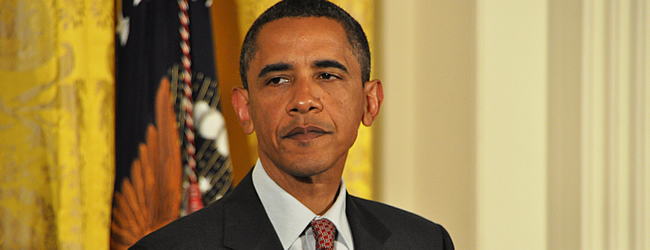
Nan Hunter, a Georgetown University law professor and prominent gay rights attorney, says President Obama has done the right thing in appealing a decision by a federal judge that overturned the ‘Don’t Ask, Don’t Tell’ law.
Hunter’s view contradicts the position of nearly all national LGBT rights groups, which have urged Obama not to appeal the decision. But she is joined by a number of other legal and constitutional experts who oppose ‘Don’t Ask, Don’t Tell’ but believe U.S. presidents are obligated to defend laws passed by Congress under most circumstances.
“I think the president, through the Justice Department, should defend federal laws, including this one,” Hunter said. “Otherwise you just get way too much. You get the president being able to ignore laws that are passed by Congress, and that’s not a good situation.”
Hunter cautioned LGBT activists that dismantling the longstanding tradition that presidents should defend duly enacted laws — even unpopular ones — could result in the refusal by a different president to enforce laws beneficial to LGBT people.
Other legal experts, including constitutional specialists with the American Civil Liberties Union and the LGBT litigation group Lambda Legal, agree that presidents generally should defend federal laws. But they say the obligation to defend a law should not apply to cases where strong evidence exists that the law is unconstitutional and a court issues a ruling overturning the law on constitutional grounds.
“The ACLU recognizes the Executive’s duty to ‘take care that the laws be faithfully executed,’” said ACLU Executive Director Anthony Romero in an Oct. 14 open letter to Attorney General Eric Holder.
“This duty includes the responsibility to defend Acts of Congress in court, provided there is at least a reasonable argument in favor of the Act’s constitutionality,” Romero said. “At the same time, the Executive is duty bound to ‘preserve, protect and defend the Constitution of the United States,’ which guarantees that no person is ‘deprived of life, liberty or property without due process of law.’”
Romero noted that U.S. District Court Judge Virginia Phillips in California ruled in September that the ‘Don’t Ask, Don’t Tell’ law is unconstitutional on those same grounds.
“The question is no longer whether the Executive will defend an Act of Congress, but whether the Executive will appeal from a well-reasoned, obviously correct federal court ruling based on findings of fact that are exceedingly unlikely to be reversed,” he said in his letter.
“Given these findings and the proper legal standard of review to be applied, there is no reasonable argument for the constitutionality of the policy, and no reason for the government to appeal,” he said.
Hunter, who personally opposes ‘Don’t Ask, Don’t Tell,’ said following that course could become a “political disaster” that prompts a possible Republican Congress next year to take action to reinstate the law or attempt to force the president to continue to enforce it.
A far better course of action, according to Hunter, would be for the administration to appeal the decision and use a careful, strategic approach to presenting its arguments before the appeals court.
“There are many, many possibilities for how the administration could respond,” she said. “It could respond by filing the appeal so that the case goes to the appeals court and then making arguments that represent the president’s view that it’s a bad law…And then the court of appeals will decide, and that will have much more authority than one District Court judge.”
Susan Sommer, director of constitutional litigation for Lambda Legal, says Obama should not have appealed Judge Phillip’s decision to overturn ‘Don’t Ask, Don’t Tell.’
“It’s really a shame that the Obama administration is appealing this decision,” Sommer said. “The president is in no position to appeal a decision on a policy that the courts say is unconstitutional. He has an obligation to uphold the Constitution.”
Sommer said she agrees that Obama has an obligation to uphold laws as well as the Constitution.
“But he does not have an obligation to defend a statute whose constitutionality is being challenged in court,” she said. “There have been precedents of a president not defending a law under court challenge. The Justice Department exercises discretion all the time on whether to take cases or not, both civil and criminal.”
David Rittgers, legal policy analyst for the Cato Institute, a libertarian think tank, and an attorney with the Army Reserves, called the ‘Don’t Ask, Don’t Tell’ case a “unique situation” that involves all three branches of the federal government.
Saying he’s speaking for himself and not the Army, Rittgers said he sides with those who believe the president should defend laws, including this one.
“Congress ultimately has to answer this question,” he said. “This will not be a settled issue until Congress acts. This is constitutionally within the realm of Congress.”
Susan Low Bloch, a Georgetown University law professor who specializes in constitutional law, said presidents have refused to enforce laws or chosen not to appeal court decisions overturning them mostly in cases where the law interferes with the president’s or the executive branch’s ability to carry out its duties.
“That’s not the situation with ‘Don’t Ask, Don’t Tell,’” she said. “And that’s why it’s not at all surprising to me that the administration has chosen to defend the law, even though they don’t like it. The way to get rid of it is to undo it the proper way—to get Congress to undo it.”
“Now if the court strikes it down, I’m sure behind the scenes the president will be very happy. But he’s not supposed to go into court and undermine it,” she said.
Asked whether she believes a president should wait for the Supreme Court to strike down a law before he or she can stop enforcing it, Bloch said, “Yes, that’s right.”
“People really shouldn’t be surprised at this course because … clearly this is the way the system has worked and I think should work,” she said.
(Obama photo by Michael Key)




California
Calif. GOP gubernatorial candidate ad ‘disgusting attempt to exploit lesbian intimacy’
Activists, anti-LGBTQ religious leaders criticized Steve Hilton spot

Two women sit on a bed, a Pride flag hanging behind them. One is nervous; the other tells her to be calm and that she’ll do “all the work.” The music swells. The two hold hands and — fill out a ballot voting for Steve Hilton?
This is the new advertisement from the Hilton gubernatorial campaign that is drawing rebuke from both sides of the aisle, but for very different reasons.
Jorge Reyes Salinas, the communications director at Equality California, said the ad was an insult to the queer community.
“This ad is a disgusting attempt to exploit lesbian intimacy for political attention,” he said. The advertisement plays on media tropes that Salinas says “reduce lesbian and bisexual women … to sexual entertainment,” rather than showing them as well-rounded characters. “Any group of the LGBTQ+ community deserves the same dignity and respect as everyone else,” he said.
The ad is truly hyper-sexualized. It ends with one woman telling the other, “Now lick it.” The two pause and stare before she reveals an envelope to send the ballot, and large text pops up saying, “Just try it!”
Salinas characterized the ad as a desperate attempt to get attention from a candidate who is trailing far behind in the polls in heavily Democratic California. The Democratic candidate Xavier Becerra, who is endorsed by Equality California, holds a 25-point lead over Hilton according to recent polling by the UC Berkeley Institute of Governmental Studies.
Conservatives have also criticized the ad.
Influential evangelical Pastor Jack Hibbs thought the ad was distasteful and said, “lesbianism among college girls and some high school girls that right now is an actual pandemic of social ill.” Republican attorney general candidate Michael Gates said it undermines “the sanctity of the relationship between parents and their children.” This criticism is rather confusing because although the ad features two relatively young women, they both appear to be adults, not minors.
“The comments from Pastor Jack Hibbs should be criticized because there is nothing wrong with two women being attracted to each other,” Salinas said. “We’re calling out the ad’s stereotypes, while also rejecting the homophobia in the response to it … by other Republicans.”
The backlash from Hilton’s own party and supporters shows that an advertisement full of queer innuendo was ill-considered, considering the national GOP’s attacks on LGBTQ people in recent years. Hilton himself has been campaigning against transgender girls and women competing in school sports and using locker rooms that correspond with their gender identity. This context might be why Hilton’s political base responded to the ad just as poorly as the liberal voters he was attempting to court.
Hilton says the ad is part of a new series rolling out before Election Day, showing stereotypical California liberal archetypes voting for Hilton. He claims these ads are authentically filmed with real actors, as opposed to being A.I. generated, like many of his previous ads. One other advertisement has been released so far by the campaign showing a man at a spiritual retreat also being swayed to vote for Hilton, although it is notably absent of sexual innuendo.
Caleb Kaufman is a California Local News Fellow placed with the Los Angeles Blade. The California Local News Fellowship is a state-funded initiative to support and strengthen local news reporting. Learn more about it at fellowships.journalism.berkeley.edu/cafellows.
2026 Midterm Elections
Trump uses anti-trans slur against Democratic Senate candidate
President mocked Annie Andrews

President Donald Trump used an anti-trans slur against Democratic South Carolina Senate candidate Annie Andrews on Monday as he sought to rally support for Republicans in the state’s Senate race.
In a post on Truth Social, Trump attacked Andrews three times, referring to her as “trannie” while promoting U.S. Sen. Darline Graham (R-S.C.)’s campaign.
Andrews is running against Graham for a Senate seat in the solidly Republican state.
Earlier this year, Graham was specially appointed to the seat following the death of her brother, Lindsey Graham, who represented South Carolina in the Senate from 2003 to 2026.
Andrews, the Democratic nominee from the state, is a pediatrician that lives in Charleston with her three children. She told NBC News that she will “work with anyone to put South Carolina first.”
“As a mom and a pediatrician, I’m in this race to fight for my patients, my three kids, and South Carolina,” Andrews said, adding that “lowering costs and making life better for families across our state is going to take all of us working together.”
Andrews used the attention from the president’s attack to emphasize what she described as a focus on policy issues rather than the culture wars that have dominated much of the political debate.
“If you care more about your bills than the politics in Washington, this campaign is for you,” she added.
Trump’s remarks have drawn criticism from leaders on both sides of the aisle.
Senate Minority Leader Chuck Schumer (D-N.Y.) condemned Trump’s words Monday night on social media, calling his attacks on Andrews “despicable.”
“Annie Andrews is a mom and pediatrician who’s always put her community first — and she’s exactly who South Carolina needs representing them in the Senate,” Schumer said on X.
Former South Carolina Gov. David Beasley, a Republican, also criticized the president’s attack on Andrews, urging voters to “reject politics based on division and hate.”
“This is abhorrent. Elections don’t have to be about cruelty and lies. South Carolina deserves better,” Beasley wrote Monday night on X.
South Carolina has not elected a Democratic senator in nearly three decades.
Andrews’s campaign website does not mention her positions on LGBTQ issues.
The Washington Blade reached out to Andrews’s campaign for comment on Trump’s attack and her positions on transgender rights but did not hear back by time of publication.
Federal Government
Bessent says Trump chose him for his qualifications, not his sexuality
Treasury Secretary Scott Bessent talked with Axios about his sexuality — and how it played no role in his nomination for the position.
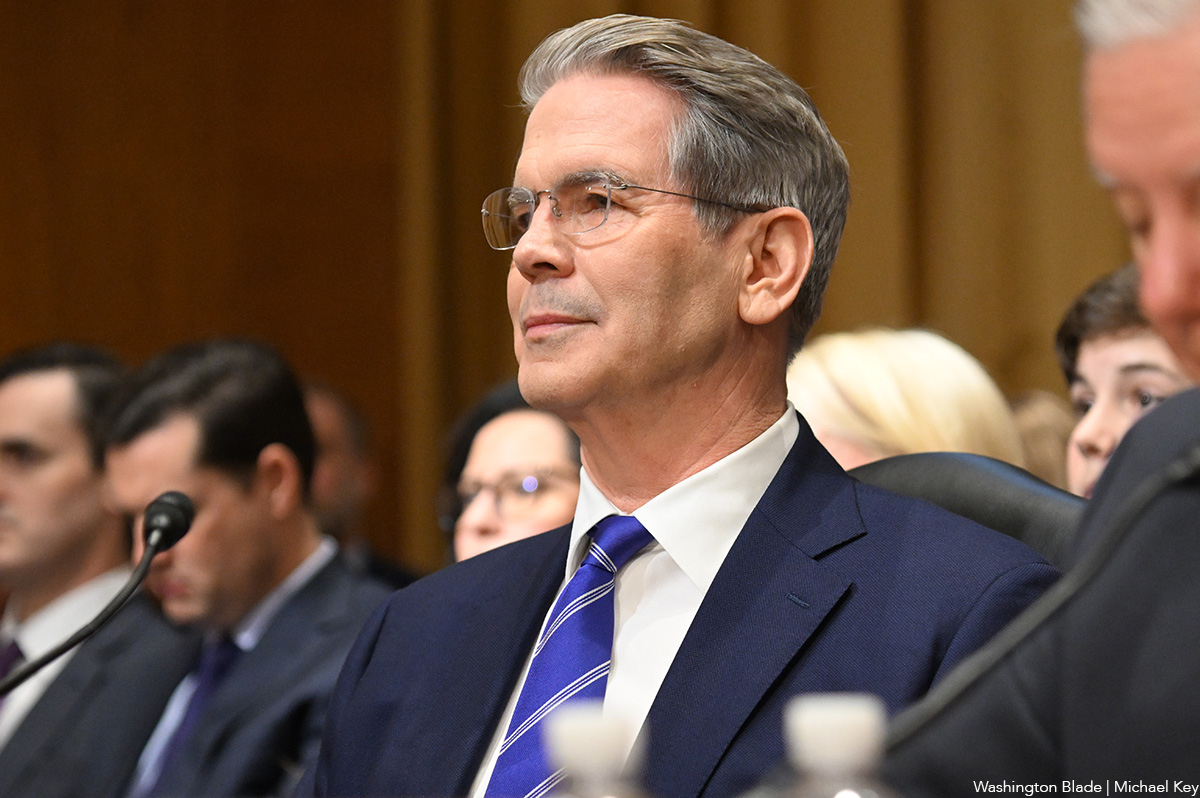
Treasury Secretary Scott Bessent participated in an interview in which he said his sexuality had no impact on the president’s selection of him.
On Sunday, Axios co-founder Mike Allen interviewed Secretary Bessent, the 79th person to lead the Treasury Department, in the “Cash Room” in the Treasury building. The two talked for more than 40 minutes about issues related to the current administration’s efforts for Axios’s YouTube channel.
Bessent has been something of an anomaly during this administration, breaking what many consider the “gay glass ceiling.” He is the first openly gay person to lead the U.S. Treasury Department, the first openly gay Senate-confirmed Cabinet member in a Republican administration, and the highest-ranking LGBTQ government official in U.S. history.
The two covered various ground — about the state of the U.S. economy, the various AI approaches by the Trump administration, and the war in Iran. All things that have made President Trump’s constant appraisal of the U.S. economy difficult to sell to the American people as the affordability crisis has worsened.
Toward the end of the interview, Allen asked Bessent about deciding not to attend the U.S. Naval Academy, knowing his sexuality would be a hindrance, and instead attending Yale University. Allen asked if his choice to attend the Ivy League school held him back in life.
“I don’t think it did at all, and it’s very difficult to talk about the counterfactual… but I don’t think going to Yale held me back,” Bessent said. “Maybe some people at other schools would think it might. But I think it makes you aware, and I’ve openly spoken about it before, too. I think maybe some of my career choices were influenced by it.”
The U.S. Naval Academy only began allowing openly LGBTQ students to apply — and be open about their sexuality — following the 2011 repeal of “Don’t Ask, Don’t Tell.” Prior to the policy’s removal, students could be removed from the school for violating the rules, including rules related to their sexuality.
“You said President Trump chose me because he believes I’m the best candidate, not because of my sexual preference or your green eyes…,” Allen said.
“Exactly,” Bessent replied. “And I think that’s one of the reasons we have such a great team. The president makes his decisions all the time. You know, he’ll occasionally tell me, ‘You’re breaking my friends’ hearts.’ They see you on TV and they want an intro, and we have to break the news to them.”
Bessent has been married to former New York prosecutor John Freeman since 2011, and they have lived together in South Carolina. There, they had two children through surrogacy.
Despite being a member of the LGBTQ community, Bessent has publicly supported Trump’s policies, including some that have drawn criticism from LGBTQ advocates and organizations. These include reductions to PEPFAR funding, policies removing transgender service members from the military, recognizing only two sexes, removing LGBTQ protections from Title IX, and other policies that LGBTQ advocates argue come at the cost of LGBTQ safety and protections.
The Washington Blade has reached out to the Treasury Department and Secretary Bessent’s team for comment and responses to these questions, including questions about how he views his identity and sexuality in relation to — and potentially at odds with — the policies and mission of the current administration. The Blade did not receive a response by publication time.

Bar Betsie, inviting and intimate, marks one-year anniversary

Trump, Netanyahu, and Putin are all war criminals

Center Arts Gallery celebrates 10 years with reception, auction

U.S. int’l trade negotiator, consultant James Bedore dies at 82

Campaign urges Virginia High School League to reverse stance on trans athletes

Eliot Glazer’s new book an engaging collection of essays

Equality Chamber hosts Pride in Business Expo and Profits & Pours

Learn more about Virginia’s queer history

‘Merrily’ is for Sondheim super fans, the uninitiated, and anyone in between

Lula, Flávio Bolsonaro to face off in second round of Brazilian presidential election
-

 Books4 days ago
Eliot Glazer’s new book an engaging collection of essays
-
Out & About4 days ago
Equality Chamber hosts Pride in Business Expo and Profits & Pours
-
Out & About4 days ago
Learn more about Virginia’s queer history
-
Theater4 days ago
‘Merrily’ is for Sondheim super fans, the uninitiated, and anyone in between