National
13 arrested at White House in ‘Don’t Ask’ protest
Activists seek order from Obama to stop discharges

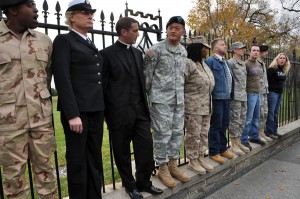
(Blade photos by Michael Key)
Editor’s note: video from this protest is available on the Blade’s main homepage; scroll down to find it on the left side.
Thirteen activists were arrested Monday afternoon for chaining themselves to the White House gates in protest over “Don’t Ask, Don’t Tell” and what they perceive as President Obama’s lack of action in stopping the discharges of gay, lesbian and bisexual members of the U.S. armed forces.
The protesters were affiliated with GetEQUAL, a group that’s organized acts of civil disobedience throughout the country over LGBT issues. Among the protesters were Lt. Dan Choi, a gay Iraq war veteran who was discharged under “Don’t Ask, Don’t Tell” and Robin McGehee, co-founder and director of GetEQUAL.
In a statement, GetEQUAL touted how three generations of LGBT activists were arrested as a result of the action. Others who were arrested include former U.S. Marine Corps Sgt. Justin Elzie, who’s gay and the first Marine discharged under “Don’t Ask, Don’t Tell” in 1993, as well as Michael Bedwell, a long-time advocate of LGBT rights and open service in the U.S. military.
The protesters superglued their handcuff locks, and, despite repeated warnings from U.S. Park Police, didn’t remove themselves from the White House fence. As police forcibly removed the activists, they dragged their feet as they were hauled into a paddy wagon. It took five police officers to remove Choi from the fence, hand-cuff him and drag him to the van.
After their arrest, the protesters were taken to Anacostia Park Station. The charges and penalties they’re facing as a result of their arrest weren’t immediately known.
As the protesters were chained to the White House fence, Choi called on President Obama to act on his promise to end “Don’t Ask, Don’t Tell.”
“After all his rhetoric, I think we must conclude that there is truth to the knowledge in homophobia of both sorts: there is a loud homophobia of those with platforms and there is a silent homophobia for those who purport to be our friends and do nothing,” Choi said. “Loud homophobia and silent homophobia have the same result. They must be combatted and this is what we intend to do today.”
While the protesters were chained to the White House fence, they chanted the often-used GetEQUAL refrain of “I am … somebody … and I deserve … full equality.” The protesters also added a new refrain, “Barack Obama … Silent Homophobia!”
Army Capt. Jim Pietrangelo II, who previously was arrested for chaining himself to the White House, led the chants of the protesters with a bullhorn from Lafayette Park.
“Why are these courageous heroes having to be arrested now?” he shouted. “Mr. President, could you follow the lead of these brave Americans and stop ‘Don’t Ask, Don’t Tell'”?
Pietrangelo called on Obama to issue an executive order to stop the discharges under the military’s gay ban.
In statement, Shin Inouye, a White House spokesperson, responded to the protest and said Obama is committed to legislative repeal of “Don’t Ask, Don’t Tell.”
“As we have said repeatedly, the president remains committed to a legislative repeal of ‘Don’t Ask, Don’t Tell,'” Inouye said. “The White House continues to work with Congress towards achieving that comprehensive and lasting solution.”
Autumn Sandeen, a transgender activist and Navy veteran who was among the 13 people arrested, told the Blade prior to the protest that she participated to bring more attention to the issue of “Don’t Ask, Don’t Tell” and to show transgender solidarity with gay, lesbian and bisexual Americans.
“Repealing ‘Don’t Ask, Don’t Tell’ will not affect transgender people one bit,” she said. “Gay, lesbian and bisexual people will be able to serve openly, but transgender people will not. But I’m part of a broader community: the lesbian, gay, bisexual and transgender community.”
Sandeen said putting pressure on the White House could push President Obama to move forward with advancing an end to “Don’t Ask, Don’t Tell.” She recalled similar protests in the spring prompted the administration to endorse a repeal compromise passed by the U.S. House.
“What we hope to do is put pressure on the White House and the president, President Obama, to fulfill the promise to actually put pressure on the Senate to repeal ‘Don’t Ask, Don’t Tell,'” she said.




Tennessee
Tenn. lawmakers pass transgender “watch list” bill
State Senate to consider measure on Wednesday
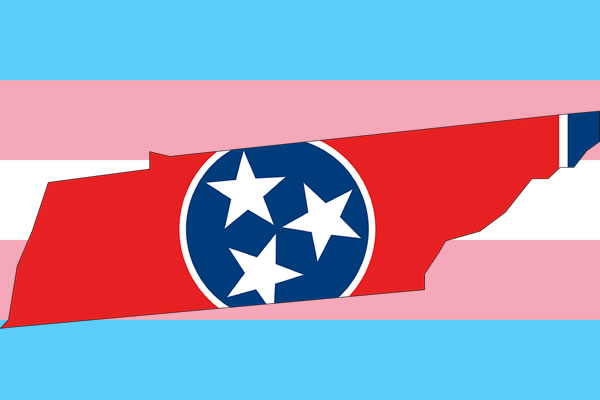
The Tennessee House of Representatives passed a bill last week to create a transgender “watch list” that also pushes detransition medical treatment. The state Senate will consider it on Wednesday.
House Bill 754/State Bill 676 has been deemed “ugly” by LGBTQ advocates and criticized by healthcare information litigators as a major privacy concern.
The bill would require “gender clinics accepting funds from this state to perform gender transition procedures to also perform detransition procedures; requires insurance entities providing coverage of gender transition procedures to also cover detransition procedures; requires certain gender clinics and insurance entities to report information regarding detransition procedures to the department of health.”
It would require that any gender-affirming care-providing clinics share the date, age, and sex of patients; any drugs prescribed (dosage, frequency, duration, and method administered); the state and county; the name, contact information, and medical specialty of the healthcare professional who prescribed the treatment; and any past medical history related to “neurological, behavioral, or mental health conditions.” It would also mandate additional information if surgical intervention is prescribed, including details on which healthcare professional made a referral and when.
HB 0754 would also require the state to produce a “comprehensive annual statistical report,” with all collected data shared with the heads of the legislature and the legislative librarian, and eventually published online for public access.
The bill also reframes detransitioning as a major focus of gender-affirming healthcare — despite studies showing that the number of trans people who detransition is statistically quite low, around 13 percent, and is often the result of external pressures (such as discrimination or family) rather than an issue with their gender identity.
This legislation stands in sharp contrast to federal protections restricting what healthcare information can be shared. In 1996, Congress passed the Health Insurance Portability and Accountability Act, or HIPAA, requiring protections for all “individually identifiable health information,” including medical records, conversations, billing information, and other patient data.
Margaret Riley, professor of law, public health sciences, and public policy at the University of Virginia, has written about similar efforts at the federal level, noting the Trump-Vance administration’s push to subpoena multiple hospitals’ records of gender-affirming care for trans patients despite no claims — or proof — that a crime was committed.
It has “sown fear and concern, both among people whose information is sought and among the doctors and other providers who offer such care. Some health providers have reportedly decided to no longer provide gender-affirming care to minors as a result of the inquiries, even in states where that care is legal.” She wrote in an article on the Conversation, where she goes further, pointing out that the push, mostly from conservative members of the government, are pushing extracting this private information “while giving no inkling of any alleged crimes that may have been committed.”
State Rep. Jeremy Faison (R-Cosby), the bill’s sponsor, said in a press conference two weeks ago that he has met dozens of individuals who sought to transition genders and ultimately detransitioned. In committee, an individual testified in support of the bill, claiming that while insurance paid for gender-affirming care, detransition care was not covered.
“I believe that we as a society are going to look back on this time that really burst out in 2014 and think, ‘Dear God, What were we thinking? This was as dumb as frontal lobotomies,’” Faison said of gender-affirming care. “I think we’re going to look back on society one day and think that.”
Jennifer Levi, GLAD Law’s senior director of Transgender and Queer Rights, shared with PBS last year that legislation like this changes the entire concept of HIPAA rights for trans Americans in ways that are invasive and unnecessary.
“It turns doctor-patient confidentiality into government surveillance,” Levi said, later emphasizing this will cause fewer people to seek out the care that they need. “It’s chilling.”
The Washington Blade reached out to the American Civil Liberties Union of Tennessee, which shared this statement from Executive Director Miriam Nemeth:
“HB 754/SB 676 continues the ugly legacy of Tennessee legislators’ attacks on the lives of transgender Tennesseans. Most Tennesseans, regardless of political views, oppose government databases tracking medical decisions made between patients and their doctors. The same should be true here. The state does not threaten to end the livelihood of doctors and fine them $150,000 for safeguarding the sensitive information of people with diabetes, depression, cancer, or other conditions. Trans people and intersex people deserve the same safety, privacy, and equal treatment under the law as everyone else.”
National
Glisten’s 30th annual Day of Silence to take place April 10
Campaign began as student-led protests against anti-LGBTQ bullying, discrimination

Glisten’s 30th annual Day of Silence will take place on April 10.
The annual Day of Silence began as a student-led protest in response to bullying and discrimination that LGBTQ students face. It is now a national campaign for the LGBTQ community and their allies to come together for LGBTQ youth.
It takes place annually and has multiple ways for supporters to get involved in the movement.
Glisten, originally GLSEN, champions LGBTQ issues in schools, grades K-12. Glisten’s mission is to create more inclusive and accepting environments for LGBTQ students through curriculum, supportive measures, education campaigns, and engagement, such as the Day of Silence.
There are three main ways for the community to get involved in the Day of Silence.
Glisten has a Day of Silence frame, a series of pictures used as profile photos across social media that feature individuals holding signs. The signs allow for personalization, by providing a space to put the individual’s name, followed by filling in the prompt “ … and I am ENDING the silence by…”
Participants are encouraged to post the photo on social media and use it as a profile picture. The templates can be found on Google Drive through this link.
Using #DayOfSilence and #NSCS, as well as tagging Glisten’s official Page @glistencommunity, is another way to participate in the Day of Silence.
Glisten also encourages participants to tag creators, friends, family and use a call to action in their caption, to call attention to the facts and stories behind the Day of Silence.
“Today’s administration in the U.S. wants us to stay silent, submit to their biased and hurtful conformity, and stop fighting for our right to be authentically ourselves,” said Glisten CEO Melanie Willingham-Jaggers. “We urge supporters to use their social platforms and check in with local chapters to be boots on the ground to help LGBTQ+ students feel seen, heard, supported, and less alone. By participating in the ‘Day of Silence,’ you are showing solidarity with young people as they navigate identity, safety, and belonging. Our voices matter.”
South Carolina
Man faces first S.C. ‘hate intimidation’ charge
Timothy Truett allegedly shot at gay club in Myrtle Beach on April 1

A South Carolina man remains in custody on a more than $300,000 bond after he allegedly opened fire at a Myrtle Beach nightclub on April 1, according to WMBF.
Reports say 37-year-old Timothy James Truett Jr., of Clover, S.C., was detained by the Myrtle Beach Police Department after the April 1 incident outside Pulse Ultra Club. He was later arrested and charged with possession of a weapon during a violent crime, discharging a firearm into a dwelling, discharging a firearm within city limits, malicious injury to real property valued over $5,000, and assault or intimidation due to political opinions or the exercise of civil rights.
At 10:57 a.m. on April 1, officers responded to a call about a possible shooting at Pulse Ultra Club, located in the 2700 block of South Kings Highway.
In an affidavit released later, the club’s owner, Ken Phillips, said he was doing paperwork that morning when he heard “five or six” gunshots. He went outside and found a window and the windshield of his SUV shattered by bullets. An SUV with blue plastic covering one window was left at the scene.
Police later reviewed footage that showed a silver vehicle stopping in the middle of the road. The video appeared to capture muzzle flashes coming from the passenger-side window.
According to the affidavit, an officer later pulled over a vehicle driven by Truett and found spent shell casings in the back seat, along with a gun.
Documents do not detail why Truett was ultimately charged under the state law covering assault or intimidation tied to political opinions or the exercise of civil rights.
As of April 1, records show Truett is being held in Horry County on a combined bond of more than $312,000.
WMBF spoke with Phillips after the incident and asked whether there was any prior conflict that might have led to the shooting.
“I don’t know if it’s personal, I don’t know if it’s related to being gay, I don’t know if it’s related to the bar issues,” Phillips told WMBF. “Anybody with a mindset of pulling out a weapon in broad daylight is not right.”
“My primary concern has and always will be the safety of my community and my customers,” he added. “It’s given me great concern … as to how far people will go.”
WMBF also spoke with Adam Hayes, vice chair of Myrtle Beach’s Human Rights Coalition, who was involved in pushing for the ordinance. He said that while the incident itself is troubling, it shows the policy is being put to use.
The ordinance is intended to deter “crimes that are motivated by bias or hate towards any person or persons, in whole or in part, because of the actual or perceived” identity, in the absence of a statewide hate crime law.
“It’s nice to see that something we put into policy is not just a piece of paper, that it’s actually being used,” said Hayes.
He said the shooting underscores the need for a statewide hate crime law in South Carolina and added that the incident has left the local LGBTQ community shaken.
South Carolina and Wyoming are the only two states in the U.S. without a comprehensive statewide hate crime law.
Truett remains in jail as of publication.

Trump’s war threats trigger rare 25th Amendment discussion

A Sondheim masterpiece ‘Merrily’ rolls onto Netflix

ROSENSTEIN: Vote McDuffie for mayor of D.C.

New book celebrates 1970s dance music icons

Report: Grenell wants Russian ambassadorship

Risking it all for love during World War II

D.C. is the place for the Democratic Socialists of America

PHOTOS: The Bonnet Ball

Key lifestyle changes can help patients cope with diabetes