Local
UPDATE: GLLU gets temporary new sergeant
Mahl ‘rotating through as part of his training’
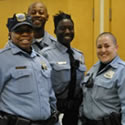
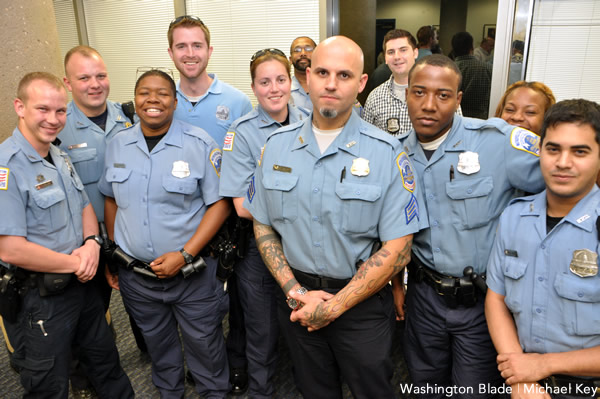
Members of the Gay & Lesbian Liaison Unit. (Blade photo by Michael Key)
A sergeant from the D.C. Police Department’s Sixth District began work on July 1 as supervisor of the department’s Gay and Lesbian Liaison Unit as part of a three-month training program and will return to the Sixth District upon completion of the program, according to a police spokesperson.
Earlier reports from police sources, now said to be incorrect, indicated that Sgt. Matthew Mahl would become the new permanent supervisor of the GLLU, marking the first time the unit has had a full-time supervisor assigned exclusively to the unit since 2009.
“Sergeant Mahl is an affiliate member [of the GLLU] and he is rotating through as part of his training,” Police Chief Cathy Lanier said on Friday in an email to gay activist Peter Rosenstein.
In a separate email, police spokesperson Gwendolyn Crump told the Blade, “Sgt. Mahl is an affiliate and like every member who attends affiliate training, he is rotating through and will return to his assigned element at the end of his detail.”
Lanier told the Blade in an interview last week that GLLU affiliate members are detailed to the GLLU headquarters in Dupont Circle for a 90-day training period before being rotated back to their regular assignment in one of the department’s seven districts.
Some local LGBT activists have urged Lanier to appoint a full-time sergeant to head the GLLU instead of retaining the unit’s current status of being headed by a sergeant who divides his duties between the GLLU and the department’s Latino Liaison Unit.
Since 2009, Sgt. Carlos Mejia has served as supervisor of both the GLLU and the Latino Liaison Unit. He has been praised by LGBT activists who say he has been doing an excellent job.
But the activists, including leaders of the local group Gays and Lesbian Opposing Violence (GLOV), have said the liaison units would be better served – as they had in past years – with a full-time sergeant assigned exclusively to each of the units, including the GLLU.
“I’m glad that Sgt. Mahl is rotating through the GLLU for training but we are still hoping that previous commitments from the chief and the mayor will secure a fulltime permanent sergeant for the unit,” Rosenstein said on Friday.
In her email to the Blade, Crump said Mejia and Sgt. Kenny Temsupasiri are permanently assigned to the Special Liaison Division, which oversees the GLLU, the Latino Liaison Unit and two other special units — the Asian Liaison Unit and the Deaf and Hard of Hearing Liaison Unit.
Temsupasiri heads both the Asian and Deaf and Hard of Hearing Units.
Mahl told the Blade on Thursday that during his tenure at the Special Liaison Division he would serve as full-time supervisor of the GLLU and Mejia would serve exclusively as the Latino Liaison Unit’s supervisor.
“He’s helping me out getting things settled down here,” Mahl said of Mejia.
Capt. Edward Delgado, who heads the Special Liaison Division, sent an email on Thursday to LGBT advocates and various LGBT organizations announcing Mahl’s assignment at the GLLU.
“I would like for each of you to introduce yourself and inform him of the services that each of your organizations provide the community,” Delgado said in his email. “I know that he has been out in the community conducting meet and greet sessions. Therefore, let’s give Sgt. Mahl a warm welcome and support him while he is detailed to the Special Liaison Division,” he said.
Mahl said he has been on the police force for eight and a half years. He began as an officer assigned to the Third District and was assigned to the Sixth District shortly after being promoted to sergeant in 2009.
He said he’s looking forward to working with the LGBT community during his tenure as a GLLU supervisor.
Original post below:
A sergeant from the D.C. Police Department’s Sixth District has been named supervisor of the department’s Gay and Lesbian Liaison Unit, marking the first time the unit has had a full-time supervisor assigned exclusively to the unit since 2009.
Sgt. Matthew Mahl has replaced Sgt. Carlos Mejia, who had been serving as supervisor of both the GLLU and the Latino Liaison Unit.
LGBT activists, while praising Mejia for his work at the GLLU, have long called on police officials to name a sergeant to head the GLLU who spends all of his or her time assigned to the unit.
But the head of the police division that oversees the GLLU and three other special police liaison units, Capt. Edward Delgado, suggested in an email sent to LGBT activists on Thursday that Mahl’s assignment with the GLLU could be short-lived.
“I would like to welcome Sergeant Matthew Mahl who is an Affiliate Sergeant from the Sixth District,” Delgado said in his email. “He is detailed to the unit to get a better understanding of GLLU operations and requirements…Therefore, let’s give Sergeant Mahl a warm welcome and support him while he is detailed to the Special Liaison Division.”
A police spokesperson couldn’t immediately be reached to determine whether Mahl’s tenure at the GLLU is consider permanent or temporary.
The Special Liaison Division oversees the GLLU as well as the Latino Liaison Unit, the Asian and Pacific Islander Liaison Unit, and the Deaf and Hard of Hearing Liaison Unit.
Mahl said Mejia, who is helping him “get on the ground running” at the GLLU, will remain as head of the Latino Liaison Unit.
“The plan is for him to just take over full time the Latino Liaison and myself the Gay and Lesbian Liaison,” Mahl told the Blade on Thursday. “He’s helping me out getting things settled down here.”
Former D.C. Police Chief Charles Ramsey created the GLLU in the late 1990s as one of the first such units in a large metropolitan police department to be given full authority to make arrests and investigate crimes as well as reach out to the LGBT community.
Current D.C. Police Chief Cathy Lanier expanded the GLLU and the other three liaison units over the past four years to include dozens of affiliate officers assigned to each of the department’s seven police districts.
The GLLU affiliate officers, who receive training on LGBT related issues, respond to calls in their respective districts on matters such as anti-LGBT hate crimes or LGBT related domestic violence.
The GLLU’s headquarters in Dupont Circle currently includes five full-time “core” officers along with Mahl as supervisor. An aide to Lanier said last week that there are currently 99 GLLU affiliate officers based in the seven police districts.
Sgt. Brett Parson served as full-time supervisor of the GLLU from 2001 to 2007, receiving praise from LGBT activists for having a highly visible presence in the community. Parson served as head of the then Special Liaison Office, which oversaw the GLLU and the other three liaison units, between 2007 and 2009.
In 2009 Parson also took on the role of GLLU head after his replacement, Sgt. Tania Bell, left the unit. Later that year Parson requested a transfer to a street patrol position, saying his first love as a cop was to focus more on active crime-fighting duties. It was at that time that Lanier assigned Mejia to serve as supervisor of the GLLU while retaining his existing post as supervisor of the Latino Liaison Unit.
Lanier said that due to city budget cuts and police spending constraints, it became necessary to assign Mejia to take on the dual role of supervisor of both units.
The two other special liaison units – the Asian Pacific Islander Liaison Unit and the Deaf and Hard of Hearing Liaison Unit – retained a full-time sergeant serving as supervisor.
Mahl said he was approached about taking on the role as head of the GLLU by Deputy Police Chief Diane Groomes and Delgado.
He said he has been on the force for eight and a half years. He said he began as an officer in the Third District and was promoted to sergeant in 2009 before being assigned to the Sixth District. Mahl said he looks forward to his duties with the GLLU and will be meeting with LGBT advocates and various LGBT organizations over the next few weeks.
“I don’t know how long these things last, but I’m here for now,” he said, when asked whether he was told how long his detail with the GLLU would last.
As of Thursday, the department had not issued an official announcement of Mahl’s assignment to the GLLU.
A.J. Singletary, chair of Gays and Lesbians Opposing Violence (GLOV), which monitors police related issues, said he was unaware of Mahl’s assignment as GLLU head until the Blade contacted him about the development.
“I think it’s great,” he said. “Having someone talking on this role is something we have been asking for and the community has been asking for. GLOV has always called for having a full-time sergeant.”


District of Columbia
Blade contributor, husband exchange vows in D.C.
Yariel Valdés and Kevin Vega held ceremony at Jefferson Memorial on March 23

Washington Blade contributor Yariel Valdés and his husband, Kevin Vega, exchanged vows at the Jefferson Memorial on March 23.
The couple married in Fort Lauderdale, Fla., on Nov. 24, 2025. The Jefferson Memorial ceremony — which Blade International News Editor Michael K. Lavers and Samy Nemir Olivares officiated — coincided with the third anniversary of Yariel and Kevin’s first date.
Yariel in 2019 asked for asylum in the U.S. because of the persecution he suffered as a journalist in his native Cuba. He spent nearly a year in U.S. Immigration and Customs Enforcement custody before his release on March 4, 2020.
Yariel wrote a series of articles about his time in ICE custody that the Blade published. The series was nominated for a GLAAD Media Award in 2022.
Yariel and Kevin live in South Florida.
District of Columbia
‘Out for McDuffie’ event held at D.C. gay bar
Mayoral candidate cites record of longtime support for LGBTQ rights
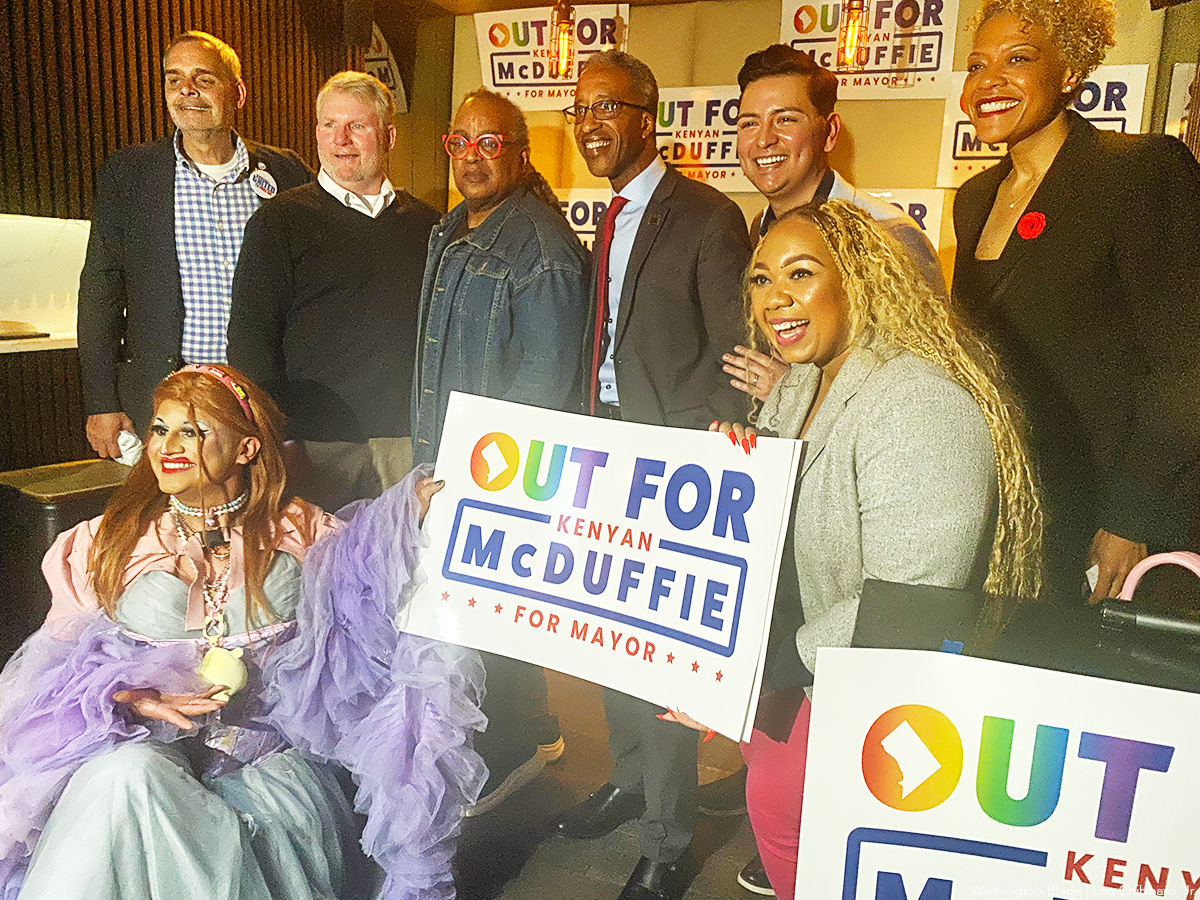
More than 100 people filled the upstairs room of the D.C. gay bar Number 9 on Thursday night, March 26, to listen to D.C. mayoral candidate Kenyan McDuffie at an event promoted as an “Out for McDuffie” meet and greet session.
Several local LGBTQ activists who attended the event said they support McDuffie, a former D.C. Council member, in his run for mayor while others said they had not yet decided whom to vote for in the June 16 D.C. Democratic primary election.
As of March 27, eight other Democrats were competing against McDuffy in the June 16 primary, including D.C. Council member Janeese Lewis George (D-Ward 4), considered McDuffie’s lead opponent. Lewis George also has a record of strong support on LGBTQ issues.
Most political observers consider McDuffie and Lewis George the two lead candidates in the race, with the others having far less name recognition.
The two lead organizers of the Out for McDuffie event were LGBTQ rights advocates Courtney Snowden, a former D.C. deputy mayor in the administration of Mayor Muriel Bowser, and Cesar Toledo, a local LGBTQ youth housing services advocate.
“I’m a candidate for mayor of Washington, D.C. and I’m running for mayor because I love this city,” McDuffie told the gathering after being introduced by Snowden. “And now more than ever we need leadership to take us to the future,” he said, adding that he and his administration would “stand up and fight” against President Donald Trump’s efforts to intervene in local D.C. affairs.
“Our strength is in the 700,000 beautifully diverse residents of Washington, D.C.” he told the gathering. “And as Courtney said, I didn’t just show up and run for mayor and then start saying that I’m going to be an ally for the queer community, for the LGBTQ+ community,” he said, “I’ve lived my entire professional life fighting for justice and fighting for fairness.”
Following his speech, McDuffie told the Washington Blade, “We’re going to fight to protect our LGBTQ+ community every single day. That’s what I’ve spent my career doing, making sure we have a beautifully diverse and inclusive city.”
He remained at Number 9, located at 1435 P St., N.W., for nearly an hour after he spoke, chatting with attendees.
District of Columbia
‘No Kings’ protests set for D.C.
Anti-Trump demonstrations to take place across country on Saturday

As President Donald Trump and his administration escalate rhetoric targeting transgender youth and student athletes, push efforts to restrict voting access for millions of Americans, and pursue foreign policy decisions that critics say bypass congressional authority, organizers across the country are once again mobilizing in protest.
For many LGBTQ advocates, the moment feels especially urgent.
In recent months, activists have pointed to a surge in anti-trans legislation, attacks on gender-affirming care, and efforts to roll back nondiscrimination protections as direct threats to the safety and visibility of queer and trans communities. Organizers say the demonstrations are not just about policy, but about defending the right of LGBTQ people — particularly trans youth and people of color — to live openly and safely.
Thousands of “No Kings” protests are planned nationwide, with multiple demonstrations set to take place in D.C.
One of the primary events, “No Kings Washington,” will be held in Anacostia, an overwhelmingly Black area of D.C. that is often at the center of conversations around racial justice, policing, and access to resources in the nation’s capital.
The protest in Anacostia is focused on what organizers describe as the “power behind the throne,” specifically Stephen Miller, the White House Deputy Chief of Staff for Policy and Homeland Security Advisor. Miller has been closely associated with the administration’s “zero tolerance” immigration policy, including the family separation practice that resulted in thousands of children being separated from their parents at the Southern border.
Activists have also linked immigration enforcement policies to broader concerns about LGBTQ migrants, including queer asylum seekers who often face heightened risks of violence and discrimination both in their home countries and within detention systems.
Anacostia protest details:
Participants are asked to gather starting at 1:30 p.m. on the southeast side of the Frederick Douglass Bridge. The closest Metro station is Anacostia on the Green Line, about an 8-minute walk from the starting point. Organizers strongly encourage attendees to use public transportation, as street parking is limited.
The march will proceed past Fort McNair and conclude near the Waterfront Metro station.
D.C. icon and LGBTQ activist Rayceen Pendarvis is set to speak at the protest around 2 p.m.
Kalorama protest details:
A separate protest will take place earlier in the day in Kalorama, a neighborhood long associated with political power and home to presidents, cabinet officials, and foreign ambassadors. Demonstrators are expected to gather at 10 a.m., with a march running until approximately noon near the intersection of Connecticut Avenue and Kalorama Road.
Arlington/National Mall protest details:
Another group is expected to assemble at Memorial Circle near Arlington National Cemetery at 10 a.m. before crossing the Memorial Bridge into D.C., passing the Lincoln Memorial and continuing on to the Washington Monument. Organizers say the march is intended to defend “American democracy, the rule of law, and a healthy planet.”
Unlike last June — when organizers discouraged large-scale demonstrations in D.C. due Trump’s military/birthday parade — activists are now explicitly calling on people to show up in the nation’s capital and surrounding areas.
The protests also coincide with Transgender Day of Visibility weekend, which includes additional gatherings and celebrations on the National Mall. At the same time, peak bloom for the National Cherry Blossom Festival is expected to draw large crowds to the city. With multiple major events happening simultaneously, officials and organizers anticipate significant congestion, increased traffic, and crowded public transit throughout the weekend.
Organizers are urging participants to plan ahead and come prepared.
“Bring your signs, noisemakers, music, and creative ideas, and gather in joyful, nonviolent protest,” they said. “Children are very welcome.”
For more information, visit nokings.org.

Thousands attend ‘No Kings’ protests in D.C.

Blade contributor, husband exchange vows in D.C.

Ghanaian president welcomed to Philadelphia amid backlash over anti-LGBTQ bill

PHOTOS: ‘No Kings’ rally and march

‘Out for McDuffie’ event held at D.C. gay bar

Pa. House passes bill to codify marriage equality in state law

Introducing the Torchbearers Awards honoring queer, trans women and nonbinary people

New IOC policy bans trans women from Olympics

A surtax would end this war quickly

‘No Kings’ protests set for D.C.
-

 Pennsylvania5 days ago
Pa. House passes bill to codify marriage equality in state law
-
a&e features5 days ago
Introducing the Torchbearers Awards honoring queer, trans women and nonbinary people
-
Sports5 days ago
New IOC policy bans trans women from Olympics
-
Opinions5 days ago
A surtax would end this war quickly