Local
Probation for D.C. cop in trans shooting case
Judge rejects prosecutor’s request for five-year jail term
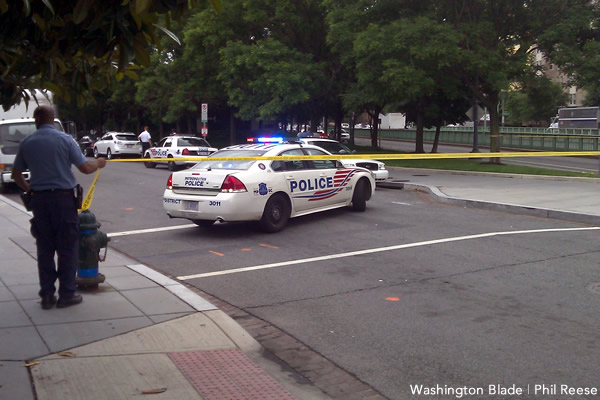
D.C. police officer Kenneth Furr was sentenced in a case related to the firing of his gun through the windshield of a car with the five people inside. (Washington Blade photo by Phil Reese)
An off-duty D.C. police officer accused in August 2011 of firing his service revolver into a car occupied by three transgender women and two male friends was sentenced on Thursday to three years of supervised probation, a $150 fine, and 100 hours of community service.
D.C. Superior Court Judge Russell Canan also sentenced Officer Kenneth Furr, 48, to five years in prison but suspended all but 14 months of the prison term and credited Furr with the 14 months he already served between the time of his arrest and his trial last October.
Canan released Furr October 26 while awaiting sentencing after a Superior Court jury convicted him of assault with a deadly weapon and solicitation for prostitution but acquitted him on six other charges, including the most serious charge of assault with intent to kill while armed.
The latter charge was linked to his firing of five shots into the car where the transgender women and their friends were sitting.
Police and prosecutors have said the shooting occurred following a confrontation that started when Furr solicited one of the transgender women for sex for money at 5th and K Streets, N.W., and followed the woman after she rejected his offer. Furr then argued with one or more of her friends who asked Furr leave her alone.
At the time of his arrest, police said Furr’s blood alcohol level was twice that of the legal limit for drivers.
Canan rejected a request by Assistant U.S. Attorney Laura Worm, the lead prosecutor, that Furr be given the maximum sentence of 5 years in prison for the assault with a deadly weapon charge. He also denied her request for an additional three months incarceration for the solicitation conviction.
News of the shooting outraged LGBT activists as well as Mayor Vincent Gray and members of the D.C. City Council, who called for stepped up efforts to curtail violence against the city’s transgender community.
The D.C. Trans Coalition issued a statement late Thursday calling the sentence of no additional jail time for Furr “outrageous” and said it would heighten longstanding fears by the transgender community of mistreatment and abuse by police officers.
“This result is the product of a legal system that constantly devalues trans lives, particularly trans people of color,” said D.C. Trans Coalition member Jason Terry. “Officer Furr’s defense team actively sought to portray the victims as somehow deserving of this violence, and apparently they succeeded,” he said.
“If roles had been reversed and a black trans woman had gotten drunk and shot a gun at a police officer, the results would be drastically different,” Terry said.
Court observers said the jury’s decision to find Furr not guilty on the assault with intent to kill while armed charge most likely resulted from a successful effort by Furr’s attorneys to portray the shooting as an act of self-defense.
Canan said his suspension of 46 months of the 60 month (five year) prison term was contingent upon Furr’s successful completion of his three year probation period and other restrictions, including a requirement that he stay away from the five complainants.
Court records show Canan also ordered Furr to stay away from “the area bounded by: New York Avenue, Massachusetts Avenue, 7th Street, N.W. and North Capitol Street, N.W.,” which is widely known as one of the city’s transgender prostitution zones.
In addition, Canan set as a condition for the parole that Furr enter an alcohol treatment program and enroll in anger management classes.
In the sentencing memorandum on behalf of the U.S. Attorney’s office, Worm said one reason why Furr was not a good candidate for a sentence involving parole and no prison time was that he failed to immediately comply with his pre-sentencing release conditions. She noted that although he was instructed to report immediately after his release on Oct. 26 for regular alcohol testing and other conditions, he did not report for the testing until a full month after his release.
The charge of assault with a deadly weapon, on which he was convicted, stemmed from allegations by prosecutors that Furr pointed his gun at one of the transgender women’s friends outside a CVS store on the 400 block of Massachusetts Ave., N.W. at about 5 a.m. on Aug 26, 2011.
According to testimony by the victims, Furr solicited one of the trans women propositioning sex for money minutes earlier on the street at 5th and K Streets, N.W. The woman rebuffed his request and walked away, but Furr followed her to the CVS store, where one of her male friends called on Furr to leave her alone, witnesses reported.
Furr then started an argument that continued outside the store, where Furr pulled out his gun and pointed it at the women’s friend.
Although Furr did not fire the gun, prosecutors argued his action constituted an assault with a deadly weapon and persuaded the jury to convict him on that count.
During the trial the defense presented evidence, which prosecutors acknowledged was factually correct, that the trans women and their male friends responded by following Furr in their car after Furr drove away from the CVS store.
Trial testimony showed that the group followed Furr to the area of 3rd and K Street, N.W., where they observed Furr attempting to solicit another transgender woman for sex. At that point, two of the people in the car got out and confronted Furr and one or both of them assaulted Furr, witnesses testified during the trial.
Furr then returned to his car and drove away, with the trans women and their male friends following him again, witnesses testified. This prompted Furr to stop his car at First and Pierce Streets, N.W., and fire his gun at the other car, which Furr’s lawyer said was in pursuit of his, according to testimony at the trial.
One of the male friends driving the vehicle ducked to avoid being shot and unintentionally rammed the car into Furr’s car, witnesses testified.
Furr responded by climbing on the hood of the car occupied by the transgender women and their friends and fired five times through the front windshield, causing three of the occupants to suffer non-fatal gunshot wounds.
Within minutes D.C. police rushed to the scene and arrested Furr, who was found to have a blood alcohol level twice the legal limit under D.C. law.
David Knight, Furr’s lead defense attorney, appeared to have persuaded the jury that the people he shot at were the aggressors and Furr acted in self-defense, court observers said.
“He was alone, outnumbered and under attack,” the Washington Post quoted Knight saying to the jury. “He was threatened, assaulted and pursued by a car full of people who wanted to harm him.”
In her sentencing memorandum, Worm said that at no point did Furr identify himself as a police officer to the complainants nor did he call for police help if he believed he was in danger.
“To be sure, some of the complainants involved in this incident engaged in risky behavior and bad judgment,” she said in the memo.
“The government does not minimize the fact that both parties had opportunities to withdraw from this conflict, but the government’s view, as exhibited in its charging decisions, is that the defendant bore criminal responsibility for provoking and escalating the conflict, and introducing a deadly weapon into a situation that could have otherwise been resolved,” Worm wrote in the memo.
“Many of the witnesses who testified at trial were associated, in some way, with Washington, D.C.’s transgender community,” Worm said in the memo. “That community has historically suffered discrimination from a variety of sources. Moreover, the members of the transgender community bear a heightened risk that they will be victims of violent crime,” she wrote.
“This defendant was a police officer charged with protecting and serving the citizens of the District of Columbia,” she said. “Defendant Furr’s actions on the night of this offense increased the transgender community’s already significant safety concerns and their distrust of the Metropolitan Police Department.”
D.C. police spokesperson Gwendolyn Crump said Furr has been suspended without pay and that the department will follow its standard procedure for dealing with an officer convicted of a felony. Police observers have said a felony conviction, especially one associated with violence, usually results in the firing of a police officer.
District of Columbia
‘No Kings’ protests set for D.C.
Anti-Trump demonstrations to take place across country on Saturday

As President Donald Trump and his administration escalate rhetoric targeting transgender youth and student athletes, push efforts to restrict voting access for millions of Americans, and pursue foreign policy decisions that critics say bypass congressional authority, organizers across the country are once again mobilizing in protest.
For many LGBTQ advocates, the moment feels especially urgent.
In recent months, activists have pointed to a surge in anti-trans legislation, attacks on gender-affirming care, and efforts to roll back nondiscrimination protections as direct threats to the safety and visibility of queer and trans communities. Organizers say the demonstrations are not just about policy, but about defending the right of LGBTQ people — particularly trans youth and people of color — to live openly and safely.
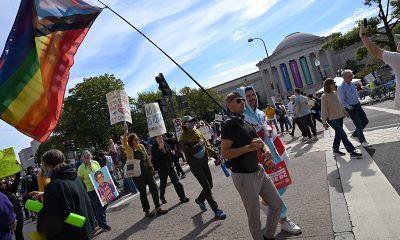
Thousands of “No Kings” protests are planned nationwide, with multiple demonstrations set to take place in D.C.
One of the primary events, “No Kings Washington,” will be held in Anacostia, an overwhelmingly Black area of D.C. that is often at the center of conversations around racial justice, policing, and access to resources in the nation’s capital.
The protest in Anacostia is focused on what organizers describe as the “power behind the throne,” specifically Stephen Miller, the White House Deputy Chief of Staff for Policy and Homeland Security Advisor. Miller has been closely associated with the administration’s “zero tolerance” immigration policy, including the family separation practice that resulted in thousands of children being separated from their parents at the Southern border.
Activists have also linked immigration enforcement policies to broader concerns about LGBTQ migrants, including queer asylum seekers who often face heightened risks of violence and discrimination both in their home countries and within detention systems.
Anacostia protest details:
Participants are asked to gather starting at 1:30 p.m. on the southeast side of the Frederick Douglass Bridge. The closest Metro station is Anacostia on the Green Line, about an 8-minute walk from the starting point. Organizers strongly encourage attendees to use public transportation, as street parking is limited.
The march will proceed past Fort McNair and conclude near the Waterfront Metro station.
D.C. icon and LGBTQ activist Rayceen Pendarvis is set to speak at the protest around 2 p.m.
Kalorama protest details:
A separate protest will take place earlier in the day in Kalorama, a neighborhood long associated with political power and home to presidents, cabinet officials, and foreign ambassadors. Demonstrators are expected to gather at 10 a.m., with a march running until approximately noon near the intersection of Connecticut Avenue and Kalorama Road.
Arlington/National Mall protest details:
Another group is expected to assemble at Memorial Circle near Arlington National Cemetery at 10 a.m. before crossing the Memorial Bridge into D.C., passing the Lincoln Memorial and continuing on to the Washington Monument. Organizers say the march is intended to defend “American democracy, the rule of law, and a healthy planet.”
Unlike last June — when organizers discouraged large-scale demonstrations in D.C. due Trump’s military/birthday parade — activists are now explicitly calling on people to show up in the nation’s capital and surrounding areas.
The protests also coincide with Transgender Day of Visibility weekend, which includes additional gatherings and celebrations on the National Mall. At the same time, peak bloom for the National Cherry Blossom Festival is expected to draw large crowds to the city. With multiple major events happening simultaneously, officials and organizers anticipate significant congestion, increased traffic, and crowded public transit throughout the weekend.
Organizers are urging participants to plan ahead and come prepared.
“Bring your signs, noisemakers, music, and creative ideas, and gather in joyful, nonviolent protest,” they said. “Children are very welcome.”
For more information, visit nokings.org.
District of Columbia
Gay priest credited with boosting church support for LGBTQ Catholics
Fr. Tom Oddo’s biographer speaks at Dignity Washington event
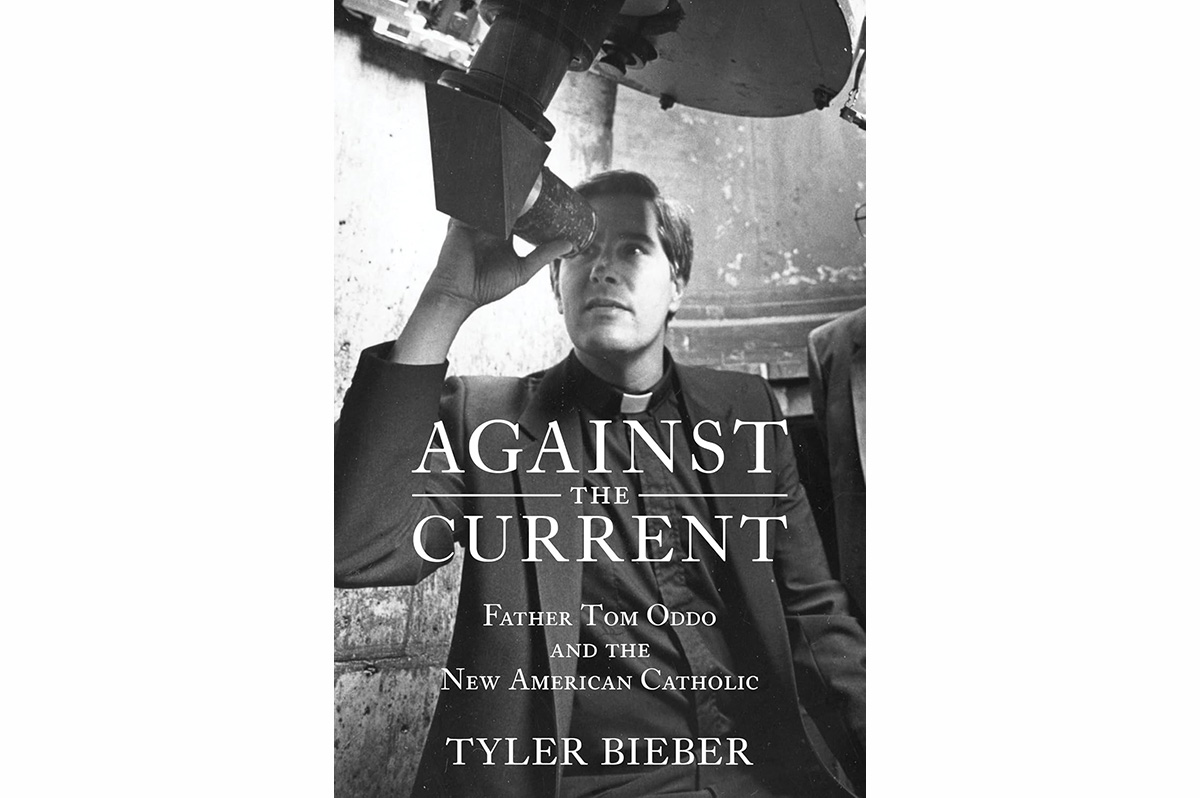
The author of a biography of a U.S. Catholic priest said to have advocated for support by the Catholic Church of gay Catholics in the early 1970s has called Father Thomas ‘Tom’ Oddo a little known but important figure in the LGBTQ rights movement.
Tyler Bieber, author of the recently published book “Against The Current: Father Tom Oddo And the New American Catholic,” told of Oddo’s life and work on behalf of LGBTQ rights at a March 22 talk before the local LGBTQ Catholic group Dignity Washington.
Among Oddo’s important accomplishments, Bieber said, was his role as a co-founder of the national LGBTQ Catholic group Dignity U.S.A. in 1973 at the age of 29.
But as reported in the prologue of his book, Bieber presented details of the sad news that Oddo died in a fatal car crash in 1989 at the age of 45 in Portland, Ore., where he was serving as the highly acclaimed president of the University of Portland, a Catholic institution.
“He was a major figure in the gay rights movement in the 1970s, an unsung hero of that movement,” Bieber told Dignity Washington members, who assembled for his talk in a meeting room at St. Margaret Episcopal Church near Dupont Circle, where they attend their weekly Catholic mass on Sundays.
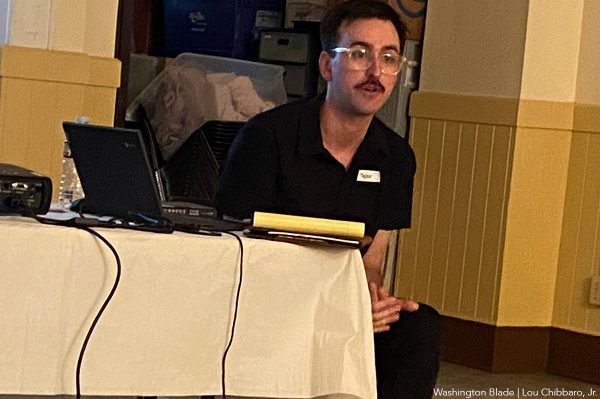
“And Dignity U.S.A. saw intense growth in membership and visibility” during its early years under Oddo’s leadership, Bieber said. “The story of Father Tom and his contemporaries is a story largely untold in the history of the gay rights movement, but one worth knowing and considering,” he said.
As stated in his book, Bieber told the Dignity Washington gathering Oddo was born and raised in a Catholic family on Long Island, N.Y., and attended a Catholic high school in Flushing Queens. It was at that time when he developed an interest in becoming a priest, according to Bieber.
After studying at the University of Notre Dame and completing his religious studies he was ordained as a priest in 1970 and began his work as a priest in the Boston area, Bieber said. It was around that time, Bieber told the Dignity Washington audience, that gay Catholics approached Oddo to seek advice on how they should interact with the Catholic Church. It was also around that time that Oddo became involved in a group supportive of then gay Catholics that later became a Dignity chapter in Boston.
In a development considered unusual for a Catholic priest, Bieber said Oddo in 1973 testified in support of gay rights bill before a committee of the Massachusetts Legislature and collaborated with then Massachusetts gay and lesbian rights advocate Elaine Noble.
In 1982, at the age of 39, Oddo was selected as president of the University of Portland following several years as a college teacher in the Boston area, Bieber’s book states. It says he was seen as a “vibrant and capable administrator who delivered real results to his campus,” adding, “His magnetism was obvious. One student described him as ‘John Kennedyesque’ to the university’s student newspaper.”
Bieber said that although Oddo was less active with Dignity U.S.A. during his tenure as UP president, he continued his support for gay Catholics and what is now referred to as LGBTQ rights.
“For those that knew him prior to his term at UP, though, he represented something greater than an accomplished university administrator and educator,” Bieber’s book states. “He was a new kind of priest, a gay man living and ministering in a world set loose from tradition by the Second Vatican Council,” the book says.
It was referring to the Vatican gathering of worldwide Catholic leaders from 1962 to 1965 concluding under Pope Paul VI that church observers say modernized church practices to allow far greater participation by the laity and opened the way for sympathetic consideration of gay Catholics.
District of Columbia
HRC to host National Rainbow Seder
Bet Mishpachah among annual event’s organizers

The 18th National Rainbow Seder will take place at the Human Rights Campaign on Sunday.
The sold out event is the country’s largest Passover Seder for the Jewish LGBTQ community.
Organizations behind the event include Bet Mishpachah, a local D.C. LGBTQ synagogue that Rabbi Jake Singer-Beilin leads, and GLOE, an Edlavitch DC Jewish Community Center program that sponsors events for the queer Jewish community. The theme for this year’s Seder is “Liberation For All Who Journey: Remembering, Resisting, Rebuilding.” Rabbis Atara Cohen, Koach Frazier, and Avigayil Halpern will lead it.
The Seder will honor the late GLOE co-chair Michael Singer. Singer also served on the Edlavitch DC Jewish Community Center’s board.
“This Seder is both a celebration of how far we have come and a call to continue building a more just and inclusive world.” Bet Mishpachah Executive Director Joshua Maxey told the Washington Blade.

‘No Kings’ protests set for D.C.

Border to border: modern slavery and human trafficking in refugee movements across East Africa

New IOC policy bans trans women from Olympics

Introducing the Torchbearers Awards honoring queer, trans women and nonbinary people

Pa. House passes bill to codify marriage equality in state law

PHOTOS: Capital Stonewall Democrats 50th anniversary

Small is beautiful: subcompact SUVs

‘Inherit the Wind’ isn’t about science vs. religion, but the right to think

Polish court rules country must recognize same-sex marriages from EU states

Capital Stonewall Democrats 50th anniversary gala draws sold out crowd
-

 Photos4 days ago
PHOTOS: Capital Stonewall Democrats 50th anniversary
-
Autos5 days ago
Small is beautiful: subcompact SUVs
-
Theater5 days ago
‘Inherit the Wind’ isn’t about science vs. religion, but the right to think
-
Poland4 days ago
Polish court rules country must recognize same-sex marriages from EU states