National
Strike up the band
LGBT ensemble set for return appearance in Inauguration Parade

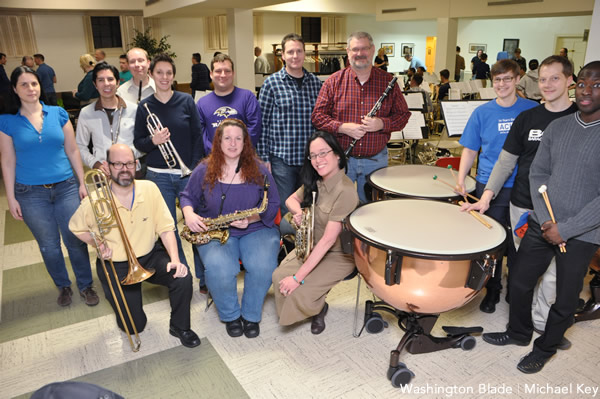
Members of the Different Drummers prepare to march with the Lesbian & Gay Band Association in the 2013 Presidential Inauguration Parade. (Washington Blade photo by Michael Key)
It won’t be hard to pick out the Lesbian & Gay Band Association amid all the other contingents on Monday during the 57th Presidential Inauguration Parade.
The honor guard will be carrying a rainbow Pride flag as it leads the rest of the band members across Pennsylvania Avenue. One of the selections the band will play is “Edge of Glory,” a hit from gay icon Lady Gaga. And the band members will be clad in fitted black outfits with purple accents.
Adam DeRosa, president of the Lesbian & Gay Band Association, says the outfits were chosen with a nod to symbolism.
“Purple is in some ways, if you’re going to narrow it down to one color, a much more of a universal for the gay community,” DeRosa says. “And for the camera, again, we wanted it to be something that was really going to stick out.”
The band association — an organization of 32 local bands from across the country — will send 240 members to participate in the second-term inauguration of President Obama — a U.S. president who rode into re-election with a message of support from the LGBT community after, among other achievements, coming out in favor of same-sex marriage and repealing “Don’t Ask, Don’t Tell.”
DeRosa, a 37-year-old French horn player with the Ft. Lauderdale-based South Florida Pride Wind Ensemble, said the LGBT achievements seen under the Obama administration are one of the reasons he and other association members want to take part in the inauguration — taking particular note of the victory on Election Day for marriage equality in Maine, Maryland and Washington State.
“Because we’re a national and international group, we have, for instance, a band that’s in Seattle, and we now have members of the organization that are married since that election in November,” DeRosa says. “This is very real to us, and we absolutely are honored to part of it in that respect.”
In addition to the rainbow flag at the head of the unit, the honor guard in front will bear an American flag and a flag representing the band association. Members will carry state flags to represent each of the local bands participating in the contingent — making for a total of at least 20 flags.
Besides Lady Gaga, other songs the band is set to play are standard brass tunes intermixed with modern songs. On the playing list is a mashup of “Battle Hymn of the Republic” and “Simple Gifts” as well as “Gimme Everything Tonight,” a more recent song by Pitbull. When the band reaches the glass box where President Obama and first lady Michelle Obama will sit, the band will break into a rendition of “Tonight” from “West Side Story.”
Other local members involved in the association express similar excitement about participating in the parade based on work that President Obama has done on LGBT issues during his first four years in office.
Rachel See, a 37-year-old transgender French horn player for the Capital Pride Symphonic Band, says participating is “just a real honor” because, as an attorney for the National Labor Relations Board, she was helped by Obama’s memoranda instituting non-discrimination protections for transgender U.S. government employees.
“As a federal employee, I came out as transgender last year and the policy the administration has put into place supporting transgender federal employees and transgender people across the nation have been wonderful,” See says. “I’m glad to see that it was done and look forward to the next four years.”
Derrick Johnson, a 27-year-old black gay man and drum major in D.C. Different Drummers, says he feels “a symbolic connection” with Obama because they share the same race and because of the leadership Obama has exercised on LGBT issues during his first term.
“The correlation is definitely there,” Johnson says. “Breaking that barrier of the stereotypical president definitely helped to create a shift in thought and mindset in our country, and hopefully our world, in acceptance of differences and various demographics — and also coming down the pike and seeing his outright acceptance of gay rights definitely speaks highly toward the African-American community.”
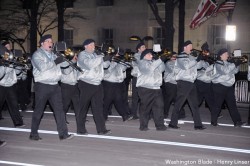
Members of the Lesbian & Gay Band Association marched in the 2009 Presidential Inauguration Parade. (Washington Blade file photo by Henry Linser)
It’s not the first time the association has participated in the inaugural parade. For the first time ever, the association was selected to march in the 2009 inaugural parade after Obama first won election to the White House. During the inaugural festivities for former President Bill Clinton, the group performed on the sidelines, but didn’t take part in the inaugural parade itself. The association didn’t participate in the inaugural festivities for former President George W. Bush.
Lacey Janet Rose, the Presidential Inaugural Committee’s deputy director of constituency press, says inauguration organizations are thrilled the association — which was selected among 2,800 bands that submitted applications — will have the opportunity to take part in the inaugural parade a second time.
“We are thrilled that the Lesbian and Gay Band Association has accepted their invitation to join President Barack Obama and Vice President Joe Biden’s Inaugural parade,” Rose said in a statement. “The 2013 parade participants will showcase extraordinary talent and reflect the vibrant diversity of America. President Obama and Vice President Biden are proud to have the participation of the Lesbian and Gay Band Association for the second time in history.”
DeRosa, who’ll perform in the parade in a non-musical role as an honor guard, says despite the excitement, members were asked to commit to take part as the application was being compiled even before election results were known — regardless of whether the winner was Obama or Republican presidential nominee Mitt Romney.
“We basically had a pre-registration for us to understand who really was committed to this, but again, that was all happening prior to the election results, so people were really committed to being part of this event really regardless of what the outcome was,” DeRosa says. “So the gist of that alone logistically has helped us out. We had a much firmer number in our application to know exactly how many people, and because of that, we see that we’re going to have a larger group than we did last time.”
A number of prominent public officials supported the band’s application to perform. Sen. Al Franken (D-Minn.), Sen. Claire McCaskill (D-Mo.), Sen. Kirsten Gillibrand (N.Y.), Rep. Ed Pastor (D-Ariz.) and Rep. Alcee Hastings (D-Fla.) were among 30 lawmakers who sent letters to the committee advocating for the association’s participation.
Democratic National Committee Chair Debbie Wassserman Schultz, who represents DeRosa’s district of Fort Lauderdale in Congress, expressed similar excitement about the band’s participation in the parade in a statement issued by the association.
“I have been deeply heartened by President Obama’s commitment to creating one of the most open and inclusive administrations in history,” Wasserman Schultz says. “By choosing the LGBA for the Inaugural Parade this spirit will continue by treating Americans to the performance of a talented, worthy and deserving musical group.”
It’s because of this sense of openness and inclusion that DeRosa says association members are eager for a repeat performance in the nation’s presidential inauguration festivities.
“We feel a little bit more confident this time around since we’ve done it before,” DeRosa says. “But definitely still exciting, definitely still a lot of work to do. And really just trying to make it to be really representing the community as best as we can and see that we’re going to give an experience to our members that’s something they won’t forget.”



Federal Government
Markwayne Mullin confirmed as next DHS secretary
Okla. senator to succeed Kristi Noem
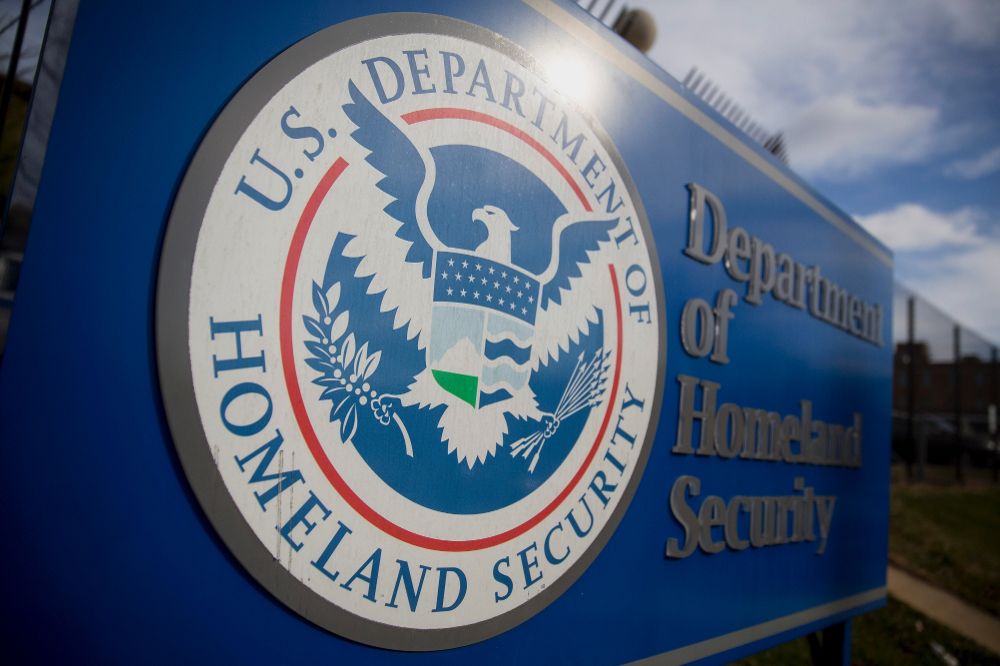
The U.S. Senate confirmed Markwayne Mullin as the next secretary of Homeland Security on Monday, as the agency continues to grapple with what lawmakers have described as a “never-ending” funding standoff, with Democrats attempting to withhold funding from one of the nation’s largest and most costly agencies.
Mullin — a Republican senator from Oklahoma, former mixed martial arts fighter, and plumbing business owner — was confirmed in a 54–45 vote. Two Democrats — U.S. Sens. John Fetterman (D-Pa.) and Martin Heinrich (D-N.M.) — sided with Republicans in supporting his confirmation.
The new agency head is expected to follow the policy direction set by President Donald Trump, emphasizing stricter immigration enforcement. This includes proposals to support immigration agents at polling sites and to cut funding to so-called “sanctuary cities.”
Mullin replaces Kristi Noem, who was fired earlier this month following a widely scrutinized 2-day congressional hearing on Capitol Hill.
During the hearing, Noem faced intense questioning over her response to several crises, including the fatal shooting of two American citizens in Minneapolis by U.S. Immigration and Customs Enforcement agents, a $220 million border security advertising campaign that featured her on horseback near Mount Rushmore amid one of the largest federal workforce reductions in U.S. history, and the federal response to major natural disasters such as the July 2025 Texas floods and Hurricane Helene in 2024.
Noem had previously drawn criticism for a series of policy decisions in South Dakota that broadly focused on restricting the rights of LGBTQ individuals. In 2023, she signed House Bill 1080, banning gender-affirming medical care for transgender minors. She also signed legislation and executive orders restricting trans athletes’ participation in women’s sports, as well as the state’s “Religious Freedom Restoration Act,” which critics argued enabled discrimination against LGBTQ individuals. Additionally, the state canceled contracts related to LGBTQ support services — including suicide prevention and health care navigation programs‚ and later agreed to a $300,000 settlement with trans advocacy group, The Transformation Project.
Despite her removal from DHS, Noem will remain in the Trump-Vance administration as a special envoy for the “Shield of the Americas,” an initiative aimed at promoting U.S. influence in the Western Hemisphere, including efforts to counter cartel networks, reduce Chinese influence, and manage migration.
The new head of DHS has served in Congress since 2013, in both houses of the federal legislature. While in the Senate and a member of the Health, Education, Labor, and Pensions (HELP) Committee, Mullin has been a vocal critic of policies aimed at expanding LGBTQ inclusion. He led a group of lawmakers in urging the Administration for Community Living to reverse a rule requiring states to prioritize Older Americans Act services based on sexual orientation and gender identity, arguing the policy could have unintended consequences.
Mullin also makes history as the first Native American — and a citizen of the Cherokee Nation — to lead the Department of Homeland Security. He was also among the 147 Republicans who voted to overturn the 2020 presidential election results despite no evidence of widespread fraud, and was present in the U.S. House of Representatives chamber on Jan. 6.
Federal Government
Protesters say SAVE Act targets voters, transgender youth
Bill described as ‘Jim Crow 2.0’
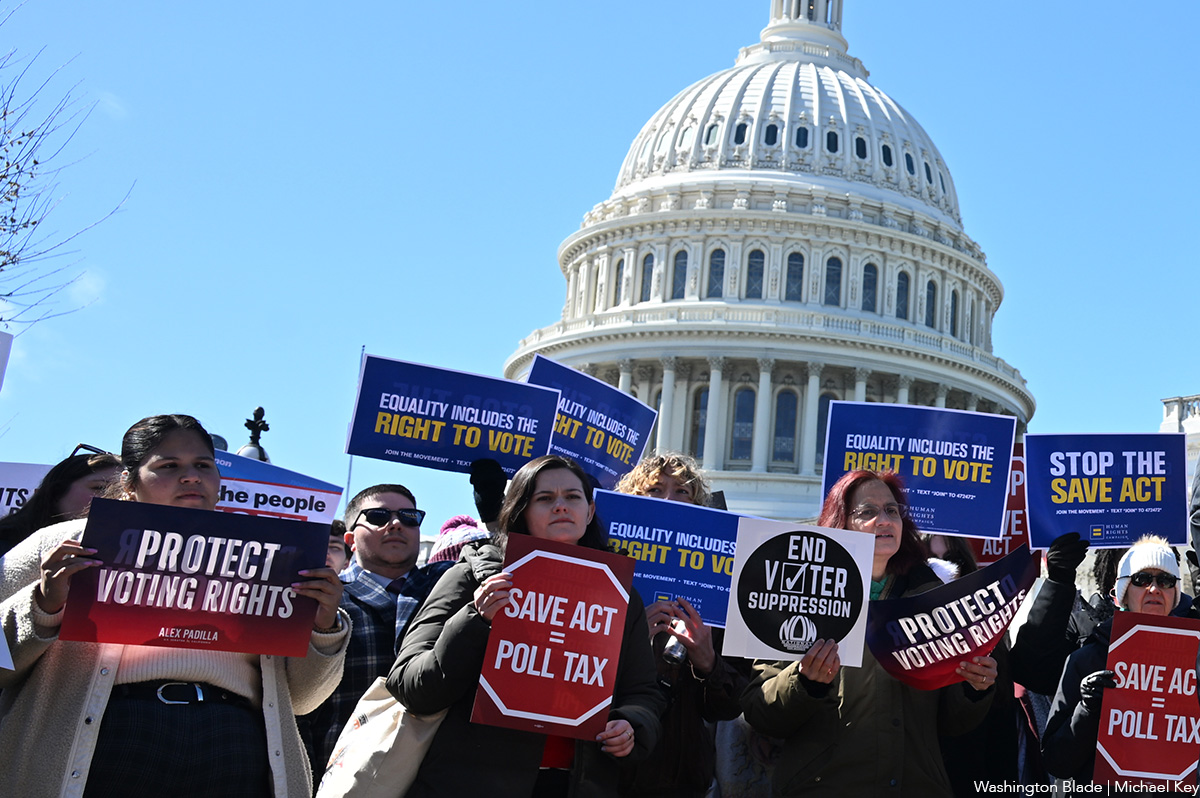
Members of Congress, advocates, and people from across the country gathered outside the U.S. Capitol on Tuesday to protest proposed federal legislation that voting rights activists have deemed “Jim Crow 2.0.”
The Safeguard American Voter Eligibility (SAVE) Act would amend the National Voter Registration Act of 1993 to require in-person proof of citizenship for anyone seeking to vote in U.S. elections.
President Donald Trump has also pushed for the proposed legislation to include a section that would ban gender-affirming medical care for transgender minors, even with parental consent, and prohibit trans people from participating in school or professional sports consistent with their gender identity rather than their sex assigned at birth.
In addition to changing voter registration requirements, the bill would limit acceptable forms of identification to documents such as a birth certificate or passport — records that the Brennan Center for Justice estimates more than 21 million Americans do not have — effectively restricting access to the ballot. It would also ban online voter registration, DMV voter registration efforts, and mail-in voter registration.
A 2021 investigation by the Associated Press found that fewer than 475 people voted illegally or improperly, a tiny fraction of the estimated 160 million Americans who voted in the 2020 election.
Senate Minority Leader Chuck Schumer (D-N.Y.) spoke at the event.
“It will kick millions of American citizens off the rolls. And they don’t even require you to be told,” the highest-ranking Democrat in the Senate told protesters and reporters outside the Capitol. “If this law passes — and it won’t — you’re gonna show up in November … and they’ll say… sorry, you’re no longer on the voting rolls.”
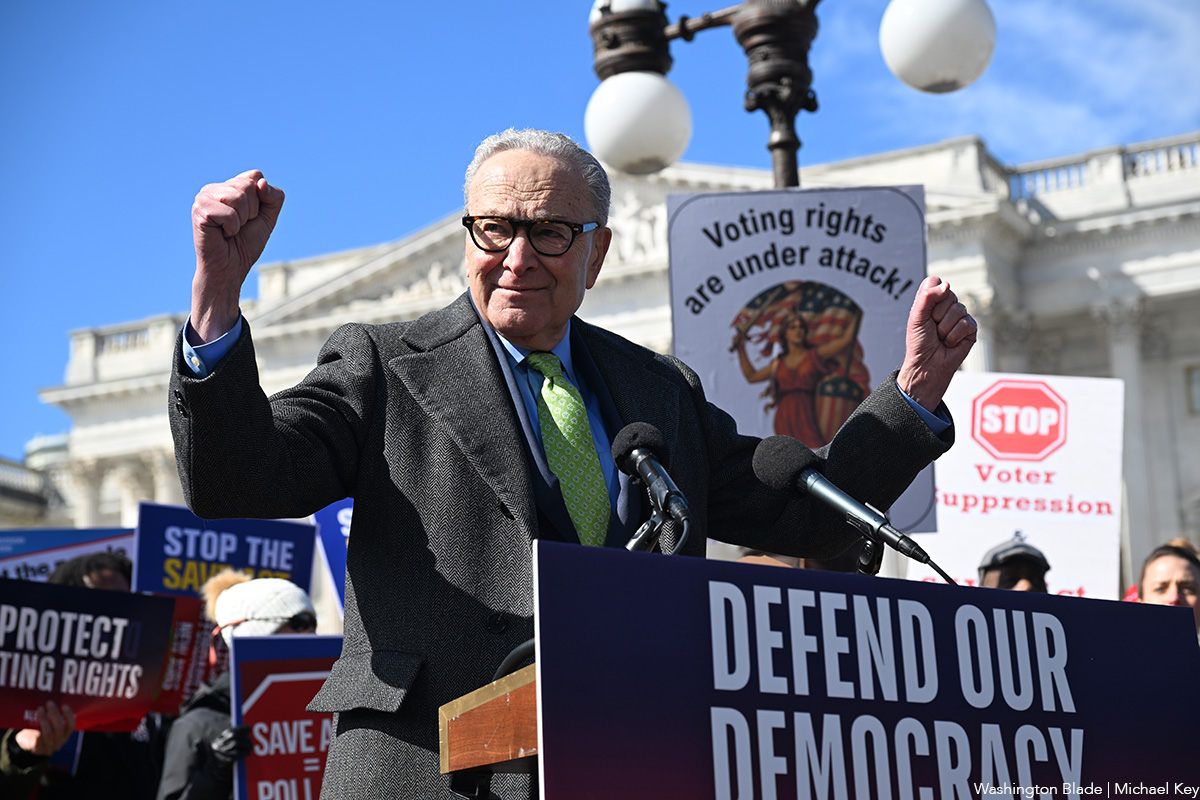
He, like many other speakers, emphasized the bill in the context of American history, pointing to what he described as its racist roots and its impact on Black and brown Americans.
“I have called this act, over and over again, Jim Crow 2.0 … because they know it’s the truth.”
U.S. Sen. Alex Padilla (D-Calif.) was one of the lawmakers leading opposition to the legislation and spoke at the rally.
“It’s not just voting rights that are on the line — our democracy is on the line,” the California lawmaker said. “It’s not a voter I.D. bill. It’s a bait and switch bill.”
He added historical context, noting the significance of voting rights legislation passed more than 60 years ago. In 1965, Alabama civil rights activists marched to protest barriers to voter registration. Alabama state troopers violently attacked peaceful demonstrators at the Edmund Pettus Bridge in Selma, using tear gas, clubs, and whips against more than 500 — mostly Black — protesters.
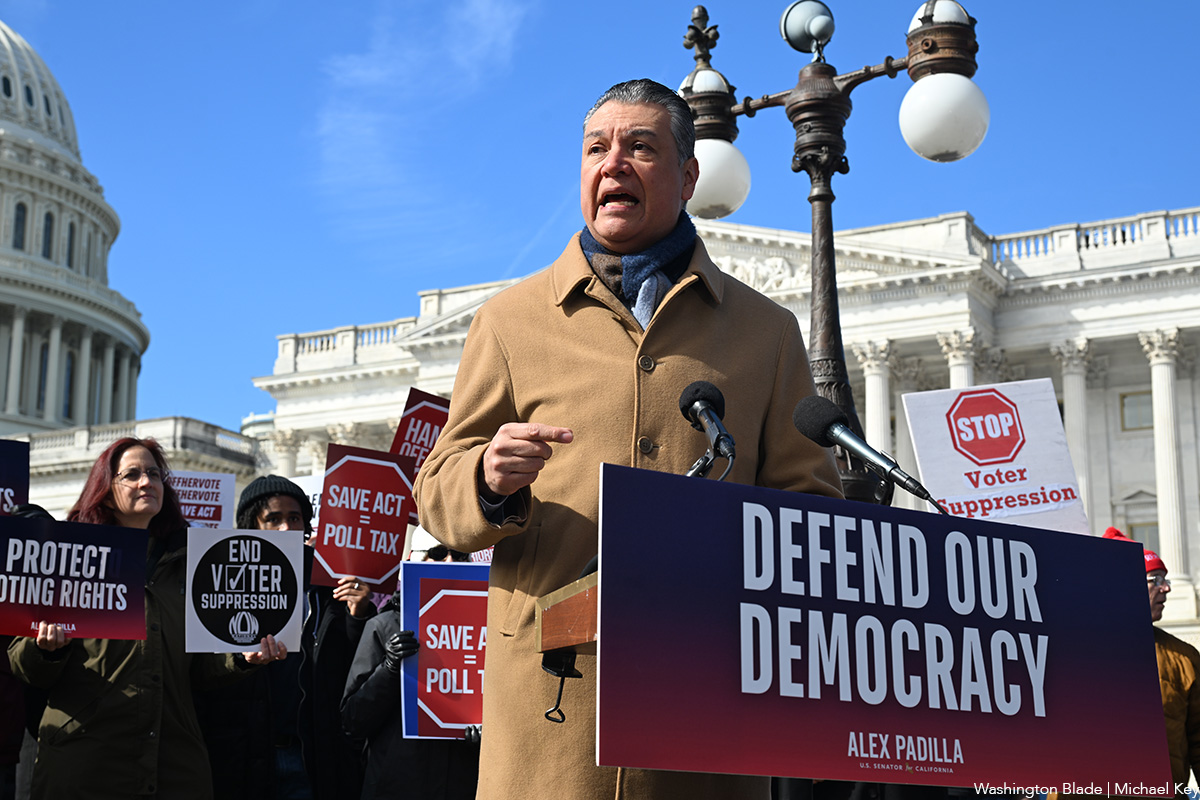
“61 years ago — not to the day — but this week, President Lyndon Johnson came to the Capitol and addressed a joint session of Congress in the wake of Bloody Sunday and pushed Congress to pass the Voting Rights Act,” Padilla said. “61 years later, Donald Trump and this Republican majority wants to take us backwards. We’re not gonna let that happen.”
U.S. Sen. Ben Ray Luján (D-N.M.) also spoke, emphasizing that he views the effort as a Republican-led and Trump-backed attempt to restrict voting access, particularly among Black, brown, and predominantly Democratic communities.
“President Trump told Republicans when they were meeting behind closed doors that ‘The SAVE Act will guarantee Republicans win the midterms and ensure they do not lose an election for 50 years,’” Luján said. “The first time I think Donald Trump’s been honest … This voter suppression bill is only that. Taking away vote by mail? I hope my Republican colleagues from states that voted for Donald Trump or where vote by mail is popular have the courage and the backbone to stand up and say no to this nonsense, because their constituents are going to push back.”
U.S. Sen. Lisa Blunt Rochester (D-Del.) also spoke.
“Our Republican colleagues have already cut Medicaid, Medicare, people don’t know how they’re gonna be able to afford energy,” she said, providing context for the broader political moment. “We’re in the middle of a war that they can’t even get straight while we’re in it and don’t have a way to get out of it. And we are now faced with defending our democracy?”
She then showed the crowd something that she said has been with her throughout her political journey in Washington.
“I brought with me something that I carried on the day that I was sworn into the House of Representatives when I was elected in 2016, and I carried it with me on the day that I was sworn in as United States senator. And I also carried it with me when I was trapped up in the gallery on Jan. 6 and all I could think to do was pray … This document allowed my great great great grandfather, who had been enslaved in Georgia, to have the right to vote. We took this and turned it into a scarf. It is the returns of qualified voters and reconstruction code from 1867. This is my proof of what we’ve been through. This is also our inspiration.”
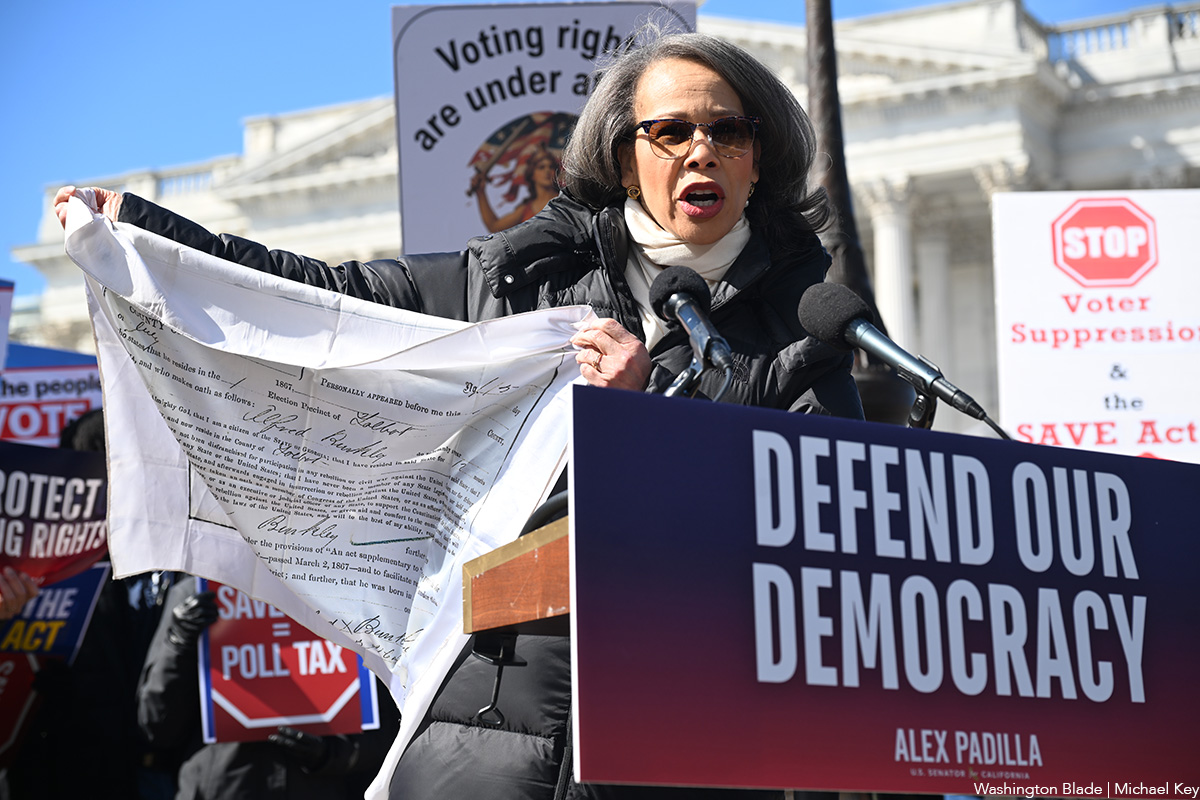
“I got to travel between the Edmund Pettus Bridge two times. And even as I thought about this moment, I recognized that while we wish we weren’t in it, while we don’t know why we’re in it, I do know we were made for it … So I came today to tell you that, um, just like the leader said, that he calls it Jim Crow 2.0. I call it Jim Crow 2.NO.”
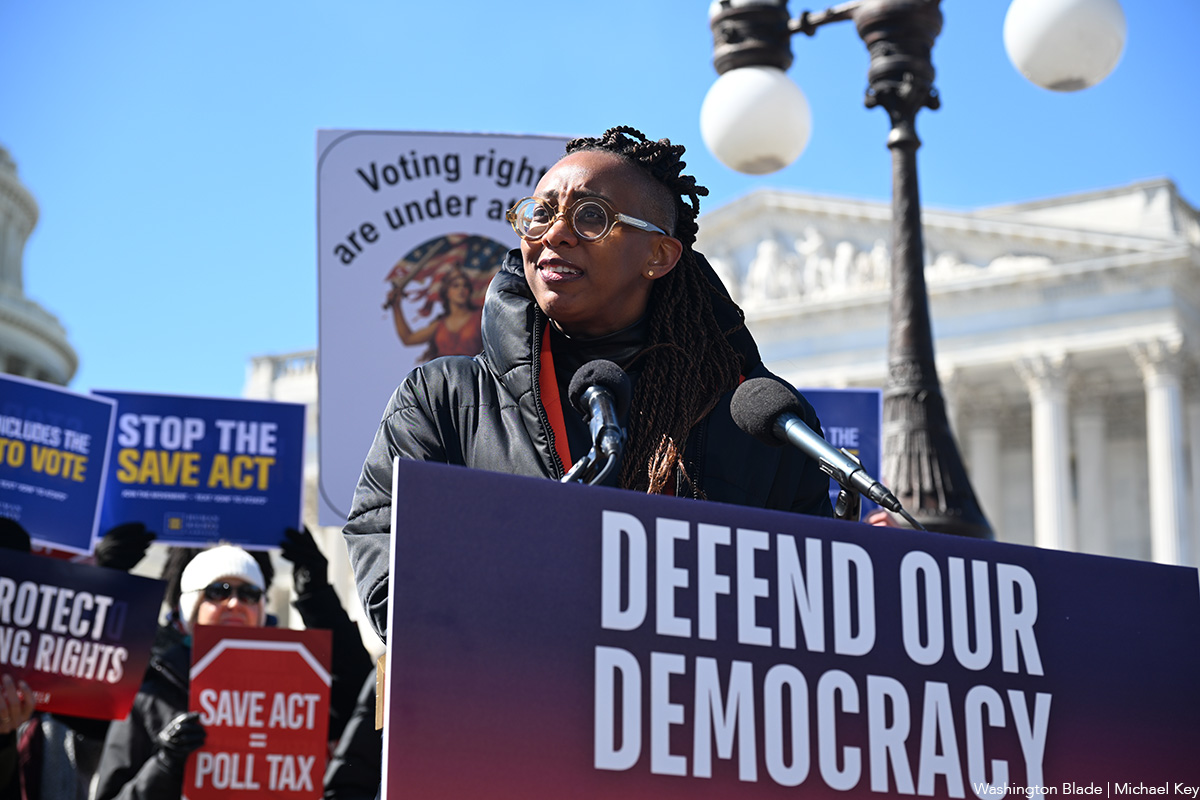
Kelley Robinson, president of the Human Rights Campaign, the largest LGBTQ advocacy organization in the U.S., also spoke, highlighting the impact of the bill’s proposed provisions affecting trans people.
“This bill is not about saving America. This bill is about stealing an election. This bill is about suppressing voters,” Robinson said. “This bill not only tries to disenfranchise voters that deserve their right to vote, it also tries to criminalize trans kids and their families … It tries to criminalize doctors providing medically necessary care for our trans youth.”
The SAVE Act passed the U.S. House of Representatives on Feb. 11 but has not yet been considered in the U.S. Senate.
Idaho
Idaho advances bill to restrict bathroom access for transgender residents
HB 752 passed in state House of Representatives on Monday
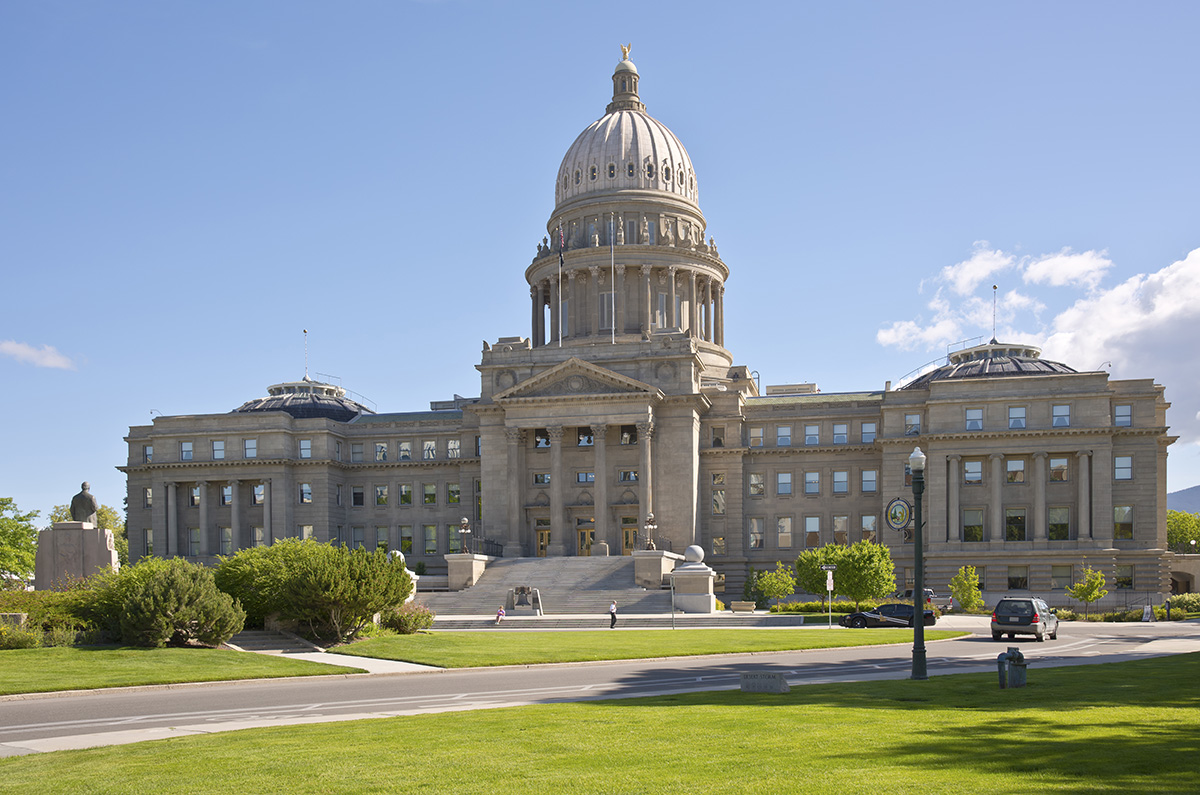
The Idaho House of Representatives passed House Bill 752 on Monday, a measure that would make it a crime for a person to use a bathroom other than the one designated for their “biological sex.”
The story was first reported by the Idaho Capitol Sun after the bill cleared the House.
House Bill 752 would make it a criminal offense — either a misdemeanor or a felony, depending on the number of prior offenses — for individuals who “knowingly and willfully” enter a bathroom or changing room designated for the opposite sex.
The bill would apply to public buildings, including government-owned spaces, and places of “public accommodation,” a category that includes private businesses.
According to the bill’s text, it would “prohibit a person from entering a restroom or changing room designated for the opposite sex; provide a penalty; provide exceptions; define terms; and declare an emergency and provide an effective date.”
A first offense would be a misdemeanor, punishable by up to one year in prison. A second or subsequent offense within five years would be a felony, punishable by up to five years in prison.
The bill passed in a 54–15 vote on Monday. Six Republicans broke with their party’s majority to join nine Democrats in opposing the measure.
The bill’s sponsor, state Rep. Cornel Rasor, a Republican from Sagle near the Washington-Idaho border, told House lawmakers that the legislation is intended to protect women and girls.
“It prevents discomfort and voyeurism escalation and assaults, while preserving single-user options and narrow exceptions so no one is denied access for emergency aid,” Rasor said.
State Rep. Chris Mathias, a Democrat from Boise, disagreed, arguing that the legislation would unfairly target transgender Idahoans.
“The truth of the matter is — and I know a lot of people don’t want to say it — but forcing people who don’t look like the sex they were assigned at birth, or transgender folks, to use other people’s bathrooms is going to put a lot of people in danger,” Mathias said.
The Idaho American Civil Liberties Union made a statement about the bill following its passage.
“Idaho lawmakers continue pushing these harmful, invasive bathroom laws, yet cannot present credible evidence that transgender people using gender-aligned bathrooms threaten public safety,” the Idaho ACLU said. “The bill does nothing to address real criminal acts, such as sexual assault or voyeurism, and disregards concerns from law enforcement about the burden enforcement would place on local resources.”
In addition to human rights advocates, who have spoken out against similar bills advancing in state legislatures across the country, Idaho law enforcement groups have also opposed the measure. They argue that the way the legislation is written would “pose significant practical enforcement challenges,” noting that officers are tasked with maintaining public safety — not conducting gender checks or policing bathroom access.
During a committee hearing last week, law enforcement representatives and several trans Idahoans testified that the bill would make many residents less safe.
“Officers responding to a complaint would be placed in the difficult position of determining an individual’s biological sex in order to enforce the statute,” Idaho Fraternal Order of Police President Bryan Lovell wrote. “In many circumstances, there is no clear or reasonable way for officers to make that determination without engaging in questioning or investigative actions that could be viewed as invasive and inappropriate.”
The Idaho Sheriffs’ Association requested that lawmakers amend the bill to require that individuals be given an opportunity to leave a bathroom immediately before facing potential prosecution.
The bill now heads to the Idaho Senate for consideration. To become law, it must pass both chambers and avoid a veto from the governor.
A separate bathroom bill, House Bill 607, which would be enforced through civil lawsuits, passed the House last month but has not yet received a committee hearing in the Senate.

Markwayne Mullin confirmed as next DHS secretary

Gay man murdered in Va.

Trans Day of Visibility events planned

Virginia General Assembly’s 2026 legislative session ends

Polish court rules country must recognize same-sex marriages from EU states

Queer American in Israel discusses Iran war’s impact

Calendar: March 21-26

‘How We Survived’ panel set for March 25

Small is beautiful: subcompact SUVs