Opinions
A journalist’s convictions and a lawyer’s fire
Remembering NLGJA’s Michael Triplett, who died at 48
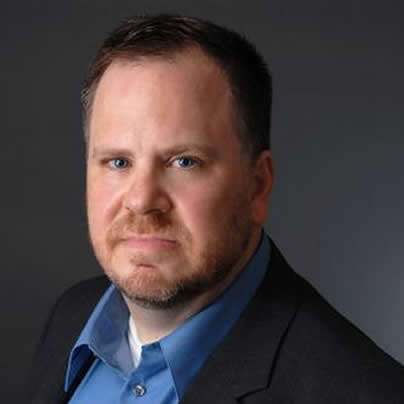
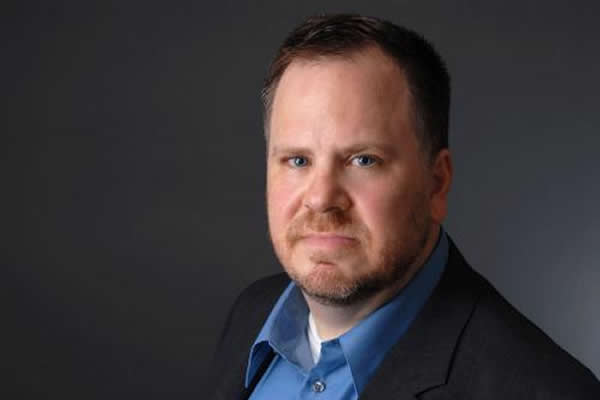
The late NLGJA President Michael Triplett (Photo courtesy of NLGJA)
By MATTHEW E. BERGER
There are people who are constants in your life, arriving at an undefined moment and in the background for the large and small milestones. And then there are those who are with you for just a short time, but leave an impression that is everlasting.
Michael Triplett, president of the National Lesbian and Gay Journalists Association, died last month, losing his battle with oral cancer. He was too young—48—and had too much left to give. Michael had a journalist’s convictions and a lawyer’s fire. He was a strong advocate for the communities he cared for. But what he taught me was that quiet, persistent passion can often be more effective than being the loudest voice in the room.
I first met Michael six years ago when, as president of NLGJA’s D.C. chapter, I sent out a notice seeking a treasurer. Michael responded that he knew how to balance a checkbook. We’d meet for coffee regularly, choosing our Starbucks based on the attractiveness of the baristas. It was there that I realized that Michael was not like many other journalists. He was stoic and focused in a fast-paced environment. Nothing seemed to faze him.
Michael succeeded me as chapter president and helped organize forums on the 2008 elections. He soon became a member of NLGJA’s national board and then its vice president. Our friendship was upgraded as well, as we started meeting for brunch in Clarendon, at a spot chosen for its buffet (as well as the large number of cute, young suburban dads).
In the short time we were friends, Michael changed in my eyes. He became more outspoken, more comfortable in his own skin. He seemed to be hitting his stride. He found a partner, was promoted at work, was doing charity work overseas. Michael seemed happy, well adjusted, successful, as if he had the whole world in front of him.
On Michael’s 47th birthday, he started a Tumblr page – My 48th Year. There, he spoke of his happiness at home and at work. “But I also get to see a doctor today about my cancer,” he wrote. “A week after it being diagnosed, Jack and I are going to see a head and neck oncologist to figure out what to do about this little tumor on my tongue. Well, I hope it’s little. I pray it’s little. We will see.”
Michael saw opportunity in everything, even cancer. He blogged often about the indignities of his treatment, how he lost the taste for food and found it difficult to shave. He wrote essays on oral cancer, its link to the human papilomavirus (HPV) and the potential for it to be spread through oral sex. And he showed the lighter side as well, how he may have been the only person who could thank cancer for making him look younger and thinner.
As he fought cancer, Michael pressed on. He rarely missed a meeting or an email exchange. He kept chairing committees and blogging for our website. When NLGJA was asked to join an alliance of minority journalists known as UNITY: Journalists for Diversity, Michael was the voice that brought calm to sometimes contentious meetings. He was the leader we needed, and he soon became our president.
Throughout the fall, it seemed Michael kept being told he needed one more treatment or surgery. When he got the news he had been dreading, that the cancer was terminal, he took to Tumblr to share the news and his thoughts—a writer to the end.
Michael showed me that advocacy can take many forms. He fought for what he believed in because he knew his thoughtful words and sweet nature would get his point across. He knew a good writer uses his pen for everything, from advocacy to therapy.
But more importantly, Michael showed me there is more than one way to make an impression. Michael left many, and our community is better for his efforts and his passion.
A memorial service will be held at noon on Saturday, Feb. 2 at St. Paul’s Lutheran Church, 4900 Connecticut Ave., N.W. A reception will follow. Memorial contributions may be made to NLGJA (2110 L St., N.W., Suite 850, Washington, D.C. 20037); St. Paul’s Lutheran Church; or to Hospice Family Care (3304 Westmill Dr., S.W., Huntsville, Ala. 35805).
Matthew E. Berger is vice president of Dezenhall Resources, a crisis communications firm, and a member of NLGJA’s board of directors.




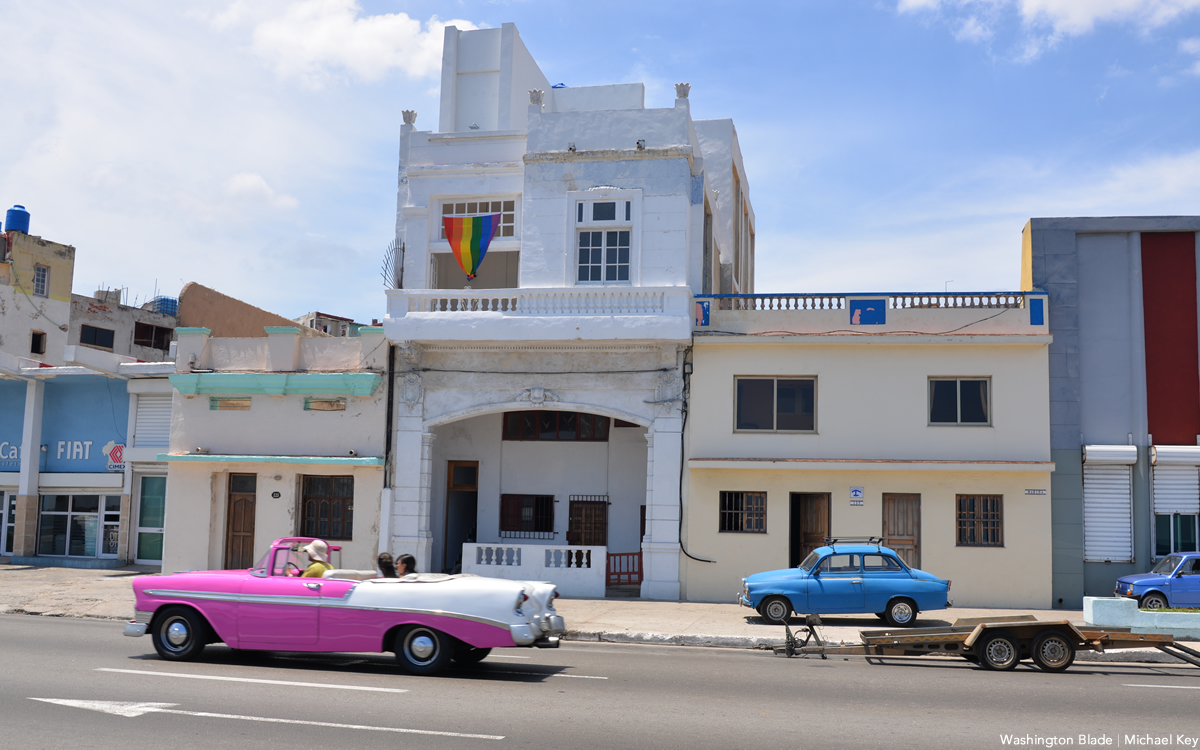
Tensions between the U.S. and Cuba are rising again. This is not new, but the current moment feels different. Recent measures from Washington aim to further restrict the Cuban government’s financial channels, limit its sources of revenue, and apply pressure to key sectors of the economy. This is not symbolic. It is a deliberate policy.
From the U.S. perspective, the message is clear. The goal is to force change that has not happened in more than six decades. There is also a domestic political dimension, shaped by sectors of the Cuban exile community that have long demanded a tougher stance. All of this is part of the landscape.
But that is only one side.
On the Cuban side, the response follows a familiar script. The government speaks of external aggression, economic warfare, and a tightening embargo. Each new measure becomes an opportunity to reinforce that narrative and close ranks. There is no room for public self-criticism. The blame always points outward.
Meanwhile, life on the island follows a different logic.
The energy crisis Cuba is facing today did not begin with these recent measures. It has been building for years. The electrical system is deteriorated, poorly maintained, and increasingly unreliable. Blackouts are not new. What has changed is how severe and how constant they have become.
For years, oil entered Cuba, especially from Venezuela. There were supply agreements. There were resources. And yet, the daily life of ordinary Cubans did not improve. Electricity remained unstable. Fuel was rationed. Transportation was still a daily struggle.
So the question is not new.
If the oil was there, why didn’t anything change?
Where did those resources go?
Where is the money that was generated?
Today, restrictions on oil are often presented as the main cause of the current crisis. They are not. They make an already fragile situation worse, but they do not fully explain it.
There is a deeper, longer story that cannot be ignored.
The same applies to Cuba’s international medical missions.
For years, they were presented as acts of solidarity. And in many cases, they were. Cuban doctors worked in difficult conditions, saving lives and supporting health systems abroad. That is real.
But they also functioned as one of the Cuban state’s main sources of income.
Many of these professionals did not receive the full salary for their work. A significant portion was retained by the government. In some cases, they had little or no control over the money they generated.
And there is a harsher reality.
If a doctor chose not to return to Cuba, that income often did not reach their family. It was withheld.
Today, several countries are reevaluating or canceling these agreements. Once again, the official response is to point outward. But the same question remains.
Is this the loss of international cooperation, or the collapse of a system built on control over its own professionals?
Inside Cuba, the conversation sounds very different.
People are not speaking in geopolitical terms. They are talking about survival. About getting through the day. About blackouts, food shortages, transportation problems, and a life that keeps getting harder.
Some see the new U.S. measures as a form of pressure that could lead to change. Not because they want more hardship, but because they feel the system does not change on its own. There is a deep sense of stagnation.
But that sense of expectation exists alongside a harsh reality.
Sanctions do not hit decision-makers first. They hit ordinary people. The ones standing in line. The ones losing food during power outages. The ones who cannot move because there is no fuel.
That is the contradiction.
The Cuban government calls for international solidarity. And it receives it. Countries send aid. Organizations mobilize. Public voices defend the island.
But another question is also present.
Does that aid actually reach the people?
The lack of transparency in how resources are distributed is part of the problem. Because this is not only about what enters the country, but about what actually reaches those who need it.
Reducing Cuba’s reality to a dispute between two governments avoids the core issue.
There are shared responsibilities, but they are not equal.
The U.S. exerts external pressure with real economic consequences. That cannot be denied. But inside Cuba, there is a system that has had decades to reform, to respond, to open, and it has not done so.
That part cannot continue to be ignored.
I write this as a Cuban. From what I lived. From what I know. From the people who are still there trying to make it through each day.
Because at the end of the day, beyond what governments say or decide, the reality is something else.
Cuba today is under more pressure, yes. But it has also spent years carrying problems that no one has seriously confronted.
And as long as that remains the case, it does not matter what comes from outside. The problem is still inside.
Opinions
D.C. is the place for the Democratic Socialists of America
Our endorsed candidates hold their affiliation as a badge of honor
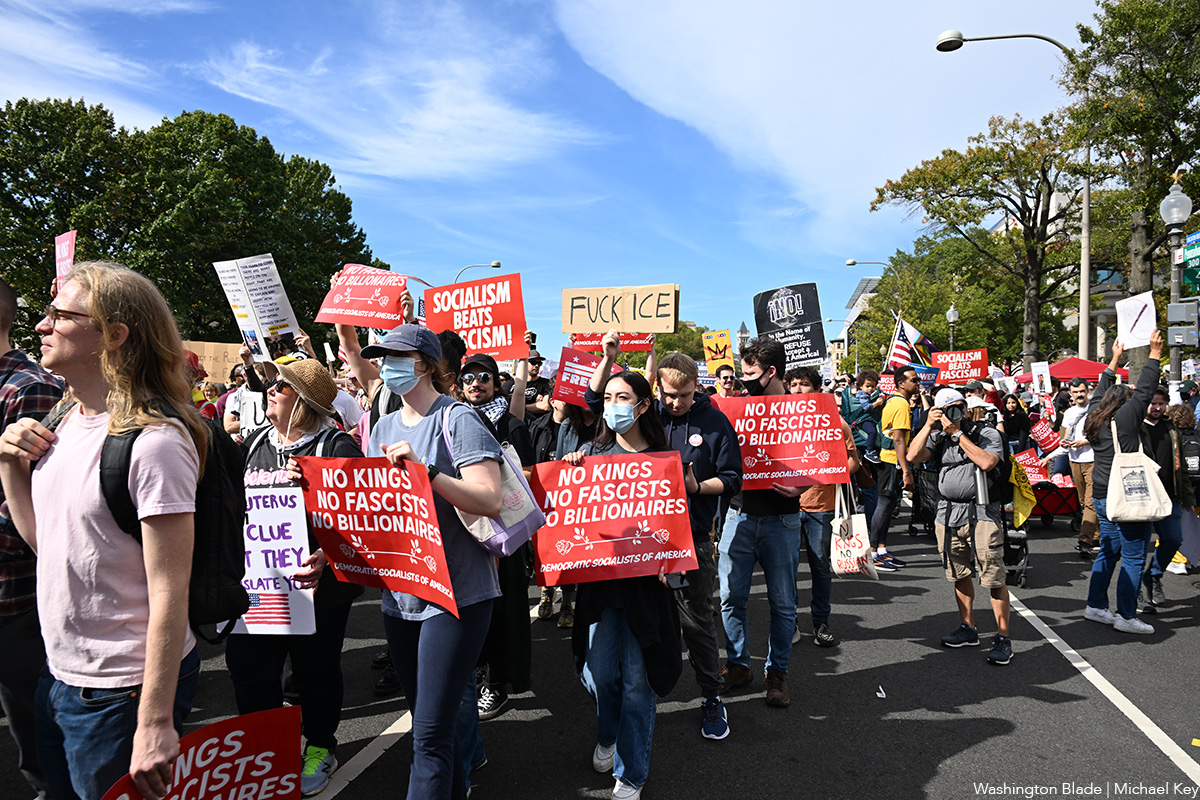
D.C. is the place for the Democratic Socialists of America (DSA). We believe in a District where everyone can live a happy and dignified life. That means housing, healthcare, transit, education, and safety are treated as guarantees rather than privileges reserved for the wealthy and well-connected.
Our endorsed candidates do not hide what they believe. They engage in the democratic process openly, explain their politics clearly, and ask their fellow members to spend long nights and weekends doing the hard work of campaigning. And as the last six years of local elections have shown, including three successful D.C. Council campaigns and the overwhelming passage of Initiative 82, D.C. voters are often a great deal more interested in the endorsement of Metro DC DSA than in the handwringing of the Washington Post editorial board.
That is what makes Peter Rosenstein’s April 2 op-ed in the Blade so revealing. His piece was not just wrong. It was smug, unserious, and politically disconnected from the actual lives of queer people in this city. Worse, he used the platform of our local LGBTQ outlet to disregard Palestinian humanity while scolding democratic socialists for refusing to join him in that moral failure. Put plainly, Rosenstein has been publishing crank op-eds for years, and this one was no exception.
My name is Hayden Gise. I am a transgender, lesbian, Jewish, Democratic Socialist, and I am a union organizer. I do not speak on behalf of the national DSA organization, the local chapter, or any campaign. But I will not sit quietly while Rosenstein wraps himself in the mantle of queer Jewishness to sell the lie that anti-Zionism is antisemitism.
He packages that lie in the same kind of pinkwashing rhetoric used by Benjamin Netanyahu, who mocked solidarity with Palestinians by saying, “Some of these protesters hold up signs proclaiming ‘Gays for Gaza.’ They might as well hold up signs saying ‘Chickens for KFC.’” Rosenstein’s liberal Zionism is not thoughtful, brave, or nuanced. It is just a more polished way of telling Palestinians their lives matter less and telling queer people we should be grateful for the empire so long as it flies a rainbow flag. Which, by the way, is showing itself to be a losing strategy.
The ongoing genocide in Gaza is not some tragic deviation from the history of an otherwise peaceful Israel. The Nakba was the mass expulsion and displacement of Palestinians during Israel’s establishment in 1947–49, when hundreds of thousands were driven from their homes. My Jewish values tell me that is wrong. Rosenstein’s politics treat anti-Zionist Jews like me as illegible. No serious person should treat that accusation as an argument.
But the deeper problem with Rosenstein’s piece is that he has no real understanding of why Democratic Socialism resonates here. For queer people in D.C., Democratic Socialism is not an abstract theory. It is rent that does not consume half your paycheck, a union on your job, childcare you can actually afford, public transit that works, and a city where working-class Black and brown queer people are not displaced so developers and donors can cash in. Queer politics is not only about recognition. It is also about whether ordinary people can afford to survive.
That is why D.C. is fertile ground for Democratic Socialism. In the race for mayor, one of the leading candidates is Kenyan McDuffie, whose campaign already looks like a focus-grouped merger of Andrew Cuomo’s slogan and Donald Trump’s graphic design instincts, backed by big business interests and the super PAC money that follows them. The other has the endorsement of the major labor unions in the District. Who has a cohesive vision to make D.C. more affordable and childcare universal. Who puts people over profit and human rights over political expediency. Our next mayor, and our first Democratic Socialist Mayor: Janeese Lewis George.
D.C. is exactly the kind of city where Democratic Socialism should grow: working-class, queer, tenant-heavy, union-minded, and tired of being told that dignity is too expensive. Which side are you on? I know what side the queer people of the District of Columbia will be on.
Hayden Gise is a union organizer in Washington, D.C.
Peter Rosenstein responds:
I am responding to a column by Hayden Gise who says in her column she is a transgender, lesbian, Jewish, Democratic Socialist, and supports having the Democratic Socialists of America (DSA) in Washington, D.C. She is definitely as entitled to her view on this, as I am to mine. However, I was surprised she clearly felt it important in her column to attack me personally, without even knowing me.
What she didn’t do is respond to the issues in the DSA platform I have a problem with and I asked candidates endorsed by the DSA to respond to. Are they for the abolition of the State of Israel? What is their definition of a Zionist? What is their definition of antisemitism? Will they meet with Zionist organizations? Do they support BDS? The DSA is also clear no person can be a member of a local DSA without being a member of the national organization.
Just so Gisa has a better idea of who I am she should know: I was a teacher and a union member. I worked for the most progressive member of Congress at the time, Bella S. Abzug (D-N.Y.), and supported her when she introduced the Equality Act in 1974, to protect the rights of the LGBTQ community, and have fought for its passage ever since. I have spent a lifetime fighting for civil rights, women’s rights, disability rights, and LGBTQ rights. I have no idea what Hayden Gise’s background is, or what her history of working for the causes she espouses is. But I would be happy to meet with her to find out. She should know, I take a backseat to no one in the work I have done over my life fighting for equality, including economic equality, for all. So, I will not attack her, as I don’t know her, and contrary to her, don’t personally attack people I don’t know much about.
I have, and will continue to attack, what the government of Israel is doing to the Palestinian people, and now to those in Lebanon and Iran. I will also attack the government of my own country, and the felon in the White House, and his sycophants in Congress, for what they are doing to our own people, and people around the world, and will continue to work hard to change things.
However, I will also continue to stand for a two-state solution with the continued existence of the State of Israel, calling for a different government in Israel. I also strongly support the Palestinian people and believe they must have the right to their own free state.

For half a century, the arc of LGBTQ progress in America has bent—slowly, imperfectly—toward justice. We fought for visibility, for legal protections, for the right to marry, serve openly, and live with dignity. Each generation built on the courage of the last.
And yet today, that progress is in peril. Across the country, lawmakers are rolling back protections, demonizing LGBTQ people for political gain, and trying to erase us from public life.
Opponents of our equality are working to erase us from the Constitution, and indeed, public life. In moments like this, based on my personal involvement working with one of the most effective leaders for LGBTQ rights I find myself asking a simple question: What would Jeffrey do?
Jeffrey Montgomery—the focus of a new documentary “America You Kill Me” and a long time Michigan activist and founder of the Triangle Foundation—was never content with quiet advocacy or compromise. He was a rabble-rouser, a strategist, and a relentless thorn in the side of powerful bigots. When politicians tried to marginalize LGBTQ people, Jeffrey didn’t politely ask for scraps. He forced the issue.
Jeffrey Montgomery started with his own determined voice and turned it into a movement. His story is living proof that personal courage can spark national conversations about justice and inclusion.
At a moment when the LGBTQ movement again faces hostility and regression, Jeffrey’s playbook offers lessons we would be wise to remember.
First, Jeffrey understood the importance of punching above our weight. In the early days of LGBTQ organizing, our movement was small, underfunded, and politically marginalized. But Jeffrey refused to let opponents see us that way. Through visibility, media savvy, and relentless organizing, he made LGBTQ advocates appear larger, stronger, and more unified than our numbers alone might suggest.
That perception mattered. Political opponents think twice before attacking a movement that looks organized, energized, and capable of mobilizing public pressure. Jeffrey knew that power is partly about reality—but also about what your opponent believes your power to be.
Second, Jeffrey never compromised on the value of our lives. Movements make compromises all the time. Politics often requires it. But Jeffrey understood that some things are not negotiable. The basic humanity of LGBTQ people is one of them. You can’t put our basic rights on the ballot. You don’t tell people to wait their turn. There are no turns. It’s now. It’s always now.
Too often, our opponents frame equality as something to be bargained over—as if the dignity and safety of queer people were a policy preference rather than a fundamental right. Jeffrey rejected that premise entirely.
You can negotiate strategy. You can negotiate timelines. But you cannot negotiate the worth of human lives.
And finally, Jeffrey understood the power of coalition. Today, one of the most effective tactics used against marginalized communities is division. If LGBTQ people can be fractured—by identity, ideology, generation, or strategy—our collective strength weakens.
Jeffrey instinctively resisted that trap. He worked with civil rights groups, labor leaders, faith communities, civic leaders and allies across movements. He understood that the fight for LGBTQ equality was never isolated from the broader fight for justice.
When opponents try to divide us, the answer is not retreat into smaller camps. The answer is to build broader ones.
If Jeffrey Montgomery were here today, he would not be discouraged by the backlash we are seeing. He would recognize it for what it is: the predictable response of those who feel their power slipping away.
And he would remind us that progress has never been linear. It has always required courage, persistence, and a willingness to challenge power directly.
So, when the moment feels uncertain, when the political winds shift against us, and when our opponents try to make us feel small, the question remains a useful one: What would Jeffrey do?
If history is any guide, the answer would be simple. He would make some noise. And making noise, today, means refusing to let fear, fatigue, or false unity quiet us when our lives are on the line.
Sean Kosofsky was director of policy at the Triangle Foundation.

Cuba under pressure and without answers

Police mental health struggles gain growing attention

Man faces first S.C. ‘hate intimidation’ charge

Trump budget would codify expanded global gag rule

D.C. is the place for the Democratic Socialists of America

VIDEO: Gay journalist detained for booing Trumps at ‘Chicago’ opening night

Pam Bondi ousted as attorney general

JD Vance to travel to Hungary next week

Mayor Bowser signs bill requiring insurers to cover PrEP

Belarusian lawmakers approve bill to crackdown on LGBTQ rights
-

 The White House5 days ago
VIDEO: Gay journalist detained for booing Trumps at ‘Chicago’ opening night
-
The White House5 days ago
Pam Bondi ousted as attorney general
-
Hungary5 days ago
JD Vance to travel to Hungary next week
-
District of Columbia5 days ago
Mayor Bowser signs bill requiring insurers to cover PrEP