Connect with us

Arts & Entertainment

Calendar through May 23

A packed trans pride weekend has concerts, parties and more
Published

on

Comedian Vicki Lawrence, Ram's Head, Gay News Washington Blade

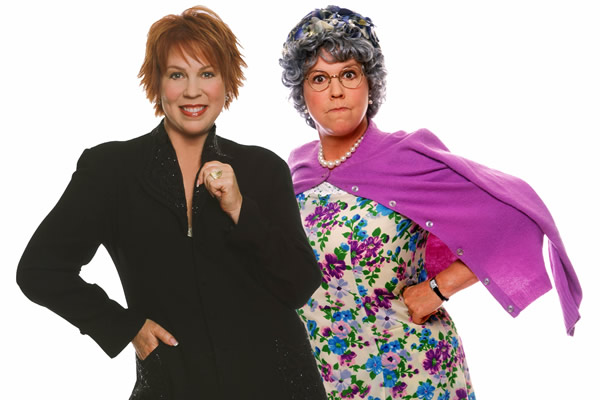
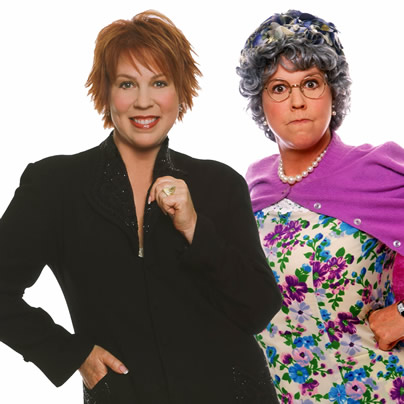
Comedian Vicki Lawrence comes to Ram’s Head On Stage with her show ‘Vicki Lawrence & Mama’ this weekend. (Photo courtesy the Brokaw Company)

Friday, May 17

Washington Blade hosts its seventh annual Rehoboth Summer Kickoff Party at the Blue Moon (35 Baltimore Ave., Rehoboth Beach, Del.) today at 5 p.m. A $5 donation is suggested and will go toward the Washington Blade Foundation. For more information, visit the Facebook event or washingtonblade.com.

Friends of the Library, Montgomery County and the Latino Gay Lesbian and Transgender History Project host inaugural poet Richard Blanco this evening at 7:30 p.m. at the Rockville Memorial Library (21 Maryland Ave.). Blanco is a Cuban-born writer whose family emigrated to Spain, New York and then eventually settled in Florida. He is the author of three books and a bilingual triptych of poems that were submitted for the inauguration. Tickets are $30-$100. Attendees can buy packages that include a signed book. Visit folmc.org for more information.

Whitman-Walker provides free HIV Testing at Town (2009 8th St., NW) starting at 8 p.m. For more information, visit whitman-walker.org.

Saturday, May 18

The Hagerstown Hopes Pride & Diversity Celebration takes place  today from noon-4 p.m. at Doubs Woods Park (1307 South Potomac St., Hagerstown, MD). The event’s goal is to educate, enlighten and entertain the LGBT community. For details, visit pflagcentralmd.org.

Emmy-winning comedian Vicki Lawrence comes to Rams Head On Stage (33 West St., Annapolis, Md.) bringing her show “Vicki Lawrence & Mama, A Two Woman Show” tonight at 8 p.m. One of her most endearing and famous characters, Thelma Harper, also known as “Mama,” was created in the seventh season on “The Carol Burnett Show.” Tickets are $75. For more information, visit ramsheadonstage.com.

The fourth Gaithersburg Book Festival takes place from 10 a.m.-6 p.m. on the grounds of City Hall in Old Towne (31 S Summit Ave.). This year coordinators are trying a new format to bring more authors and greater diversity. There will be pairings of authors, panel discussions and one-on-one conversations between authors and critics and industry insiders. Food, drink and ice cream is provided. Admission is free. Visit gaithersburgbookfestival.org for more information.

MOVA (2204 14th St., NW) holds its “Blast from the Past ‘80s Night” tonight hosted by Stormy Vain and music by VJ Tre. There will be drink specials for ‘80s themed drinks all night. For details, visit movalounge.com or the Facebook event.

Burgundy Crescent, a gay volunteer organization, volunteers today for the Lost Dog & Cat Rescue Foundation at Falls Church PetSmart (6100 Arlington Blvd., Falls Church, Va.) starting at 11:45 a.m. For more information, visit burgundycrescent.org.

Whitman-Walker provides HIV Testing at Capital Trans Pride today from 10 a.m.-4 p.m. at National City Christian Church (5 Thomas Circle, NW). The clinic provides testing again at the D.C. Eagle (639 New York Ave., NW). For more information, visit whitman-walker.org.

The Green Spring Garden (4603 Green Spring Rd, Alexandria Va.) hosts its Spring Garden Day on today at 9 a.m. The even features 40 vendors of rare and unusual plants. For more information, visit fairfaxcounty.gov/parks/greenspring.

A new New Balance shop opens today in Fairfax’s Mosaic District (2910 District Ave., Fairfax) and will carry the entire collection of athletic shoes, casual shoes and athletic apparel. Several discounts, prizes and raffles will be available today and Sunday. The shop is just steps away from the Dunn Loring/Merrifield Metro stop. Store hours today are 10 a.m.-8 p.m. Visit nbretail.com for more information.

Sunday, May 19

The D.C. Center and Professionals in the City host Women’s Speed Dating tonight at 7 p.m. at Finn and Porter in the Embassy Suites Hotel (900 10th St., NW). This event is for bisexual and lesbian women in their 20s and 30s. Admission is $30. For more information, visit thedccenter.com.

Monday, May 20

The Shakespeare Theatre Company hosts an installment of its Classic Conversations with Michael Kahn featuring Audra McDonald and Christopher Plummer tonight at 7:30 p.m. at Sidney Harman Hall (610 F St., NW). The series of discussions covers the topics of classical theater and the craft of acting. McDonald is both and actor and opera singer, while Plummer is a classical actor who is known for his role in “The Sound of Music.” Tickets are $20-$35. Visit shakespearetheatre.org for more information.

The D.C. Center (1318 U St., NW) holds coffee drop-in for the senior LGBT community today at 10 a.m.-noon. The Center will provide complimentary coffee and a community to chat with. For more information, visit thedccenter.org.

Bears do Yoga takes place this evening 6:30 p.m. as part of a series at the Green Lantern (1335 Green Court, NW). This is part of a basic yoga series that takes place every Monday and is open to people of varying body types and experience. There is no charge. For more information, visit thedccenter.org.

Whitman-Walker Health (1701 14th St., NW) holds its HIV+ Newly Diagnosed Support Group tonight at 7. It is a confidential support group for anyone recently diagnosed with HIV and the group welcomes all genders and sexual orientations. Registration is required and attendees must call 202-797-3580 or email [email protected]. For details, visit whitman-walker.org.

Tuesday, May 21

The Stephen Sondheim production “Company” opens tonight at 7:30 p.m. at Signature Theatre (4200 Campbell Ave., Arlington, Va.). The show is about Bobby, a commitment-phobic bachelor, who searches for the answers to love and life in New York City. He observes the joys and pitfalls of marriage from his five couple friends while enjoying the company of the ladies. Sondheim’s award-winning score includes “Being Alive,” “Side By Side,” “Little Things You Do Together,” “Another Hundred People” and “Ladies Who Lunch.” The show runs until June 30. Tickets are $25-$80. For more information, visit signature-theatre.org.

Wednesday, May 22

Whitman-Walker Health (1701 14th St., NW) holds its HIV+ Newly Diagnosed Support Group tonight at 7. It is a confidential support group for anyone recently diagnosed with HIV and the group welcomes all genders and sexual orientations. Registration is required and attendees must call 202-797-3580 or email [email protected]. For details, visit whitman-walker.org.

Thursday, May 23

Lambda Sci-fi has its book discussion tonight at 7:30 p.m. at 1425 S St., N. Tonight the group will be discussing the book “Kindred” by Octavia Butler. For more information, visit lambdascifi.org.
Advertisement
FUND LGBTQ JOURNALISM
SIGN UP FOR E-BLAST

Photos

PHOTOS: ‘Defrosted’

Live drag musical performed at JR.’s

Published

on

'Defrosted' was performed at JR.'s on Saturday. (Washington Blade photo by Michael Key)

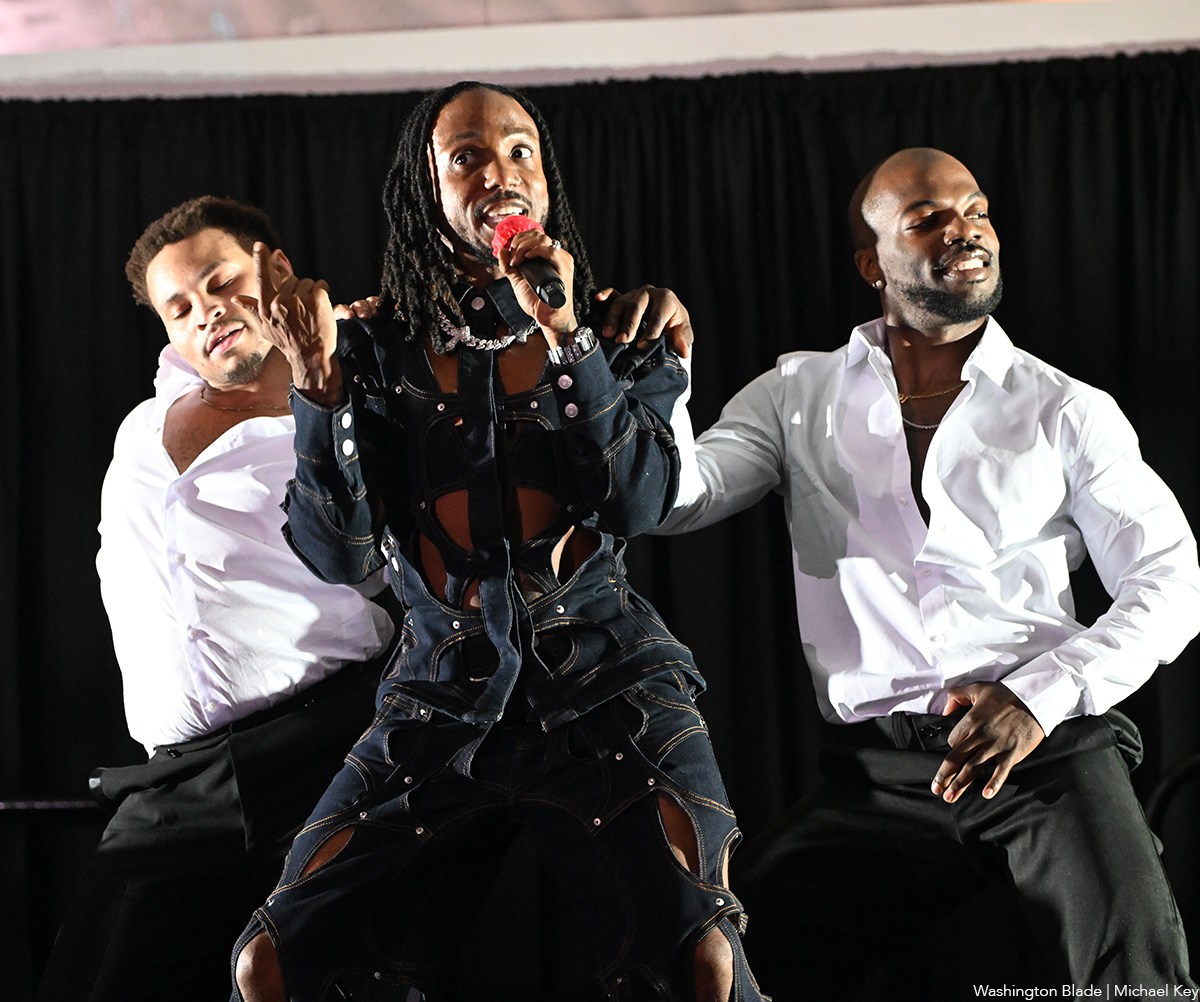
Highball Productions held performances of a drag musical, ‘Defrosted,’ at JR.’s on Friday and Saturday. 

(Washington Blade photos by Michael Key)
Continue Reading

Movies

Intense doc offers transcendent treatment of queer fetish pioneer

‘A Body to Live In’ a fascinating trip into a transgressive culture

Published

on

The late Fakir Musafar in ‘A Body to Live In.’ (Photo courtesy of Altered Innocence)

Once upon a time in the 1940s, a teenager named Roland Loomis, who lived with his devout Lutheran parents in Aberdeen, S.D., received a hand-me-down camera from his uncle. It was a gift that would change his life.

Small and effeminate, he didn’t exactly fit with the “in” crowd of his small rural town; but he had an inner life more thrilling than anything they had to offer, anyway, and that camera became the key with which it could finally be unlocked. Waiting patiently for those precious hours when he was alone in the house, he used it to capture images of himself that expressed an identity he had only begun to explore, through furtive experiments in body manipulation that incorporated exotic costuming, erotic nudity, gender ambiguity, and what many of us might call (though he would not) self-mutilation, including the piercing of his skin and other extreme forms of physical modification.

Young Roland would go on to become famous (or perhaps, notorious) in the decades to come, but it would be under a different name: Fakir Musafar, the focal figure of filmmaker Angelo Madsen’s documentary “A Body to Live In,” which opened in Los Angeles on Feb. 27 and expands to New York this weekend. 

Like Musafar himself, who died of lung cancer at 87 in 2018, it’s a documentary that doesn’t quite follow the expected rules. Eschewing “talking head” commentators and traditional narration, Madsen spins his movie from his subject’s extensive archives and allows the information to come through the voices of those who were close to him: collaborator and life partner Cléo Dubois, performance artists Ron Athey and Annie Sprinkle, and underground publisher V. Vale are among the many who contribute their memories and impressions of him, while evocative photos and film footage create a hazy “slide show” effect to provide a guided tour of his life, his art, and his legacy. Less a biography than a chronicle of profoundly unorthodox self-discovery, it details his development from those early days of clandestine self-photography through a continual evolution that would see him become a performance artist, a central figure in the burgeoning BDSM culture, a seeker who espoused eroticism as a spiritual practice, the founder of a “Radical Faeries” offshoot for the kink/fetish community, and ultimately an elder and mentor for a new generation for whom his once-taboo ideas and explorations had essentially become mainstream – thanks in no small part to his own pioneering efforts.

It’s a fascinating, hypnotic trip into a culture which might feel disturbingly transgressive to those who have never been a part of it – yet will almost certainly feel like being “seen” to those who have. It opens a window into a lifestyle where leather, kink, BDSM, gender play, and non-monogamous “situationships” are not just accepted but viewed as natural variations on the spectrum of human sexuality; and in the middle of it all is Musafar, on a deeply personal quest to connect with the deepest part of his essence through the intense and ritualistic pursuit of an inner drive that keeps pushing him further. As one reminiscing cohort remarks during the film, it’s as if he is “trying to find an answer to a question that” he “cannot form.”

Indeed, it might be said that Madsen’s movie is an exercise in forming that question; bringing his own “transness” into the mix as he examines the various aspects of Musafar’s ever-evolving relationship with self, identity, and presentation, he evokes a timely resonance in which the imperative to make physical form match psychic self-perception becomes an irresistible force, and draws a direct line between his subject’s fluid ambiguity and the plight faced by modern trans people over the bigotry of those who think gender is strictly about genitalia. Perhaps the question has to do with whether we are defined by our identities or by our physical form – or if both are malleable, adaptable, and in a constant state of flux.

In any case, with regard to Musafar, “A Body to Live In” is unquestionably a film about transformation, not just of physical manifestation but of consciousness itself. In his journey from being little Roland, the outcast schoolboy with a secret fetish, to Fakir, the spiritual psychonaut for whom sex and gender are only walls that separate us from a true and eternal essence, he is embodied by Madsen’s reverent documentary as a being in the process of breaking free from the restrictions of physical existence, of transcending all such distinctions by letting go of life itself – something underscored not only by the section of the movie dealing with the impact of the AIDS epidemic on Musafar’s deeply-bonded community, but by his own words, spoken in a deathbed interview that serves as a connecting thread throughout the film. We are kept unavoidably aware of the mortality which – for Musafar at least – seems little more than a prison that keeps us from the unfettered joy of our true nature.

But while Madsen honors his subject as a pillar – and an under-sung hero – of contemporary queer culture, he also addresses the aspects that made him a “problematic” figure; in his life, he drew criticism over perceived cultural appropriation from the indigenous American tribes whose sacred rituals inspired the kink-flavored practices which facilitated his own spiritual odyssey, and which he popularized among his own acolytes to give rise to the still-controversial “Modern Primitive” movement that has been criticized by some for turning meaningful cultural traditions into an excuse for trendy fashion accessories. Even Musafar’s survivors, whose love for him exudes palpably from the stories and memories they share of him throughout the film, make observations that point to his flaws; yet at the same time, Madsen’s documentary makes clear that Musafar himself never saw himself as perfect, either – just as someone willing to endure the kind of suffering that most of us might find unbearable in order to get closer to perfection.

Of course, it probably helped that he enjoyed that so-called “suffering,” but that’s perhaps too glib an observation in the face of a film that so clearly makes a case for the deep and sincere commitment he held for his quest for transcendence; but it’s also a helpful reminder that his practices – which might seem macabre and twisted to the uninitiated – were also an experience of joy, an exercise in rising above pain and making it a vehicle toward enlightenment, and in achieving a deeper understanding of one’s own place in this confusing place we call the universe.

Full disclosure: “A Body to Live In” is an intense experience, replete with candid sexual conversation, frequent nudity, and graphic scenes of extreme fetish practices – like suspension by metal hooks through the skin – which might be hard to handle for those who are unprepared to be confronted by them. Even so, as dark and menacing as it might be for the squeamish outsider, the world revealed in Madsen’s eloquent portrait is full of treasures and steeped in dark beauty, and it’s hard to imagine a more fitting way than that to portray a queer pioneer like the former Roland Loomis.

Continue Reading

Nightlife

In D.C. comedy, be sure to shop local

A thriving patchwork of queer-friendly stages in Washington, Baltimore

Published

on

(Photo courtesy of Jamie Mack)

Most people know stand-up comedy from Netflix specials or late-night sets on Comedy Central. The reality is far different for local working comics like me. A few times a month, I might get paid $50 for a 10-minute set and my photo on a bar flyer to show off to the ladies in my scrapbooking club.

Still, it’s a joy sharing laughs about my well-worn Washington career arc — from conservative reporter to openly trans organic grocery store worker and nightclub comedian. Or, as I like to say onstage, from Fox to foxy.

Stand-up is hard. Offstage, it’s even harder. It took more than a year and nearly 80 open mics to land my first paid set. Since then, I’ve performed in coffee shops, bars, restaurants and even on a city sidewalk. I once performed in the Catskills, which felt like a big deal — even if it was a bigger deal in the 1950s.

As an older trans comic in Washington, I’ve found it nearly impossible to get stage time — or even the courtesy of a returned email — at the big, corporate-owned comedy clubs. Fortunately, there’s a thriving patchwork of queer-friendly producers in Washington and Baltimore creating shows that reflect the diversity of our communities, instead of straight male-dominated lineups that look like the cast of “Ice Road Truckers.”

“There are so many kinds of funny people, but a lot of barriers exist for women and queer people because it’s a very masculine culture,” said Dana Fleitman, who runs the Just Kidding Comedy Collective and is helping produce the Woke Mob Comedy Festival in April, featuring many women and queer comics.

Full disclosure: I’m not performing in the festival. But I am proud to be one of more than 50 women and nonbinary comics Fleitman and her colleagues have helped “train up” through an incubator program she first ran through Grassroots Comedy and now through Just Kidding Comedy Collective.

Another trans comic, Charlie Girard, who splits time between New York and Washington, runs an incubator program called Queers Can’t Take a Joke. He has trained more than 100 comics in Washington.

Girard has one rule: no punching down.

“The best comics speak truth to power,” Girard said. “Making fun of marginalized communities is simple lazy writing based on tired, old stereotypes.”

Ultimately, Girard wants to prepare students not just for queer rooms, but to find their voice and expand into all kinds of spaces.

Comics trained by Girard and Fleitman have gone on to produce or help run shows like Clocked Comedy, Backbone Comedy, the Crackin’ Up open mic and Funny Side Up. Several have found a home on Barracks Row at As You Are — one of my favorite places to perform. In Washington, comic Jenny Cavallero’s show Seltzer is a sober comedy night frequently featuring local queer comics.

In Washington, performer and producer Arzoo Malhotra, who runs Zoo Animal Productions, said it’s a critical moment to support community-based comedy producers, often the first hit by worsening economic conditions.

“We’re losing spaces faster than we’re creating them,” Malhotra said. “We are in the use-it-or-lose-it stage. If there’s a restaurant you like or a performer you want to keep seeing, patronize them now — because they’re going away.”

I’m also grateful for producers in Baltimore, which has a thriving queer comedy scene. Comic Hannah Alden Jeffrey’s monthly “The Really Cool Open Mic,” created for women and trans performers but open to all, regularly draws up to 100 people.

Hannah’s mic and Kenny Rooster’s “Dramedy” open stage have provided safety and opportunity when other stages felt out of reach. Comedians Michael Furr and Jake Leizear also produce shows regularly featuring queer comics.

“We started the REALLY COOL Open Mic because every other mic in town catered toward straight dudes that dominated the Baltimore scene,” Alden Jeffrey said. “Contrary to the lineups of many shows today, people don’t want to see a show of eight guys being bigots. Go figure.”

One of the most important moments for me came when I attended a free showcase at a well-known Adams Morgan club. Like other big venues, it hadn’t responded to emails from a new comic looking for a shot. I sat in the back row thinking maybe these comics were just way funnier than I am.

Then a straight male comedian — with hair even more gorgeous than mine — launched into a long joke comparing eating pizza to performing oral sex on a woman.

At that moment, I walked out feeling better about myself. I remember thinking: nope. I absolutely deserve to be on that stage, too.

Lots of us do.

Jamie Mack is a stand up comedian, speaker and writer. Follow them on Instagram at @jamiemack_blt or email [email protected].

Continue Reading

Popular