News
EXCLUSIVE: Fla. congresswoman meets with Cuban LGBT rights activists
Ileana Ros-Lehtinen met with Wendy Iriepa Díaz and Ignacio Estrada Cepero.
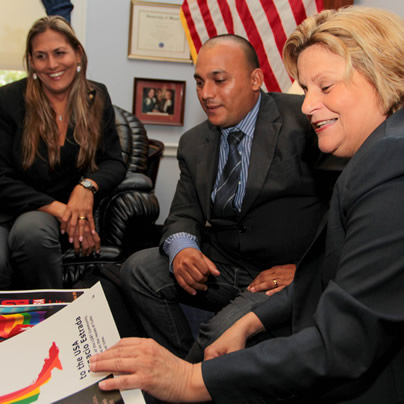
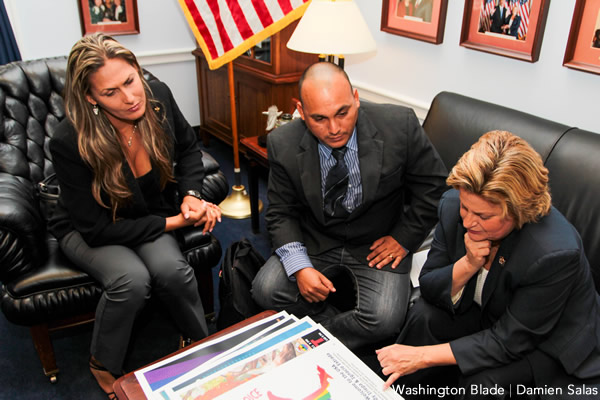
LGBT advocates Wendy Iriepa Díaz and Ignacio Estrada Cepero meet with Rep. Ileana Ros-Lehtinen (R-Fla.) to discuss human rights in Cuba in the Rayburn House Office Building on Wednesday, July 31, 2013. (Washington Blade photo by Damien Salas)
Florida Congresswoman Ileana Ros-Lehtinen on Wednesday met with two Cuban LGBT rights activists in her Capitol Hill office.
The Washington Blade had exclusive access to the majority of the meeting between the Cuban-born Republican who represents portions of Miami-Dade County and Wendy Iriepa Díaz and Ignacio Estrada Cepero that lasted more than half an hour.
Estrada, who founded the Cuban League Against AIDS in 2005, dismissed the Cuban government’s claims that people with HIV/AIDS receive free anti-retroviral drugs and other treatment under the island’s health care system. He and Iriepa, a transgender woman whom he married in a high-profile wedding in the Cuban capital of Havana in 2011, also criticized Mariela Castro, the daughter of President Raúl Castro who is the director of Cuba’s National Center for Sexual Education (CENESEX) that has publicly backed LGBT rights in the country.
Cuba has offered free sex-reassignment surgeries to trans Cubans under the country’s health care system in 2008.
Iriepa, who worked for CENESEX for seven years until she married Estrada, underwent the procedure herself in 2007. She told the Blade during an interview earlier this week that only 20 trans Cubans have received SRS since the law changed – and CENESEX determines those who will actually receive it.
Estrada and Iriepa arrived in D.C. on Monday and are scheduled to return to Miami tomorrow.
They are in the nation’s capital less than three months after Mariela Castro traveled to Philadelphia to receive an award from Equality Forum, an LGBT advocacy group.
Mariela Castro in May 2012 appeared on a New York City panel with Rea Carey, executive director of the National Gay and Lesbian Task Force. Mariela Castro also met with LGBT rights advocates in San Francisco while she was in the U.S.
“With these international trips, with this amount of recognition she has undermined the work of the (Cuban) LGBT community,” Estrada told Ros-Lehtinen as he showed her posters of Pride walks and other events that he and other Cuban LGBT rights advocates organized independent of CENESEX. “You are seeing a broken policy.”
Ros-Lehtinen applauded Estrada and Iriepa at the end of the meeting.
“I feel very honored to be able to meet you,” she said. “I am grateful to you for filling this tremendous role inside of Cuba that is certainly not easy.”
“It’s very important for the U.S. community to understand what is the status of LGBT rights and the denial of rights in Cuba,” Ros-Lehtinen told the Blade after the meeting. “Mariela Castro, as part of the regime, has been on a propaganda tour internationally and here in the U.S. especially trying to sell this facade that is really non-existent in Cuba.”
A Cuban government representative did not immediately return the Blade’s request for comments about Estrada and Iriepa’s meeting with Ros-Lehtinen.


District of Columbia
Anti-LGBTQ violence prevention efforts highlighted at D.C. community fair
Mayor’s Office of LGBTQ Affairs organized May 8 event
Detailed advice on how LGBTQ people can avoid, defend themselves against, and prevent themselves and loved ones from becoming victims of violence, with a focus on domestic and intimate partner violence, was presented at a May 8 LGBTQIA+ Safety in Numbers Community Fair.
The event, organized by the D.C. Mayor’s Office of LGBTQ Affairs, included five workshop sessions and information tables set up by 14 LGBTQ-supportive organizations and D.C. government agencies or agency divisions, including the D.C. Metropolitan Police Department’s LGBT Liaison Unit and the D.C. LGBTQ+ Community Center.
Also playing a lead role in organizing the event was the D.C. LGBTQIA+ Violence Prevention and Response Team, or VPART, a coalition of D.C. officials and leaders of community-based organizations that work with the Office of LGBTQ Affairs.
The event was held in meeting space in the building where the Office of LGBTQ Affairs is located at 899 N. Capitol St., N.E.
The workshop topics included de-escalation training on healthy relationships, bystander intervention, self-defense training, violence prevention grants, and suicide prevention.
“This will be a public safety and violence prevention event where community partners will educate attendees on various methods of violence intervention and trauma-informed practices,” according to a statement released by the Mayor’s Office of LGBTQ Affairs prior to the start of the event.
The statement adds, “We will have live demos, interactive games, and workshops focused on strategies for self-defense, protecting vulnerable communities, increasing access to mental health resources, providing tools for recognizing domestic violence/intimate partner violence signs in intimate relationships, and assistance for substance abuse.”
Sonya Joseph, associate director of engagement for the Office of LGBTQ Affairs, told the Washington Blade that studies have shown rates of domestic or intimate partner violence are higher in the LGBTQ community than in the community at large.
“Domestic violence and intimate partner violence are two very big prevalent issues in the LGBTQ community,” she said, adding that some of the workshops at the event would be providing “training on healthy relationships and how to recognize and prevent intimate partner violence and the signs of it.”
About 35 to 40 people attended the workshop sessions.
Experts specializing in violence impacting the LGBTQ community have said domestic violence refers to violence among people in domestic relationships that can include spouses but also siblings, parents, cousins, and other relatives. Intimate partner violence, according to the experts, refers to violence perpetuated by a partner in a romantic or dating relationship.
These D.C. based organizations or agencies that participated in the LGBTQIA+ Safety in Numbers event, and which can be contacted for assistance, include:
• Defend Yourself
• DC LGBTQ+ Community Center
• American Foundation for Suicide Prevention
• Joseph’s House
• Us Helping Us, People into Living, Inc.
• MCSR (formerly known as Men Can Stop Rape)
• MPD LGBT Liaison Unit
• Volunteer Legal Advocates
• DC SAFE
• Destination Tomorrow
• D.C. Office of Victims Services and Justice Grants
• Life Enhancement Services
• ONYX Therapy Group
• U.S. Attorney’s Office for D.C.
Rehoboth Beach
Celebrated performer Rose Levine plays Rehoboth on May 15
Freddie’s to host Fire Island legend

Rose Levine is a celebrated entertainer best known for her longstanding performances in Cherry Grove, Fire Island, since 1955 where she has become a beloved fixture of the community’s vibrant arts and nightlife scene. With a career spanning decades, Levine has captivated audiences with her cabaret singing shows full of charisma, classic numbers, humor, and unmistakable stage presence—proving that some stars don’t fade, they simply get better lighting.
Levine is also closely associated with the legendary Fire Island Invasion of the Pines, the annual Fourth of July spectacle in which performers and revelers make their grand (and gloriously over-the-top) entrance by boat from Cherry Grove to Fire Island Pines, now a 50-year tradition. Her role in launching and sustaining this tradition has helped make it one of the most iconic—and entertaining—events of the summer season.
A consummate storyteller, Levine brings audiences along for a glittering ride through entertainment history. Rose will sing her Broadway melodies by Jerry Herman, Irving Berlin, Cy Coleman, Cole Porter, and others. With music direction by Mark Hartman the one-night-only event will celebrate Levine’s legendary life in drag, featuring signature crowd-pleasers and celebrity stories. A friend of Broadway composer Jerry Herman, she shares delicious stories of legends like Ethel Merman and recalls a young Barbra Streisand before she became Barbra Streisand while both performing at the famed singing contests at Greenwich Village’s famed Lion nightclub before her big break at the Bon Soir. Her shows are a mix of music, mischief, and memories of old New York and Fire Island — back when Cherry Grove didn’t even have electricity, but somehow still had better nightlife than most cities today.
Her legendary Fire Island home, Roseland, has hosted its fair share of unforgettable gatherings (and likely a few stories that can’t be printed in a family newspaper), making it a cornerstone of the community’s social scene. Levine splits her time between Manhattan and her summer perch on Fire Island—though audiences across the country are grateful she travels.
In fact, she performs at The Green Room and 54 Below in Manhattan, Cherry Grove in Fire Island, Act 2 and The Palm in Puerto Vallarta, Red Dot Cabaret in Hudson, N.Y., and now Freddie’s in Rehoboth Beach—because retirement, frankly, sounds boring. Her place in the Guinness Book of World Records as the oldest continuously performing drag queen in the world only adds to the legend and gives her bragging rights she fully intends to use.
And now, Rehoboth—consider yourself warned.
Don’t miss Rose Levine live on May 15 at Freddie’s Beach Bar. Dinner begins at 6:30 p.m., with the show at 7 p.m. Come for the cocktails, stay for the stories, and leave wondering how one person can have that many fabulous decades.
Levine’s legacy is defined not only by her remarkable career, but by her ability to connect with audiences across generations—usually while making them laugh, gasp, and occasionally blush. Don’t miss this show.
Federal Government
Senate Democrats press DOJ over anti-trans prison directives
Markey joins other lawmakers in demanding reversal of policies

U.S. Sen. Edward Markey (D-Mass.) is urging acting Attorney General Todd Blanche and William Marshall III, director of the Federal Bureau of Prisons, to reverse a policy affecting transgender inmates that lawmakers say is “endangering” their “health and safety.”
Markey, along with U.S. Sens. Jeffrey A. Merkley (D-Ore.) and Mazie K. Hirono (D-Hawaii), sent the letter that the Washington Blade verified on Monday.
The letter is a direct response to a change in prison policy that went into effect in February 2025, rolling back Biden-era protections for trans inmates. The senators described how President Trump’s Executive Order 14168, titled “Defending Women from Gender Ideology Extremism and Restoring Biological Truth to the Federal Government,” forced a policy shift they argue is rooted more in political rhetoric than in medical research or evidence-based correctional practices.
In the letter, the lawmakers wrote “On Feb. 21, 2025, the BOP issued a memo to implement President Trump’s EO, requiring BOP staff to ‘refer to individuals by their legal name or pronouns corresponding to their biological sex,’ banning the use of funds for any ‘items that align with transgender ideology,’ and suspending clothing accommodations, pat search accommodations, and support programs offered to transgender individuals.”
“In a second memo, issued one week later, the BOP banned the use of federal funds for ‘any medical procedure, treatment, or drug for the purpose of conforming an inmate’s appearance to that of the opposite sex.’ These changes have resulted in the denial — or threatened denial — of hormone treatment and gender-affirming accommodations for transgender individuals in BOP custody.”
“On Feb. 19, 2026, the BOP escalated its attacks, issuing a program statement titled, ‘Management of Inmates with Gender Dysphoria.’ It prohibits incarcerated people from receiving gender-affirming care, even if paid for with private funds. This practice forces incarcerated people to discontinue care, regardless of medical recommendations.”
The senators continued, “The agency has repeatedly enacted policies that strip transgender individuals of their gender identity and dignity. This includes requiring staff to refer to transgender individuals by pronouns that ‘align with their biological sex’ rather than gender identity and to confiscate gender-affirming items, such as undergarments, clothing, cosmetics, and wigs.”
“These policies risk triggering mental health crises, including increased suicidality, among incarcerated people with gender dysphoria. The BOP’s repeated guidance to roll back gender-affirming protections — despite a federal court order finding that the BOP’s actions to discontinue gender-affirming care are likely unlawful — generate confusion about the current state of regulations and convey the BOP’s indifference to court orders and the rule of law.”
“By stripping away appropriate medical and psychiatric care, safety protections, and measures to provide dignity, the BOP is exposing transgender individuals to significant harm.”
The Marshall Project, a nonprofit newsroom focused on the U.S. criminal justice system and immigration enforcement through data-driven reporting, also reported on the policy change. The outlet spoke with Shana Knizhnik, an attorney with the American Civil Liberties Union, about the impact of the changes.
“It’s clear that this new policy is a ban on gender affirming healthcare,” Knizhnik, who works for the nationwide chapter of the ACLU said. “This is a policy that disregards the medical needs of our plaintiffs.”
The letter also asked the BOP and the DOJ specific questions regarding why the policy went into effect, as lawmakers suggested the changes appear politically motivated rather than based on new medical evidence regarding treatment for trans inmates.
The senators requested answers to these trans policy-specific questions by May 21, including:
“Does the BOP plan to monitor and assess the impacts of recent policies that eliminate gender-affirming medical and psychiatric care?”
“Since January 20, 2025, how many transgender, nonbinary, intersex, and gender-diverse individuals have been transferred to a different facility to meet the EO’s goal of housing individuals ‘according to their biological sex?’”
“Given that the BOP has stopped enforcing Prison Rape Elimination Act regulations related to gender identity and collecting data on gender identity, how will the BOP protect the physical and emotional health and safety of incarcerated transgender individuals?”
“How does the BOP plan to monitor and assess the impact of eliminating protections against sexual violence for this population?”
“Does the BOP plan to institute a specific process by which transgender individuals may seek assistance or lodge complaints regarding harms they experience from the recent BOP policies and actions implementing President Trump’s EO?”
“Describe the specific criteria the BOP intends to use to determine whether it will allow a ‘social accommodation’ for gender dysphoria.”
Markey also included a personal statement to the Blade explaining why he is using his position on Capitol Hill to push for more information and advocate for reversing the policy.
“This administration continuously shows their contempt for trans people and a total disregard for their rights and humanity. As part of this cruel campaign, the Bureau of Prisons has systematically stripped health care access and basic protections from trans people, abandoning its duty to the people in its custody. I won’t stop fighting until this administration’s hateful anti-trans policies are reversed and trans people’s rights are secured.”
The Blade reached out to the DOJ and the BOP for comment but had not received a response at press time.

Anti-LGBTQ violence prevention efforts highlighted at D.C. community fair

Celebrated performer Rose Levine plays Rehoboth on May 15

The rise of accidental landlords

Senate Democrats press DOJ over anti-trans prison directives

Washington Blade’s Pride on the Pier returns June 13 to kick off D.C. Pride week

Memorial service for trans rights advocate SaVanna Wanzer set for May 17

LGBTQ people, weed, and mental health: what you need to know

Your guide to D.C. region’s many Pride celebrations

New Vatican report acknowledges LGBTQ Catholics feel isolated in the church

Repression, toxic masculinity fuel intense queer drama ‘Half Man’
-

 District of Columbia5 days ago
Memorial service for trans rights advocate SaVanna Wanzer set for May 17
-
Cannabis Culture4 days ago
LGBTQ people, weed, and mental health: what you need to know
-
District of Columbia4 days ago
Your guide to D.C. region’s many Pride celebrations
-
The Vatican4 days ago
New Vatican report acknowledges LGBTQ Catholics feel isolated in the church